# Creating a NIFTYBANK++ Index-Fund using Smallcase
**URL:** https://tradingqna.com/t/creating-a-niftybank-index-fund-using-smallcase/115862
**Category:** Personal finance
**Created:** [August 1, 2021, 11:50am UTC](https://tradingqna.com/t/creating-a-niftybank-index-fund-using-smallcase/115862 "2021-08-01T11:50:45Z")
**Posts on this page:** 6
**Page:** 1
### Author:  [@cvs](https://tradingqna.com/u/cvs)
#### Post date: [August 1, 2021, 11:50am UTC](https://tradingqna.com/t/creating-a-niftybank-index-fund-using-smallcase/115862/1 "2021-08-01T11:50:45Z")
Hi All,
i am new to this and would like to share something i noticed based on the various sources i have read.
Let us say one in interested in investing (not trading) based on **[NIFTYBANK](https://niftyindices.com/indices/equity/sectoral-indices/nifty-bank)** index.
One of the simplest ways to do this would be to simply buy one of the many ETFs available.
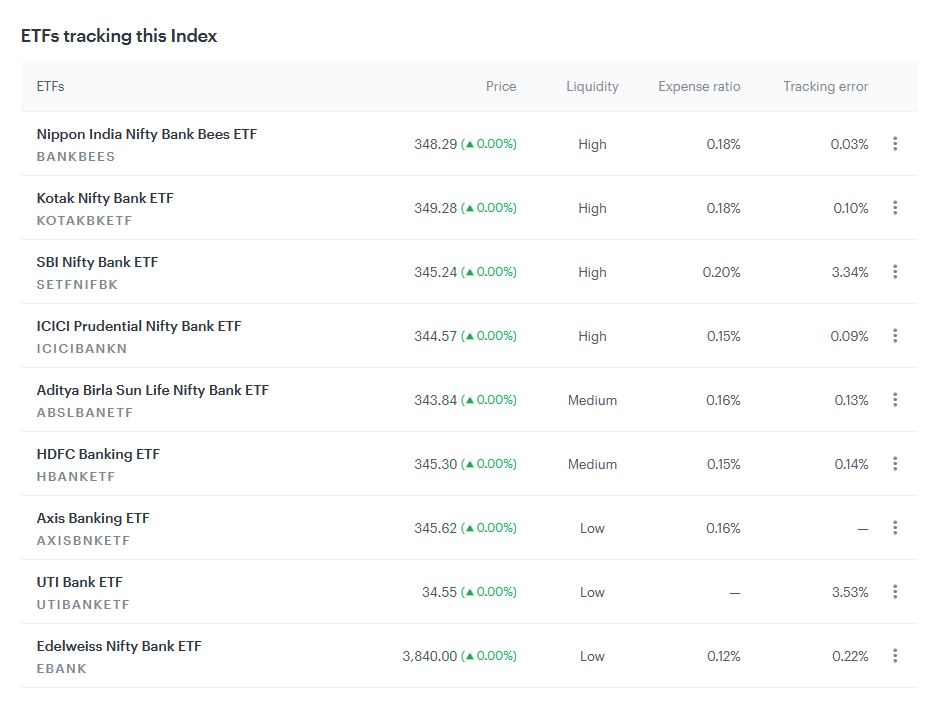
Currently, among the [**NIFTYBANK ETFs**](https://www.tickertape.in/indices/nifty-bank-index-.NSEBANK/etfs) with **High Liquidity** ,
> **ICICIBANKN** ETF appears to be the one with the lowest overheads ( **Expense ratio** ) .
Also, when investing over the long-term,
i assume a lower liquidity may NOT be a major concern,
i.e. when selling/exiting after several years, one can afford to wait a few days.
> **EBANK** ETF appears to be the ETF with the lowest overheads ( **Expense ratio** ) overall in this bunch.
Thus, if one wishes to invest **Rs. 1Lac** into one of these 2 NIFTYBANK ETFs,
the current expense ratios of 0.15% or 0.12%
effectively amount to **Rs.150** or **Rs.120**.
* * *
Alternately, one could purchase and hold
all the [**constituent 12 stocks of the NIFTY BANK index**](https://niftyindices.com/IndexConstituent/ind_niftybanklist.csv)
in the same ratio as the NIFTYBANK index.
It appears that Smallcase makes it extremely easy to do this.
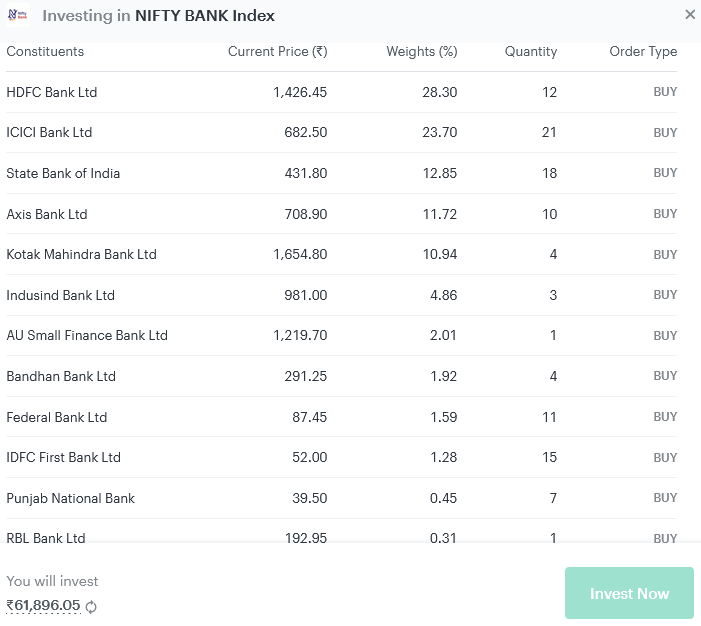
> As one cannot purchase fractional shares,
>
> - A **minimum amount** needs to be invested to purchase **all the constituent stocks** of the index.
> (in this case Rs.62K).
>
> - The ratio of the **stocks in the index** vs. ratio of the **stocks purchased** is slightly different.
> (in this case, \<1% point for few stocks).
For an investment of **Rs.1Lac** ,
the charges of purchasing a Smallcase = **Rs.118** (100+GST)
amount to 0.118% overhead.
> Thus, for an investment of Rs.1lac,
> the expense overhead of manually creating and purchasing a Smallcase
> is nearly as low as the ETF with the lowest expense ratio (0.12%). 🙂💡
* * *
**Advantages of holding individual stocks (instead of an ETF) ?**
1. Can get higher exit/selling prices of a stock with poor fundamentals that will be removed from the index
by rebalancing the stock holdings manually (selling off the underperforming stock) , sooner than the index.
Note that **NIFTYBANK** is [**rebalanced ONLY once every 6 months**](https://niftyindices.com/Methodology/Method_NIFTY_Equity_Indices.pdf).
2. What other advantages can you think of ?.. 🤔
**Disadvantages of holding the individual stocks (instead of an ETF) ?**
1. Need to manually purchase/sell individual shares in reaction to any changes in the index.
2. Slightly lower exit/selling prices than what the ETF gets (as one would be reacting to popular sentiment).
3. What other disadvantages can you think of ?.. 🤔
---
### Author:  [@cvs](https://tradingqna.com/u/cvs)
#### Post date: [August 1, 2021, 12:11pm UTC](https://tradingqna.com/t/creating-a-niftybank-index-fund-using-smallcase/115862/2 "2021-08-01T12:11:45Z")
The calculations to be carried out,
to periodically (every 6months) rebalance the NIFTYBANK index and determine the constituent stocks,
appear to be clearly documented **[here](https://www1.nseindia.com/content/indices/ind_nifty_bank.pdf)**.

Even though one might NOT be able to predict the exact % rebalancing of various stocks in the index, one could make a fair approximation of it.
More importantly, by manually applying the index methodology to the **[publicly available information of eligible bank stocks](https://www.screener.in/company/compare/00000006/)**, one can calculate / predict with confidence any stock that shall be added to / dropped from the index (ONLY the top 12 by Market-Cap.) a few days/weeks in advance of the bi-annual NIFTYBANK index rebalancing event. **Right?** 🤔

Assuming a stock being added to the index results in its price going up,
and a stock being removed from the index results in its price going down,
One benefits from rebalancing one’s Smallcase
in advance of the scheduled biannual NIFTBANK index rebalancing.
- One purchases at a current discount, some shares of a stock that is going to be added to the index.
- One sells at a current higher price some/all shares of a stock that is going to be removed from the index.
Thus, manually rebalancing a Smallcase of constituent stocks,
in advance of the index being rebalanced,
one should be able to broadly follow the index and slightly beat it. Right? 🤔
---
### Author:  [@CoolBird](https://tradingqna.com/u/CoolBird)
#### Post date: [August 2, 2021, 3:21am UTC](https://tradingqna.com/t/creating-a-niftybank-index-fund-using-smallcase/115862/3 "2021-08-02T03:21:35Z")
why are you complicating your life so much? Just buy BANKBEES ETF which has good liquidity at strategic dips (oversold zones) & partial exit/re-entry (as i had stated in my other post) you see how you can compound your wealth. Keep investments simple with active strategy on passive instruments …
---
### Author:  [@rahulkind](https://tradingqna.com/u/rahulkind)
#### Post date: [August 2, 2021, 4:22am UTC](https://tradingqna.com/t/creating-a-niftybank-index-fund-using-smallcase/115862/4 "2021-08-02T04:22:29Z")
Exactly. Simple strategies are more effective.
---
### Author:  [@cvs](https://tradingqna.com/u/cvs)
#### Post date: [August 2, 2021, 12:14pm UTC](https://tradingqna.com/t/creating-a-niftybank-index-fund-using-smallcase/115862/5 "2021-08-02T12:14:43Z")
> [@CoolBird](#):
>
> Just buy BANKBEES ETF
> which has good liquidity at strategic dips (oversold zones)
> & partial exit/re-entry (as i had stated in my other post)
This definitely sounds simpler than the strategy i had in mind. 👍
**Can you elaborate a bit more ?**
(or share a link to your other post if it has the details already)
Also, anyone has any tool/website recommendations
to back-test Coolbird’s and my strategies in this thread?
---
### Author:  [@CoolBird](https://tradingqna.com/u/CoolBird)
#### Post date: [February 21, 2022, 5:14am UTC](https://tradingqna.com/t/creating-a-niftybank-index-fund-using-smallcase/115862/6 "2022-02-21T05:14:41Z")
for my strategy, you can do it in excel/google sheet by taking in all historic ETF prices…it gets tricky for getting entry points using rsi or william%r but even that can be formulated.