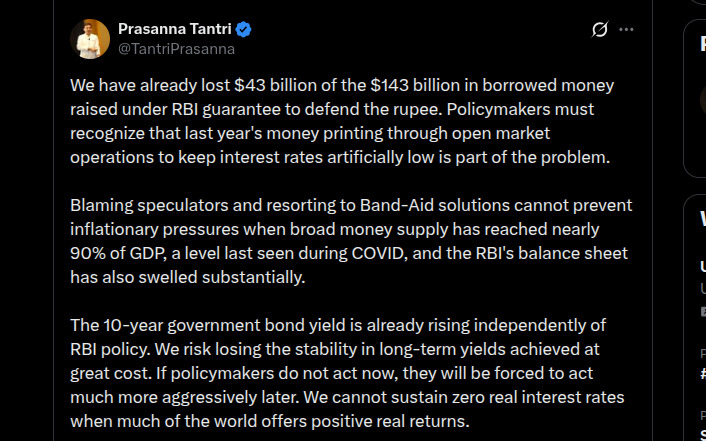
Yeah, CDS was already pretty much dead, but RBI seems to think there’s still some room for tighter controls. This time, they’ve cut the limit from $100 million to just $5 million, a 95% reduction.
Here’s what has changed and what it means for traders.
The new rules came into effect on October 10, 2026, and apply to both OTC forex derivatives and exchange-traded currency derivatives involving INR.
What exactly has changed?
Earlier, traders and businesses could take currency derivative positions up to $100 million without having to establish their underlying exposure upfront. RBI has now reduced this threshold to $5 million.
But this doesn’t mean traders were allowed to speculate freely up to $100 million. The requirement for a genuine underlying exposure already existed. The relaxation was only from having to prove it upfront.
For example, say you’re an importer who needs to pay $1 million to a US company after three months. If USDINR moves from ₹90 to ₹95, your payment increases by ₹50 lakh. You can hedge this risk using currency derivatives. Here, your $1 million payment obligation is the underlying exposure.
What does this mean for CDS traders?
For traders in the Currency Derivatives Segment (CDS), the $5 million is a combined limit across all INR currency pairs and exchanges. It is not a separate limit for each currency pair or exchange.
For example, suppose a trader holds $4 million worth of USDINR futures on NSE and another $2 million on BSE. Together, that’s $6 million, which exceeds the new threshold. The trader would need to establish the required underlying exposure rather than rely entirely on the documentation relaxation.
To put this into perspective, one USDINR futures lot represents $1,000, so $5 million is equivalent to around 5,000 lots.
For most small retail traders, the reduction in the threshold may not have much practical impact because their positions are well below $5 million. However, larger traders and accounts with significant currency derivative positions may face additional documentation requirements.
The circular does not introduce new margins, change lot sizes or specify automatic square-offs for positions exceeding $5 million.
What else has changed?
RBI has also stopped the rebooking of cancelled INR forex derivative contracts, including deliverable and non-deliverable contracts. Earlier, cancellation and rebooking were generally allowed subject to conditions. However, rollovers at maturity can still continue.
RBI has also tightened documentation requirements. Authorised dealer banks must obtain declarations confirming that the same exposure hasn’t already been hedged elsewhere. They are responsible for verifying compliance and retaining the required records for at least two years.
Earlier vs new rules
| Particulars | Earlier | Now |
|---|---|---|
| OTC threshold without upfront exposure proof | $100 million | $5 million |
| Exchange-traded INR currency derivatives threshold | $100 million | $5 million |
| Cancellation and rebooking | Generally allowed with conditions | Rebooking prohibited |
| Rollover at maturity | Allowed | Still allowed |
| Duplicate hedging checks | Existing requirements | Additional declaration required |
| Documentation | Existing requirements | AD banks must retain required records for at least 2 years |
Why is RBI doing this?
RBI has cited evolving market conditions as the reason behind these changes.
With the rupee under pressure, one possible concern is excessive positioning in currency derivatives and repeated cancellation and rebooking of forex contracts. Tightening these rules could help reduce such activity and ensure derivative positions are backed by genuine forex requirements.
However, RBI hasn’t specifically said that speculation or rupee depreciation is the reason for this circular.
Overall, RBI is not stopping genuine currency hedging. It is making it harder to maintain large positions without establishing the underlying exposure and tightening how forex derivative contracts are managed.
Source: RBI Circular — Risk Management and Inter-Bank Dealings, October 10, 2026