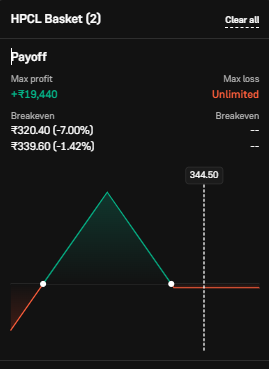
Is there any way to create an options payoff structure like the one shown in the attached screenshot, where the long option becomes ITM only after the short option becomes ITM ??
Hey @Patel_6, yes, you can create this strategy directly in Kite Basket by adding the required option legs and then using Analyse to check the payoff structure, max profit/loss and breakeven.
You can also build and analyse the same strategy on Sensibull using its Strategy Builder. It also has practice trading, so you can test your strategies without using real money in the live market.
You can check out Sensibull here
1 Like
Do you even listen to your self when you ask these questions?
Options don’t do loyalty programs, unfortunately. 
U mean it’s impossible ??

Can you explain it well?
Is it possible to construct the payoff at expiry shown in SS using a combination of CE/PE , such that before expiry, a long CE/PE position becomes ITM only if the corresponding short CE/PE position (if any) also becomes ITM .This would allow us to hold the entire position until expiry without having to arrange additional delivery margin.
In the ss, the position consists of 1 lot long 340 pe and 2 lots short 330 pe. The problem is that if the stock price moves in a favourable direction (below 340) near expiry, then we will have to arrange delivery margin.
The problem is that physical delivery margin is charged separately on each position, regardless of whether it’s hedged or not. Even if you construct a strategy where both the long and short legs are ITM and the net delivery obligation is zero, you’ll still need to maintain the required physical delivery margin near expiry. So changing the CE/PE combination won’t really solve the margin issue.
1 Like
I wasn’t aware of this. I had asked a Zerodha member whether the long and short ITM positions would be netted off for delivery, so I thought this strategy wouldn’t attract delivery margin either.
You can create a similar payoff using a combination of long and short options with different strike prices and expiries. The key is to choose the strikes and premiums carefully so the desired payoff appears at the right price levels. However, the exact structure depends on the underlying and option type.
Possible , but it’s irrelevant now.
@Patel_6 what you’re describing is just a credit spread, where the short leg is closer to the money than the long leg:
- Calls: sell the lower strike call, buy a higher strike call (bear call spread). As price rises, the short call goes ITM first and the long call only goes ITM after price crosses the higher strike, which is where your loss stops growing.
- Puts: sell the higher strike put, buy a lower strike put (bull put spread). Same idea on the downside.
You collect a net credit, keep all of it if price stays on the safe side of the short strike at expiry, and the max loss is the strike gap minus the credit. If your screenshot has a flat line after the second strike, it’s one of these two. Easiest way to confirm is to add both legs in a basket and check the payoff in Analyse, as rihan_baji said.