# Most active funds fail to beat their benchmarks
**URL:** https://tradingqna.com/t/most-active-funds-fail-to-beat-their-benchmarks/163011
**Category:** Personal finance
**Created:** [March 29, 2024, 6:47am UTC](https://tradingqna.com/t/most-active-funds-fail-to-beat-their-benchmarks/163011 "2024-03-29T06:47:33Z")
**Posts on this page:** 11
**Page:** 1
### Author:  [@Bhuvan](https://tradingqna.com/u/Bhuvan)
#### Post date: [March 29, 2024, 6:47am UTC](https://tradingqna.com/t/most-active-funds-fail-to-beat-their-benchmarks/163011/1 "2024-03-29T06:47:33Z")
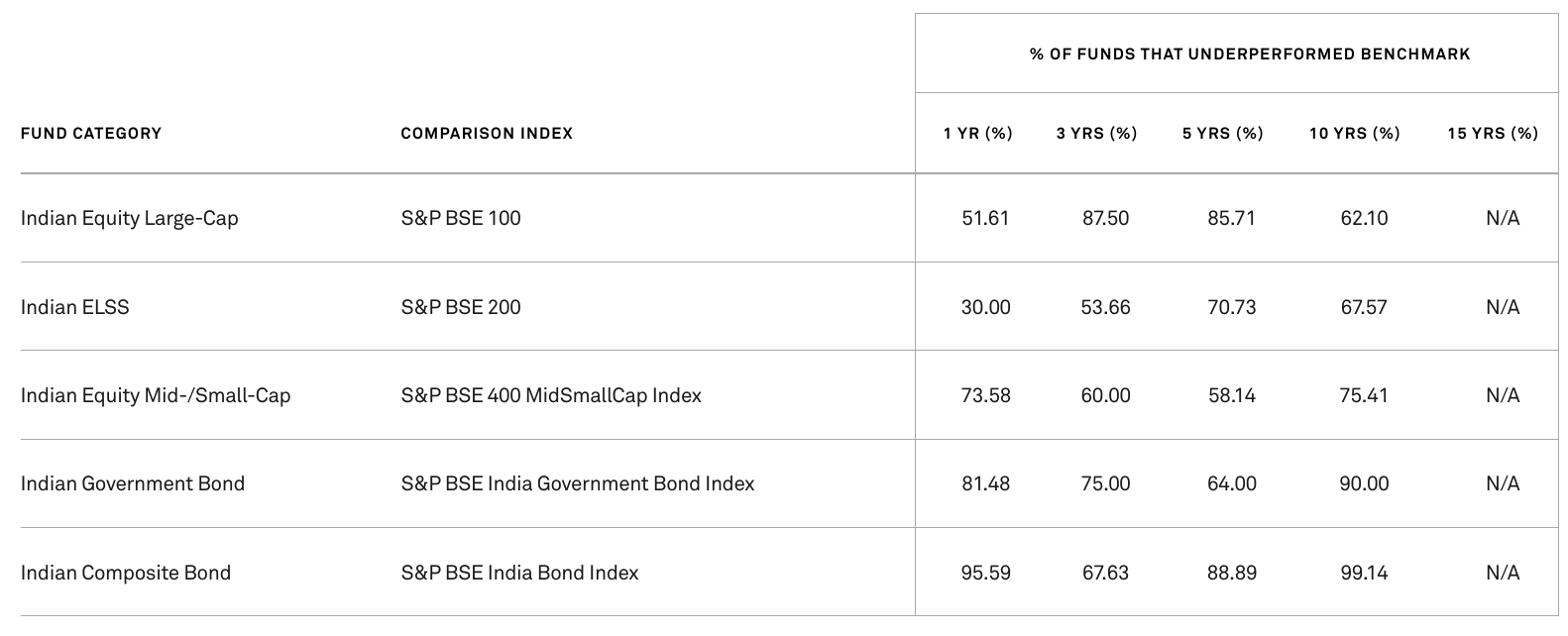
The latest [S&P SPIVA data](https://www.spglobal.com/spdji/en/research-insights/spiva/#india) came out, and it once again shows the difficulty of most active funds in beating their benchmarks over long periods of time.
It’s a no-brainer to use index funds for your [core equity and debt allocation](https://zerodha.com/varsity/chapter/personal-finance-review-part-2/) and then use the other funds to complement them.
Learn more about index funds and ETFs
> **[Index Funds – Varsity by Zerodha](https://zerodha.com/varsity/chapter/introduction-to-index-funds/)**
>
> This chapter is focused on the Introduction, overview, history and the types of Index funds. Read the chapter to learn more.
> **[Exchange-traded funds (ETF) – Varsity by Zerodha](https://zerodha.com/varsity/chapter/exchange-traded-funds-etf/)**
>
> A mutual fund is a pooled investment vehicle that collects the money from various investors, invests and manages that money on their behalf.
---
### Author:  [@Suyash.K](https://tradingqna.com/u/Suyash.K)
#### Post date: [March 29, 2024, 7:00am UTC](https://tradingqna.com/t/most-active-funds-fail-to-beat-their-benchmarks/163011/2 "2024-03-29T07:00:50Z")
Surprising to see that the underperformance is more in the mid and smallcap category as compared to the large cap category.
We were always given to understand that alpha generation is harder in the large cap category. But here we see that 3 out 4 funds in the small and midcap category failed to outperform the benchmark over a period of 10 years.
---
### Author:  [@deepak.shenoy](https://tradingqna.com/u/deepak.shenoy)
#### Post date: [March 29, 2024, 10:08am UTC](https://tradingqna.com/t/most-active-funds-fail-to-beat-their-benchmarks/163011/3 "2024-03-29T10:08:58Z")
I believe we should recheck the data. I did a check earlier this month using actual data, and a substantial number of large cap funds have beaten the S&P BSE 500 index. We should be careful here that SPIVA is actually representing an index provider and therefore will have an inherent bias - so we must cross check the data appropriately. We are active managers, so you should also do this data calculation yourself as well.
[https://twitter.com/deepakshenoy/status/1766415012451463439](https://twitter.com/deepakshenoy/status/1766415012451463439)
---
### Author:  [@viswaram](https://tradingqna.com/u/viswaram)
#### Post date: [March 29, 2024, 10:30am UTC](https://tradingqna.com/t/most-active-funds-fail-to-beat-their-benchmarks/163011/4 "2024-03-29T10:30:05Z")
> [@deepak.shenoy](#):
>
> We are active managers, so you should also do this data calculation yourself as well.
Never realized you were part of this forum. I am a big fan of your work and research articles.
If time permits, request you to post some of those exceptional content here too.
---
### Author:  [@slow](https://tradingqna.com/u/slow)
#### Post date: [March 29, 2024, 10:30am UTC](https://tradingqna.com/t/most-active-funds-fail-to-beat-their-benchmarks/163011/5 "2024-03-29T10:30:13Z")
Thanks for the insights . I appreciate your hard work.
Well in other perspective, over 5-10 year duration 40% of active funds in equities still outperform the index .
---
### Author:  [@deepak.shenoy](https://tradingqna.com/u/deepak.shenoy)
#### Post date: [March 29, 2024, 10:39am UTC](https://tradingqna.com/t/most-active-funds-fail-to-beat-their-benchmarks/163011/6 "2024-03-29T10:39:03Z")
Been here for a long long time 🙂 Happy to post - nowadays twitter/CM is where I end up posting our research
---
### Author:  [@deepak.shenoy](https://tradingqna.com/u/deepak.shenoy)
#### Post date: [March 29, 2024, 10:44am UTC](https://tradingqna.com/t/most-active-funds-fail-to-beat-their-benchmarks/163011/7 "2024-03-29T10:44:08Z")
In general, anything that has sufficiently open barriers to entry will see a power law = most will underperform the average, as the winners will take the spoils. This is true everywhere - the top 20% of brokers will have more than 50% of customers, the top 20% of stocks will be nearly all the market cap in India, etc.
Therefore the rule that most active funds should beat the index is inherently wrong. How do you choose a fund? Typically you take 1 year, 3 year or 5 year performance, and choose a fund that has a) beaten the index in that time, and b) is the top quartile of performance (i.e. in the top 25% of all funds)
If you do that for any year, how many of the top quartile funds in any year continue to beat the index in the next year? or if you take 3 year top quartile perf + index beat as input filters, how many beat in subsequent 1 or 3 years? That is a good question to answer using data. This would be a better way to test, IMO.
Am checking how I can do this meaningfully and quickly.
---
### Author:  [@iy3r](https://tradingqna.com/u/iy3r)
#### Post date: [March 29, 2024, 11:18am UTC](https://tradingqna.com/t/most-active-funds-fail-to-beat-their-benchmarks/163011/8 "2024-03-29T11:18:40Z")
Did a quick check using AMFI NAV Text files for Dec 2022 end and Dec 2023 end. SPIVA used regular plans to check whether a fund has outperformed the index or not. Which is, err, meh. No reason to do that when comparing performance of active vs passive.
Eg., for Large Caps, if you consider direct plans, **only 29.03% (i.e. 9/31) under performed BSE 100 TRI**
vs 51.61% (i.e. 16 out of 31) reported by SPIVA
The denominator should actually be 30, as the IDBI fund merged into LIC, which makes it:
Direct: 8/30 = 26.67% under performed
Regular: 15/30 = 50% under performed
So with this, SPIVA is actually exaggerating the under performance by almost 100% 😅
AMFI NAV files can be downloaded here: [AMFI NAVAll.txt](https://www.amfiindia.com/nav-history-download)
Wrote a parser to convert this to a better structured csv: [NAVAll.txt to CSV Converter](https://observablehq.com/d/4b97b2543ee3c6c7)
---
### Author:  [@slow](https://tradingqna.com/u/slow)
#### Post date: [March 30, 2024, 4:26am UTC](https://tradingqna.com/t/most-active-funds-fail-to-beat-their-benchmarks/163011/9 "2024-03-30T04:26:07Z")
Hi Sir, thank you for your insight into this. I really appreciate you providing this view . I do not have such data nor have enough skills to possibly correlate and predict the next winner really with high confidence based on the past data.
I am a strong believer in active equity fund management during heavy up cycles and beaten down down cycles because more than fundamentals , the behavioural traits play into the investment and stock selection. This is my observation over 8 years.
Sir , one question that bugs me all the time is that , are the Indian market indices have become strong indicators of market direction as the US indices so much that we could bet on going all passive?
I thank you again for your insight and I hope to hear your continued insights on mutual funds and investments in this forum . 🙏🏻
---
### Author:  [@deepak.shenoy](https://tradingqna.com/u/deepak.shenoy)
#### Post date: [March 30, 2024, 8:42am UTC](https://tradingqna.com/t/most-active-funds-fail-to-beat-their-benchmarks/163011/10 "2024-03-30T08:42:01Z")
Firstly, don’t “sir” me so much 🙂
Now, the important question. Will active beat passive? The answer to that is one clear thing - passive itself will not beat the index - it typically underperforms between 0.2% and even 1% per year. So what you want to do is ask if active will be passive funds.
In general, it is perfectly fine to bet that in any field with lots of players, the best will be concentrated in a few players and they will mostly dominate for a long time. Like there are 140 crore Indians but just five or six get to represent India in cricket and less than 200 play at any time in the IPL but we are perfectly ok with an attempt to play cricket well to attempt to reach the team. We know that less than 1% of people who write the IITJEE exam will get into IITs. But they will still write it.
If you believe only the average will win, then there is no point attempting. But because some people attempt it, you get the winners that make the averages go up. Without those people we would have lousy averages.
So you need a mix of active and passive, even for passive to work. For example, if there is only passive, even if a company’s promoter did fraud, no one would sell the shares because it’s still part of the index. And if the share price doesn’t fall, it will not go out of the index. THe only reason the stock falls is that there are active people out there.
Will active win? I believe that over the long term, a few active managers - maybe 20% or so - will have long term returns that beat the index most of the time. You don’t want somethign that beats 100% of the time - that’s a little insane. Even 75% will do, I beleive. That means for three out of four observations, if the active fund beats the index, that’s fine.
In mid and small caps, the information arbitrage is wide enough for the next decade or two to continue to have great returns for active. In large caps I don’t think so, so today’s observations of large cap winning is probably an aberration (in my view). Still, we should acknowledge that indexes will not win all the time and even lesser, passive will not win all the time.
Most importantly the idea is that if you choose top performers in any time, will they beat the index in the future? That data in my view should be more skewed towards the active funds. We have to test and see. If that is true, then selective active funds still holds good. If that is false or becomes false, then a switch to pasive is preferable.
(Essentially, don’t look at stats that look at “all” active. Use only “top performing active” as known earlier - i.e. today look at the top performers in 2021 to see if they are beating the index today, because those were the funds you would have chosen in 2021)
---
### Author:  [@ranton137](https://tradingqna.com/u/ranton137)
#### Post date: [March 31, 2024, 11:20am UTC](https://tradingqna.com/t/most-active-funds-fail-to-beat-their-benchmarks/163011/11 "2024-03-31T11:20:33Z")
@Bhuvan (OP) - What do you have to say about this seems like the data is misleading and cherry picked.