yep, according to me you are correct.
yep, I think should be possible.
lol, yeah, maybe.
yep, according to me you are correct.
yep, I think should be possible.
lol, yeah, maybe.
hello, do you trade in usa options as indian resident from cash account? have you been paying global taxes here in india and was there an issue with it? Thank you
Any lead guys?
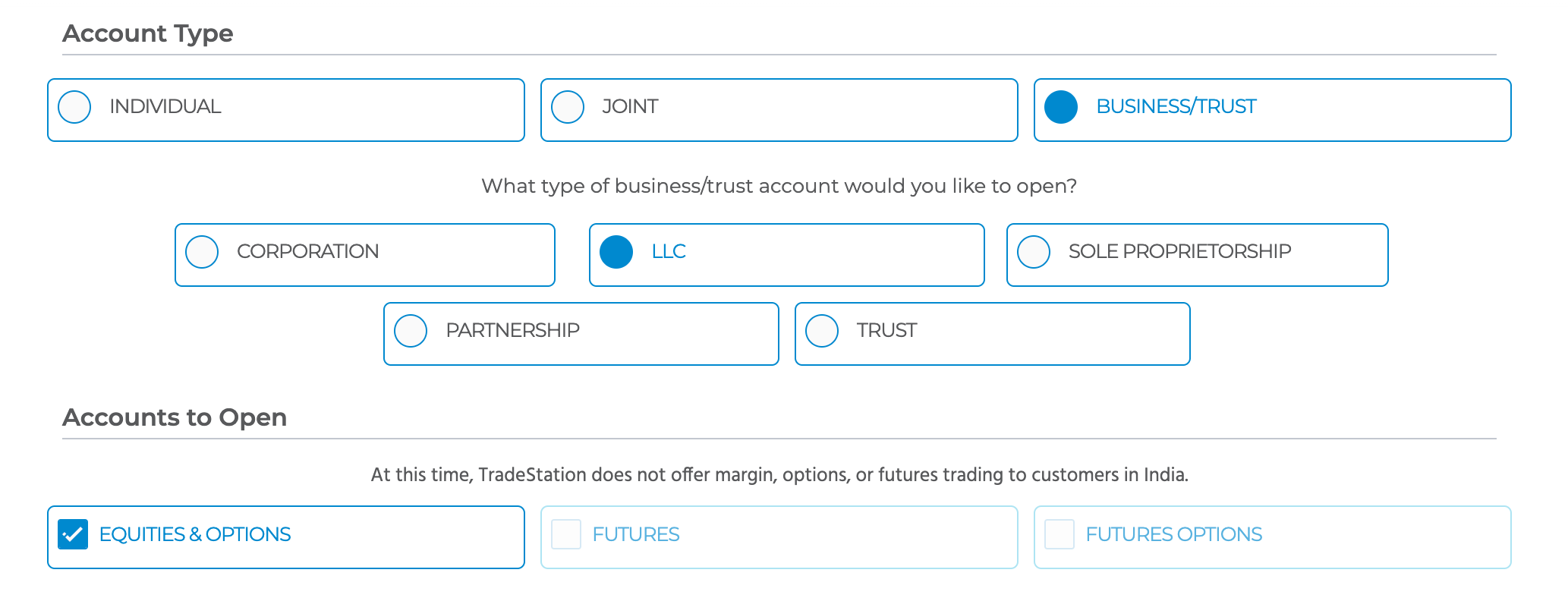
I myself tried creating a dummy account with tastyworks and tradestation. Both did not work as the moment you mention that you are from India, the system automatically prohibits from creating margin account. If you mention you are from US, you need to provide US address (for the company as well as the individual operating it).
If you want to go with Charles Schwab, they require a minimum of $250k for US-LLC account. My only hope now is IBKR and any shitty futures broker which are a rip-off if you want to move funds.
No! It’s not possible. FEMA 1999 prohibits Margin Trading.
I am trying to legally do this. I have shares vested out of ESPP in foreign broker account. This is not sent through India/LRS. I am hoping this is good for trading CSP and CC options. What I find tricky is where to show this loss/gain in ITR? Capital gains is for equity and underlying buy/sell price accounts for this.
“money from India using LRS shouldn’t be used. Money/Salary in netherlands can be used for european markets I guess no issues. Check local law applicability”.
@trader29 Thanks for the clarification. Are we sure about this? I’m in similar position where I trade USA F&O using money earned in US and going to keep it there when I move to India and become resident Indian. Can I still continue trading the same? Any reference that we can use, in case some trouble occurs in future?
Any help here? The money I hold is in terms of RSU/ESOP in Schwab and there is atleast 25k$. I am planning to play with covered calls and secured puts with these stock vests. This I believe should be legal and is not out of LRS and fully tax paid. My question is how to show the losses/gains in ITR? @nithin
Yep, grey area. No real way to show gains of covered calls or puts on in your ITR.
one way would be to open a bank account in Dubai, then have a relative/friend who lives outside of India transfer that money to the Dubai bank account, then those funds would not be LRS. use those funds to trade derivatives, u can always transfer the money to u friend
I have similar question to that of aaridrakamanu
Let’s say I have stocks of foreign company as part of RSU. Two questions which I have:
If I sell those stocks, will it come under LRS? As it was part of salary but vested outside India. What all rules/law applicable on such stock ownership.
If it comes under LRS or not, is it legal to buy leveraged/inverse ETF?
Did you get a response to your RTI?
Read the section K where it is clearly mentioned on RBI website(Reserve Bank of India - Notifications) that Indians can invest in foreign derivatives(stocks and options), mentioned below in a simplified language in section K
Schedule I outlines a list of “Capital Account Transactions” that can be undertaken by “Persons Resident in India.” These transactions involve the movement of funds or assets between India and other countries.
Here’s a breakdown of the listed items:
Here’s a breakdown of the listed items:
Can an Indian citizen open a bank account in Dubai ?
Yes, if you’re a resident over there!