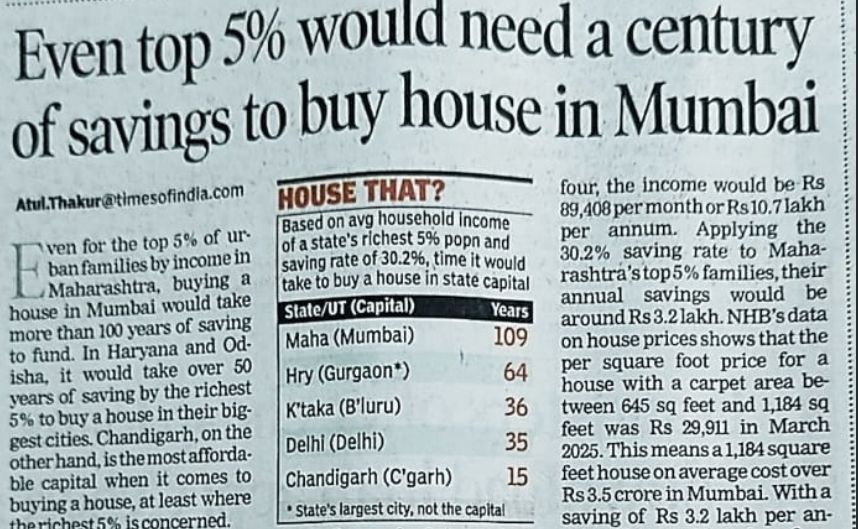
Saw this chart and genuinely had to pause. If the richest families in Maharashtra need over a century of disciplined saving to buy a basic home in Mumbai, what’s left for the rest of us?
I know lump-sum saving is nearly impossible for most, which brings me to SIPs. What kind of SIPs do people here think are realistic to bridge even part of this gap?
Makes you question everything:
- Why are we still obsessed with home ownership in metros?
- Should we really be doing SIPs in mutual funds, hoping for a house 20 years later? Great, but how long till they beat property inflation in Mumbai?
- Rent forever and invest in everything but real estate? Or just give up and call it “manifestation”?
1 Like
To be fair, housing has become a global issue.
Ever since Real Estate turned from a commodity to an investment, housing has become crazy unaffordable. I think India might be an edge case in this regard. A lot of demand is coming from people genuinely wanting a place to live rather than hedge funds. There is also chronic under supply in the urban areas given the large migrant inflows from more rural areas in search of opportunities.
On the other hand, Real estate is one of the investment vehicles used to invest “Black money”. Housing would become much more accessible if this crappy practice can be stopped. The current system with “circle rates” just isn’t working. The issue is much more systematic. You need to lower capital gains tax to make sure that people only want to sell if they get the entire capital in their bank not in cash. You also want to lower taxes so more people have the capital to actually purchase homes. The investments of Black money in real-estate would start to move towards stocks and bonds while freeing up housing inventory.
There have been suggestions on restricting the number of units which one person could hold or prevent NRIs from buying property. Even increasing property taxes on a local and central level. I think such measures only add more friction and make a first time purchase more difficult. Restricting capital flows specially on an individual level never helps.
The best, fastest and easiest solution however, is simply- BUILD BUILD BUILD. And cut down on Red tape as much as possible. A common trend with Indian government is, the more local the government the worse the processes. Central government has kind of figured out its digital stack and is now using it to fast track all sorts of permits. State governments are all over the place and are trying to build these systems but not to much success. Local Municipal corporations in places like Delhi and Mumbai are horrible at this. They can’t get anything done properly and I think it is about time we have a discussion about the very existence of these bodies.
I was trying to pay property tax for my places in Delhi just yesterday and wow is MCD’s online portal a mess. It is horrific. It makes me miss the income tax department website. This should all be centralized. Same with building permits. Building is difficult and requires crazy amounts of bribes to be given to everyone from Local to State and on occasion central government officers. Less Government Intervention = More housing supply.
Given the undersupply we are living through, I would propose to suspend ALL building regulations other than safety regulations.
I know quite amount of real estate. Most of metros are bought by NRI. Here i believe people with dollars earning abroad are giving hard time to people who are earning in INR
Easiest option is to move to Tier 2/3 towns. Cos should be incentivised to move their offices to these towns and taxed heavily for staying in metros. This will ease pressure on metro infra and resources like Water, Roads, Real Estate etc making these cities more liveable and also parallely ensure development of basic infra in smaller towns.
3 Likes
I think the NRI issue is overblown. Indian Real estate is notoriously hard to invest in. NRIs also don’t have access to “Black money”. Furthermore, taking the capital gains or any rental income out of India is a nightmare.
So if NRIs do purchase property, it’s more likely to live in once they return to India. It’s also important to remember that NRIs are Indian citizens and are just not tax residents.
The NRI investments in indian real estate, equity, debt and the remittances they send are what keep the Indian forex reserve intact despite us running a consistent current account deficit.
It’s extremely important to motivate more investments in India and not paint NRIs into bad people inflating property prices. If NRIs are blocked next scape goat will be HNIs. The real issue is not enough supply due to over regulation and stupid indian Babucracy.
2 Likes
Not at all. Ask yourself a question, in a population where only 4% pay direct income tax and only 1% are actual rich, how exactly buyers are able to afford 1 cr homes? Where are these buyers coming from? . Answer will always be NRI’s.
I have seen a entire neighborhood whose kids went to abroad and that entire neighborhood real estate went to crs. How did it go when there are no billion dollar companies nearby? It because of NRI’s.
Only PPL who went to US return. Others don’t. NRI’s are Indian citizens. Alright , let me ask you something, the govt charges me road tax and luxury tax on car because why , only rich can afford. I am saying why not charge something like non occupancy tax. If a home owner is not in his house for 60 days at a stretch, let him pay 20 to 30% of property value at end of financial year as non occupancy tax. If I am buying a car, I help the manufacturers, the engineers , etc. If I am buying real estate in which I don’t live, I am screwing the others in that area. Thats a simple concept.
Equity, debt fund fine but not real estate. Land has to be used productively. If majority of income of metro salaried class is going to mortgages , they won’t be able to spend in other areas which will help economy. Think of it this way, a man pays 40k EMI, he has no money to spend on online courses for his kids. If his monthly emi of houses was less, he can afford online courses for kids. People need to have money to invest in online courses education (like buying adrino boards, CAD licensed, ) that’s how economy will develop.
As far as current account deficit, the answer is political and controversial. Who elects dumb idiots that does defecit spending giving freebies and also has reservation all of which destroys productivity of economy. Not only that, also have policies that only support crony capitalists and no space for small companies. We kicked away so many brillant small companies lol.
HNI atleast create businesses which is different from NRI. Bussiness create value, product, employment which is very different.
1 Like
Most of your arguments are just NRIs are bad. They aren’t some extremely privileged class. NRI by definition means any Indian citizen who lives abroad. Some of them come from privileged backgrounds. Some go abroad on their own merit with a lot of struggle. Every taxi driver, every grocery shop cashier and businessman are all NRIs. It is a broad definition. Your grudge seems to be with NRIs who earn well. The thing is, there is no way to target them.
Only PPL who went to US return. Others don’t.
Source?
Non-occupancy charges
In some cities these do exist. In Delhi (and strictly under DMC), there is a higher property tax if the property is not self occupied. The problem with your logic for solely hitting NRIs with extra non-occupancy charges is that there are also resident Indians who have multiple properties. I know many friends from large cities who own multiple properties in Goa or hill stations or smaller Tier 2 towns for investment and they used their own hard earned money to buy these places. Stopping this would require capital controls by state borders will essentially erode the single economy that is India. So if you live in Delhi, buying a property in a different city is fine but if it becomes Dubai it is an issue?
current account deficit, the answer is political and controversial
You are confusing current account deficit with government deficit. They are two different albeit similarly named concepts. Spending leads to government deficits. Import of Goods and Services lead to current account deficit. Basically, India imports more than it exports. This is a structural weakness in the Indian economy. NRIs help fix this with their remittances to India. This is why Indian Forex reserve is so large. Pakistan doesn’t have this and this is exactly why they keep asking for Loan and are broke all the time. It is the foreign currency. This spending comes mostly by way of private sector imports. So if it wasn’t for NRIs, India too would face such international trade issues.
It is very easy to blame NRIs for the issues with the Indian real estate crisis. The fact is, the issue is a lot deeper, NRI numbers are insignificant, most of this is misdirected anger and even if NRIs are blocked completely the housing crisis won’t even see a dent. Lastly- answer this: Someone goes abroad to work hard, earn money and wants to come HOME to India where they are from. They can’t even buy a house just because they work abroad? This is outright discrimination against those who help India’s forex reserves and economy in a very structural manner.
It is common to blame others when the fault lies within your own self or system. In the US, Canada or UK, they blame the immigrants. In India, there is no meaningful inward immigration so you blame the outward immigrants? Wow.
Using your own hard earned money has become a crime now simply if you have an NRI label attached to you plus as a bonus you have to pay more in tax too!
1 Like
In 2008 the housing market collapsed. The same is going to happen again in the coming years accompanied with the crash of debt market. Buy now pay later is on the verge of collapse already.
2008 was a very different crisis. Oversupply and Subprime mortgages contributed to that.
2025 is Undersupply and there are strict checks on the quality of the credit being given out.
This paper may shed more light on the root causes…
TLDR- the issue is pro tenet policies and weak contract enforcement (as in tenant can take over your property). The yields don’t make meaningful sense so given the risks it’s just easier not to rent out real estate and keep it as an investment for the capital gains. Pro land lord policies would help with some of these issues but if you swing the pendulum the other way too much, you’d see rents sky rocket. More importantly the issue of weak contract enforcement is one that’s a structural issue with the indian legal system.
The Contract enforcement needs to be redone from scratch in this country since this issue has come up multiple places and hinders investment.
In India, except the actual decision makers, everyone knows what should be done. 
1 Like
Yup. It’s across the board. Too few judges leading to *Justice delayed is justice denied."
1 Like
If you’ve already bought the property, rental income is like dividend.
Not sure this argument holds.
Assuming contract enforcement is fixed, that is. Otherwise, yes, that’s what people are doing. Don’t risk capital over dividends. Logical.
It’s like a dividend but with risk. What if your tenant refuses to pay and leave? Forced eviction in India is very difficult. It’s not impossible that someone just takes over your property if you don’t actively work to have a bad tenant evicted.
Also, contract enforcement isn’t about Justice. It’s about keeping promises. Good businesses need contract enforcement for certainty and clarity. Indian courts seem to have their own interpretation of contract laws and have consistently passed poor enforcement rulings to the point that a contract in India doesn’t mean much. The long wait times too are an issue.
Interesting point, one I wasn’t aware of till now. Will have to look into this.
Thanks