Welcome to the midweek edition of The Long and the Short—a show where you can expect an honest take on trading. Something you won’t hear elsewhere. I’m Sandeep Rao.
As the year comes to a close, it’s that familiar season when we start making promises to ourselves. “In 2026, I’ll eat healthier.” “I’ll stop doomscrolling.” Maybe your list includes goals that are very personal to you — more ambitious, hopeful, and often repeated each year.
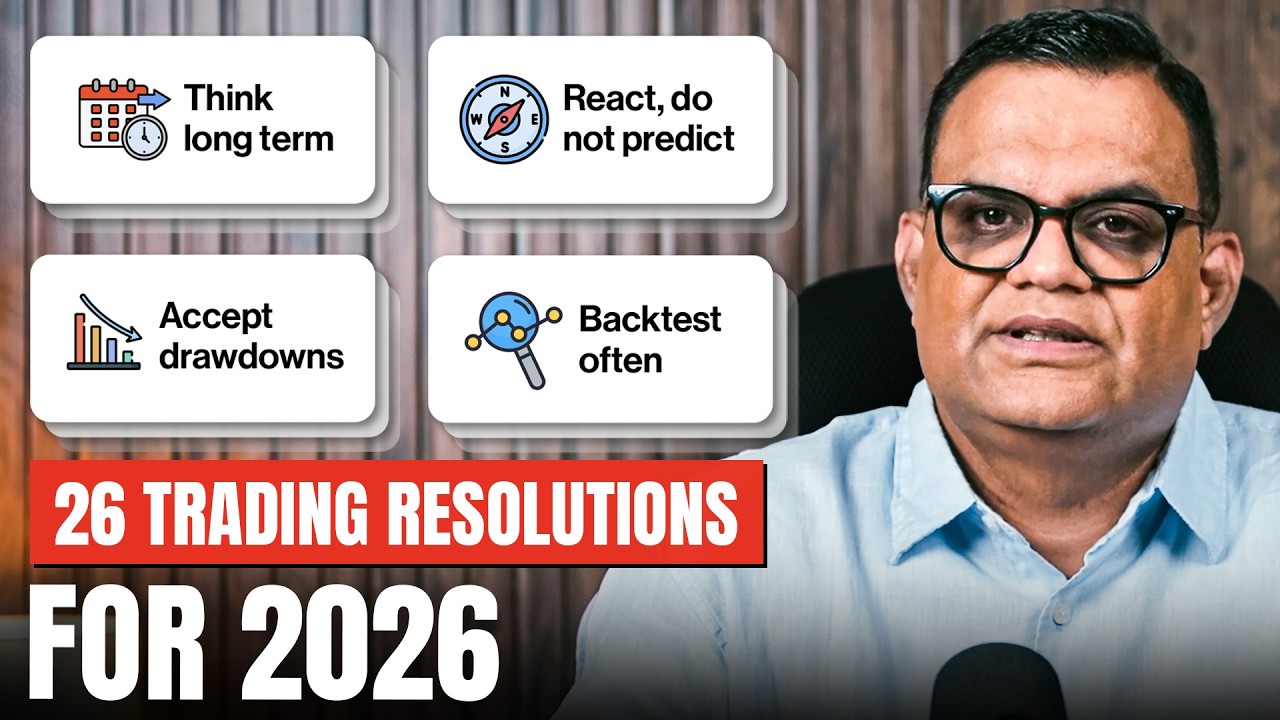
We call these resolutions. And when they’re made around the start of the calendar year, they earn the special title of New Year’s resolutions. Chances are, we’ve all made a few — and let them slide into oblivion within a week or two.
Still, there’s something about milestones like New Year’s or birthdays that naturally makes us reflect. Even if we don’t always follow through, we feel compelled to pause, recalibrate, and set intentions for who we want to become.
In this newsletter, I’ll explore a bit of history behind the resolution-making ritual, share research-backed ways to improve our chances of sticking with them, and most importantly — I’ll offer 26 trading resolutions that could help you level up your trading journey in 2026 and beyond.
The Origin Story
If you trace the tradition back in time, the practice of making New Year’s resolutions dates back nearly 4,000 years. In ancient Babylon — in what is now modern-day Iraq — there’s evidence that kings made public vows, known as negative confessions, pledging to act justly and remain accountable to their people.
Later, the Romans formalized January 1st as the start of the year when they adopted what would eventually become the Gregorian calendar. They, too, embraced the idea of resolutions through renewal rituals — traditions that involved cleaning homes, settling debts, and making amends to start the year with a clean slate.
In one form or another, this ritual of reflection and renewal has carried on through the centuries, evolving into the modern-day New Year’s resolutions we’re familiar with today.
Why We Struggle to Stick to Resolutions
Now to the more important question — why do we struggle to stick to our resolutions? Research suggests there are three main reasons why many of us fall off track, often within just a few weeks of the new year.
First, our goals tend to be either vague, unrealistic, or overly ambitious. Saying something like “I’ll go to the gym five days a week” sounds impressive, but without a clear plan or prior habit, it becomes difficult to sustain. A more manageable goal — for instance, “I’ll go to the gym twice a week for the next month” — creates a clearer, more achievable path and builds momentum over time. When we overcommit from the start, it often leads to burnout or frustration.
Second, many resolutions suffer from a lack of intrinsic motivation. Deep down, if the goal doesn’t matter to you personally — if you’re setting it just because it’s what everyone else is doing — it’s hard to stay committed. Resolutions that align with your own values, interests, or sense of purpose are far more likely to succeed than those based on external pressure or social comparison.
Lastly, the all-or-nothing mindset often derails progress. If you miss a workout or break your diet once, it’s easy to fall into guilt and assume the entire resolution has failed. But one misstep doesn’t erase the progress you’ve made. In fact, people who succeed with resolutions often anticipate slip-ups and bounce back without giving up altogether.
Understanding these psychological traps — and planning for them — can significantly increase your chances of following through on the commitments you make to yourself. Small, meaningful steps with the right mindset are what lead to lasting change.
26 Trading Resolutions for 2026
Think of this as a comprehensive list from which you can pick the ones that resonate most with your trading journey. You don’t need to relate to all of them.
1. I will consume high-quality content
There’s a popular saying that the person you become in five years depends on the books you read, the food you eat, the people you spend time with, the habits you adopt, and the conversations you engage in.
I’d add one more to that list: the content you consume. While “good” content can be subjective, it’s essential to be selective in the world of finance and trading, where hype, misinformation, and snake oil are rampant.
That’s why developing a strong bullshit detection system is essential. One resource I highly recommend is the University of Washington’s course “Calling Bullshit: Data Reasoning in a Digital World” by professors Carl T. Bergstrom and Jevin West. It’s a powerful guide to recognizing misleading information and flawed logic — skills that are crucial for any trader or investor. In short, make it a habit to consume only the content that passes your internal bullshit filter.
2. I will first focus on the basics of personal finance before trading
It means you will need to make sure you have created an emergency fund, have insurance (health and life), and solid financial stability before thinking of trading. If the foundation is weak, no trading strategy can save you.
3. I will keep an open mind and continue learning new things
One of the best ways to learn is to find your tribe and learn together—being a lone wolf seldom helps. There will always be people at different levels of understanding, and being with the right set of people helps you progress faster. Success also demands a high degree of discernment. Beyond simply avoiding bad actors, one must be wary of intellectual echo chambers. These environments foster a cult-like adherence to a fixed set of beliefs where dissent is discouraged, and new ideas are viewed as threats rather than opportunities.
4. I will attempt to understand finance as an industry and a large ecosystem, not just trading
Understanding the space, the playground, and the products is key to getting better at trading. On financial products in India, check out the video “Financial Products in India: A Trader’s Toolkit” from The Long & The Short series.
5. I will think long-term and not trade like a degenerate gambler
It means you will not bet everything on one trade, hoping it will change your life. Trading is about consistency over the long term, not miracles, not windfalls.
6. I will not predict; I will react
Markets don’t reward opinions; they reward execution. Your job is not to forecast the future but to respond to what the market is actually doing and find systems and rules that will help you to react better.
7. I will learn to backtest and backtest often
Trade ideas can be borrowed, but conviction cannot. Until you backtest an idea yourself, you won’t have the confidence to trade it—especially at size. Check out the episodes on “What is a Backtest?” and “How to Backtest a Trading Strategy” from The Long & The Short series—that’s a good starting point.
8. I will log every trade and regularly review my worst trades, not just my best ones
There’s more learning in pain than pleasure, if I’m honest enough to look at it. Without a trade log, I have no real visibility into my trading journey. With today’s LLMs, a simple log can generate deep insights. This applies to both discretionary and systematic traders. Systematic traders can even automate logs and review summaries weekly, which is what I do. Someone once asked me why I trust my systems so much—and then answered it themselves: because you keep revisiting your trade logs. I think they are right.
9. I will take complete ownership of all my trading outcomes, including losses
Ownership of outcomes is a prerequisite to progress. If you blame the markets or your broker for your losses, you remain stagnant. Many traders fail because they feel like victims of circumstance rather than architects of their own future.
10. I will not hide my trading performance from my family or close friends
Trading is a lonely profession. The people closest to you should know how you are doing. Trading affects mental, emotional, and eventually physical health. Being transparent with those who matter—especially dependents like children, parents, or a spouse—helps reduce unnecessary pressure.
11. I will keep my position size in check
Recency bias can be dangerous. Increasing size after a winning streak or reducing size during losses can both hurt performance. Instead, position sizing should be based on total capital, not emotions. For example, if you trade one lot for every ₹5L of capital, you should not add another lot until your capital reaches ₹10L—whether through profits or additional capital.
12. I will always ask: if it was so easy, why are they not doing it? I will question myself and my ideas first
There are two contexts to this. One is, if making money through trading was so easy, why would so many people with so much wealth not just trade and make money? Why would one need to struggle to run businesses? Second perspective—which is more trading and investing specific—is that yes, there are indeed things which are easy or difficult based on size, so there could be some niche strategies which are easy for retail traders due to smaller sizes.
13. I will be clear about why I am trading
You could be trading with different purposes in your mind, but be sure: are you trading to learn, to have fun, or to generate returns on your capital? Each phase needs a different approach and mindset. Also, it’s important to accept that trading cannot be the source of wealth creation when done at an individual level.
14. I will not take popular quotes on their face value
There are hundreds of popular quotes that get thrown around, like “trend is your friend, till it bends,” “be fearful when others are greedy,” and all such stuff. Just ignore, or if you are curious, try and understand in what context it was said—just the way we explored in the Warren Buffett quotes episode. There is nothing more to it.
15. I will stop acting on business news or social media to dictate my trades
There are two things here: just because there is news or a prediction shared on mainstream media does not mean you have to react. Next, just because something is trending on Twitter or YouTube doesn’t mean you trade it. There’s another important thing to keep in mind. Social media often becomes a stage where people showcase a carefully curated life — luxury cars, exotic holidays, and flashy “success” stories. Many times, this isn’t just sharing; it’s marketing. The goal is often to sell a course, a service, or a trading system. That’s why it’s important to stay grounded and a little skeptical. Don’t get carried away by the shine. Look beyond what’s being shown and always ask yourself what the real intent behind the content might be.
16. I will respect risk before I respect returns
Returns are seductive, risk is boring—but risk is what keeps you in the game. Every trade will start with “how much can I lose?”, not “how much can I make?”
17. I will accept drawdowns as a cost of doing business
Even the best systems and traders go through drawdowns. If I can’t sit through a drawdown, I don’t deserve the upside. Backtests are the only way to know possible drawdowns, and correct position sizing is the only way to be in the game for the long term.
18. I will not blindly copy trades or systems and will also not blindly follow advisors and analysts for strategies and recommendations
I have to talk about this one. Way back when I started trading in 2000, I went through this phase when I started making losses. I would tell myself that I will stop trading and follow XYZ advisory, assuming they are better than me, only to realize that they were as bad as I am. Most of them, 90% of them. Back then, there were no SEBI-registered analysts—there were many advisors who would give stock recommendations through mail for a subscription fee. That subscription fee was paid through bank transfer. What crazy days. While we have come a long way, I notice that our psychology has not changed. I still see people blindly chasing advisors and analysts, sometimes in an attempt to recover losses. Never seen it end well.
19. I will not spend money on training and learn to recognize FURUs
There is nothing out there that cannot be learnt from books and free resources that are available. If you are looking for instructor-led courses, they are available too, all for free. Check out Varsity Live, learn to identify the best books and resources, and learn from it. We’ve also covered the dark side of trading education in India in a previous episode.
20. I will not trade or upsize my trades to recover losses
Revenge trading is nothing but emotional leakage. The market doesn’t owe you a recovery trade just because you had a bad day or a bad week. Also, do not randomly change size, something I’ve mentioned before as well.
21. I will avoid over-optimizing strategies
If a system works perfectly after 17 parameters, it’s perfect curve-fitting—it probably won’t work in live markets. Okay, I just randomly threw that number, but you know what I mean.
22. I will periodically withdraw profits and diversify as I get better
Seeing real money hit the bank reinforces discipline and prevents the illusion that trading profits aren’t real. Also, as your profits increase, it’s better to diversify instead of compounding.
23. I will protect my mental capital as much as my financial capital
If you are exhausted, emotionally disturbed, or distracted, pause trading. Nothing comes before mental peace. Come back once you are mentally in a better place. Also, if your trading is the cause of stress, think again—it could be due to bad position sizing.
24. I will stop looking for holy grail strategies
There are none. But that doesn’t mean you stop looking for strategies—a combination of non-correlated strategies is as close as it can get to a holy grail.
25. I will stop thinking about being a full-time trader
This one is really important. I cannot even tell you the number of people across different age groups who come to me asking for this. We’ve even done an episode on it. There is no one answer for it, but for most people, full-time trading on an individual scale and with capital is simply not worth it.
26. I will be more physically active and will schedule time away from screens
This is a note to self. I know and realize that constant monitoring of trades and being on screen creates anxiety and overtrading. Sometimes the best trade is to close the laptop. Some of my best ideas have come when I was away from the screen.
That brings us to the end of this exploration of trading-focused New Year’s resolutions. We covered 26 ideas — think of them as a menu to choose from, not a checklist to complete. Pick the ones that resonate most with you and focus on those.
Remember, nothing meaningful is built overnight — progress in trading, like anything worthwhile, is a journey. As long as you’re moving in the right direction and improving step by step, you’re on the right path.
On that note, I wish you a peaceful, steady, and insightful year ahead. May it be filled with learning, growth, and meaningful progress toward your trading goals.
