Are SBI MF, BOI MF, UTI MF, LIC MF, Canara Robeco MF, etc. backed by governments?

I would like to know whether AMCs like SBI MF, BOI MF, UTI MF, LIC MF, Canara Robeco MF, etc. are owned and backed / managed by Government of India / state governments. I believe these MFs are joint ventures of PSU banks, so I was wondering whether any backing or support of the government is there for the money that we invest.

Are these AMCs / fund houses considered safe as compared to their private counterparts (HDFC MF, Edelweiss MF, ICICI MF, HSBC MF, Nippon MF, etc.) either during normal times or during any economic / political uncertainties?

3 Likes

all mutual fund AMC or safe - there is nothing different about these all AMC company - you can invest any small amc to big AMC all are regulated by SEBI

Money is 200% safe in any AMC in india - all are protected by SEBI

2 Likes

Owned very very indirectly.
Govt. ownership in a PSU that has a part ownership in the AMC that is a joint-venture with other corporate entities.

Govt. backing, None AFAIK (from a quick online search).

One angle to consider would be to use a mutual fund house that has higher AUM (especially of mass-market individual investors)

  • to minimise the chances of being affected by unpopular political changes
  • and to maximise the chances of some form of relief in case of a black-swan event.

But this would not be the primary factor to pick a mutual fund.

2 Likes

I agree that all AMCs are well regulated but deep in my heart, if I have a choice between SBI and private AMC, all other things being same with regard to the fund, I will only go for SBI, followed by other known private bank who owns AMCs.

Gives me comfort that if massive fraud or anything happens, the unit holders might be in a better position than other private AMC.

It is exactly like banking with SBI and any other small bank - both are insured for max 5 L, but we all know that SBI will be backed by Government in case of need.

Example: Franklin Templeton closure of debt fund during corona. People got their money but it took time. FT is not a small name by any standards, they went into trouble.

In such scenario, SBI or AMC which is government owned might be better.

Just like for Term Insurance, I only go for LIC .

Thanks

Thanks for your insights on this

On the other hand, Government control is the con as well. Corruption and the arrogance to do anything willy nilly for some group for favors behind closed doors. LIC playing with investor money is probably worse than any other insurance player. LIC money is probably keeping the market afloat in bad market times. They use your money at the whim of government’s desires. They may use your money to bail out their friends and their companies. In the Big bazaar- Reliance saga, SBI played a crucial role, which resulted in enormous gains for Reliance, at the cost of tax payer money. Specifically, In case of SBI MF, SBI, in a growth fund paid dividends regardless of what retail investors want or was advertised, for “the corporation”.

Because of government support, they have no reason to play ball with you and will screw you, if they think they can get away with it(and most of the time, they can). They aren’t motivated to invest or grow or keep your money safe. It’s the “too big to fail” attitude. They’re basically a bigger BSNL. Only in cases of total economic collapse, investing with government mfs “may” help, assuming the government can help, at that point. But overall, it’s bad for the common people and nation as a whole.

4 Likes

Noted but retail investor will not suffer financially.

Not true. As the link says above, if you’ve invested in SBI NIFTY ETF during the given time frame and you’re in the highest tax bracket, you would’ve had to pay 30% tax instead of 10% LTCG during the time. That is financial loss of a solid 20% gain. In a sense, they basically took your money and gave it to someone else - in a really complicated way.

3 Likes

Wow, what confidence.
Seems like people have already forgotten Franklin fiasco :slight_smile:

In general I agree that all are AMCs are safe, but I wouldn’t put 200% number for some AMCs at least.

3 Likes

Sure. Time for some history lessons :slight_smile:

One of the first scam / fraud / mismanagement in India’s mutual fund industry was done by govt institution called Unit trust of India. (hopefully name rings a bell)
It was so big that books were written on it :slight_smile:
It broke people’s trust so much, that UTI bank renamed it as Axis bank

Here is the brief summary:
UTI Scam 2001: How India’s Biggest Financial Scandal Shook Investors

While investors technically were paid back over years so you can claim they didn’t loose money. But this took years.
And for some period money was completely frozen.
Also no real way to calculate the opportunity lost when that money was frozen.

So trusting government is good, but blind trust should be avoided :slight_smile:

3 Likes

My father had units in this. Money was fully repaid at its face value. If I remember correctly around 10 or 12rs. Yes the fraud was massive but Govt came to the rescue. This is exactly the point. If it was any private AMC, money ie Capital could have been lost.

Between private and Government, 100% safer to trust Govt owned AMC. There is no two way to it.

Please read the article, it explains how Govt stepped in to safe guard the unit holders. This is exactly the point being discussed. Who is better, a private owned AMC or Govt backed. I rest my case.

1 Like

I am invested in SBI Nifty ETF - What is the point. Did you lose Capital. The point here is how safe AMCs are - not policy decision which keeps happening. Even in private AMC, Kotak for example closes funds which is not making money or merge the same with other funds. Few increase expense ratio as well. FT suspended relatively safer debt fund.

you need to understand time value of money.

If I invest 10 rs. with you on promise that you will pay me 12% returns a year, and if you stop paying me interest nor allow me to take back my 10 rs. for two years, that is a loss to me.
After 2 years, if you pay me back my 10 rs. and claim that money is fully repaid and there is no loss to you then it is a wrong claim.

You are free to have your opinions and trusting govt.
But claiming that there was no loss to investors - both in uti and SBI ETF (where you conveniently ignored tax angle which @BB789 explained) are wrong claims

5 Likes

Sir, the question here is not about time value of money, it is about getting back the capital back. What would have happened if UTI64 was owned by a private company.

Time value of money if it was owned by a private company would be zero.

This was the point of discussion.

Again you conveniently changed the main topic, no loss to investor was in relation to Capital loss not some dividend paid etc which many other AMC frequently do, like I said, merging of funds, suspension of funds by FT etc.

These are wrong claims which I did not make.

but you are free to have your opinion.

1 Like

What would have happened if UTI64 was owned by a private company.

First, It wouldn’t have got that much funds. Funds were given because it was trusted by people exactly because it was government backed.

Secondly, likelihood of corruption was multiple times lower than a government employee run fund. It might never have entered the crisis in the first place as there is a lack of political compulsion. So, the likelihood of crisis itself was low. But if it did enter some crisis, what would’ve happened?

Time value of money if it was owned by a private company would be zero.

That’s not necessarily true either. FT had a crisis with it’s debt funds in 2020 as well and as you said they did shutdown the redemptions, but as of 2023, they repaid all their debts more than their NAV(Have Franklin Templeton mutual fund investors got closure? - The Economic Times). They act/at least try to act in the interest of the unit holders. Did UTI pay back more or less?

Say, some private company mutual fund defaults. Could it have been zero? Absolutely. Even if it was government backed, even sovereign bonds could become zero(say severe war or economic collapse with government unable to repay). You’re seeing everything in absolutes. Everything is relative. Money/Capital is relative. 1000 rupees now is worth more than 1000 rupees 3 years from now. If you got back what you were owed 3 years later, that’s not capital preservation, that’s a capital loss. The value of INR is not constant. You perceive it as the same. It’s not. Sovereign bonds are unlikely to go caput. Risk of India defaulting is relatively less(but not zero). That’s why India needs to pay interest rate(more than say the US). The rate is directly proportional to the perceived risk of default by investors. Risk of private companies defaulting is relatively more. Risk of government owned entity engaging in corruption and putting your money at risk is relatively more. FWIW, SBI only owns 63% of SBI-MF and if government decides they can sell 14% before any crisis and wash their hands, as it would be a private company. Also, GOI only owns 57% in SBI itself(Perhaps why it still works and we don’t hear new sbi scams every month).

So, what do you do to reduce risk? Diversify. That won’t make the risk zero, but it does reduce it.

2 Likes

Absolutely no relevance to the main topic. The point was which is safer, in a UTI64 kind of situation people are lucky to get their capital back when in fact if it was a private entity they would have lost everything. When yes bank wrote off AT1 Bonds, investors were not worried about time value of money or saying 1000 in 3 years and now etc. they just wanted the invested money back.

This was the main topic. Which is better government backed or purely private. Going on and on

1 Like

Didn’t I explain how UTI US-64 happenned because of government? So, how is it not relevant? Why would you think government is safe, when that government failed spectacularly in the case of US64? Could you name any private player with that amount of AUM, that failed and failed to reimburse? Beating someone bloody and then bandaging them daily for the next month, doesn’t mean they were never beaten or that the bandage fixed every thing. They should never have been beaten in the first place.

SBI also issued AT1 bonds and they are subject to the same write off as well, if needed. It’s the nature/type of the bond and not the company behind it that determined the write off. Do you think if you bought NIFTY50 ETF from SBI and NIFTY fell 50%, government will reimburse your investment, because you bought it from SBI and not from private players like Zerodha? “AT-1” is a similar riskier type of bond(obviously proved itself more riskier than equity in this case). And, if the write off was illegal, The investors shouldn’t just want their money back, but principal(adjusted for inflation), interest and compensation.

…and was soon clarified as
none of the mutual fund AMCs discussed are government backed.
So for practical purposes they are in the same risk class, with one nuanced exception -

There have been past instances in which mutual fund houses acted in the interest of the masses.
So, one may instinctively feel that investing in such mutual funds houses,
aligns oneself with the masses,
and thus one can expect some additional assurance that
the policies/actions of such a fund house will be friendly to the investor.

However, a key aspect to note is that
investing in any mutual fund of such a mutual fund house,
does not always guarantee that
one’s financial interests are aligned with the interests of the masses.

An example of such a difference is
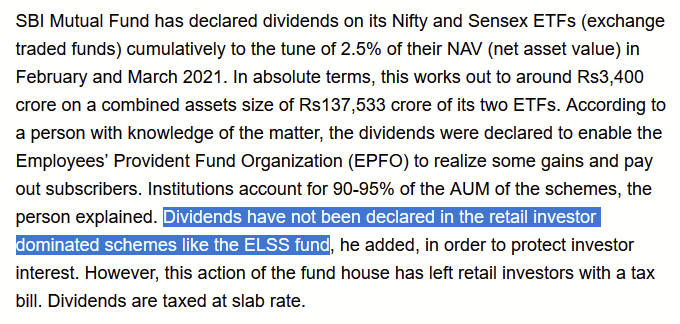
when a specific AMC opted to declare tax-inefficient dividends
a seemingly sub-optimal policy for its investors,
presumably in the interest of the masses (via the major EPFO investment in the security).

At the same time, the same AMC did not follow the same sub-optimal policy for another of the securities they offered, as doing so would have had no major impact on the masses (as no major EPFO investment in this other security).
image
Source: Article linked earlier in this thread.

In future, the expectation that such an AMC would be bailed-out is far from guaranteed, as the relief that may be provided in such a scenario may apply specifically for the masses and not necessarily to all the investors.


Then how does one identify “too-big-to-fail” institutions to invest in ??

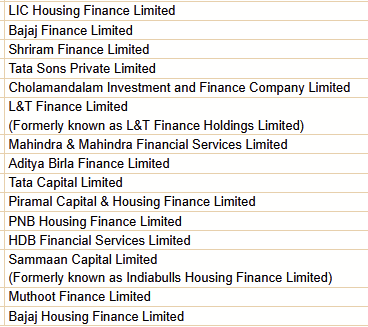
If one is interested in relying on a “too big to fail” aspect, for some form of additional assurance, instead of looking for Government PSUs in the ownership patterns of MF-AMCs as a proxy for “too-big-to-fail”,
one would likely be better served looking to invest in
securities offered by financial institutions formally designated as “too big to fail” -

Note that D-SIB and NBFC-UL/SI designations do NOT constitute any form of additional guarantees or backing for investors. It is just that the institutions designated as such have additional stringent regulations to comply with, which is expected to reduce the risks associated with them (relative to similar institutions without such a designation).

1 Like

Only way is diversification. Even for a simple thing like Nifty ETF, buy Nifty ETFs of 2-3 AMCs instead of just one

1 Like