Hey, sorry to hear about this. Have escalated this to the broking team. Would still urge you to consider our products on their merits. Thanks 
Finally we got passive hybrid index fund . Edelweiss MF launches hybrid passive index fund tracking 70:30 equity–G-Sec strategy - CNBC TV18
2 Likes
@VishalJain THIS IS BIG
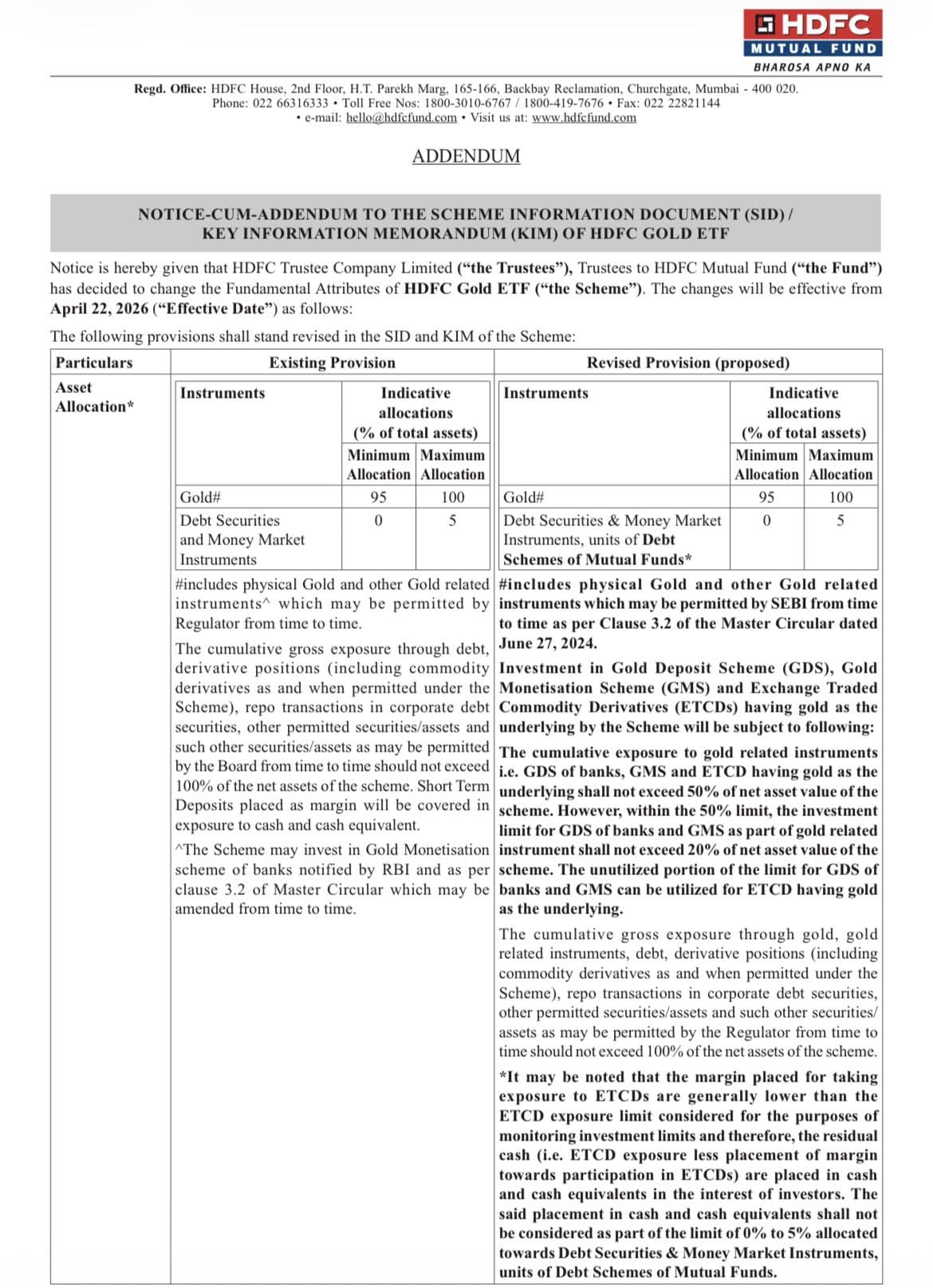
HDFC may hold upto 50% in derivatives in their Gold ETF. This takes away thesis of ETF as alternate to physical gold as all etf’s in India have been carrying out.
Vishal Sir you have been involved since the first Gold ETF in India.
Kindly comment on this. This is AMC specific or gradually this will be the norm. Will Zerodha move to this model. Has there been any ask from Government regarding this. Need your advice on what current investors should do.
Kindly reply.
2 Likes
Hey Abhinav, ETCDs have been allowed in the regulations since a while now. Some of the ETFs have made provisions others have not. 50% is a regulatory limit, does not mean the limit wold be used. Please also note that ETCDs are exchange traded and settlement guaranteed and can also be physically settled on expiry, so do not see a concern. It can also improve trackability as there is 3% GST component in the ETF which acts as a drag on the fund when compared to physical. Also, enabling ETCDs can have benefits such that on occasions when futures are cheaper than physical, it gives the fund the ability to benefit, finally improving returns for investors. So this is not a concern. Rgds
2 Likes
Sir,
Thanks for the clarification.
But my reservation still stays of mixing derivative products in simple Gold ETF offering.
All my Gold exposure is through Zerodha Gold ETF only.
Do you see in near future Zerodha also adding derivatives to it’s product?
Hey Abhinav, we have been using derivatives since a while. There is a 3% GST component in the NAV which sits as a cash entry in the books and creates a drag on the fund. We currently use ETCDs to cover that portion to ensure we are tracking the underlying physical as close as possible. Rgds
2 Likes
Got it. This metric is definitely to keep an eye on as percent of overall holdings.
Thanks for reply.
1 Like
Edelweiss just launched one. NFO ongoing. Nifty 250 (70%) + 8-13y Bond(30%). Monthly rebalance.
1 Like
@VishalJain Thank You for the new NFO Zerodha Nifty LargeMidcap250 Plus 8-13 yr G-Sec 70:30 Index Fund . What about 50% equity , 50% bonds and 70% bonds , 30% equity passive hybrid funds ? There is no passsive conversative hybrid index fund in the market .
1 Like
Passive hybrid in conservative category is required.
Regarding the multi asset FOF, do you double charge expense ratio for the underlying assets?
Suggestion Noted. Thanks
Hey Anubhav, yes. The FOF has a cost structure and so do the underlying ETFs in which the FOF is investing. We are displaying the TER for the FOF and the wtd avg TER for the underlying ETFs as well on the following link
Go to Fund Details & click “Know More” which mentions the FOF TER as 0.21% and that of underlying ETFs as 0.23%. So in effect the total TER that is 0.44%.
Hope this helps.
Rgds
1 Like
@VishalJain Sir,
With Multiasset Passive, fund is rebalancing based on weightage. Every 5% disbalance is brought back to defined ratio.
With upcoming 70:30 hybrid fund, rebalance is being done monthly.
Just curious, did you considered the first approach for rebalancing in backtest as it seems more logical and would result in less transactions?
May be the performance too would be better.
Regards.
Hey Abhinav, pertinent question. The 70:30 hybrid tracks a passive index for which the index service provider defines the rebalancing frequency and so is not in our hand, which is not the case with the multi-asset fund. Hope this clarifies. Rgds
1 Like
Ok got it.
Thanks!!
Please suggest me some mf schemes of Zerodha AMC or other AMC in which I can invest through Zerodha coin. Scheme should meet both the criteria. First exit load should be less or zero. Secondly the scheme should give dividend once a year. Only equity or aggressive hybrid scheme. From less exit load i mean 0.5 percent or lower. Otherwise no exit load after 1 or 2 months
Hello @VishalJain Sir,
I hope all is well. I have two doubts, and would like your view on them.
Firstly;
Why is there no Nifty Small Cap 50 ETF, and similarly no Nifty Mid Cap 100, Small Cap 100 Index Fund? Is there some condition or just a coincidence?
Secondly;
Due to the new SEBI guidelines on TER/BER, I am not able to get my head around the costs. Earlier, “I used to look for a low-cost passive Index fund” if other things remain the same. Now, just the TER of the same fund is not static. (It’s across fund houses, not just Zerodha) How do we go about it?
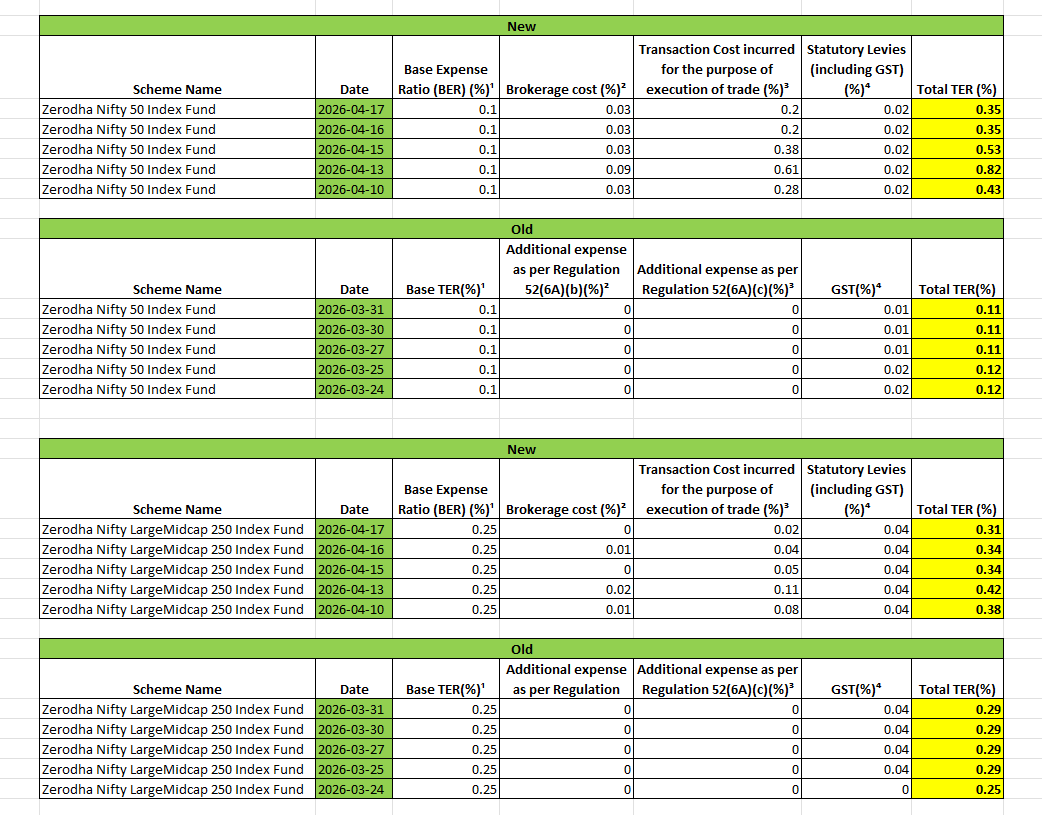
Were these costs earlier not included in the TER? Should I only look at BER for a broad sense, as I was earlier looking at Zerodha Nifty MidSmallcap400 50:50 Index Fund. For this fund, the transaction costs are higher than the BER. Is it for the first few days before it stabilises?

To sum it up, I would like to know if TER now keeps changing DoD. How would one come to know which is a low-cost passive index fund, or any fund for that matter?
Thanks & Regards
3 Likes
Hey Shaan, sorry for the delay in responding to this. In most cases, the objective while launching diversified products is to cover the segment appropriately in terms of coverage and to avoid having multiple products covering the same segment unless there is a specific usecase. So therefore covering entire Largecap 100, Midcap 150 and Smallcap 250 would cover the relative segments in general and would be the first option. For smallcap we have preferred a 100 stock one as it is an ETF and therefore we had concerns over the liquidity of the tailend and 50 stock would not appropriately cover the segment. On this Index Fund side till now our product suite covers solutions in the form of combos such as LargeMidcap. MidcapSmallcap and Multi-asset. So i guess, its more a product strategy relative to each AMC than anything else.
Wrt to the BER & TER, you could continue to look at the BER for comparisons which is the same as the earlier TER. The rest of the costs have always been there in every fund, just that there is more transparency now in terms of disclosures.
Hope this clarifies.
2 Likes