Gold ETFs are no longer “pure physical gold only”

Earlier, Gold ETFs were almost entirely backed by physical gold. Now, SEBI allows fund managers to invest a portion of the portfolio in gold derivatives such as futures, while still maintaining at least 95% exposure to gold and gold-related instruments. It is evolving into a hybrid instrument .
refer : https://www.business-standard.com/finance/personal-finance/are-gold-etfs-moving-away-from-physical-gold-what-investors-should-know-126040600163_1.html

This means Gold ETFs are no longer strictly holding only physical gold. A small portion of the exposure can now come from financial contracts that track gold prices rather than actual gold stored in vaults.

Another important change is in valuation. Previously, Gold ETFs were largely benchmarked to international gold prices with adjustments. Now, valuation is more aligned with domestic spot prices in India, which improves price accuracy for local investors.

Because of these changes, Gold ETFs are moving from being a pure physical gold proxy to a slightly more flexible structure. This introduces some new elements such as derivative exposure, which can involve roll-over costs and minor tracking differences. However, the overall gold exposure requirement ensures that the fundamental nature of the ETF remains intact.

From an investor perspective, this does not significantly change the role of Gold ETFs as a tool for price exposure to gold. They still remain suitable for liquidity, allocation, and portfolio diversification.

However, investors who specifically want pure physical gold exposure should be aware that ETFs may no longer fully serve that purpose in the strictest sense.

When huge investment happens in gold etf , physical gold may get more demand so waiting for physical gold may lead to tracking error . This time the future will be helpful to invest money rather than waiting for the physical gold .

The key takeaway is that Gold ETFs remain a price-tracking instrument for gold, but they are no longer a perfect representation of holding physical gold. Investors should start paying attention not just to returns, but also to how individual funds are managing their gold exposure.
This thread also say limit 50 perc ETCDs

ref : Ask me anything about Zerodha Fund House - #477 by VishalJain
2 Likes

Hi, I’ve a doubt. Is the regulations in place on minimum 50% allocation to physical gold but not earlier 100% allocation? If yes apart from sgbs are there any ways to get near 100% exposure to physical gold?
I couldn’t find a proper info on this topic.

Dear @Prashanth_Cm tagging @VishalJain , @cvs is the most effective way to get an authoritative answer on how they specifically manage their gold allocations.

First, SGBs aren’t gold backed at all. There’s 0% gold backing in SGB as that was a naked short by GOI. Secondly, ETCDs itself are physically linked to Gold though. The seller of the futures gold contract will have to compulsorily give gold to buyer of the contract, if held till expiry.

The purpose of this relaxation seems to be to curb physical gold demand by switching mandatory physical gold to paper gold. Personally I think paper gold fixes the physical gold prices and not the other way around.

3 Likes

Few general thoughts on this topic -

Physical gold without intermediaries is 100% exposure to gold,
comes with a “running cost” (cost of verifying it, physically securing it, insuring it, …).

Depending on the individual’s situation and amounts involved,
for some, this still might still be the most financially optimum option.

This article goes into the details of the various costs involved.

Also checkout this recent topic-thread on bank lockers
New Bank Locker Rules - Banks liable upto 100 times the annual rent

Financial instruments, with intermediaries involved
can provide returns correlated to physical gold minus expenses.

Any of those whose operational expenses are lesser
than an individual’s expenses securing physical gold,
seem attractive alternatives to physical gold.

However, by definition, the behavior of each of these derivatives will fail to match the behavior of Gold under respective corner-cases. And the risks associated with each intermediary (however well regulated, and minuscule the risks maybe) are what one needs to consider.

If one is seeking exposure to Gold as a hedge against global economies going haywire, then those are precisely the scenarios when such financial instruments are likely to fail. No free lunch here.

Alternately, if one seeks exposure to gold with certain assumption (trust in a specific intermediary - sovereign/framework/institution) or is willing to ignore/discount certain risks, or already has an alternate hedge against such scenarios, can then opt for exposure to Gold through that route.

In addition to SGBs,
domestic and international ETFs and ETCDs,
and R-GDS/STBD # under GMS (example)
are a few options that immediately come to mind.

# - Purchasing physical gold and depositing it in a R-GDS/STBD scheme to minimize the “running costs” associated with securing physical gold.


Close but not exactly.
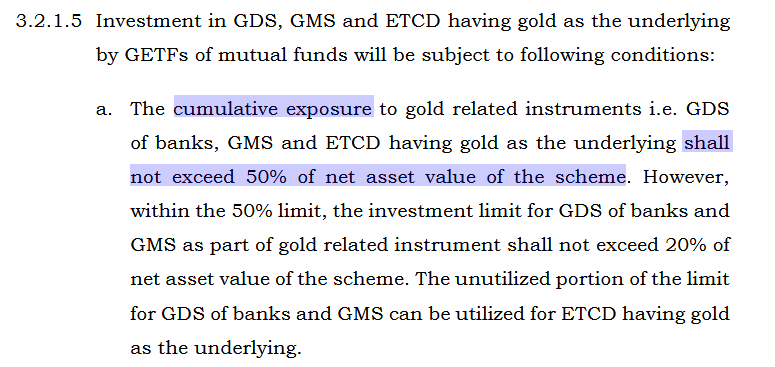
Of the NAV,
i. Upto 20% allowed in GDS/GMS
ii. Upto 50% allowed in “gold related instrument” (inclusive of i above)
iii. >95% required to be Gold + Gold-related instruments.

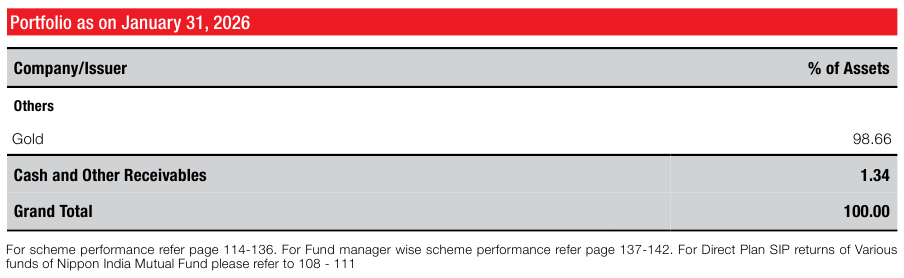
For example, recently in Jan 2026,
apparently Nippon India’s GoldBeES had ~1.34% in cash/cash-equivalent for operational reasons.

Source: Section 3.2 Gold Exchange Traded Fund Scheme of Master Circular for Mutual Funds (from 27 Jun 2024).


If you have read so far,
you may also enjoy reading this recent post on The opaque curtains of India’s gold pricing to explore some of the not-so-obvious risks associated with gold as an investment class.

3 Likes

Hey Sandeep, have answered on this topic earlier as well. The regulatory provision to do ETCDs has been there since a while, its just that some of the AMCs are now modifying their SIDs to accommodate the same. Keeping in mind the nuances and vagaries of the physical market as has been experienced in the past, it opens up another avenue to ensure that the scheme meets its objectives in terms of tracking the underlying. ETCDs are regulated products and exchange guaranteed, so do not see an issue in them being used.

1 Like