In the early years of my career as a finance writer, whenever the topic of buying a house came up, buyers and experts gave the same advice: “Avoid under-construction properties—buy only completed projects.”
Though under-construction properties came at a significant discount compared to ready-to-move-in flats, the big risk was that buyers could end up stranded with no roof over their heads.
There were so many issues. The most common ones were delays in handing over the house, stalled projects, false promises, misuse of funds, and the builder’s own cashflow problems, often leaving behind the remains of half-built structures.
Then came 2016, when the RERA Act—Real Estate Regulatory Authority Act—was introduced. It promised to pour concrete where the cracks ran deepest.

It mandated that builders register projects before the first brick is laid, regularly inform buyers of construction updates, commit to delivery timelines, and follow standard rules for carpet area, sale deeds, etc. And for the first time, the scale tilted towards the buyer’s side.
“It’s the 10th year of RERA, yet many homebuyers are still unaware of the rights the law gives them,” said Abhilash Pillai from Cyril Amarchand Mangaldas, who has over 20 years of experience in the real estate space.
So, we asked him to share the most important ones, which we’ve put together here. And if you think these could be just some boring rules, you’re mistaken. When you read them, you understand how the real estate space works from a buyer’s perspective, and you will start to look at those huge ‘buy-your-dream-home ’ hoardings a little differently.
Before we move on, the real estate market is very state-specific, and each state has drafted its own set of rules. Here, though, we’ll focus on the broader rules that laid the foundation.
1. All details of the project on the RERA website
When most of us think of buying a home, we start with the obvious checklist: a nice neighbourhood, good schools, markets nearby, maybe a metro station around the corner. That’s all important, no doubt. But a good location means little if the project itself isn’t solid.
Get used to your state’s RERA website, where you can get all the details about the project. Just for example, here are links to MahaRera (Maharashtra’s) and Karnataka Rera.
Just type in the project name and you’ll know instantly whether it’s registered. By law, any project with more than eight units or more than 500 square meters must be registered with RERA. If it isn’t, the builder is not even allowed to market it to you.
And if someone tells you they are “in the process” of getting a RERA registration and asks for a booking advance, that’s a clear red flag.
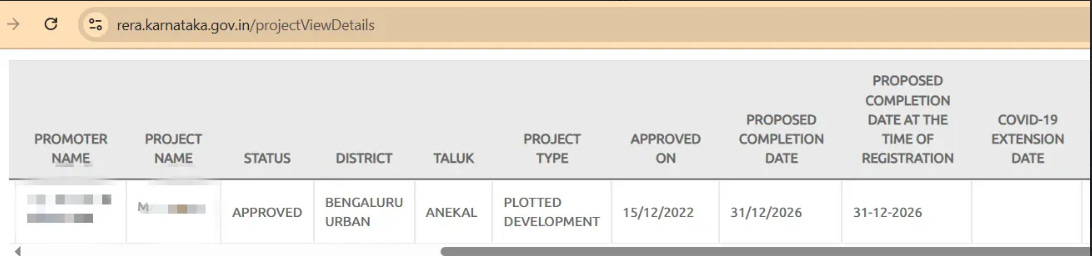
Credits: Screenshot from Karnataka Rera website
Once you find the project, spend some time going through the details. Check if the unit count, carpet area, and layout plans match what the sales team showed you. Land details, project clearances, and estimated completion dates should all be listed there.

Credits: Screenshot from Karnataka Rera website
As the saying goes, “Credibility is the foundation; without it, everything else crumbles.” That’s literally and figuratively true for real estate, where the credibility of the developer matters most. One section on the RERA website that helps you gauge this is the ‘complaints’ section , which gives you a good sense of the developer’s track record.
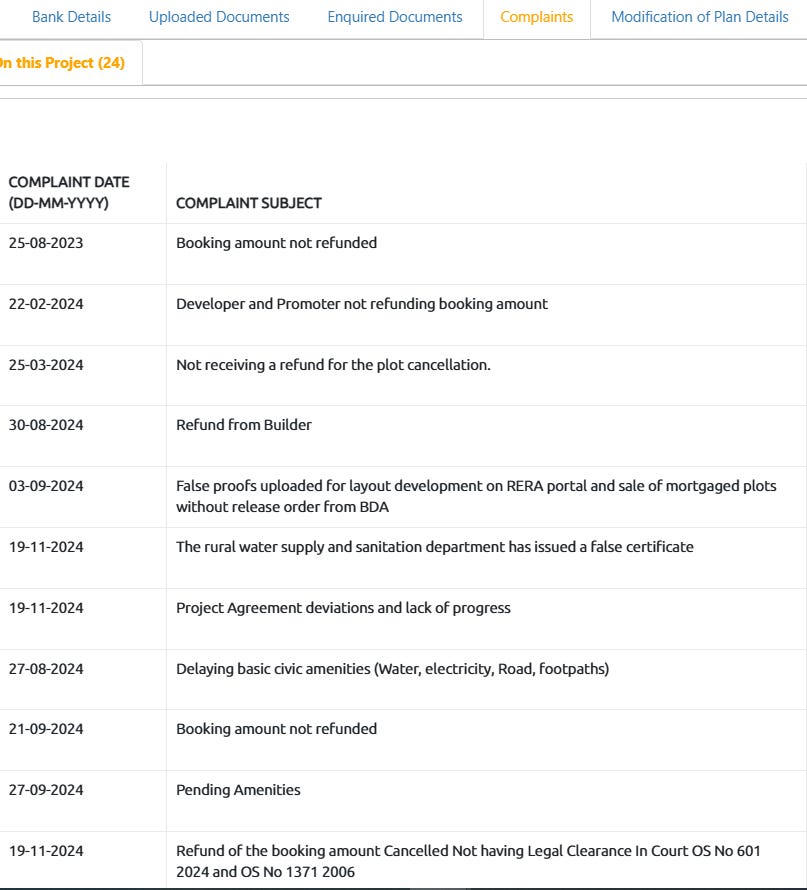
Credits: Screenshot from Karnataka Rera website
Talking about credibility, a trick sellers often use is creating a false sense of scarcity to make buyers rush into a decision. With RERA, some state websites now even show you the number of units sold and unsold.
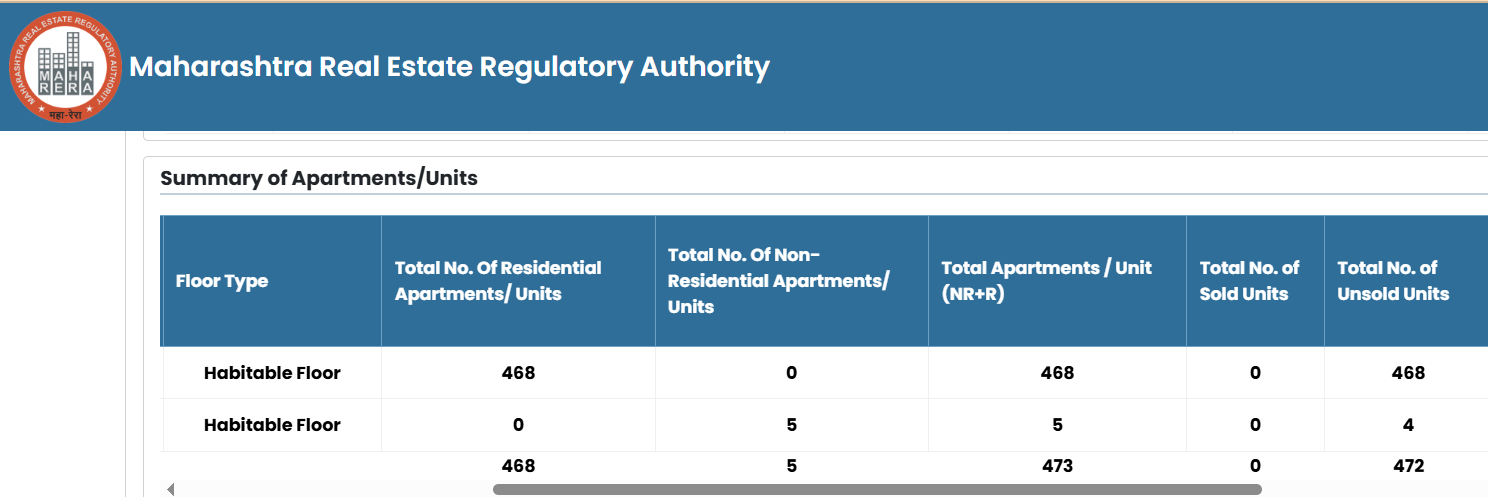
Credits: Screenshot from Maharashtra Rera website
While you’ll start to appreciate the wealth of information available online, remember this: you might get land title deeds on the website, but it’s still on you to visit the sub-registrar’s office to verify the authenticity of the legal title and check if there are any encumbrances on the property.
2. Only carpet-area-based sale
Earlier, houses were sold based on the built-up area. Built-up area doesn’t just mean your home; it also includes a proportion of the common spaces like the lobby, lifts, and even terraces.
The problem? Buyers thought they were paying for, say, a 1,200 sq. ft. flat, but when they moved in, the actual usable space inside the home - the part you could actually walk around in - was much smaller. This mismatch created confusion and plenty of room for builders to take advantage.
RERA changed that by making carpet area the benchmark. Carpet area simply means the actual usable area within the walls of your flat, the space you can literally lay a carpet on. You can find these details, too, on the RERA website.
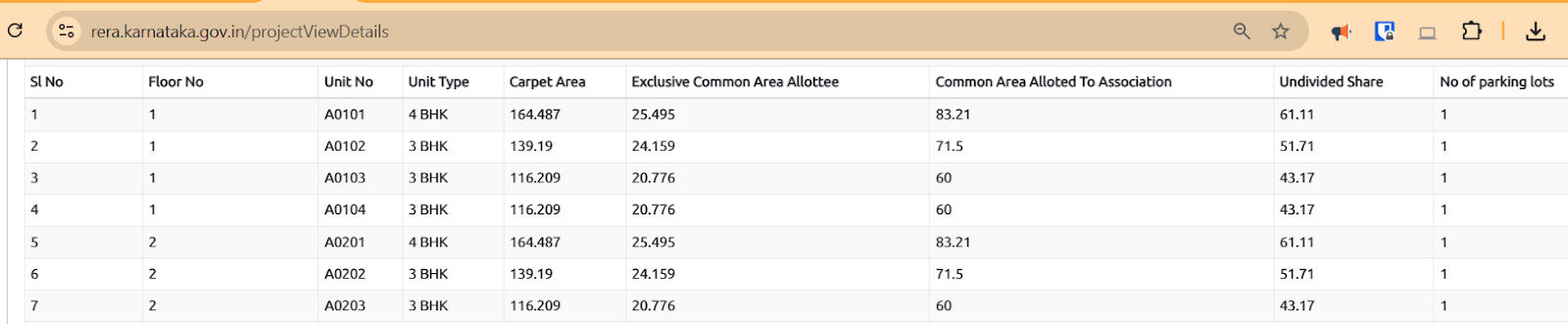
Credits: Screenshot from Karnataka Rera website
Now, what about your share in the land when you buy a property? That’s called the Undivided Share (UDS) of land. Interestingly, this UDS is still calculated based on the built-up area (since you cannot exclude common areas when you calculate the share of land).
Another thing to know: Per RERA rules, an open or stilt car parking space cannot be sold to you separately. It can only be allotted along with your home purchase.
3. Low scope for fraud
“What proof do I have that the builder is actually using my money to construct my home and not siphoning it off somewhere else? “What if he simply takes the money and disappears?”
RERA has tried to put guardrails around these fears.
As per the rules, when you pay, say ₹100 to the builder, only ₹30 is available for his direct use. The remaining ₹70 must go into an escrow account—a separate bank account created specifically for that project.
The builder can withdraw this money only in phases, and only after hitting certain construction milestones. That too, only after getting certifications from an engineer, an architect, and a chartered accountant confirming that the milestone has been achieved. This ensures that the money you pay is used only for the intended purpose, building your home.
There are also clear rules for entering into an agreement, too.
A builder cannot ask for more than 10% of the property cost without first entering into a formal agreement. When you pay the initial booking amount, you should receive an allotment letter. To collect anything beyond 10%, the builder must sign a registered Builder-Buyer Agreement.
Finally, once the construction is complete and the builder obtains an Occupancy Certificate—a legal document issued by the local authority confirming that the building is safe and fit for residents to move in—the last step is executed: the conveyance or sale deed transferring the property to you.
4. Timely delivery
Undue delay in handing over homes used to be one of the most rampant issues with under-construction properties. You would have heard at least one story where money was collected, but the project either stalled midway or dragged on for years, sometimes decades.
While we are still far from ideal, Pillai says the number and extent of delays have come down significantly since the introduction of RERA.
Under RERA rules, if there’s an unjustified delay, the buyer has the following rights:
You can terminate the agreement and claim a refund with interest, or you can choose to stay invested and receive interest on the money you’ve already paid.
In extreme cases, developers may even face criminal proceedings.
You can also track progress on the website, as developers are required to upload quarterly progress reports.
Of course, if the delay is caused by genuine reasons—like the COVID-19 lockdowns when construction was halted—then the RERA authority grants an extension. In such cases, buyers are not entitled to compensation for the delay.
5. Covering problems post-possession
Now imagine this: the developer followed all the rules, delivered the property on time, payments went smoothly, everything looked perfect. But once you move in, you realise the quality of the structure isn’t up to the mark. Cracks on the wall, leaking pipes, faulty wiring—what then?
RERA makes sure the builder’s responsibility doesn’t end the moment the keys are handed over. Under the law, there is a defect liability period of 5 years. This means that if any structural defects or quality issues come up within five years of possession, the builder is obligated to fix them at no extra cost to you within 30 days.
The accountability continues well beyond possession.
Wrapping up
Out on the field, things are not always as hunky-dory as the theory suggests.
The law has good intent, but its implementation is still evolving. While buyers have every right under RERA to file complaints and seek resolutions, the process can sometimes be time-consuming, and even when an order is passed, enforcement is not always straightforward.
Since the rules are state-specific, the efficiency of implementation also varies widely.
According to Pillai, MahaRERA is often regarded as the gold standard in enforcement, while states like Karnataka and Haryana are praised for their user-friendly websites.
And just to reiterate: RERA ≠ title guarantee. RERA registration does not automatically guarantee that the land on which a project is built is dispute-free. It’s still the buyer’s responsibility to do proper due diligence by visiting the sub-registrar’s office and verifying the title.
In the end, RERA may not have solved every problem in Indian real estate, but it has surely tilted the scales in favour of the buyer.
This Newsletter was written by Satya Sontanam.
Do read Tata Nano - Visionary product or failed experiment? newsletter on our Side Notes by Zerodha Varsity.
For any feedback or topic suggestions, write to us at [email protected].