My question is that i wanna buy nifty 50 index for long term ( Very long term ) basically dont wanna sell it. And i wanna invest huge sum. Through which AMC it is best to buy it. So that i dont have to worry about anything and how to buy ? Are ETFs are the only way to buy Nifty or there are more ways that i dont know YET ?
Mutual fund can be bought in two forms, though. Demat and SoA. For demat mode, you may buy from Zerodha Coin. For SoA mode, use the fund house’s website or app.
Choose AMC based on Base Expense Ratio and Tracking Error. Aforementioned Zerodha fund has relatively small AUM (at 71Crore) compared to some big names, though.
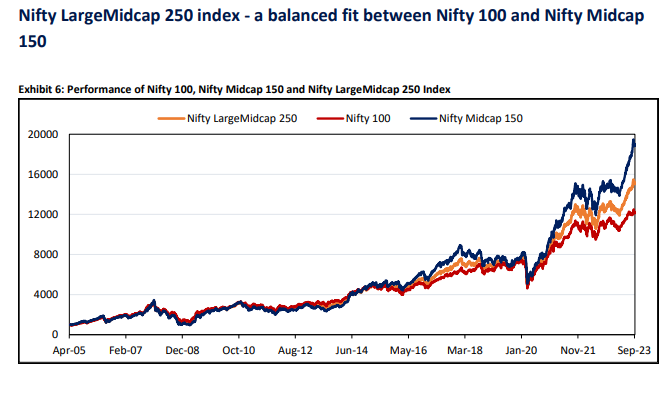
Would you be open to exploring another index for a very long-term horizon? The Nifty LargeMidcap 250 could be a stronger alternative to a plain vanilla Nifty 50 fund.
It combines the top 100 large-caps with 150 mid-caps in a 50:50 split. Because it mechanically rebalances every quarter, it naturally executes an automated “buy low, sell high” approach. Historically, this has boosted its risk-adjusted returns (Sharpe ratio), especially over longer holding periods.
“The Nifty LargeMidcap 250 Index has outperformed the Nifty 100 index across the long term horizon period of 3, 5, 7, 10 and 15 year. Over the last 5 years, between September 30, 2018 to September 29, 2023, Nifty LargeMidcap 250 index has delivered 17.1% CAGR as against 13.2% CAGR delivered by Nifty 100 Index.”
and
“The Nifty LargeMidcap 250 Index has a higher return-risk ratio than the Nifty 100 Index over the long and shortterm horizons”
Although Nifty100 is similar to nifty 50 in terms of behavior ..still is not exactly same. So I ran query “compaire long term risk adjusted returns of Nifty50 and Nifty LargeMidcap 250” to gemin AI
Gemini AI Response pasted as it is.. however you can do your own analysis.
While the Nifty LargeMidcap 250 delivers higher absolute annualized returns than the Nifty 50, evaluating them on a risk-adjusted basis reveals how much extra volatility, drawdown severity, and downside pain an investor must accept to capture that outperformance.
Captures more upside than downside over full market cycles.
Breakdown of Risk Factors
Downside Volatility & The Midcap Drag:
During major liquidity crunches or recessionary bear markets (e.g., 2008 Global Financial Crisis, 2018–2019 midcap shakeout, March 2020 crash), midcaps face acute liquidity freezes. The 50% midcap exposure drags the LargeMidcap 250 into deeper troughs than the Nifty 50, causing shorter-horizon (1–3 year) risk-adjusted metrics to deteriorate sharply during corrections.
The Quarterly Rebalancing Buffer:
Pure midcap indices (like the Nifty Midcap 150) suffer from elevated drawdown risk and lower long-term Sharpe ratios. However, because the LargeMidcap 250 mechanically rebalances back to a 50:50 ratio every quarter, it systematically harvests midcap gains into large caps at market peaks and re-enters midcaps during troughs. This structural rule improves its Sharpe and Sortino ratios relative to both pure midcaps and pure large caps over a complete 7+ year horizon.
Recovery Horizon & Drawdown Duration:
While the Nifty 50 tends to reclaim prior all-time highs faster (led by institutional foreign inflows into blue chips), the LargeMidcap 250 exhibits a steeper trajectory during the subsequent expansion phase, making its recovery robust once broad market breadth broadens.
Strategic Takeaways
Choose Nifty 50 if:
Your horizon is under 7 years or you are in/near the capital distribution phase.
Deep drawdowns trigger behavioral panic or unplanned redemptions.
You prioritize liquidity, the tightest tracking error, and lower impact cost.
Choose Nifty LargeMidcap 250 if:
You have a 7- to 10-year+ investment horizon.
You can tolerate 5%–10% steeper peak-to-trough drawdowns in exchange for an extra 150–250 basis points of annual compounding.
You want a self-balancing core equity foundation without needing to manually rebalance between large-cap and mid-cap funds.