
Our goal with The Daily Brief is to simplify the biggest stories in the Indian markets and help you understand what they mean. We won’t just tell you what happened; we’ll tell you why and how too. We do this show in both formats: video and audio. This piece curates the stories that we talk about.
You can listen to the podcast on Spotify, Apple Podcasts, or wherever you get your podcasts and watch the videos on YouTube. You can also watch The Daily Brief in Hindi.
In today’s edition of The Daily Brief:
- Can a “miracle drug” change how we work? GLP-1 drugs like Ozempic are often touted for boosting workplace productivity, but a landmark Danish study reveals a more nuanced picture. While the medication reduced long-term sick leave by 17%, it produced no net gain in employment or income, as Denmark’s welfare system absorbs illness costs—saving money for employers and municipalities rather than raising worker pay. With generic semaglutide expanding rapidly across India, the economic impact could unfold very differently in a market without formal safety nets.
- SEBI wants to create a mutual fund distributor for bonds. SEBI has proposed creating Fixed Income Channel Partners (FICPs) to expand retail participation in India’s ₹60 trillion corporate bond market, borrowing a blueprint from mutual fund distributors. However, unlike mutual funds, single bonds carry concentrated credit risk, thinner secondary liquidity, and complex pricing. With capped upfront commissions potentially incentivising portfolio churning, the key challenge will be expanding reach without creating mis-selling risks for retail investors.
Can a “miracle drug” change how we work?
GLP-1s began as diabetes treatments. Then they became a breakthrough in weight loss. Now the promise is expanding again: better health should mean people miss less work, stay productive, and remain economically active for longer.
That last claim matters a lot. It is increasingly used to justify spending on these drugs. But until recently, nobody had tested it properly.
Someone finally did.
Their employment rate had not moved either. If anything, the estimate leaned slightly negative, though it was statistically indistinguishable from zero.
That finding comes from a July 2026 working paper circulated by the National Bureau of Economic Research in the US. Five economists used Danish administrative records to track what happened after people started taking Ozempic. The paper has not been peer-reviewed yet, but it is the most careful attempt so far to test whether these drugs improve people’s working lives.
The answer is yes, just not in the way many expected.
This matters to us because India is now running its own version of the experiment, at speed and without a control group. Semaglutide’s core compound patent in India lapsed in March 2026, and dozens of generic brands entered almost immediately, many at prices far below what the innovator had been charging. Sales spiked, then growth slowed sharply within a few months.
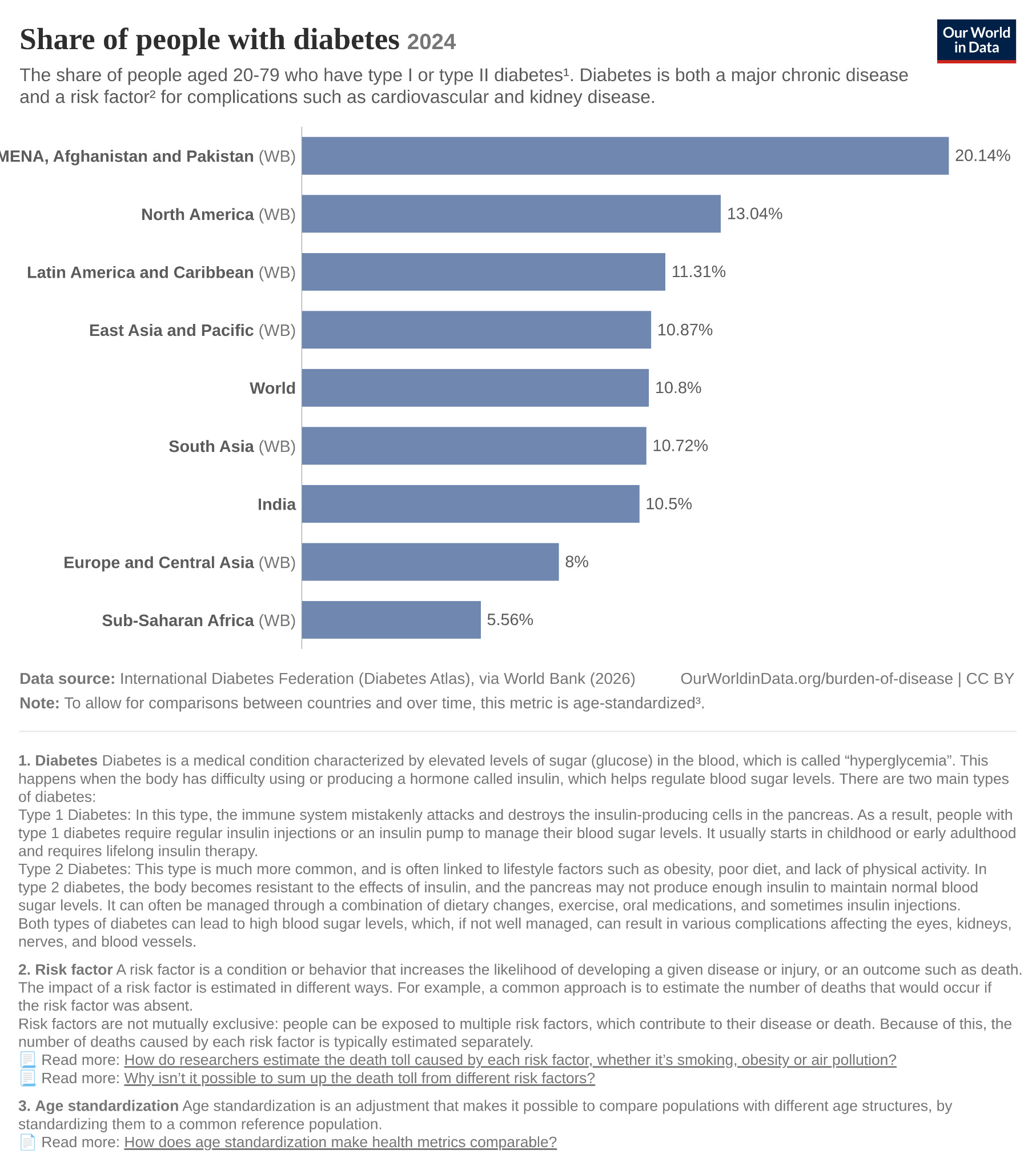
Meanwhile, an estimated 10.5% of Indians aged 20 to 79 were living with diabetes in 2024, while roughly 8% of adults were obese. The disease burden is huge, the drugs are suddenly much cheaper, and nobody in India is systematically measuring what any of this does to people’s working lives.
Denmark, thankfully, measures everything.
Why you can’t just compare people who take the drug to people who don’t
Before getting to what the researchers found, there is one important question: how do we know Ozempic actually caused any of it?
That is harder to answer than it sounds. If you simply line up Ozempic users against non-users and find that the users do better at work, you’ve learned almost nothing. People who show up at a clinic, get a prescription and stick with an injectable drug for years are not a random slice of the population. They may be sicker in specific ways, but also better informed, more motivated or more connected to the healthcare system. Any of those things could affect employment and income on their own. You’d be measuring the kind of person who takes Ozempic, not what Ozempic does to them.
So the researchers did something cleverer. They compared people who started Ozempic in its first seventeen months on the Danish market with people who started the same drug roughly four years later. Then they matched the two groups on age, sex, diabetes, obesity, and a long list of social, health and economic characteristics. That left 7,011 early starters paired with 7,011 near-identical later starters, covering 71.6% of everyone eligible in the early group.
The logic is simple. Both groups eventually took Ozempic, so they are much more alike than users and non-users would be. The crucial difference is timing. The later group therefore becomes a stand-in for what might have happened to the early group if their treatment had been delayed by four years.
There is one more caveat before we get to the results, because it shapes how we should read them. Everyone in the sample was between 30 and 59 when the study began, and 84% had diabetes. So these are not necessarily the people you picture when you hear “GLP-1” today. This was not a broad weight-loss population. It was mostly middle-aged people with diabetes, most of whom were already employed, taking the drug for the reason it was originally approved.
The drug worked, and it took its time
So, with those caveats in mind, what actually happened after people started taking Ozempic?
First, most of them kept taking it. Four years after starting, 75% of early users filled at least one semaglutide prescription that quarter. That doesn’t prove continuous use, let alone that every dose was injected. But it is a remarkably high persistence rate for a chronic medication, helped in part by Denmark’s heavy drug subsidies.
Then the absences started falling.
Denmark’s main measure of long-term sick leave generally captures medically certified absences lasting more than 30 days. Before treatment, people in the study spent about 5.5% of their months on such leave. After starting Ozempic, that fell by 0.95 percentage points, or 17.3%. Put differently, roughly one in six of those long periods of sick leave disappeared.
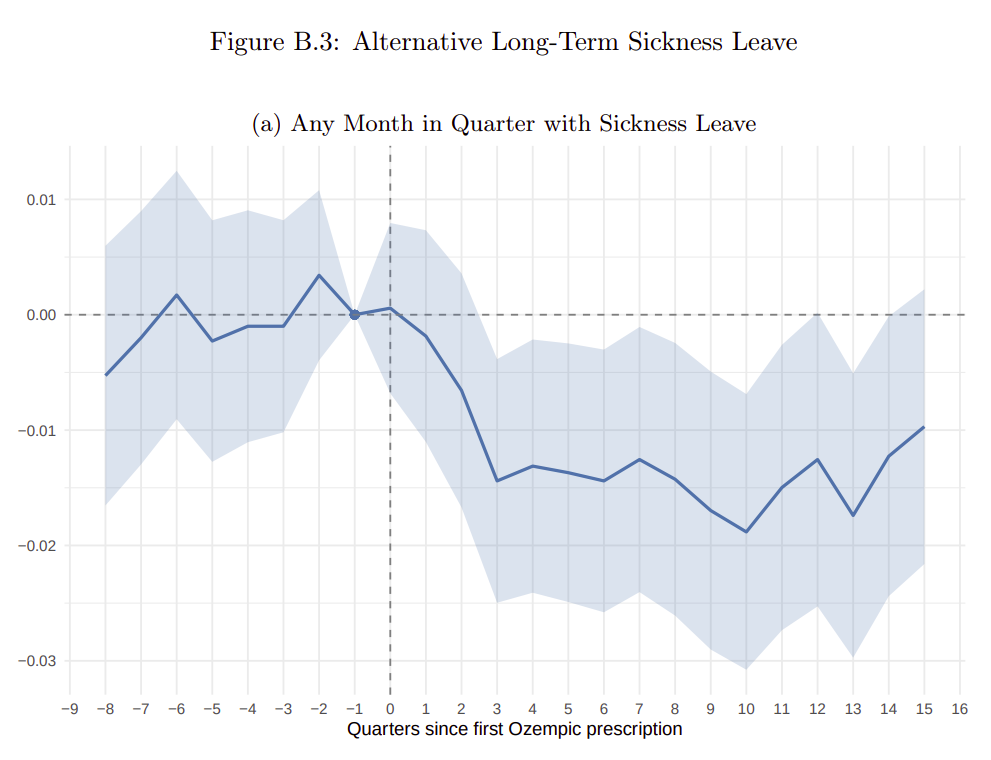
And the effect took time. In the first two years, sick leave fell by about 0.8 percentage points. By years three and four, the decline had widened to roughly 1.1 points. That is what you might expect if the benefits come from gradual improvements in health rather than something that changes overnight.
Other measures moved in the same direction. Municipality-paid sickness benefits, which kick in after the first 30 days of an absence, fell too. The researchers also found fewer emergency department visits, fewer cardiovascular drug prescriptions and fewer consultations.
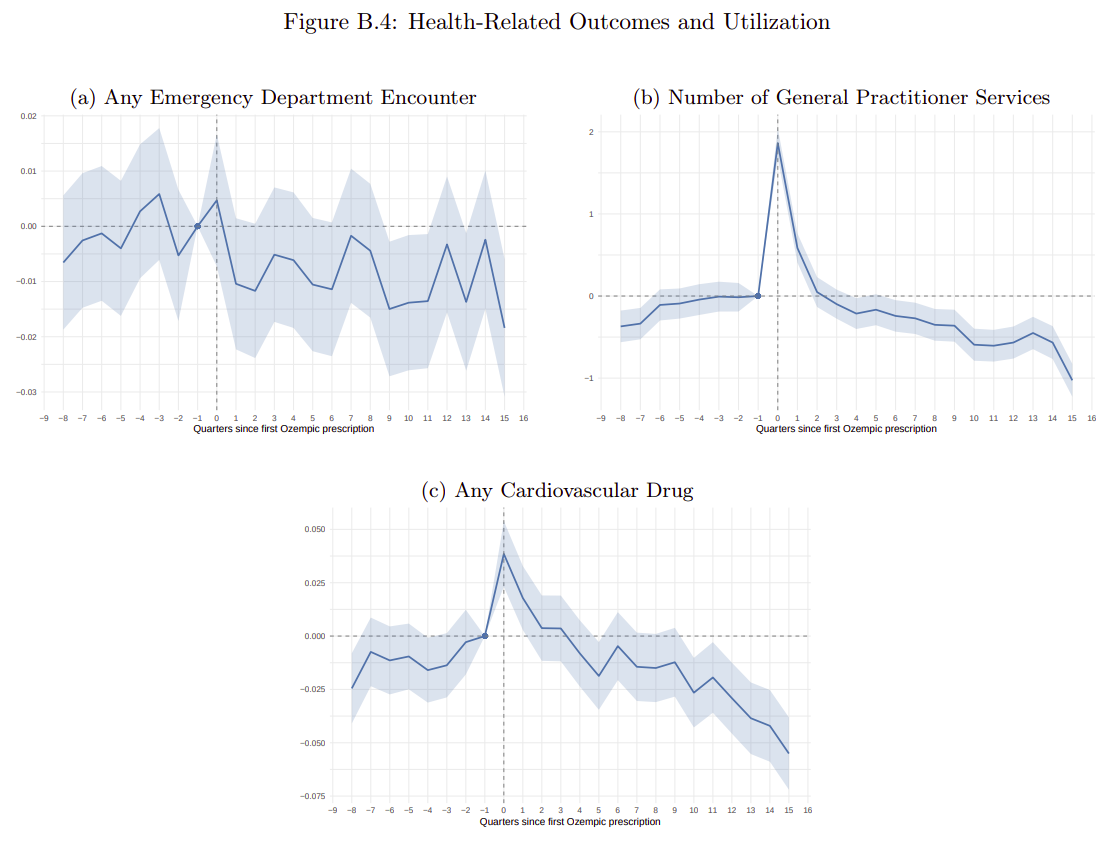
That makes for a coherent story, but there is an important limit to how far we can take it. The Danish records tell us about prescriptions, hospital visits and benefit payments. They don’t tell us people’s weight, blood glucose readings, or why each person went on sick leave. So the study can show that health indicators improved while long-term sickness leave fell. It cannot prove that those health improvements caused the decline in absences.
So where did the gain go?
Here is where the paper gets genuinely surprising. The same treatment that cut prolonged sickness absence by a sixth produced no detectable improvement in whether people were employed, how much they worked, or what they earned.
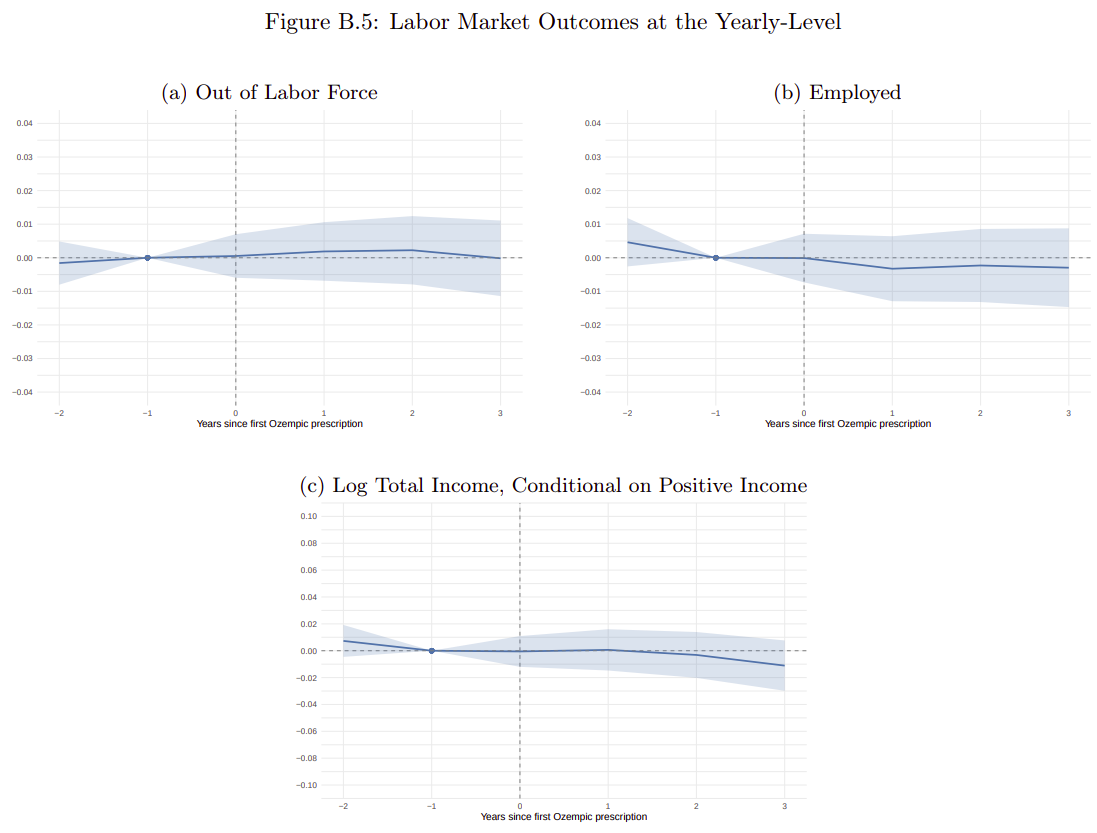
And this is not just a case of noisy data. The estimates are precise enough to put a ceiling on what could be hiding underneath them: the researchers can rule out an employment gain larger than 0.4 percentage points and an income gain larger than 0.7%. If there were a meaningful labour-market payoff, it should have shown up. They also split the sample by sex, age and education to see if the effect appeared somewhere else. It didn’t. Some estimates were even negative.
The explanation is not medical. It is institutional, and it may be the most useful idea in the paper.
In Denmark, employers generally cover the first 30 days when an employee falls ill. After that, the municipality pays sickness benefits to those who qualify. For many lower-paid workers, those benefits replace most of the income they would otherwise lose. So a Danish worker who is sick for two months may take only a small financial hit. And if that two-month illness is prevented, their measured income does not rise much either.
The money is still being saved. It just goes to whoever would have paid for the absence. The employer avoids paying for those first 30 days. The municipality avoids paying afterwards. The economic benefit shows up not as higher income for the worker, but as a cost that never appears on someone else’s books.
It is worth being clear about what this does not mean. This is an offset, not a verdict. The paper does not run a full cost-benefit analysis, subtract these savings from the price of the drug, or measure things like whether people become more productive while they are actually at work.
“Ozempic pays for itself” is not a claim this study makes.
A different study found the opposite, for different people
Around the same time, another NBER paper by Rebecca Diamond looked at American women taking GLP-1s specifically for weight loss. Among women who weren’t employed before starting treatment, employment was estimated to be 26.9% higher over quarters six to eighteen.
That is an enormous effect. It is also one to treat carefully.
The full matched study includes only 242 treated women, and the non-employed subgroup is smaller still. A stricter statistical check puts the result just outside the conventional 5% significance threshold. And when all the women are pooled together, the employment effect gets smaller and is no longer statistically significant.
There is another complication. Diamond notes that the result fits two very different stories. Losing weight might make it easier for someone to work. Or employers might respond differently to visibly thinner applicants. The data cannot tell us which one is happening.
But this doesn’t necessarily contradict the Danish paper. The two studies are looking at different people starting from very different places. Denmark’s sample was mostly people with diabetes who were already working, so better health could show up mainly as fewer days away from work. Diamond looked at women taking GLP-1s for weight loss who weren’t working to begin with, so any labour-market benefit could instead show up as entering employment.
What travels to India, and what doesn’t
Denmark’s result is partly a product of Denmark’s plumbing. Because workers can have much of their income replaced during a long illness, the financial gain from preventing that illness largely went to employers and municipalities rather than workers. Change the plumbing and the money lands somewhere else. In a system where a long illness can mean lost wages or even a lost job, preventing it could show up directly in the household — as more hours worked, higher earnings, or a job retained. The government’s savings would be smaller for the simple reason that it wasn’t paying much of the cost to begin with.
That is more likely to be the shape of the effect in India, where most workers don’t have a 30-day employer-funded cushion followed by a municipality picking up the tab. Which is exactly why we need to measure the effect here rather than import the Danish estimate. The system is different enough that the Danish number tells us very little about where the economic gains would land in India.
The patients would differ too. Denmark’s early adopters were overwhelmingly people with diabetes, a group with a lot to gain clinically. A cheap, widely marketed weight-loss drug can bring in a very different patient: someone with less illness to reverse, and potentially less sickness absence to prevent. India’s post-patent market could increasingly include that second group.
And right now, we can’t see much of it. Pharmacy sales data can tell us how many units moved. It can’t tell us how many distinct people started treatment, whether they were treating diabetes or trying to lose weight, or how long they stayed on the drug. That last part matters enormously. In Denmark, the effect took years to build. A market where people fill two prescriptions and stop is unlikely to reproduce the same result, no matter how many boxes get sold.
So the useful question was never simply whether GLP-1s pay for themselves. It is who benefits financially, through which channel, and over how long. In Denmark, part of the answer was employers and municipalities, quietly, over four years, through absences that never happened.
In India, we don’t know yet. And the data that could tell us largely isn’t being collected.

SEBI wants to create a mutual fund distributor for bonds
SEBI wants to create a new kind of bond distributor.
It has proposed a new intermediary called a Fixed Income Channel Partner, or FICP, that would help people buy bonds through online bond platforms. The inspiration is fairly obvious: mutual fund distributors helped take mutual funds beyond wealthy, urban investors. SEBI now wants to see if something similar can work for bonds.
There is just one complication. A bond is a much trickier product to hand to a commissioned salesperson than a mutual fund.
Why it matters: India’s corporate bond market is worth roughly ₹60 trillion, but retail investors barely participate in it. SEBI has spent the past few years making bonds easier to buy. Distribution is the next problem it wants to solve.
Driving the news: In a consultation paper released on August 21, SEBI proposed allowing individuals and firms to enlist with stock exchanges as FICPs. SEBI-registered Online Bond Platform Providers, or OBPPs, could then appoint them to find and assist investors.
SEBI released another consultation paper the same day proposing tighter advertising rules for OBPPs, including restrictions around pitches such as “fixed returns”, “passive income” and FOMO-style marketing. The two papers fit together neatly: SEBI wants bonds sold more widely, while trying to make sure they aren’t oversold.
Catch up quick
SEBI has already tried fixing access.
In 2024, it reduced the minimum face value of many privately placed bonds from ₹1 lakh to ₹10,000. Before that, its 2022 OBPP framework brought online bond-selling websites under regulation, requiring them to register as stock brokers in the debt segment and follow disclosure rules.
That made buying a bond easier. It did not necessarily make bonds mainstream.
SEBI’s own assessment is that OBPPs have mostly attracted tech-savvy, urban investors. But the investors outside that bubble haven’t necessarily followed.
Mutual funds offer an obvious template for what comes next. India has roughly 2.75 lakh AMFI-registered mutual fund distributors sitting behind an industry with ₹79.5 lakh crore of assets. Distributors played an important role in taking mutual funds beyond the largest cities.
How FICPs would work
The entry barrier is deliberately low. An individual needs to be an Indian citizen, at least 18, have passed Class 12, have a clean record, and hold the relevant NISM Fixed Income Securities certification.
SEBI is also creating two obvious pools of potential distributors.
AMFI-registered mutual fund distributors would have their enlistment fee waived , although they would still need the NISM certification. Stock brokers that are not already registered in the debt segment could become FICPs too. That second route could end up being just as important.
An FICP would enlist with one stock exchange, with the enlistment valid for three years, and could work with multiple OBPPs. They could help with onboarding, documentation and KYC.
But the actual transaction stays with the platform. Orders must route through the OBPP. The FICP cannot handle the client’s money or securities, or issue contract notes.
And this is where things get interesting: the FICP gets paid by the OBPP out of its brokerage. Total charges to the client cannot exceed 2.5% of the investment value .
The guardrails
SEBI seems well aware of what can go wrong when you put a commission between a salesperson and a complicated financial product.
So much of the liability sits with the OBPP.
The platform would be responsible for what its FICPs do. It must conduct know-your-distributor checks and in-person verification, keep track of which clients came through which FICP, and resolve complaints within 21 days.
For clients in remote areas, the OBPP must also call them to check for malpractice.
Sales incentives cannot include gift vouchers, gadgets or entertainment. And some of the riskiest products are simply kept out: AT1 bonds and unsecured perpetual debt cannot be sold through FICPs.
Those restrictions matter because India has already seen what bad bond distribution can look like.
A few years back, YES Bank’s AT1 bonds were sold as “Super FDs”, but roughly ₹8,800 crore worth of them were eventually written off completely. About 1,346 individual investors held them. Keeping AT1s away from this new distribution channel looks very much like a lesson learned.
Where the mutual fund analogy breaks
There is a reason mutual fund distributors worked so well: the product they were selling was designed for retail investors. A bond isn’t quite the same thing.
A debt mutual fund can spread your money across dozens of issuers. Buy one corporate bond, and you are taking the credit risk of one company.
A mutual fund gives you a daily NAV. With many corporate bonds, figuring out whether the price you are being offered is actually fair is much harder.
And if you want out, there may simply not be a buyer. Secondary-market liquidity in many corporate bonds remains thin.
But perhaps the biggest difference is how the salesperson gets paid.
An MFD typically earns a recurring trail commission as long as the investor remains invested. An FICP would earn from the OBPP’s brokerage when the bond is sold. That changes the incentive. The mutual fund distributor benefits from keeping assets invested, but the bond distributor would benefit from just churning the portfolio.
That makes SEBI’s 2.5% cap worth looking at closely.
On a three-year bond yielding 9%, a 2.5% charge is equivalent to roughly 80 basis points a year before considering compounding. On a shorter bond, the drag is even larger. Stating the cap as a percentage of the amount invested rather than an annual charge makes the same fee progressively more expensive as maturity gets shorter.
There is another problem: investors may not see that economics as clearly as they would with a mutual fund expense ratio. If the distributor’s compensation ultimately sits inside the price or yield being offered, the investor mostly sees the final yield.
And then there is the question of what gets sold.
The safest corporate bonds often yield only modestly more than bank deposits. That leaves less room for platforms and distributors to earn attractive spreads while still giving the investor a compelling yield. Move down the credit curve and the economics get better. The downside is that the risk gets higher too.
What happens next
Comments on the proposal close on September 11. After that come SEBI’s final rules and the exchange-level machinery needed to make the system work.
But there are three things worth watching.
First, the fee. Does the 2.5% cap survive, and does SEBI eventually require clearer disclosure of exactly what the distributor earns?
Second, the platforms. Making OBPPs fully responsible for their distributors creates compliance costs that larger, better-capitalised platforms should find easier to absorb.
And finally, the distributors themselves. India may have 2.75 lakh mutual fund distributors, but they don’t automatically become bond distributors. They still need the fixed-income certification. How many bother to get it will determine whether FICPs become a genuine distribution network or just another regulatory acronym.
SEBI is probably right that India’s bond market has a distribution problem. And mutual funds are good evidence that distribution can change how far a financial product travels.
But mutual funds didn’t become mainstream simply because India created an army of salespeople. The product itself was built for retail: diversified, professionally managed, transparently priced and relatively easy to exit.
With bonds, SEBI is now trying to build the salesforce around a product that still lacks many of those protections.
- This edition of the newsletter was written by Bhuvan & Kashish.
Tidbits
1. Govt mandates disclosure of sterilisation subcontractors on medical device labels
To improve traceability, the Ministry of Health and Family Welfare has mandated that medical device manufacturers outsourcing sterilisation must disclose the subcontractor’s licence number on their device labels. Domestic manufacturers have raised concerns that the new compliance burden could delay export shipments.
Source: Business Standard
2. Urban Company sues Kent RO over ads targeting its water purifiers
Urban Company has filed a defamation and disparagement suit against Kent RO Systems in the Delhi High Court over advertisements claiming its Native water purifiers were “unsafe” and “risky.” Following a court hearing, Kent RO agreed to pull down the offending advertisements and promotional content within 15 days.
Source: The Economic Times
3. Govt comes down heavy on Starlink for signing MoUs with states without a licence
The Indian government has strongly reprimanded Elon Musk’s Starlink for entering into Memorandums of Understanding with state governments before obtaining a valid commercial operating licence. The move signals regulators’ intent to strictly enforce compliance before allowing satellite broadband operations to commence in the country.
Source: The Hindu BusinessLine
4. Govt helps Indian chipmakers pool demand for global foundries
The Ministry of Electronics and Information Technology (MeitY) is stepping in to help Indian fabless chip designers pool their manufacturing demand. Pooling their orders could give smaller Indian chip designers more bargaining power on pricing, capacity, and manufacturing terms with global foundries.
Source: Livemint
5. Citigroup and Axis Bank team up on leveraged dollar deposit boom
Citigroup and Axis Bank are partnering to capitalise on a leveraged dollar deposit boom in India, as the RBI seeks to attract dollar inflows and bolster foreign-exchange reserves. Under the arrangement, Axis Bank will provide standby letters of credit to support offshore financing extended by Citigroup.
Source: Business Standard
6. Finance Ministry flags oligopoly concerns in airport privatisation
The Finance Ministry has raised concerns over an emerging oligopoly in India’s aviation sector due to the current trajectory of airport privatisation. The ministry noted that private operators Adani and GMR now account for more than half of the country’s air passenger traffic, highlighting potential risks to competition and pricing.
Source: Business Standard
Beyond Today’s Brief
There’s always more happening at Markets by Zerodha.
- The Chatter: How is the RBI pushing banks toward alternative data and AI oversight? How is 3M India localising production to protect margins, and what is driving momentum for Blue Star, KFintech, and EV material producer HEG?
- Aftermarket Report: How does the famous 45 DTE options strategy hold up when backtested on NIFTY? What helped the index recover in late trade to close above 24,200 despite a choppy, range-bound session? And why has India lifted its years-long ban on wheat exports amidst rising global prices?
- Points & Figures: Beyond equity trading, how are new investors and alternative assets reshaping India’s financial ecosystem? Drawing from SEBI’s latest report, Points & Figures tracks key shifts: Tier-II cities surpassing Tier-I in mutual funds, net SIP inflows surging 26%, and rapid expansion across AIFs, REITs, SME IPOs, and municipal bonds.
Join us on WhatsApp , where we share interesting soundbites from concalls, articles, and everything else we come across throughout the day. You’ll also get notified the moment a new video or article drops so that you can read or watch it right away.
Thank you for reading. Do share this with your friends and make them as smart as you are 