Nice connecting the dots 
However, IMHO, the limited info we have in the linked “Daily Brief” In the Money post
is NOT yet conclusive (in either way) just yet. 
Sidebar: A note on 'Daily Brief' posts off-late (and other Zerodha opinion pieces on this forum).
Recently, i have come to the realization that the Daily-Brief posts are approaching mainstream media articles with truisms and premature/unjustified jumps to conclusions.
I arrived at this conclusion after i observed Gell-Mann amnesia effect - Wikipedia at play when i found fundamentally incorrect assumptions (and an incorrect conclusion) in a Daily Brief post on a domain that i have personally spent decades in. Since then i find the value of the Daily Brief posts is not in their editorial opinions/conclusions, but the facts and any references/links shared in them.
The same is at play in other opinionated posts on the forum.
For example, in the above linked Daily Brief In The money post,
the summary is opinionated and unsubstantiated.
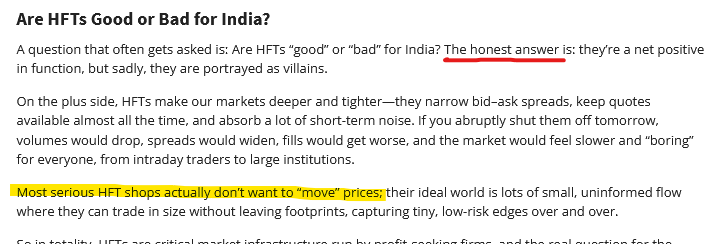
- What leads one to conclude “overall net positive”
- Without references/numbers, it is just an opinion.
- Are most HFT shops able to achieve the “ideal world” ?
- Or do they end-up moving prices at a cost to other market participants (even if inadvertently?)
- Alternately is a small minority of HFT shops (but with massive volumes) acting detrimentally to other market participants?
Essentially the problems with the summary of the In The Money post -
Summary Paragraph 1.
- “
honest answer” → “honest opinion”
Summary Paragraph 2.
- Strawman fallacy and a false dichotomy.
- Allowing HFT and disallowing HFT aren’t the only 2 possible options.
- Ideally one would restrict/eliminate rent-seeking/profiteering HFT strategies.
Summary paragraph 3.
- Claims the number of shops pursuing non-profiteering strategies is high
whereas the volume of HFT trades engaged in such strategies would be of relevance. - Focuses on intent and doesn’t consider inadvertent negative-impacts as “side-effect”.
especially critical when it is unclear if intent is being successfully achieved without “side-effects”.
For example,
the increase in “middlemen” entities will itself lead to shrinking margins even if spreads increase.
(as long as amount of spread-increase is outpaced by increase in number of “middlemen”)
Regarding the observations that spreads have also shrunk,
even in such a scenario,
here are a couple of questions that lead to potential ways i could quickly think of
how middlemen can profiteer without contributing to a more efficient market
for the other entities involved -
Q1. How much of the reduced spread is benefiting the non-middlemen entities?
How much of the traded volume is…
a. …between 2 “middlemen”
b. …between a “middleman” and a “producer”
c. …between a “middlemen” and a “consumer”
Q2. Are there price swings between trades of scenarios b and c, especially ones that are in favor of the “middlemen” ?
I wonder if there are any such statistical analyses of market data by exchanges or regulator that can help confirm/disprove this line of thought? Or some such possible using publicly available data? 
@Meher_Smaran can you please check if anyone in the team is already aware of, or is interested to pursue this further, and share?
Sidebar: A slightly more elaborate list of additional potential scenarios to consider...
Here is the updated list, classified by whether the middleman’s role is primarily
- Contributing (adding systemic efficiency/utility)
or - Profiteering (extracting rent without adding proportional value).
NOTE: Collected using an LLM + Web-search, and manually reviewed/categorized.
-
Temporal Arbitrage (Contango Plays): Contributing
Moves supply from times of excess to times of scarcity, smoothing consumption. -
Spatial Arbitrage: Contributing
Resolves geographic shortages by physically moving goods to where they are needed most. -
Blending/Transformation: Contributing
Creates tangible utility by converting unusable raw materials into market-ready specifications. -
Information Synthesis: Contributing & Profiteering
Accelerates price discovery, though profits are often derived solely from asymmetry and hoarding proprietary data. -
Latency Arbitrage & Microstructure Gaming: Profiteering
Extracts value via speed (HFT), quote stuffing (clogging exchanges), and rebate harvesting (gaming fee structures) without taking genuine risk. -
Predictive Analytics: Contributing
Signals future risks to the market early, smoothing out potential price shocks. -
Basis Trading & Squeezes: Contributing & Profiteering
Tethers futures to spot prices, but can cross into cornering/squeezing—hoarding physical supply to force counterparties into “ransom” settlements. -
Liquidity Provision: Contributing & Profiteering
Enables trade in illiquid markets, but often utilizes negative selection (filling orders only when the client is wrong) or monopoly pricing. -
Financing Premiums: Contributing & Profiteering
Provides capital to distressed producers, often extracting value via predatory valuation or distress discounts. -
Operational Flexibility: Contributing
Increases systemic efficiency by reducing physical waste and logistic delays. -
Internalization & Principal Conflict: Profiteering
Matches orders internally to capture spreads while keeping markets opaque and potentially front-running client flows (putting house trades before clients). -
Structural & Regulatory Arbitrage: Profiteering
Exploits legal loopholes, manipulates benchmarks (“banging the close”), or wraps complexity around products to hide excessive fees, adding zero economic efficiency.