What do you think is the possibility of sebi following similar path to China
Remove weekly expiries and have only monthly and quarterly expiries.
Banning Intraday trades ( mandating delivery for all trades )
With all the recent stories floating about Sebi banning weekly expiries to reduce speculation and now reviewing the margins in the cash market, what are the chances that Sebi implements the above changes.
Looking forward to it becoming commonly accepted that trading is not worthier (must not be rewarded higher) than the underlying economically productive activity that it is trying to facilitate. Tail shouldn’t wag the dog.
…and China is trying everything in their power to control/prevent that.
Out of curiosity, have you come across / tried searching online for the contrary opinions?
There are opinion pieces that predict both.
Is there anything other than your gut feel, that leads you to confidently consider/state only one of the opinions on macroeconomic behaviour and disregard the opposing view?
Honestly I dont think SEBI is going to ban weekly expiries. The idea is mainly to slow down the heavy overspeculation that is happening, not to kill innovation in the markets. Weekly contracts brought liquidity, better hedging and more participation. Removing them would create more problems than it solves.
Some tweaks or guardrails may come, but a full ban looks very unlikely to me.
First things first, let’s get the misunderstandings out of the way -
This is a false dichotomy.
There is a spectrum of possibilities in the nuanced view of the world, not just 2 simplistic extreme opinions. Sometimes inaction can also be the best (or least worse) of all available options.
In this scenario, looking at the household finances as the end-to-end chain,
is it possible for a homemaker to be paid more than the sum total of what others earn in the home?
Additionally, is it optimal for the homemaker to be paid even the sum total of what others earn in the home, or even close to it?
as that leaves none/little for actual home expenses (raw-materials, services, assets) beyond what the homemaker provides.
With the logical fallacies out of the way, …
Would you agree that
in a chain of activities that generate some benefit,
there is a fundamental upper-limit on the share of the benefits that are paid out to the “price-discovery” activities in the entire value generation chain of activities?
As “price-discovery” keeps getting costlier,
at what point does price-discovery become costlier than the alternative
i.e. operating in an “inefficient market” without price-discovery?
(especially, when this “price-discovery” in increasingly uninformed and volatile, as is the general consensus in the recent past)
Are we at that point yet for any specific chains of value generation in “the market”?
If yes, is it logical to try to curtail the current “price discovery” / trading activity in such markets?
While simultaneously encouraging improving the quality of traders/price-discovery?
Exactly. And that’s what follows - an attempt to help identify any details that help attribute more value/confidence to this opinion (and not consider it noise).
So when i see a statement like this…
My first instinct is that - This is an overtly-simplistic model / world-view.
So, i am immediately curious why someone feels that this particular opinion is more likely than the opposing one. Since there appear to be sound analyses that both support and oppose this opinion, what gives someone the confidence to state this prediction 25 years into the future!
Are the “is expected to” and “is likely to” are doing a lot of heavy-lifting?
i.e. calling these predictions with a 51-49 possibility (barely more likely than a 50-50 possibility) ?
Here's a nuanced overview from an online search with references that check-out.
Note on INR vs CNY: Why the Simple 25-Year FX Story Is Too Confident
1. On the Indian Rupee: “will keep depreciating due to high inflation and chronic CAD”
Inflation is no longer structurally “high” post-2016
India adopted flexible inflation targeting (4% ± 2%) in 2016. RBI data show CPI inflation averaging in the mid-single digits (excluding the COVID shock), a clear break from the double-digit episodes of the 2000s.
RBI describes this as a regime change toward anchored inflation expectations, not a continuation of structurally high inflation.
IMF – India 2023 Article IV, discussion of inflation targeting and performance: IMF India Country Page
India’s current account deficit (CAD) is moderate and cyclical, not an ever-widening structural hole
World Bank and IMF data show India’s CAD typically in the 0–3% of GDP range over the past two decades, with surpluses in some years (e.g. 2020–21 when oil imports fell).
IMF assessments consistently view a moderate CAD as broadly in line with fundamentals for a fast-growing, capital-importing economy.
A CAD can be consistent with a stable or even stronger currency in real terms
Open-economy macro and IMF work highlight that investment-driven CADs in high-growth economies can be sustainable and not automatically currency-negative, especially when financed by FDI and stable flows.
India’s strong services exports and remittances provide a buffer against commodity-driven import bills (notably oil).
Real exchange rate has not collapsed despite nominal INR depreciation
BIS real effective exchange rate (REER) indices show that India’s REER has often been roughly range-bound, meaning much of the nominal INR depreciation reflects inflation differentials rather than a continuous real erosion.
Source:
BIS – Effective exchange rate statistics: BIS EER Data
Counter-point: The claim that the rupee “must” keep depreciating for 25 years assumes permanently high inflation and a dangerously large CAD. Post-2016 data and IMF/RBI assessments instead point to anchored inflation, a moderate and manageable CAD, and no simple mechanical link to persistent real depreciation.
2. On the Chinese Yuan: “likely to inch up due to surplus and moderate inflation”
China’s current account surplus has already shrunk sharply and may shrink further
IMF and World Bank data show China’s current account surplus falling from >10% of GDP in the mid-2000s to roughly 1–2% of GDP in recent years.
IMF External Sector Reports highlight that as China rebalances toward consumption, ages, and faces global supply-chain diversification, its surplus is expected to remain modest, not huge.
Low inflation does not guarantee currency appreciation, especially with high debt and slowing growth
China has seen periods of very low inflation or disinflation, but at the same time faces slower potential growth, a highly leveraged property sector, and elevated local-government and corporate debt.
BIS and IMF work link such debt overhangs to downside risks for growth and currency stability, particularly if accompanied by capital outflow pressures.
Sources:
BIS – Analysis of China’s credit and property sector: BIS Quarterly Review (see China-related sections)
The RMB is heavily managed and influenced by policy and geopolitics, not just fundamentals
The RMB is under a managed float with a daily central parity set by the PBOC and capital controls that limit free two-way flows.
This means authorities can and do lean against appreciation (to support exports) or depreciation (to prevent outflows), making a smooth, market-driven long-term appreciation path far from guaranteed.
Rising US–China strategic tensions and sanctions/technology restrictions also cap foreign willingness to hold RMB assets and may add depreciation pressure in stress episodes.
Counter-point: The premise that the yuan will “inch up” for 25 years assumes a persistently large surplus and benign macro/geo-political environment. Current evidence shows a much smaller surplus, rising structural headwinds, high debt, managed FX, and geopolitical risk, all of which can easily cap or reverse appreciation pressures.
Essentially,
Over a 25-year horizon,
FX paths are driven by uncertain structural factors
(productivity, demographics, policy credibility, geopolitics).
Not just recent inflation and current-account status.
IMF, BIS, World Bank and central-bank sources collectively support the view that
both INR and CNY could move in multiple directions depending on future policy and shocks.
This makes the claim that “INR must weaken while CNY inches up”, an overtly simplistic view.
(unless supported by additional observations)
So, i ask again, are there any specific observations on the macroeconomic behavior,
that lead you to make a confident statement on INR and CNY over the next few years? (if there are none, that’s fine too,
as it exposes atleast this opinion to folks on this forum
who were unaware of even this level of detail.)
Most traders lose and a lot of it to govt and brokers. Why do you think price discovery is getting costlier ?
If edges are getting tighter, which i think in general it is, then its the opposite. My guess is less money paid to fewer people. Losing, not professional, traders only add noise i think which is what you want to curtail but what can you do against idiots and their money. Some entry barriers i would agree as i said many times.
Without price discovery and liquidity, in worst case you can see gilt market which you yourself have tried to raise awareness on how illiquid it is. More people come to know about it, more might try to provide liquidity and the edge should get smaller in theory, but there are issues that prevent large scale intervention ( ex high taxes, and low liquidity probably for Mutual funds). Opportunity is small enough that it does not get efficient and gilt owners who need exit have to pay the price for that.
Just look at USD INR too. From what i read, that market is basically unusable.
I dont know for sure, but i have heard that in early 2000s, markets were illiquid enough that people made triple digit returns through some basic arbitrage type thing.
Markets with the most volume generally tend to be more efficient and pay less to traders.
Trading is a middleman job. In all of the world, middleman is the one of the most profitable activity. Facebook/Instagram/Whatsapp is a middleman to two people. Google is a middle man to a consumer and a website. The websites do all the work, yet Google gets rewarded immensely. Bank is the middleman between a lender and a borrower(Reserve banking changed the structure a lot, but that’s how it has started). Stores are a middleman between actual producers and consumers. You could argue they all provide some type of service. I would argue that trading provides liquidity. Without trading, liquidity will dry up. It’s what helps investors get a entry point or exit point. Without it, you’ll have to pay a lot of “impact cost”. Also given that 93% of traders lose money, there is a lot of money to be made, if you know how to play. If we judge on the scale of “work done”, investors only buy and sit - near zero work, while traders actively play and spent years. Who should be rewarded more?
The crux of the matter is this -
Discovering some price has become cheaper.
But, is discovering some such price actually valuable?
Here’s my detailed train of thought.
It starts with this question - How would one distinguish between a “true price" discovery and manipulation / financialization?
Let us consider a hypothetical “true price” X.
This would be the ideal price based on
producers and consumers ONLY
in an ideal market with infinite liquidity.
Now, in a real market,
in which just the producers and consumers alone are not being able to provide sufficient liquidity at all times,
the “actual price” Y would not converge to the “true price” X.
By adding secondary/tertiary participants in such a market,
one can hope to
increase the liquidity
and converge bid-ask spreads (i.e. Y tends to X)
As the activities of secondary/tertiary participants (investors, traders),
help converge bid-ask spreads to drive the market-price as close to the true-price,
the producers and consumers would pay some fraction (difference in the bid-ask spreads in an illiquid state of the market) to the secondary/tertiary market participants.
So far, so good.
Now, let us consider what happens in a market,
where the volumes/prices are dictated by the secondary/tertiary participants
that are significantly larger than the producers/consumers
and whose incentives are NOT guaranteed to be aligned with the producers/consumers
i.e.
a. a secondary/tertiary market participant becomes the market-maker
i.e. can manipulate prices in the immediate short-term to benefit from it.
b. the evolution of technology (communication/social-media) has made it momentarily easier for a secondary/tertiary market-participant to generate consensus among the masses to create a “virtual market-maker” to move prices and benefit from it.
In such a market, how often and how close to a “true price” would the “market price” be?
Q1. In such a market, is such a “price discovery” a benefit or a burden?
Q2. Would iterated rounds of such a market,
lead to better outcomes for the producer and the consumer in the market? (or is it likely to result in unchecked middlemen squeezing out the market at the cost of the other participants, as has been observed in other such systems involving middlemen that managed to obtain control over the market?)
This gets us to…
Very well said.
This aspect is something i find very troublesome/concerning.
The examples of middlemen shared in the previous post above,
are well established examples of how, left unchecked,
they end-up engaging in “rent-seeking” behavior
and extracting larger fractions of the value chain,
and even pursuing policies to the detriment of the other participants in the chain.
IMHO, traders (and investors even) must be rewarded as long as their behavior is aligned with the rest of the market participants. Rewarding capital for rent-seeking behavior sounds justifiable ONLY if it leads to reducing wealth inequality if not immediately, then atleast in the long-run.
…or is this a fundamentally unrealistic expectation in the current world,
and things have to get way way worse before they can get better? (with a revolution or two sprinkled in between?)
First of all i am no expert in market structure, nor do i have data to back anything up.
This assumes that traders are working together . They are not, they are in competition. And i think that’s what helps bring some efficiency to markets. Markets are supposed to reward activity that makes it efficient.
If there are enough people trading different kind of things, any single participant in general will not be able to do much. Any ‘wrong’ spike can be used by a competitor to make money.
We have both momentum and mean reversion among other things to make money.
Sending a large-ish (for me atleast…) order has never been to my benefit. I just end up paying the price to get liquidity.
This is something many for some reason seem to assume that people who send large orders will benefit from the act of sending large orders, i dont think so - in most cases.
One exception seems to options where i think the difference in liquidity of options and underlying near expiry time was probably exploited by that us firm.
Yeah, this is something else. Traders playing fair, are not doing it. This kind of thing is more of a pump and dump thing, which should be illegal.
Still, in the most liquid markets. This will be somewhat hard to do. Or atleast harder to do.
I don’t believe liquid markets will have large scale profits being taken out by middlemen. Hardly, margins are pretty small and transaction costs are pretty large. This is again more likely is less liquid markets, so for example getting a large yield in gilt because seller cannot get liquidity. Or some smaller cap stock that is not traded frequently getting a pump and dump kind of activity.
So higher the activity in a market, harder it is to gain an outsized edge. This has been my experience atleast. Unless its driven my mania or in panic, which generally is short lived.
I think they should be rewarded if they make markets more efficient. Asa stupid example, if some consumers want to just keep buying a market, it should not mean that prices should always go up even if not justified. If we have different ways of making money from markets, then my guess it helps keep things in check and in cycles.
While i have not read it myself, i think Andrew Lo has some theories which sounded good to me, something around markets being evolutionary and adaptive. I read some comments on it from Adam grimes. But if interested you can look it up ( i haven’t )
He talked about it a couple of times i think, but this is what i get from google.
No chance of these happening. India draws inspiration to talk like China, but never takes action like China. Otherwise this country would have been a much better place.
And banning intraday - no chance. A huge part of STT and tax income comes from it. SEBI & govt cannot lose that much income. Who will pay for the babus and their lavish lifestyles!
Sebi Chairman recently mentioned that they want to deepen the cash market. So, banning Intraday trading and ensuring delivery for all trades seems possible isn’t?
Even without Intraday trading, stocks under T2T have good volume. So, I was wondering what are the chances Sebi actually implements this.
Sidebar: A note on 'Daily Brief' posts off-late (and other Zerodha opinion pieces on this forum).
Recently, i have come to the realization that the Daily-Brief posts are approaching mainstream media articles with truisms and premature/unjustified jumps to conclusions.
I arrived at this conclusion after i observed Gell-Mann amnesia effect - Wikipedia at play when i found fundamentally incorrect assumptions (and an incorrect conclusion) in a Daily Brief post on a domain that i have personally spent decades in. Since then i find the value of the Daily Brief posts is not in their editorial opinions/conclusions, but the facts and any references/links shared in them.
The same is at play in other opinionated posts on the forum.
For example, in the above linked Daily Brief In The money post,
the summary is opinionated and unsubstantiated.
Without references/numbers, it is just an opinion.
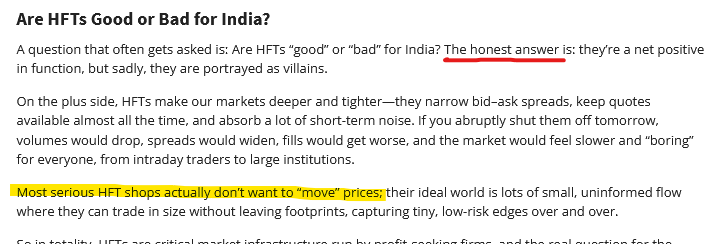
Are most HFT shops able to achieve the “ideal world” ?
Or do they end-up moving prices at a cost to other market participants (even if inadvertently?)
Alternately is a small minority of HFT shops (but with massive volumes) acting detrimentally to other market participants?
Essentially the problems with the summary of the In The Money post -
Summary Paragraph 1.
“honest answer” → “honest opinion”
Summary Paragraph 2.
Strawman fallacy and a false dichotomy.
Allowing HFT and disallowing HFT aren’t the only 2 possible options.
Ideally one would restrict/eliminate rent-seeking/profiteering HFT strategies.
Summary paragraph 3.
Claims the number of shops pursuing non-profiteering strategies is high
whereas the volume of HFT trades engaged in such strategies would be of relevance.
Focuses on intent and doesn’t consider inadvertent negative-impacts as “side-effect”.
especially critical when it is unclear if intent is being successfully achieved without “side-effects”.
For example,
the increase in “middlemen” entities will itself lead to shrinking margins even if spreads increase. (as long as amount of spread-increase is outpaced by increase in number of “middlemen”)
Regarding the observations that spreads have also shrunk,
even in such a scenario,
here are a couple of questions that lead to potential ways i could quickly think of
how middlemen can profiteer without contributing to a more efficient market
for the other entities involved -
Q1. How much of the reduced spread is benefiting the non-middlemen entities?
How much of the traded volume is…
a. …between 2 “middlemen”
b. …between a “middleman” and a “producer”
c. …between a “middlemen” and a “consumer”
Q2. Are there price swings between trades of scenarios b and c, especially ones that are in favor of the “middlemen” ?
I wonder if there are any such statistical analyses of market data by exchanges or regulator that can help confirm/disprove this line of thought? Or some such possible using publicly available data?
@Meher_Smaran can you please check if anyone in the team is already aware of, or is interested to pursue this further, and share?
Sidebar: A slightly more elaborate list of additional potential scenarios to consider...
Here is the updated list, classified by whether the middleman’s role is primarily
Contributing (adding systemic efficiency/utility)
or
Profiteering (extracting rent without adding proportional value).
NOTE: Collected using an LLM + Web-search, and manually reviewed/categorized.
Temporal Arbitrage (Contango Plays):Contributing Moves supply from times of excess to times of scarcity, smoothing consumption.
Spatial Arbitrage:Contributing Resolves geographic shortages by physically moving goods to where they are needed most.
Blending/Transformation:Contributing Creates tangible utility by converting unusable raw materials into market-ready specifications.
Information Synthesis:Contributing & Profiteering Accelerates price discovery, though profits are often derived solely from asymmetry and hoarding proprietary data.
Latency Arbitrage & Microstructure Gaming:Profiteering Extracts value via speed (HFT), quote stuffing (clogging exchanges), and rebate harvesting (gaming fee structures) without taking genuine risk.
Predictive Analytics:Contributing Signals future risks to the market early, smoothing out potential price shocks.
Basis Trading & Squeezes:Contributing & Profiteering Tethers futures to spot prices, but can cross into cornering/squeezing—hoarding physical supply to force counterparties into “ransom” settlements.
Liquidity Provision:Contributing & Profiteering Enables trade in illiquid markets, but often utilizes negative selection (filling orders only when the client is wrong) or monopoly pricing.
Financing Premiums:Contributing & Profiteering Provides capital to distressed producers, often extracting value via predatory valuation or distress discounts.
Operational Flexibility:Contributing Increases systemic efficiency by reducing physical waste and logistic delays.
Internalization & Principal Conflict:Profiteering Matches orders internally to capture spreads while keeping markets opaque and potentially front-running client flows (putting house trades before clients).
Structural & Regulatory Arbitrage:Profiteering Exploits legal loopholes, manipulates benchmarks (“banging the close”), or wraps complexity around products to hide excessive fees, adding zero economic efficiency.
PS: As always, anyone reading this, please do poke holes in any of the above, or share any counter-points / logical flaws.
The posts that you are referring to are not part of the The Daily Brief newsletters, rather they are part of a totally different initiative by Zerodha called In The Money, with traders being its primary audience.
And the post under In The Money are opinions/views of Mr. Sandeep Rao, a SEBI registered Reasearch Analyst. So if they appear to be flawed/biased in your opinion, it is probably because they are just views of this person and doesn’t necessarily have to be backed by facts.
Yes its opinion, even the experience quoted is not some hard fact but it tallies with what i see in data in my own systems. Things are not getting easier and we dont have easy large edges.
We also do not have any data against that. Its also an assumption / opinion that ‘middle men’ are taking more and more profits. That to me will be a broken system too, but i dont see it. Margins are getting lower on average over a long period.
From my own experience, based on assumption that its HFT that fills up the orderbooks in most areas ie market making, I am happy with what they provide and i do pay a decent cost for that. Without some sort of depth in orderbook, i wouldnt be able to trade reliably in a not very liquid market.
From my limited experience, if we assume larger stocks have more middle men, my slippages have always been lower on average in larger stocks. Beyond that we can keep speculating i guess.
At a single point of time, more market makers should mean tighter spreads. They need to make profits but they also need to be able to provide liquidity to make those profits.
If a HFT tries to push price to a wrong price, in theory a competing HFT could take advantage of that. If we have a good ecosystem, hopefully this is how it works. They could collude perhaps, dunno …
imo, if there are situations like these, then SEBI has to fix the issue. Intuitively, to me this will only happen when things are manipulated in some way ( so the Jane street thing is probably an example). Not in the natural order of things as everyone is competing against one another, both traders and active investors.
What exactly is a producer here ? What is a middle man ?
Is an investor booking profit not a middle man ? Why ?
Do you mean to restrict to IPOs only ?
How do you think mutual funds will accumulate large positions without enough people taking opposite positions, when most people are only buying ? What happens to the price if most people are only buying ? Is that a fair price ? Is it fairer to existing holders vs new buyers ?
To me this is a ridiculous question, and one where you too do not have any initial data to atleast justify the question.
You can try to look for markets with least trading, but i dont know how to find one.
USDINR had some large disruption, perhaps look at that.
You can only look at the gilt markets to see an extreme example of not having order book depth.
To me, only illiquid markets have a potential for incorrect prices causing harm, whether in an illegal pump or dump or a legal market making in something like gilt - you give liquidity to someone in need of an exit.
Again, as i said before the middle men are in competition. That is the point. If you make a mistake, i can profit off it. So if a price swing is incorrect you will have opposing positions putting it back into place. Ofc, nobody knows what the exact price is, but we assume that collectively it makes things efficient enough.
A simple example of how trading/ middle men might provide value to others. It is well known that we have a short intraday bias overall in equity. So traders have an incentive to short. Its not very large, so we cant just short anywhere and it might even be absent in some years, but it is there. Now this incentive to short intraday, can give liquidity to people buying through the day. This is just a small example, now i imagine we have many of these often in opposition to one another and that keeps things in check and in cycles.
Also, i have heard in multiple places, that before HFT, we had the pit guys and spreads were worse.
Maybe search if HFT profit pool is shrinking, per unit of volume in the market.
Good catch about the above not being Daily Brief. I missed it.
Thanks @SG_13 for highlighting.
FWIW, my opinion on the Daily Brief series in the previous post above,
was based on a Daily Brief post on semiconductors. (i did not repond to that Daily Brief post. and am deliberately avoiding going into the details here,
to avoid a potential conflict of interest, on public social media.)