Hello and welcome to this special edition on the eve of Muhurat Trading for the year 2025, or as it’s known in our traditional Hindu calendar — Samvat 2082 (Do hazar bayasi). I’m Sandeep Rao.
I know it’s a busy time — full of festivities, celebrations, travel, and family gatherings. But if you’re anything like me — someone who lives and breathes the markets — then no matter how packed your schedule is, you’ll still find time to participate in that hour-long Muhurat Trading window.

Today, we’ll share a few interesting Muhurat day statistics that should help you, irrespective of whether you are an investor or a trader. But it isn’t just about numbers or trades — it’s also about tradition and making a fresh start.
With that, let’s get started.
 What is Muhurat Trading?
As I always do, first things first, What exactly is Muhurat trading?
Muhurat simply means an auspicious time. It’s that one special hour on Diwali when markets open for a symbolic trading session to mark the beginning of the new financial year — or Samvat as it’s called.
The Tradition Behind the Trade
Traditionally, people from the Gujarati, Marwari, and Jain communities do what is called Chopda Poojan — which is essentially worshiping the ledgers or books of accounts.
Since earlier times, a majority of the traders and investors on the BSE were from these communities, and this practice extended to stock markets as well. It became a ritual of sorts to symbolically trade or invest on this day.
Historical Evolution
1957 : It was formally introduced at the BSE. Back then, traders would gather on the floor, perform Lakshmi Puja, and place their first trades of the year — not just for profit, but as a ritual of good fortune.
1992 : Trading became electronic, and NSE introduced a proper one-hour Muhurat trading window.
Today : It’s evolved into a beautiful blend of culture and commerce — a moment where families, investors, and traders come together to make that first, hopeful trade with the blessings of Goddess Lakshmi.
 This Year’s Muhurat Session Details
This year’s Muhurat session is scheduled for 1:45 PM to 2:45 PM on Tuesday, October 21st, with a 15-minute pre-open session from 1:30 PM to 1:45 PM.
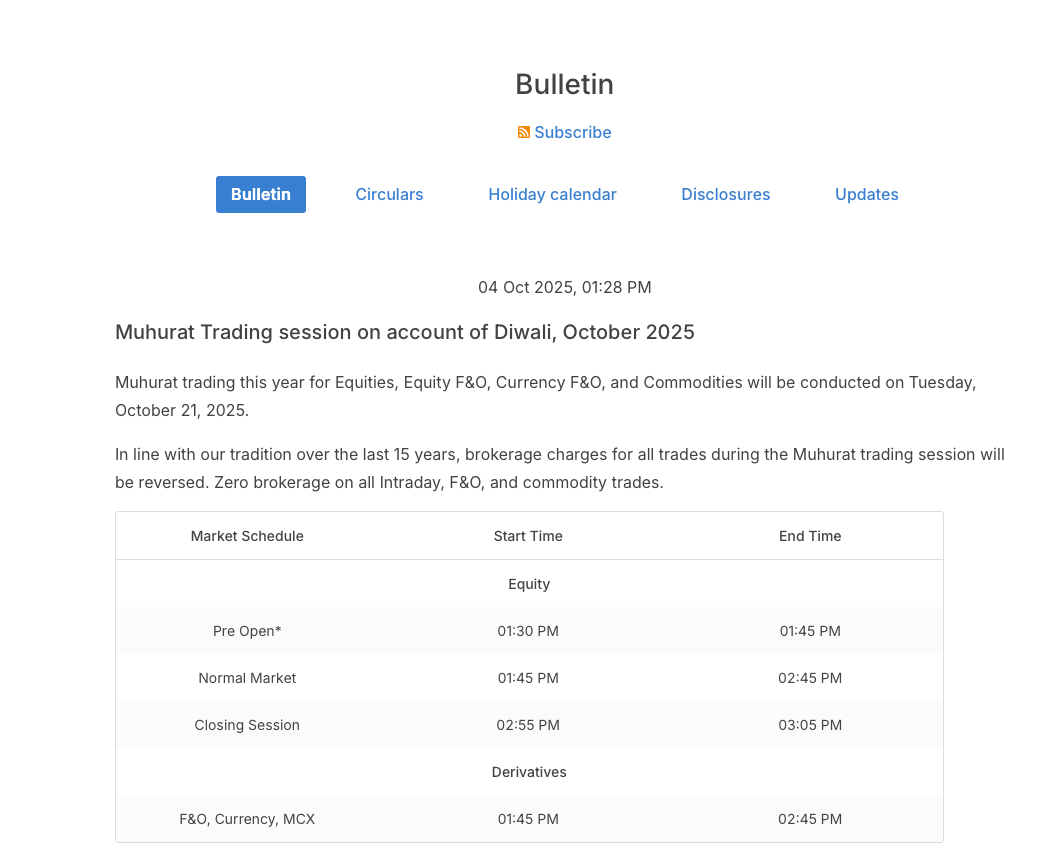
Now, let me get into the specifics for this year’s Muhurat Trading window.
Date & Time:
- Muhurat Session : 1:45 PM to 2:45 PM on Tuesday, October 21st
- Pre-open Session : 1:30 PM to 1:45 PM (15 minutes)
Trading Coverage: Trading will be open across all three major exchanges — NSE, BSE, and MCX — covering both the Cash and F&O segments.
Source: Zerodha Bulletin
 Important Disclaimer
This is not a recommendation to invest, trade, or consider any of the mentioned products for future investments. For the purpose of the backtest, I have taken the closing price as entry and exit, unless mentioned otherwise. The returns shown exclude all charges and brokerage.
And as always, we’ll start with a hypothesis.
 FOR INVESTORS: The Diwali SIP Strategy
The Hypothesis
So here’s the question — what if you had invested ₹1 lakh every year on Muhurat Trading Day for the past ten years? Essentially, a once-a-year SIP made only on Diwali.
To test this, I looked at two investing products and a third, a combination of both:
- NiftyBees ETF
- GoldBees ETF
- A 50:50 portfolio split between NiftyBees and GoldBees
Strategy 1: Investing ₹1 Lakh in NiftyBees Every Muhurat Day
Let’s start with the first one — investing ₹1 lakh in NiftyBees every Muhurat Day for the past decade.
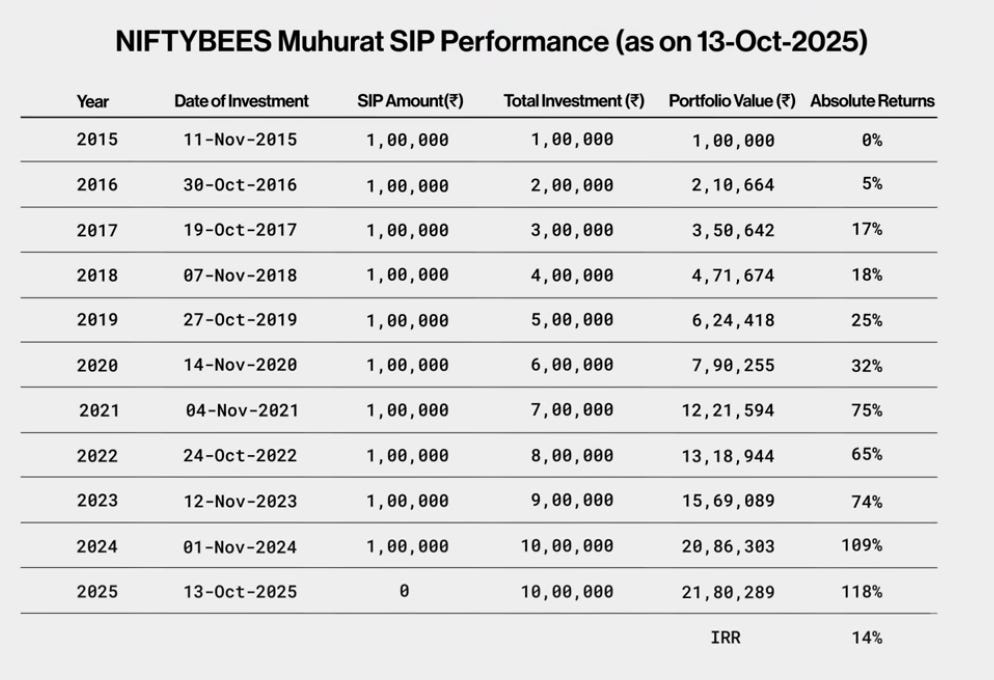
How the table works:
- Lists the year of investment
- Date of Investment (Muhurat Day)
- The SIP amount
- Total cumulative investment so far
- Portfolio value (including all returns)
- Absolute return (%)
- IRR (Internal Rate of Return) — which gives a more realistic picture of your average annualized return
Results:
10-year IRR: ~14%
Now, focus on the 10-year IRR — it’s around 14% for NiftyBees. That’s roughly in line with what you’d have earned if you’d done a regular SIP at any other fixed date during the year.
So while investing on Muhurat Day carries strong symbolic and emotional value, statistically speaking — it performs about the same as investing systematically on any other day .
Strategy 2: Investing ₹1 Lakh in GoldBees Every Muhurat Day
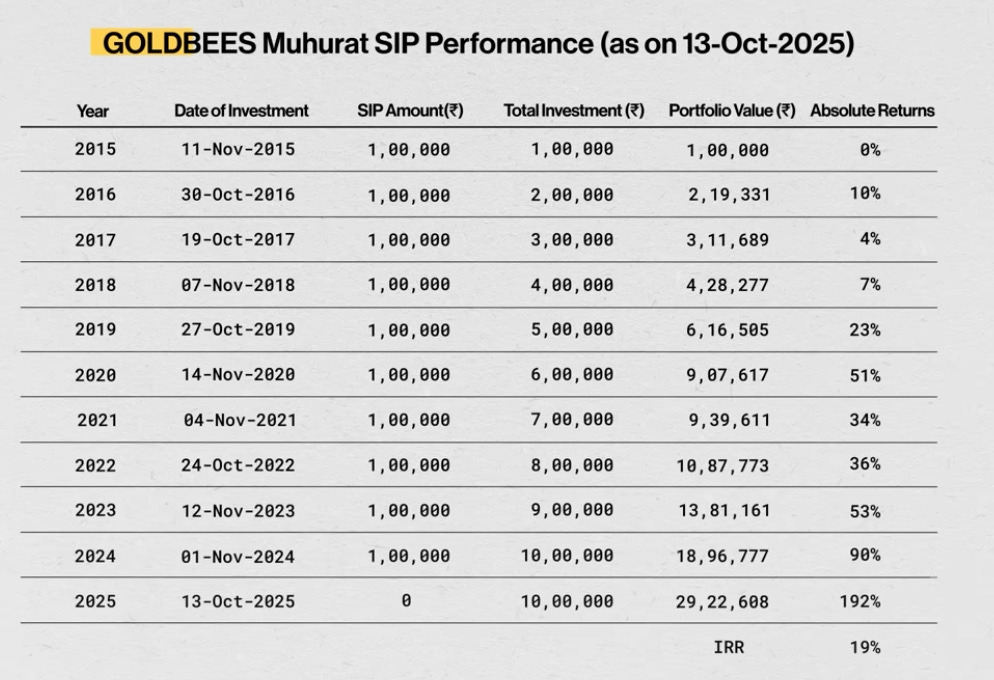
Now, let’s turn to Gold — specifically the GoldBees ETF.
Results:
10-year IRR: ~19%
Over the past decade, the 10-year IRR for Gold stands at around 19%, noticeably higher than Nifty’s 14%.
Of course, part of that strength comes from recency bias — gold has had an exceptional run in the last few years, and there’s no guarantee the next decade will look the same.
Important Observation:
To get an idea, look at the GoldBees SIP portfolio value as on 2024 Muhurat Day, which is ₹18.96L , and NiftyBees, which is ₹20.86L .
That tells us that a large part of Gold’s outperformance has come in only recently — i.e., this year.
Strategy 3: The Balanced 50:50 Portfolio
Next, let’s see what happens when we combine the two — investing ₹50,000 each in NiftyBees and GoldBees every Diwali.
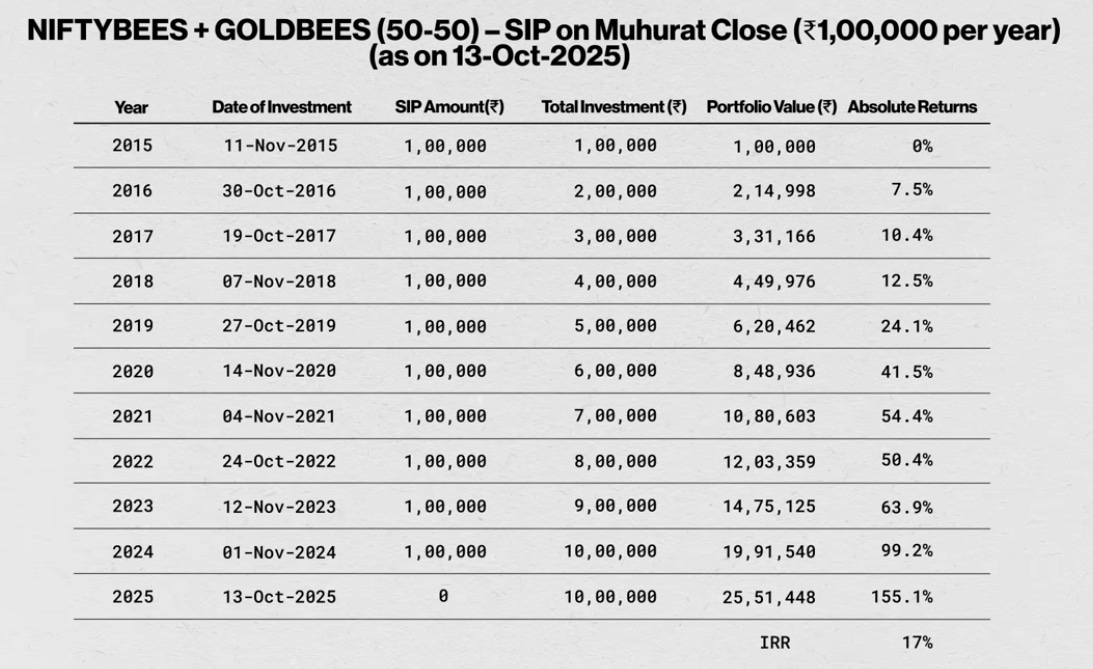
And just to clarify, this is a non-rebalanced portfolio — we simply invest and let it compound.
Results:
The result? The combination looks nice. While I haven’t calculated the volatility, it’s intuitive that a blend of equity and gold would be far more stable than investing solely in NiftyBees.
Once again — as I mentioned earlier — there’s no statistical timing advantage to investing on Diwali day versus any other day . But symbolically? It’s a wonderful tradition — one that combines faith with financial discipline. Makes complete sense to me.
Visual Comparison of All Three Portfolios
I’ve also plotted the returns of all three versions of the Muhurat SIP Portfolios for you to have a look.
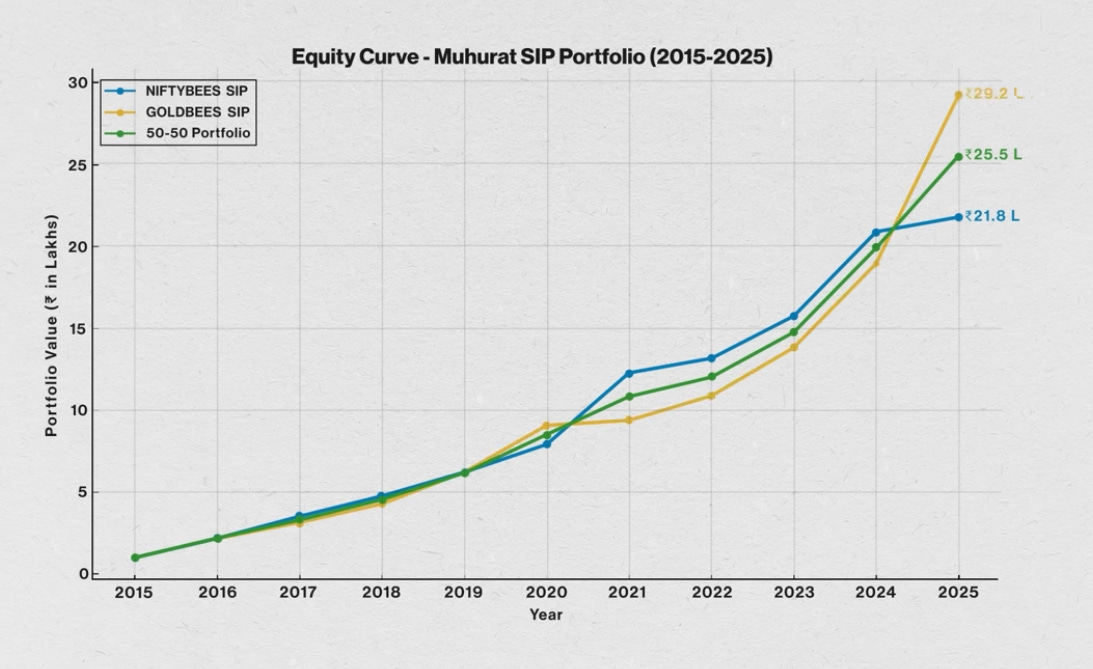
You can see that only NIFTY was leading until last year, while NIFTY + GOLD was almost similar, and the recent outperformance in gold has made the GOLD & NIFTY + GOLD portfolios take the lead this year.
The Verdict for Investors
So, for those planning to invest in index or gold this Diwali, do it for the sentiment and symbolism — and the best part is, by investing on Diwali, you’re not compromising on returns for sure.
So that was for the investors among us.
 FOR SWING TRADERS: The 5-Day Diwali Trade
Now, let’s shift gears and look at something for the short-term traders — those exploring a Diwali swing trade on the Nifty.
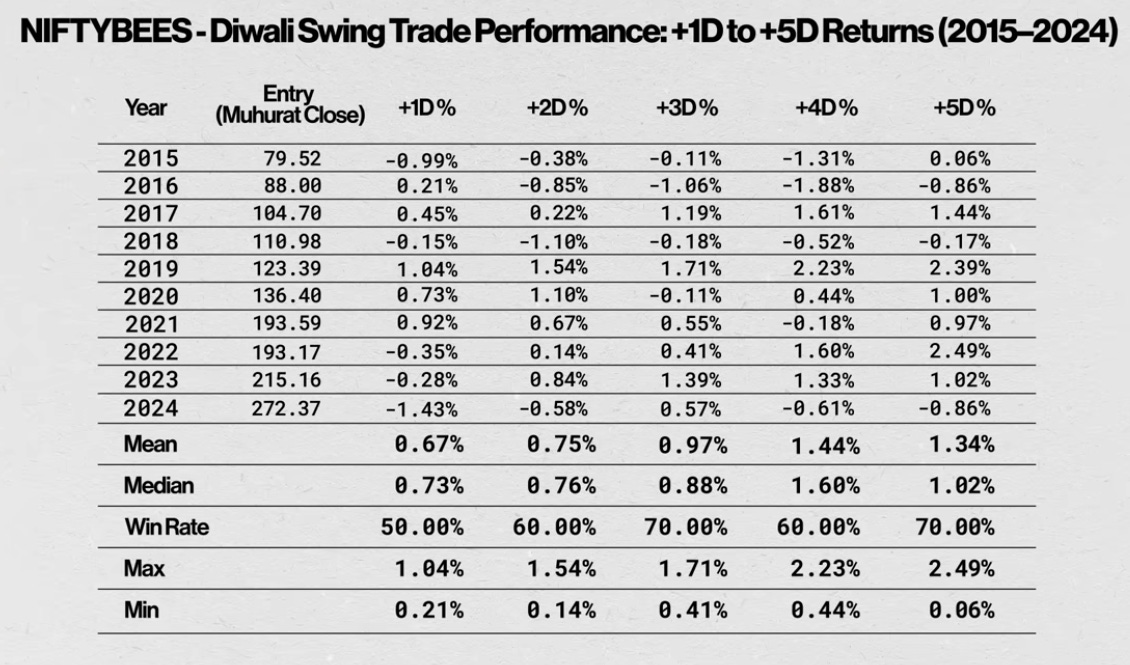
The Setup
Entry : Muhurat-day close
Exit : Anytime between Day +1 and Day +5
NiftyBees Swing Trade Performance (2015-2024)
Title : NIFTYBEES - Diwali Swing Trade Performance: +1D to +5D Returns (2015–2024)
What you see is based on NIFTYBEES data. Notice the pattern — there’s a general positive drift in the index.
Why the positive drift?
That’s because, historically, Nifty tends to trend upward over time, so almost any random five-day period will show a mild upside bias.
Performance Analysis:
Still, look at the win rates — they hover between 50% and 70% . To me, that doesn’t exactly inspire confidence for a high-probability short-term setup.
(Note to editor: Redo the table in new color scheme and add a note below the table: NIFTYBEES prices have been adjusted for splits)
GoldBees Swing Trade Performance (2015-2024)
Now let’s apply the same logic to GOLDBEES.
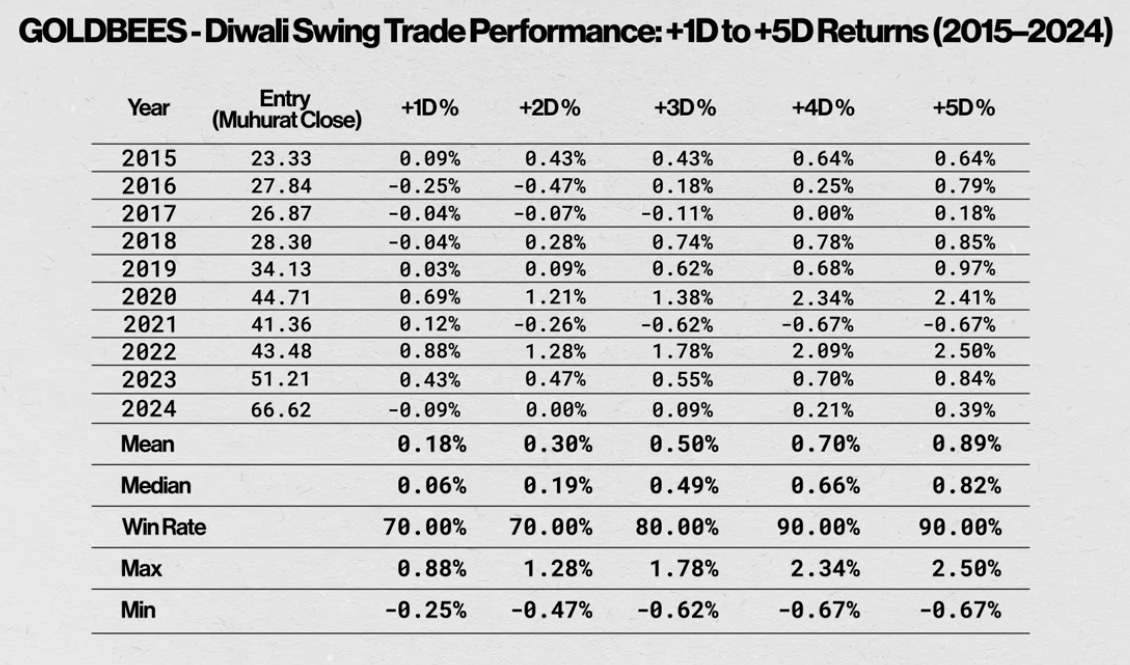
Performance Analysis:
While the returns are relatively muted, the win rates are actually higher, especially as we move to Day 4 and Day 5.
It’s again not particularly exciting, but it’s interesting for sure — gold does show a steadier short-term return profile around Diwali compared to equities.
So far, we’ve covered ideas for the investors and the swing traders among us.
 FOR TRADERS: BTST Setups (The Misfits & Mavericks)
Now, let’s turn to something more exciting — this one is for the traders, the misfits, and the mavericks in the room.
Let’s start with some BTST trade setups.
And yes — disclaimer time again — this is not a trading recommendation. I’m simply sharing historical trade statistics. Please do your own due diligence and back-tests before acting on any of this.
The Classic BTST Play on Nifty
The Hypothesis:
Buy one day before Muhurat, at the previous day’s close, and sell at the Muhurat day open — classic BTST, just timed around Diwali.
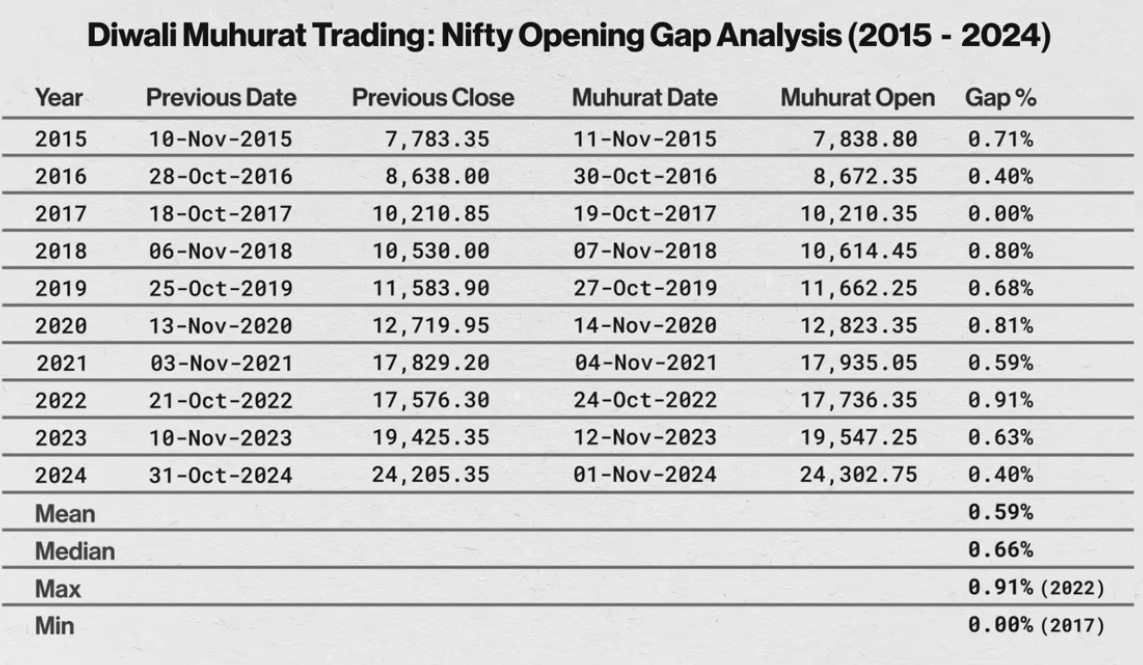
What the Table Shows:
- The year
- The Muhurat-1 date
- The closing price on that date
- The Muhurat date
- Its opening price
- The Gap : When we do Open – Previous day Close, we get the gap
- Gap % : That gap expressed as a percentage of the open
Important Caveats:
Another fair warning though — this is a small sample, just 10 data points , so treat it as an interesting anomaly, not a rule.
The data here is based on Nifty Spot , so keep in mind all the usual open-close challenges — as I explained in the Overnight vs Intraday episode, exact prices aren’t always perfectly tradable.
The Results (2015-2024)
That said… do you see what I see on the table?
We’re looking at a 100% win rate with a median return of around 0.66% — that’s quite impressive for a one-day overnight setup, I would say.
Ways to Execute This Trade
There are several ways to take this trade:
- Futures
- Options
- MTF (Margin Trading Facility), if you prefer
I’ve covered the futures and options approach in detail in the Overnight vs Intraday video — check that out if you haven’t.
And for MTF users, I’ve linked the MTF Calculator — please go through it carefully and account for all costs before using it.
BTST on GoldBees
Let’s now turn to GOLDBEES — would a BTST work here too?
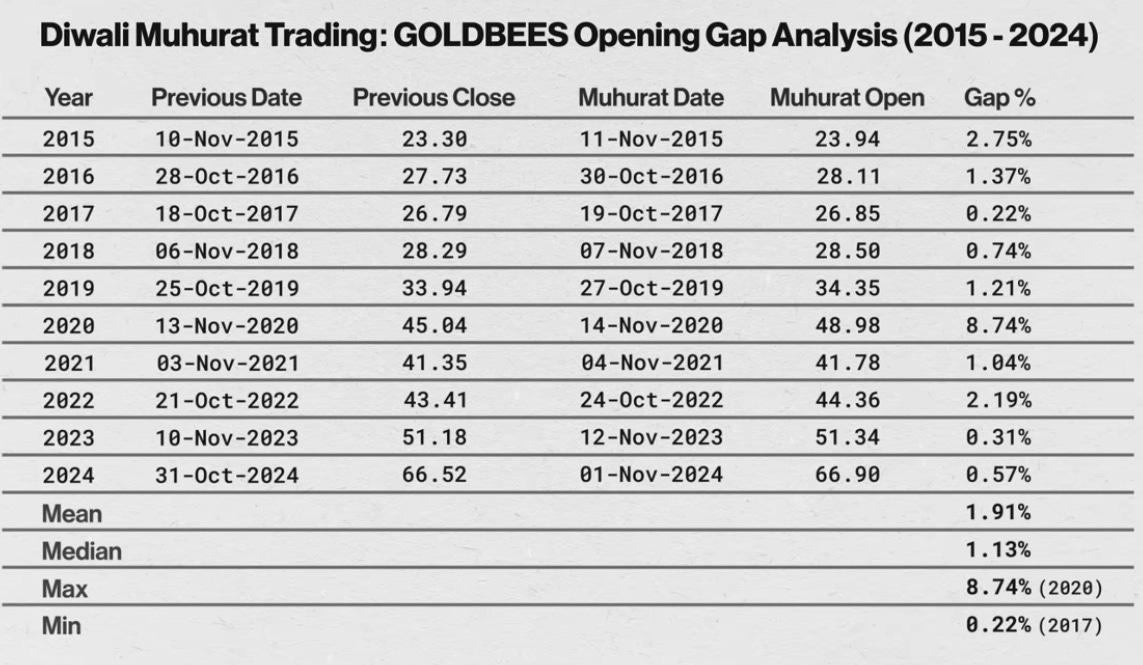
Before we dive in , a quick note on why I chose GOLDBEES:
That’s because its closing time aligns with Nifty’s regular market hours, making the comparison clean and consistent.
The Results
Now, here’s what’s interesting — GOLDBEES also shows a 100% win rate , with a median return of around 1.13% .
The gaps here are noticeably larger than Nifty’s — definitely something worth exploring further.
Diversification Strategy
And if you’re planning a BTST trade, diversifying across both Nifty and Gold could be a sensible play . You can take this either through:
- Gold futures on MCX
- Via MTF (Margin Trading Facility) on GoldBees
Just remember — returns will vary depending on your approach. Futures and options behave differently from the cash market, so factor that into your risk and cost calculations before taking any trade.
 INTRADAY: The One-Hour Muhurat Window
So, for the overnight traders, we explored a BTST setup — but I know what some of you are thinking:
“Sandeep Uncle, tell me… what actually happens intraday during that one-hour Muhurat Trading window? Is there anything worth trading there?”
Hold on to your horses — I am getting there.
Nifty Spot Intraday Analysis
Let’s start with Nifty Spot . I pulled data from the past 10 Muhurat sessions, looking at the OHLC prices for that one-hour window.
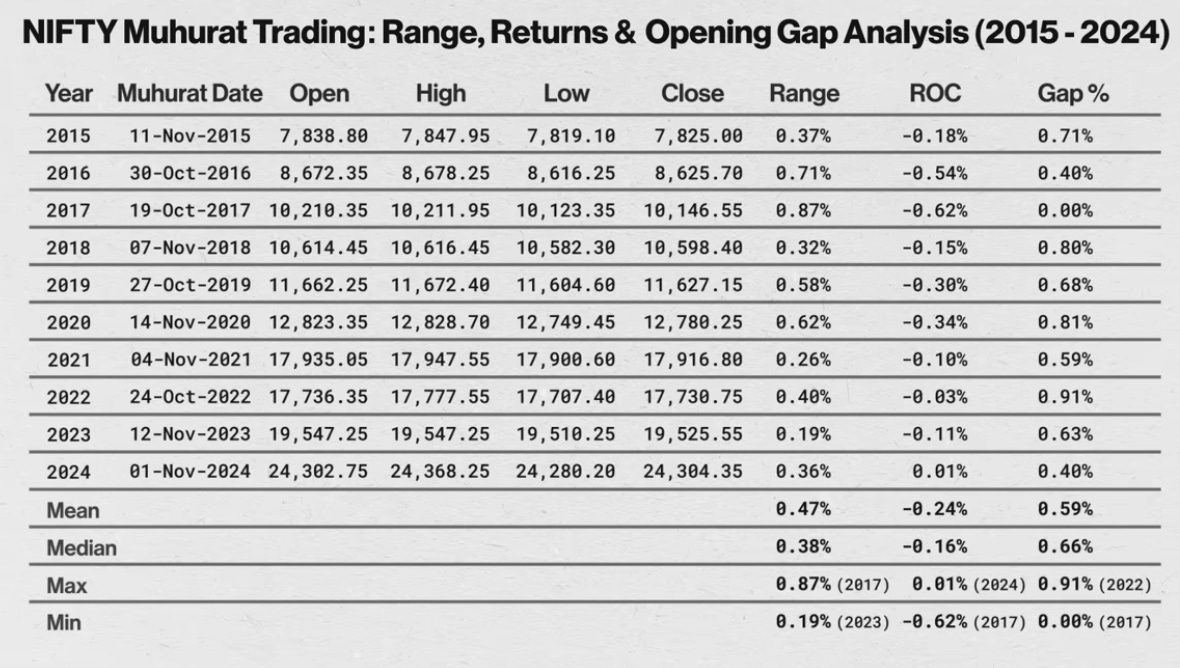
Understanding the Data:
The Range Column : It shows how much the index moved as a percentage of the open. That’s especially useful for those of you who trade short vol setups like straddles or strangles.
The ROC (Rate of Change) : Then comes the ROC — Rate of Change — and this tells a very different story.
The Surprising Anomaly
Surprisingly, in 9 out of 10 years, the index actually closed negative .
Counterintuitive, right? If everyone’s buying stocks on Diwali, shouldn’t the index go up?
Well, markets have their own logic — and this is one of those fascinating anomalies.
The Gaps Column : And finally, the last column shows the gaps, which ties back to what we discussed earlier in the BTST segment.
Gold Intraday Analysis
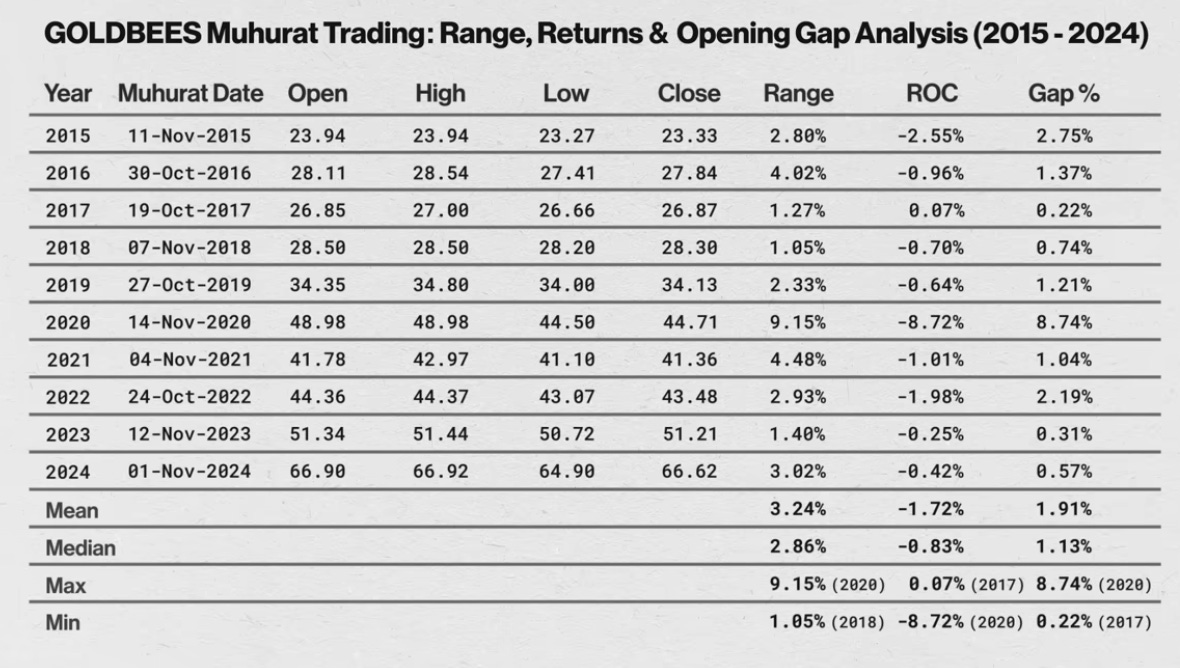
A similar story plays out in Gold — only this time, it’s far more volatile intraday. And just like Nifty, Gold too has a tendency to close negative more often than not during the Muhurat session.
Key Takeaway:
This data isn’t a trading signal, but it should help you build your own intraday setup for Muhurat trading.
 Special Offer from Zerodha
And yes, in line with Zerodha’s tradition over the last 15 years , brokerage charges for all trades during the Muhurat trading session will be reversed.
Zero brokerage on all Intraday, F&O, and commodity trades.
A Friendly Reminder
But — a friendly reminder — just because there is no brokerage doesn’t mean you go overboard with trading on Diwali .
Why?
The liquidity is quite low compared to other days because most major institutions don’t trade on Muhurat day — it’s primarily retail traders who do.
Important Guidelines:
If a trade goes wrong, you don’t want that to spoil your festive mood. So:
- Keep your position size small
- Keep your mindset light
- Most importantly — have fun
Because, after all, it’s Diwali — not an expiry day .
Final Thoughts
I hope you liked the investing and trading ideas I shared today. As always, please remember to do your own research and back-testing before deploying your capital .
With that, we come to the end of this special edition on Muhurat Trading 2025. I had fun walking you all through the data, the stories, and the traditions that make this Muhurat session so unique.
I wish you and your family a safe, prosperous, and joy-filled Diwali — and a very successful Samvat (Do hazar bayasi).
May your portfolios shine as bright as the diyas this festive season.
Happy Diwali, and happy trading!
You can check out our Newsletter here

