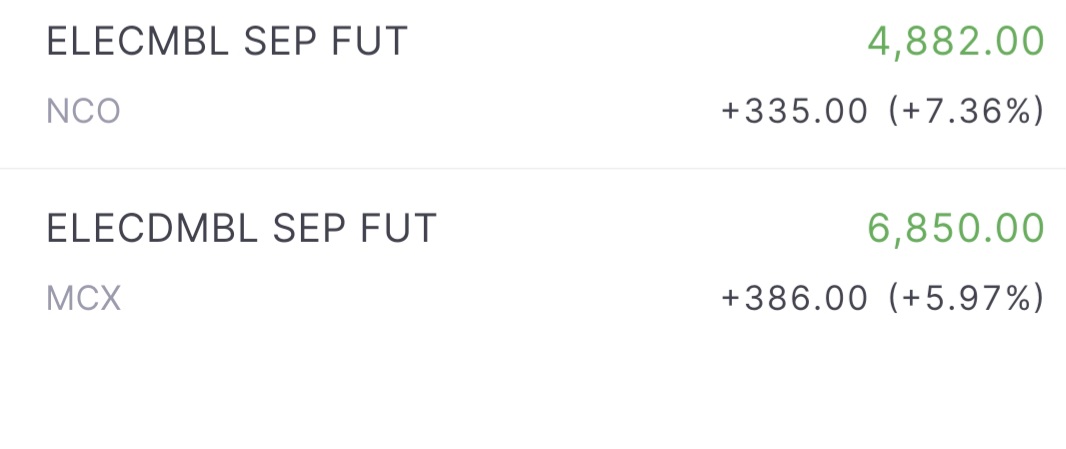
There is huge difference in prices Electricity futures on NSE and MCX. Expiry month is same. Can anyone tell why so. I am sharing prices of both exchanges.
Also how the price changes by which factors. It is up by 15% in 3 days.
There is huge difference in prices Electricity futures on NSE and MCX. Expiry month is same. Can anyone tell why so. I am sharing prices of both exchanges.
Also how the price changes by which factors. It is up by 15% in 3 days.
Both are electricity futures for the same month, but they use different methods to calculate the final settlement price. MCX mainly tracks the IEX-based electricity benchmark, while NSE uses a broader calculation involving IEX, PXIL and HPX. So even though both say “September Electricity,” they are not exactly the same contract, which is why prices can be very different. Basically, same month, same electricity, but different price-calculation formula.
Electricity futures can move very fast because electricity can’t simply be stored like gold. Hot weather, more AC demand, less wind/solar, less supply, power-plant shutdown, less supply, expensive coal/gas, leads to expensive power. So the expected monthly price can jump 10–15% quickly.
Hi,
NSE’s official specification explicitly says its final settlement is based on the average DAM-UMCP of PXIL over all calendar days of September. Read here
MCX, on the other hand, uses the IEX DAM as its reference.
Read more here
IEX and PXIL can have very different price discovery.
IEX is by far the dominant Indian power exchange, while PXIL is much smaller. Consequently, the actual clearing prices and liquidity can differ substantially.
And remember what you’re trading:
electricity cannot be transported freely from one exchange to another.
You cannot do:
Buy cheap September electricity on NSE → sell expensive September electricity on MCX → deliver the same electricity.
There is no physical delivery mechanism linking the two futures.
The two futures therefore don’t have a normal commodity arbitrage mechanism. Hence the price difference.
The rise in electricity prices can be attributed to multiple reasons:
1- India’s electricity consumption in August reached 169 BU, up 12.85% YoY.
IEX said the increase in demand pushed DAM buy bids up 61.7%, while August DAM prices rose 22% YoY to ₹4.88/unit. And we’re now seeing unusually high September temperatures in some regions.
2- Weak/erratic monsoon
This is actually quite important.
Less rainfall means less hydro generation.
At the same time:
Less rain + higher temperatures means more AC/cooling demand.
That’s a nasty combination for power prices.
3- Higher prices can also be attributed to floods in Nepal.
Nepal is a major hydropower country and many states in India but it from Nepal.
There are not the only reasons, but some of the major ones.