Feedback on The Daily Brief - Excellent content, but needs trimming

First off, I want to say a massive thank you for the effort you guys put into The Daily Brief. The depth of research is fantastic and as a reader I genuinely love getting this information to help navigate the markets.

However I wanted to share a pain point from the perspective of a daily consumer and that is the articles are currently too long for a daily format and the repetitive text creates unnecessary friction.

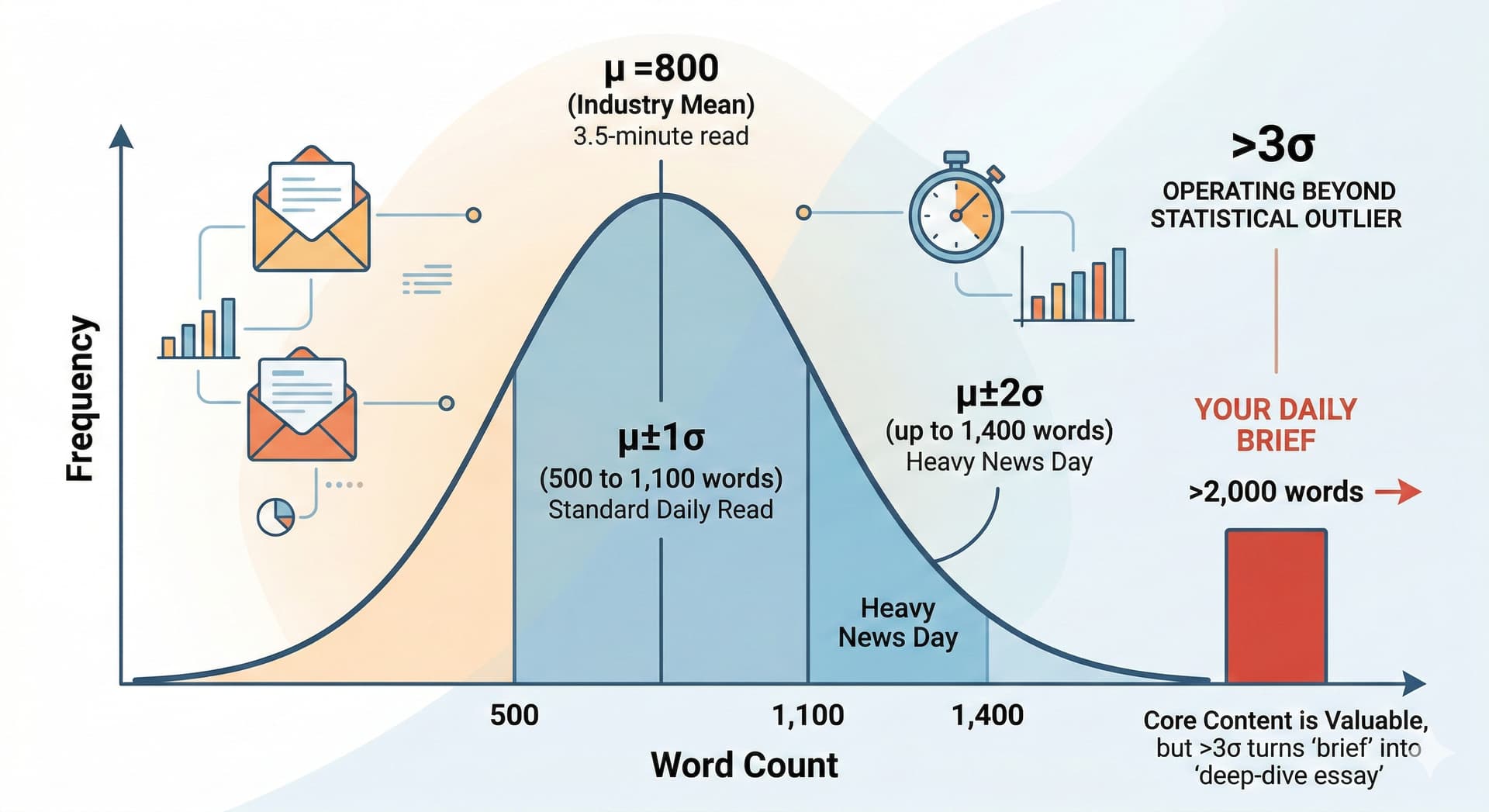
To put the length into statistical terms,

If we look at the normal distribution of an optimal daily newsletter’s word count, say x be the number of words. The comfortable industry mean (ÎŒ) is usually around 800 words (i.e. about a 3.5-minute read), with a standard deviation (σ) of about 300 words.

So a standard daily read falls within one standard deviation of the mean Ό±1σ (500 to 1,100 words). A heavy news day might push to Ό±2σ (up to 1,400 words). Right now, your Daily Brief is consistently operating beyond 3σ (often 2,000+ words). It is a statistical outlier. While the core content is highly valuable, a >3σ word count turns a “brief” into a deep-dive essay, making it difficult to commit to reading every single morning.
Secondly, the static intro and outro boilerplate on every post is quite annoying. Every day readers have to scroll past the same text explaining the goal of the brief and the reminders about the podcast, youtube, and Hindi formats. Then at the very end there is another repetitive block of text pitching the whatsapp channel.

When you open the article daily, filtering through the exact same intro and outro to find the actual signal is frustrating. If readers value the content (like I do), they will naturally seek out your other platforms. A simple sign-off like “Written by X and Y” at the bottom is honestly all you need.

Sooo
 trimming the word count and removing the daily boilerplate would itself make this the perfect daily read. Below I also suggest a few more actionable ideas:

  • Trim the article to a target of 800 words (max 800 + 300 words). Don’t believe me, believe stats.

  • Remove all static intro and outro boilerplate, sharing prompts, and socials. Just use one line at the end: By XYZ, Zerodha. Subscribe: link. Thats it.

  • Ask AI to give you a “financial newspaper opinion article headline (Mint / FT style, 10–15 words, aligned with the article type) and a subtitle (12–20 words, sharp and consistent with the stance). Something like that.”

  • Include 2 to 3 AI images in between the article sections to break up the text.

Your email delivery should look like this: In our inbox, we should see just the ‘Title’ in the subject line (no “The Daily Brief” or dates) - trust me traders/investors will definitely click it early morning if it is something related to the market. Inside the email start with a title/subtitle or TL;DR if you want to, then the article and at the end just the one line sign off and subscribe link.

Implement this and you will see your readership grow more than ever. Most importantly your readers will enjoy it more.

data scientist,

yours,
livepositionaltrader

2 Likes

Sample: India's metro ridership problem

The Metro Mirage and India’s Credit Pivot

Why billion-dollar transit systems sit empty, and how NBFCs are hiding weak loan growth behind gold.

TL;DR: India is rapidly building metros, but flawed demand models and poor last-mile connectivity leave them running at just 25-30% of projected capacity. In the financial sector, headline NBFC growth looks healthy at 18% , but core segments like home and vehicle loans are stalling , forcing lenders to take on riskier assets or rely heavily on the surging price of gold.


The Empty Trains: India’s Metro Ridership Problem

Building a metro is an engineering gauntlet. Underground construction costs anywhere from â‚č400 to â‚č600 crore per kilometer, double or triple the cost of elevated lines. The primary bottleneck is the lack of accurate 3D underground maps in Indian cities. Engineers constantly encounter uncharted water mains and high-tension cables, requiring months of “utility shifting” and coordination with municipal authorities before tunnel boring machines can advance.

Yet, the bigger failure happens after the stations open. A recent study found most Indian metros run at just 25-30% of their original projections. Delhi performs best at 47%, while Mumbai’s expensive new Aqua Line averages fewer than 20,000 daily passengers against a projection of 4 lakh.

This massive deficit stems from a fundamental conflict of interest: city governments and external consultants are heavily incentivized to produce optimistic demand models to secure project approvals and funding. Furthermore, these models entirely fail to account for the friction of last-mile connectivity. Commuters are generally willing to spend a maximum of 20 minutes on their first and last-mile transit combined. High auto-rickshaw fares, nonexistent feeder buses, and broken footpaths routinely push travel times past this threshold. Consequently, low-income users rely on cheaper informal transport, while high-income users prefer to drive.

The Great NBFC Performance Split

On paper, Non-Banking Financial Companies (NBFCs) show a healthy 18% year-on-year growth in assets under management. However, parsing the data by individual companies reveals a fractured sector where traditional growth engines are stalling.

Housing Finance Companies (HFCs) are losing their core market. Banks, armed with ultra-cheap current and savings account (CASA) deposits, are aggressively undercutting home loan rates. Unable to compete on price, prime HFC home loan growth has slowed to just 9%. To maintain margins, major players like Bajaj Housing Finance are pivoting to riskier segments like Loans Against Property (LAP), which grew at double the rate of standard home loans last quarter.

Vehicle finance presents a different illusion: loan volume is flat, yet margins are rising. Recent GST rationalizations lowered vehicle sticker prices. Consequently, even though unit sales increased, the average loan ticket size shrank, keeping total assets under management flat. Because vehicle loans operate on fixed interest rates, recent central bank rate cuts lowered the borrowing costs for NBFCs without reducing the yield on their existing loan books, temporarily inflating their spreads. As fresh, cheaper loans are issued, these margins will inevitably compress.

Meanwhile, the microfinance (MFI) sector is battling a behavioral crisis. Rather than an inability to pay due to external shocks, lenders are witnessing an unwillingness to pay. Years of over-leveraging and debt-rollover cycles broke when regulators tightened the rules, eroding the “social collateral” of group lending. While large banks are cutting their MFI exposure heavily, specialized microfinance institutions are slowly stabilizing and reclaiming market share.

To escape these systemic pressures, the entire sector is leaning heavily on gold loans. Muthoot’s core gold business soared 50% year-on-year, largely driven by surging gold prices mechanically inflating the loan value permissible per gram. While gold offers a zero-provisioning safety valve today, a sharp 15% correction in gold prices would trigger cascading margin calls, exposing the underlying weakness in organic credit demand across the economy.


Tidbits

  • IDFC First Bank repaid â‚č583 crore to Haryana government departments following a coordinated fraud discovery at its Chandigarh branch.

  • The government initiated Phase 2 of the National Monetisation Pipeline, targeting â‚č16.72 lakh crore by leasing operational public infrastructure to private operators.

  • Bharat Taxi launched as a zero-commission cooperative ride-hailing platform, allowing drivers to become shareholders for a â‚č500 fee.

By X and Y, Zerodha. Subscribe: [Link]

2 Likes

:100:

@livepositionaltrader can you also share the source(s) for the statistics quoted in the above post? Thanks.


The Daily Brief team,

  • Please continue to ensure that the relevant source/reference links are present inline.
  • Please ensure that nuances are NOT sacrificed to hit any editorial length targets.

Also, a major problem today is squeezing 2 topics into a single post.
This hides the 2nd topic.
Not sure how many folks even realize that there was something they were interested in.

Also, currently it is practically impossible to find relevant past posts half the time. :cry:

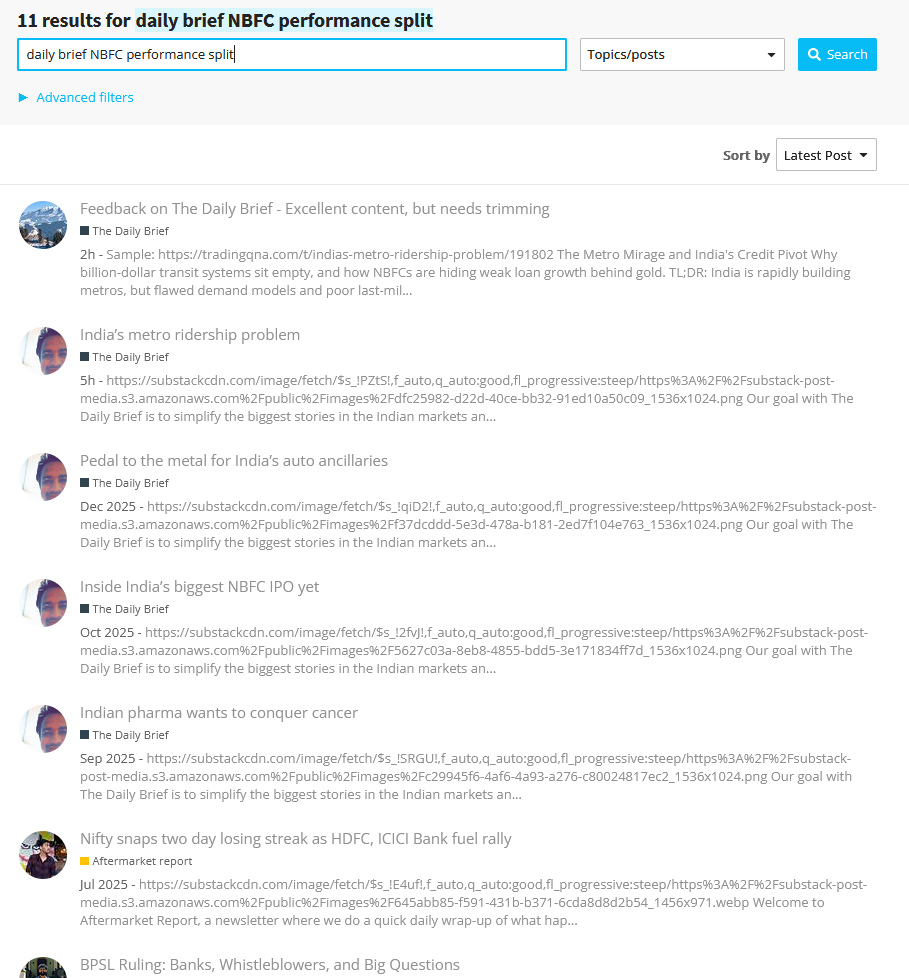
Can you guess which of the recent Daily Brief posts in the forum search results
were about - The great NBFC performance split ?

Hint: It’s the one about “Metro ridership problem”.

1 Like

I think the articles are long because they are supposed to be contain all info that they discovered while researching the topic for making the video. The video on youtube is supposed to be the “relevant” part for most people, and the article is there for people who want details.

1 Like

Data is from my office one of our departments works on content, so I am used to looking at these. the numbers like 800 are approx benchmarks not exact cut offs.

I hear you an that makes sense from a content structure perspective. we are simply offering feedback from the point of view of regular traders who read it daily. ultimately its their call how they want to structure it, but as cvs pointed out, theres a balance to be struck between completeness and readability. The feedback is only meant to improve not criticize.

1 Like