
Our goal with The Daily Brief is to simplify the biggest stories in the Indian markets and help you understand what they mean. We won’t just tell you what happened; we’ll tell you why and how too. We do this show in both formats: video and audio. This piece curates the stories that we talk about.
You can listen to the podcast on Spotify, Apple Podcasts, or wherever you get your podcasts and watch the videos on YouTube. You can also watch The Daily Brief in Hindi.
In today’s edition of The Daily Brief:
-
Fresh year, no fresh start for India’s largest IT firms
India’s largest IT companies are navigating an AI-driven shift in the services industry, where pricing pressure, changing client spending, and evolving hiring strategies are reshaping growth despite a steady pipeline of large deals. -
IndiGo’s profits drop in altitude
Despite strong revenue growth, IndiGo slipped into a loss as soaring fuel costs, a weaker rupee, and lease expenses outweighed higher fares, highlighting how vulnerable airline profitability remains to external shocks.
While The Daily Brief covers structural macro trends, Aftermarket is our quick, noise-free daily wrap-up tracking how Indian markets moved, top sector drivers, and key trading stories. Subscribe to Aftermarket to get our daily market recap delivered straight to your inbox every evening.
Fresh year, no fresh start for India’s largest IT firms
The past year for India’s largest IT companies has been full of subtle, nuanced changes in what they’ve said. For most of FY26, these companies bounced back from a weak showing. But even in their return to form, AI has left plenty of factors that IT firms previously used to take for granted in the lurch.
So, yes, we often say each successive quarter that very little changes for a business or an industry. But when you zoom out and look at all the small things that have been said throughout all the quarters, you get to see some interesting tensions in approaches across companies.
So, we start yet another fiscal year covering one of the most storied industries in India. We’ll be looking at TCS, Infosys and HCLTech this time. As always, midcap IT firms will get a separate story.
Right off the bat, the first quarter isn’t short of being happening.
For one, interestingly, after cutting jobs for a year, TCS has started hiring again. Then, Infosys lowered its own growth target, and its total headcount fell more than it first appears once you separate out the people it gained by buying smaller companies. HCLTech’s own business barely grew this quarter.
The numbers
Let’s begin with the headline numbers.
TCS’ Q1 revenue came in at $7.6 billion (~₹72,275 crore), a rise of 2.7% year-on-year. The operating margin came in at 24%, down 1.3 percentage points from last quarter, mainly on account of a company wide pay raise. Their AI services revenue has reached an annualized run rate of $2.6 billion (~₹24,600 crore).
Infosys’ Q1 revenue grew by 2.8% year-on-year in dollar terms, coming in at $5.08 billion (~₹48,211 crore). Their operating margin held steady at 21.1%, within the guidance of 20-22% that they’ve maintained all of last year. Their large deal value for the quarter came in at $3.6 billion, with 61% being net-new business. AI now makes up 8.2% of total revenue, up from 5.5% just two quarters ago.
HCLTech’s Q1 revenue came in at $3.65 billion (~₹34,579 crore), up 2.6% year-on-year. Their operating margin stood at 16.9%, or 17.5% after adjusting for one time restructuring costs. Their Advanced AI revenue reached $171 million, up 62.1% year-on-year.
AI-led deflation
Last quarter, we spent most of our coverage on understanding the deflationary effect of AI. The story is well-known: AI shifts pricing power away from manpower-based billing to outcomes. This time, we may have some concrete numbers.
AI is shrinking how much any single piece of work could be worth. Clients now want more definitive outcomes in less time. That also means that a company now has to close more deals, or bigger ones, just to book the same total revenue as before.
Last quarter, HCLTech CEO C Vijayakumar even put a number on this, saying his teams now need roughly 25-30% more effort to earn the same revenue they used to earn .
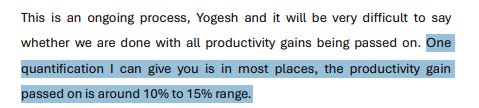
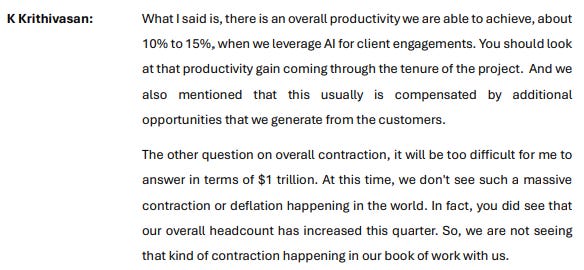
This quarter, TCS frames the same pressure in terms of pricing: how much of savings gets handed to the client once a deal is signed? CEO K Krithivasan put the number at a “10-15% range “. When TCS cuts prices this way, clients usually give it extra work in the same negotiation, a new project or a bigger scope.
Of course, the bigger implication is that AI could shrink the entire IT services business worldwide by tens of billions of dollars. An analyst asked K Krithivasan directly if TCS sees that scale of shrinkage coming. He said no , and pointed to TCS’s own headcount, which grew this quarter, as evidence, if a collapse that large were actually happening, a company like TCS would likely be cutting jobs, not adding them.
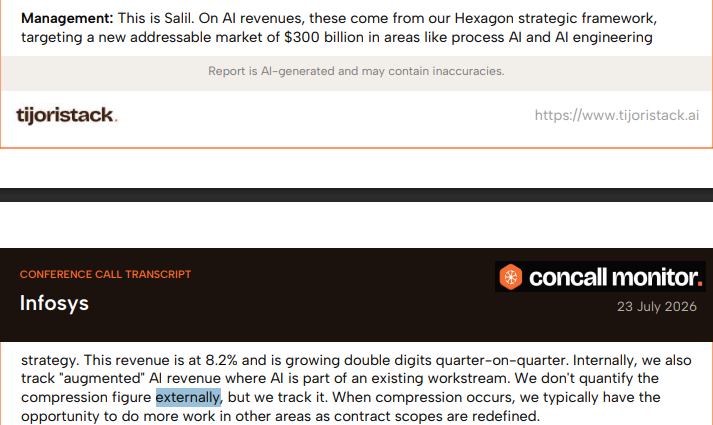
Infosys, meanwhile, stayed quiet on the number, although they did admit that they track the rate of “AI-led deflation” internally and won’t be sharing it with the public. They had the softest quarter of the three, admitting that demand was weaker than usual for this point in the year. That was partly because clients are pushing back harder on price, expecting productivity gains to be passed on to them.
AI seems to be speeding up delivery once a deal is signed, but what about whether it shortened the time it takes to win that deal in the first place? There is, to a degree, an expectation that if AI has made making demos easier, then clients would ask to close a deal faster. But they haven’t said much about that.
However, interestingly, decision cycles in certain deals have gotten longer. There is an AI component to it. Tech Mahindra and Wipro have both highlighted caution on the part of clients in terms of token costs: does AI really get us as much benefit, considering how expensive enterprise-wide Claude and chatGPT can be? Another fear that existed was that clients preferred to wait and watch to see for the next best model to release, avoiding a potential lock-in.
But there are non-AI reasons for this, too. It’s because clients in certain sectors have reduced discretionary spending in the face of geopolitical uncertainty and broader economic weakness. Infosys noted this in retail and manufacturing.

Source of demand
So, where’s demand coming from?
For one, Infosys did land some fresh wins — like a renewed Mercedes-Benz deal of moving the automaker’s hybrid cloud operations to an AI-led model, and a new Nokia network engineering partnership.
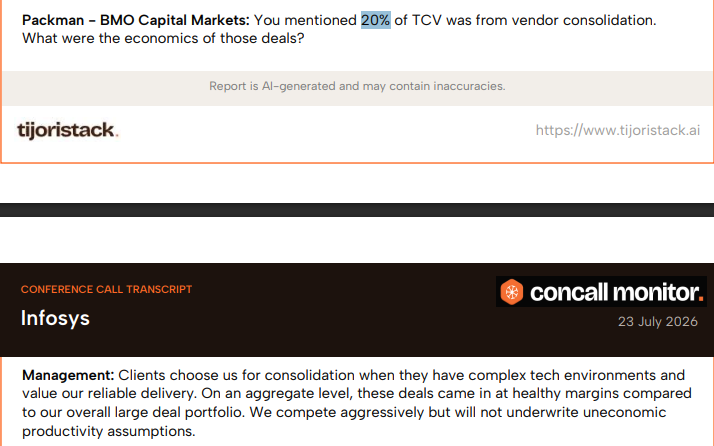
A fifth of the quarter’s large deal value came from vendor consolidation, which refers to clients cutting costs by dropping many of their other vendors. That has been one of their bread-and-butter sources of business, and the decision to consolidate vendors is primarily driven in order to cut costs, especially in a tough external environment.
Now, it is possible that AI might be the driving force behind consolidation, especially since it reduces the need for many external software vendors. But it’s unlikely, considering clients have indeed reduced discretionary spending on tech projects lately.
Infosys cut its full year revenue guidance to 1.5 to 3% partly on this, alongside one contract termination and softer volumes.
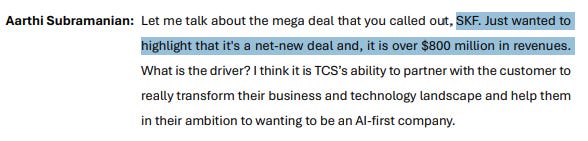
TCS, meanwhile, sounds more confident about demand than Infosys does. It signed an $800 million (~₹7,580 crore) mega deal with SKF this quarter, its sixth mega deal in five quarters.
HCLTech’s edge is hands-on engineering work, which shows up in its physical AI deals. That edge is something many of its peers don’t have. HCLTech is also building small-language models built for specific industries.
Acquisitions
Now, what about acquisitions? After all, they’re often executed in order to meet demand. And, as we’ve said before, since AI has made context inside companies all the more important, acquisitions are one of the easiest ways to acquire context about industries.
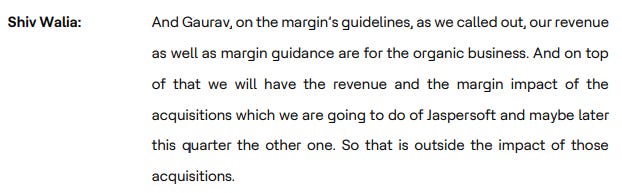
HCLTech has completed the acquisition of Jaspersoft, and mentioned a second deal closing later this quarter. However, the 1-4% growth guidance didn’t move, because it was excluding both acquisitions entirely; if closed successfully, HCL may upgrade its guidance later in the year.
But Infosys had a more sobering story. It acquired two smaller companies this year, and 1.7 percentage points of its official growth number for the year comes purely from those acquisitions and not from Infosys’s own business growing. Without them, Infosys’s real growth would look much weaker.

Data centers
One other obvious source of demand is data centers, and India’s largest IT companies are decisively cashing on it. Hot on the heels of TCS’ landmark data center announcement from last fiscal year comes HCLTech with its own data center plans.
HCLTech is investing with roughly ₹3,500 crore toward a planned 50 megawatt data centre in Odisha, funded through a mix of partner commitments with silicon and OEM vendors, plus equity and debt. The megawatt figure is impressive, but, much like TCS, the value HCLTech is chasing is the full stack of AI services it can wrap around that capacity. It provides managed services to hyperscalers, helping them manage GPU workloads in their data centers. Now, those same hyperscalers could be customers of their new data centers.
TCS hasn’t given an update on its own data centre ambitions. However, it’s worth noting that OpenAI is officially their first data centre customer.
Geography mix
Now, we move on to the geography mix.
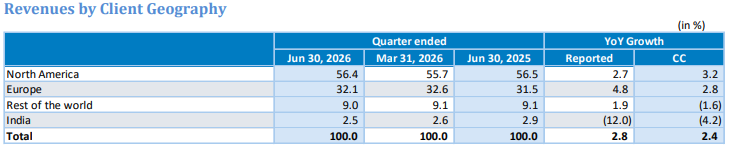
Infosys still gets 56.4% of its revenue from North America, with 32.1% from Europe, both growing modestly, while India’s revenue share has shrunk over the year. Last quarter, we’d mentioned how Europe and Japan had become new focus areas for the company.
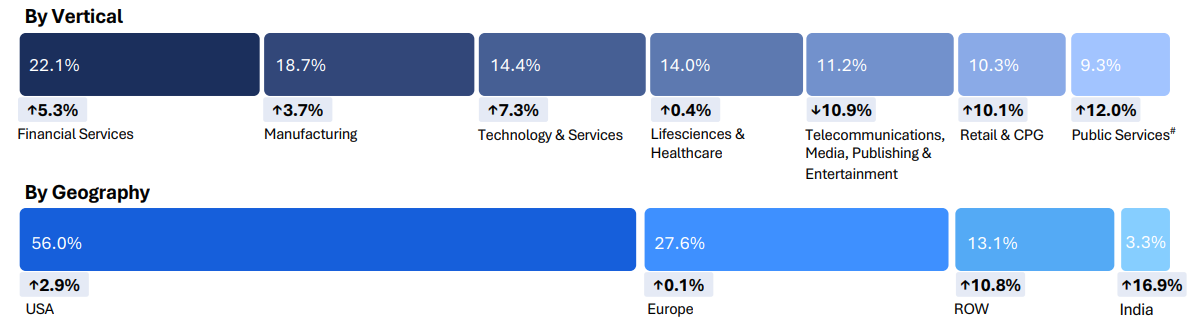
HCLTech’s spread looks different. The US business grew 2.9% year on year to 56%. Europe, meanwhile, was nearly flat. However, their “Rest of World” line grew at 10.8%, and even more impressively, India grew at 16.9%, although off a much smaller base.
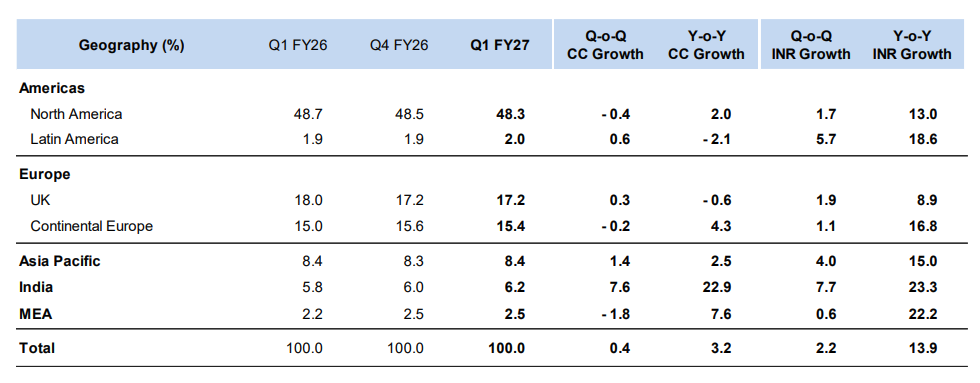
For TCS, North America makes up 48.3% of revenue. It barely grew, even slightly shrinking from last quarter. But its India business grew a whopping 22.9% y-o-y to 6.2%.
Just as we highlighted last quarter, geopolitical uncertainty has taken an interesting turn.
India’s largest IT businesses have been diversifying away from the US, and into Europe. This quarter, all three companies have won big deals from the continent: Infosys with Mercedes, TCS with SKF, and HCLTech with an unnamed Fortune Global 50 firm.
But Europe’s auto sector, now battered because of Chinese EVs, has shrivelled up their tech spend. And while the Middle East has often come up in earnings calls, it has stayed flat over the last couple of quarters because of the same uncertainty — probably more amplified with the Strait of Hormuz closure.
Headcount, three different bets
Lastly, we come to headcount.
TCS was actually net-positive on headcount this quarter, with its workforce standing at nearly 5.94 lakh. It onboarded 14,000 campus graduates last quarter alone, alongside rolling out annual wage hikes. When asked why TCS is hiring when AI is expected to shrink white-collar software jobs, K Krithivasan said that he doesn’t believe a reduction is coming.
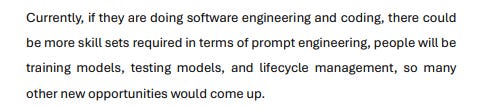
TCS doesn’t believe that reduction is coming, people will move into different roles instead, training and testing models rather than writing all the code themselves.
Infosys, which had been net-positive on hiring all of last year, will seem to continue that trend. Headcount dipped slightly to 3.28 lakh once you strip out roughly 2,000 people added through acquisitions, but it’s still targeting 20,000 campus hires this year, having already brought in over 4,000 this quarter.
HCLTech is the most aggressive outlier here. Its headcount fell by nearly 3,300 this quarter. It is the only one of the three actually shrinking its employee base even as revenue per employee climbs.
What to watch next
So, what do we watch next quarter?
Well, TCS and HCLTech both expect their margins to improve through the year as this quarter’s wage hike and restructuring costs fade. Infosys has already cut its guidance.
The sales and pricing conversations around AI are obviously getting louder. As we’d highlighted last quarter, new business models are starting to emerge in light of AI repricing the sector. We will be covering how this conversation unfolds throughout the year, be it through results stories, or through conversations with experts on Subtext.
New deals are certainly being signed, that too not just in the US. But it’ll be worth watching what sectors those are in, and how quickly they get signed, especially as midcap firms continue to creep up in leadership.

IndiGo’s profits lose altitude
IndiGo’s latest results are out, and the airline has had a rough run. In the Q3 FY26, an operational breakdown had cancelled more than 2,500 flights over three days, stranding passengers across the country. Shortly after in the last quarter of FY26, turning what would have been a profitable quarter into a ₹2,500 crore net loss.
Back then, we wrote that the worst was probably still to come. Management had warned that a weak rupee and rising Middle East tensions had pushed global crude prices higher. Fuel costs were climbing, but the full impact hadn’t yet shown up in IndiGo’s accounts. Those bills would land in the next quarter. And they largely have.
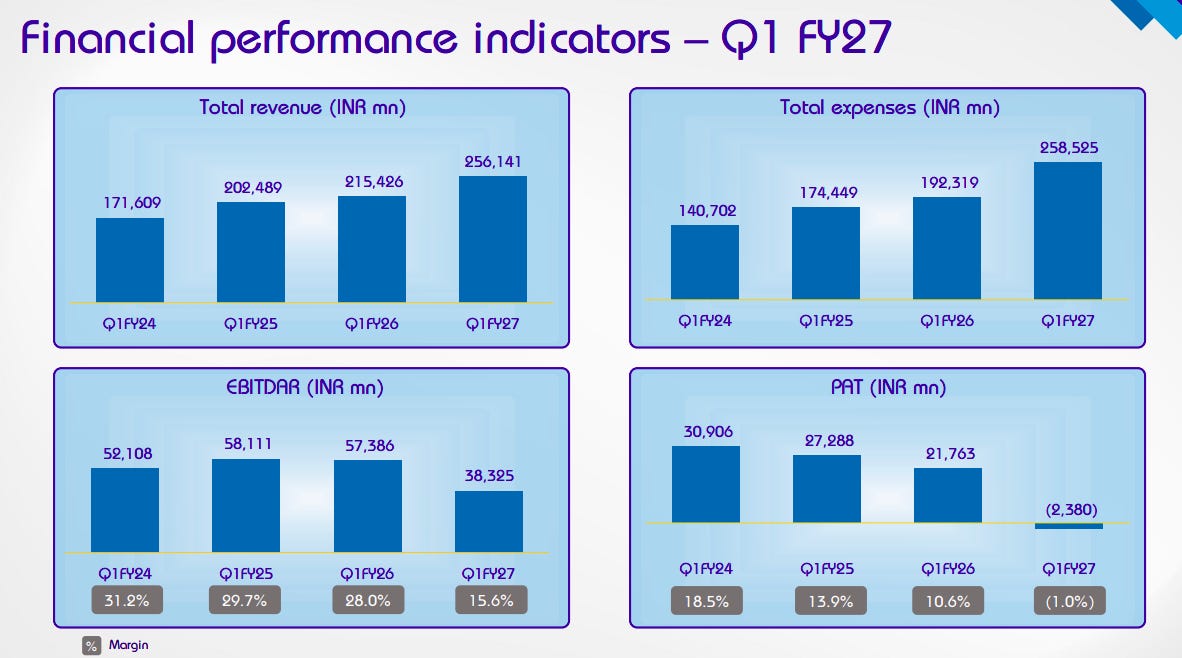
For the first quarter of this financial year, total revenue rose an impressive 19% year-on-year to ₹25,600 crore. At first glance, it looks like an airline finally putting a difficult period behind it and benefiting from a strong travel season. But once you get to the bottom line, that optimism quickly fades. You begin to see exactly what management had been warning about.
So, what happened?
What’s behind the revenue increase?
Let’s understand the revenue jump first.
Airline capacity is measured using a metric called available seat kilometres, or ASK. It simply multiplies the number of seats an airline offers by the distance those seats are flown. In other words, it tells us the airline’s total flying capacity. This grew just 3% year-on-year. For an airline targeting aggressive double-digit growth, that’s barely any growth at all.
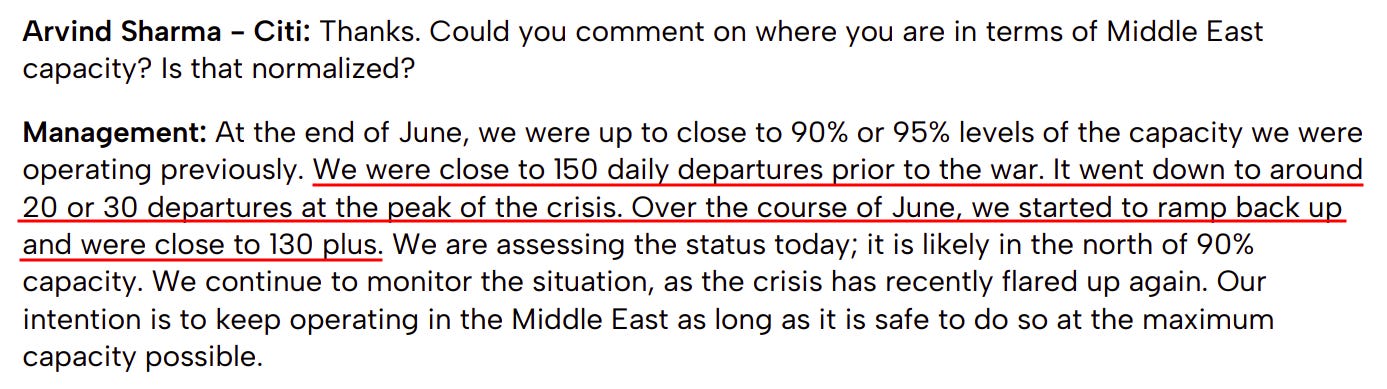
The reasons were fairly straightforward. Conflict in the Middle East disrupted airspace, forcing cancellations and long detours around conflict zones. At the peak of the crisis, IndiGo’s Middle East departures fell from nearly 150 flights a day to just 20–30, before recovering to around 130 by the end of June. Long story short, it became physically impossible for the airline to add much capacity when so many routes were disrupted.
But capacity is only one part of the story. The use of that capacity also weakened. IndiGo carried around 3.1 crore passengers during the quarter, up just 1% from a year ago. In fact, it added seats slightly faster than it added passengers, so its planes flew a little emptier. In airline jargon, this is called the load factor—the share of seats that are actually filled—and that fell by 1.3 percentage points.
So both capacity growth and its utilisation weakened, yet revenue still rose 19%. How?
Because IndiGo made a trade-off. It pushed for higher fares and was willing to accept slightly lower occupancy in return.
In other words, the extra revenue didn’t come from flying more people. It came from charging each passenger more. The industry calls this yield—the average fare paid per passenger per kilometre—and that jumped 21%.
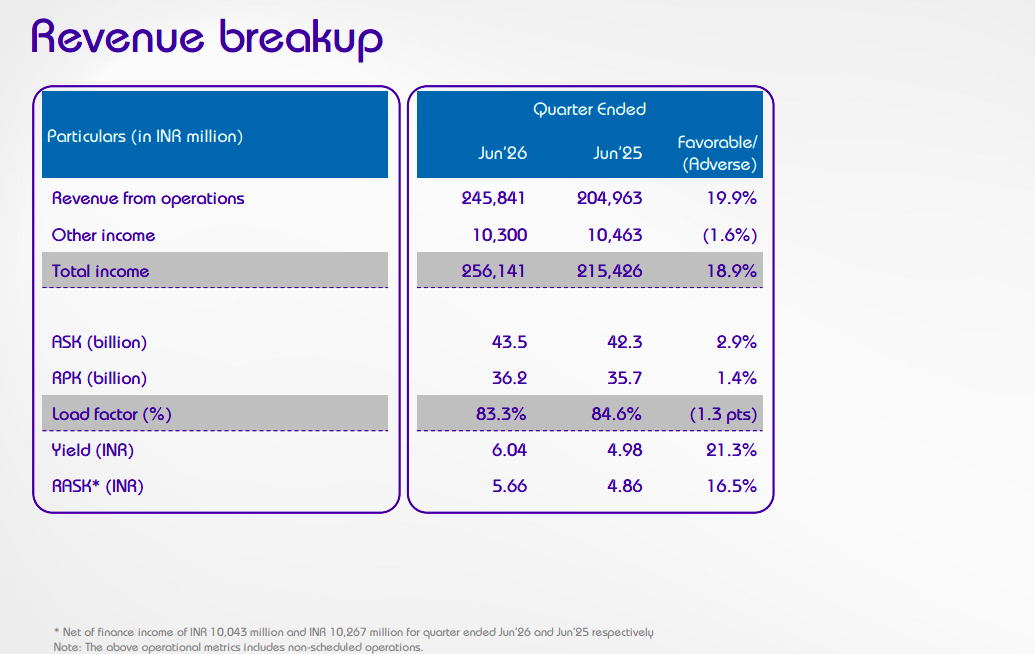
Raising fares by 21% would normally be difficult in an industry where price heavily influences buying decisions. But these aren’t normal times. Several competitors have pulled back, leaving IndiGo with far less competitive pressure. That has given the airline room to charge more without facing much resistance.
The problem is, that extra money from customers won’t necessarily end up in shareholders’ pockets.
Where was the money spent?
The biggest dent in IndiGo’s revenue came from fuel. Aviation turbine fuel remains an airline’s single largest operating expense, accounting for nearly 40% of its total costs.
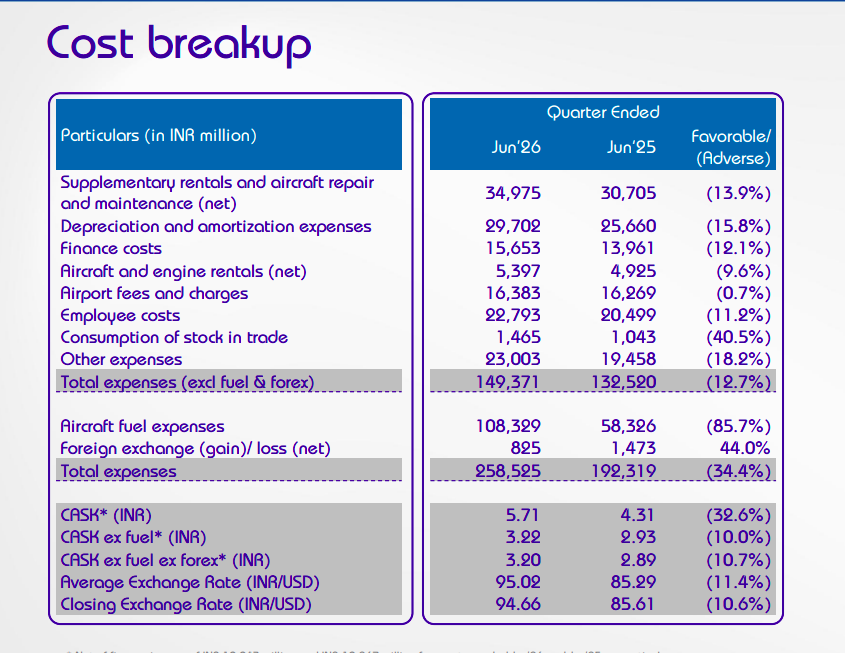
During the quarter, global crude prices were up around 50% year-on-year. But the bigger problem was the “crack spread“— the cost of refining crude oil into jet fuel — which pushed the jet fuel benchmark up by nearly 120%. As a result, IndiGo’s fuel bill surged 80% year-on-year.
You might notice something odd here. If global jet fuel prices were up 120%, why did IndiGo’s fuel bill rise only 80%? That’s not a calculation error. It’s because domestic intervention softened the blow.
Between April and the first week of June, the Indian government and public-sector oil marketing companies effectively capped domestic jet fuel prices. Airlines would pay no more than 25% above the March baseline, regardless of how high global prices went.
That kept domestic jet fuel prices around ₹110–115 per litre, while fuel for international flights continued to be priced at market rates, touching the equivalent of nearly ₹150 per litre, according to analyst estimates.
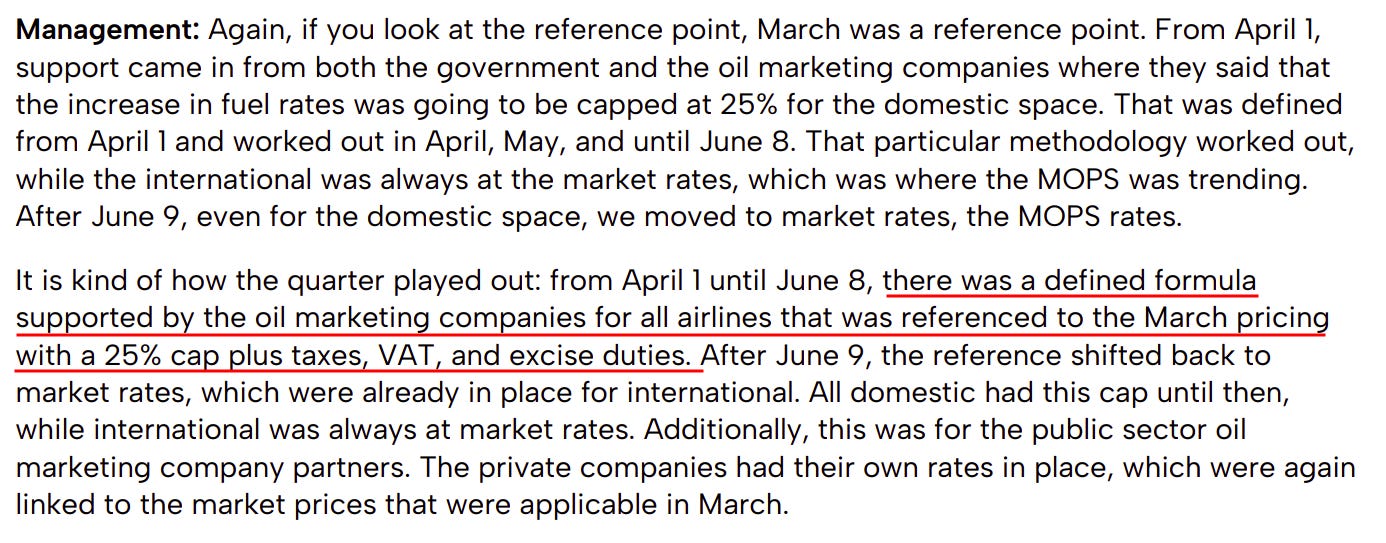
The relief wasn’t universal, though. Private fuel suppliers at domestic airports did not offer the same capped prices, forcing IndiGo to pay market rates on a portion of its domestic fuel even during the capped period. Still, since most of its fuel comes from public-sector oil companies, the airline’s overall fuel cost remained lower than it otherwise would have been.
That support ended on June 9, when the cap was lifted and domestic prices immediately returned to market rates. In other words, this cushion is now gone. Next quarter, IndiGo’s fuel bill might go up. But India did introduce a ₹10,000 crore ATF Price Stabilization scheme, so we’ll have to track this closely.
Fuel wasn’t the only pressure point. Non-fuel costs also rose 11% year-on-year.
Some of that came from employee expenses, which increased because of exceptional gratuity provisions. Engine maintenance costs also moved up due to annual contractual escalations. On top of that, many of IndiGo’s maintenance contracts, spare parts, and aircraft leases are denominated in US dollars. With the rupee down more than 11% year-on-year, every one of those bills became more expensive.
That last point is worth pausing on because it wasn’t just an accounting adjustment. It was real cash going out the door. Every maintenance invoice, every spare part, every lease payment had to be settled at a weaker exchange rate than a year ago.
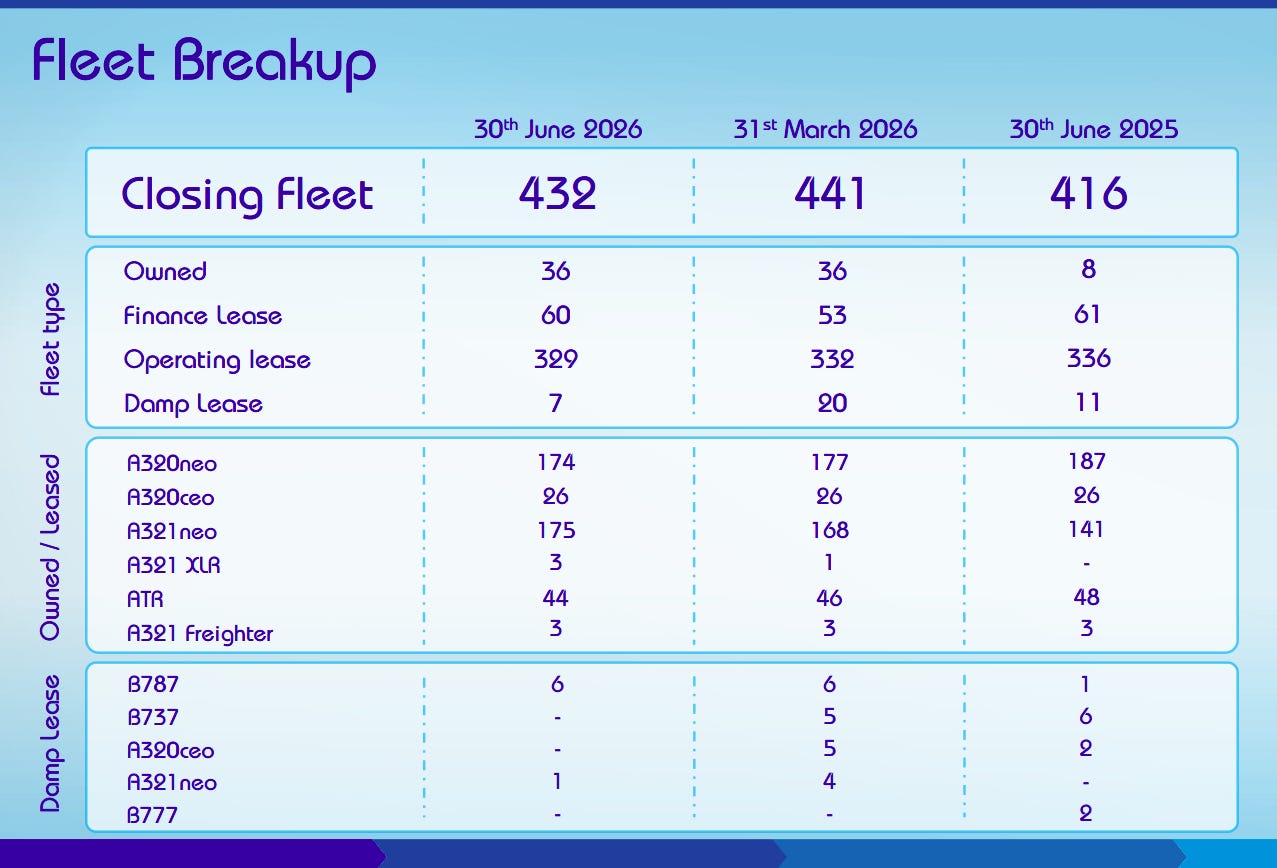
Not everything on the cost side was working against the airline, though. IndiGo pulled several levers to limit the damage. It grounded its oldest aircraft, which burn the most fuel and no longer made economic sense at these fuel prices. It permanently returned nine ageing aircraft to lessors as their long-term leases expired, cutting recurring lease costs. It also handed back 13 temporary aircraft that had been leased to meet peak travel demand, shedding those expenses as demand cooled.

The airline also tightened day-to-day spending and deferred salary increases for senior employees. Together, these steps left IndiGo operating a smaller and leaner fleet.
But against an 80% jump in fuel costs and a sharply weaker rupee, those measures could only do so much. Costs rose faster than revenue, squeezing operating profits before much of that extra revenue could reach shareholders.
How did operating earnings become a net loss?
To see how those squeezed revenues eventually turned into a net loss, we have to follow the profit and loss statement.
For every ₹100 IndiGo earned this quarter, about ₹84 went towards the basic cost of running the airline like fuel, crew salaries, airport charges, and maintenance. That left roughly ₹16 as operating profit, or EBITDA. A year ago, that number was ₹28. It’s a sharp drop, but it’s still a profit.
The problem is that operating profit isn’t what shareholders get to keep.
IndiGo leases most of its aircraft instead of owning them. So a large chunk of that ₹16 immediately goes towards lease rentals. On top of that come interest costs and depreciation.
This leasing model keeps upfront costs low but creates large long-term obligations. Today, IndiGo has ₹53,800 crore of lease liabilities on its balance sheet, taking its total debt to ₹81,500 crore.
By the time it pays lease rentals, interest, and depreciation, that ₹16 of operating profit has effectively disappeared.
Then comes the currency line.
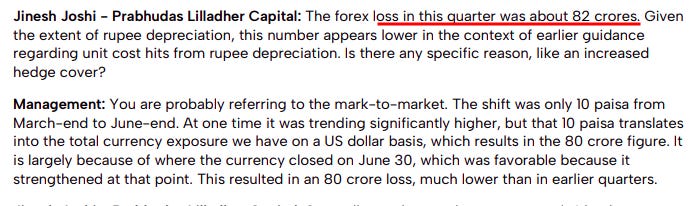
This quarter, IndiGo reported a foreign exchange loss of just ₹82 crore. That’s tiny compared to the ₹4,800 crore forex loss it reported last quarter. At first, that seems surprising. The rupee was still about 11% weaker than a year ago, so why wasn’t the forex loss much larger?
The answer lies in how these losses are calculated. Foreign currency liabilities are marked to market using the exchange rate on the last day of the quarter. Although the rupee had weakened significantly during the quarter, it recovered on June 30 and closed just 10 paise weaker than it was at the end of March. That last-minute move sharply reduced the accounting loss, leaving IndiGo with a forex hit of just ₹82 crore.
But a calm quarter-end exchange rate doesn’t solve the underlying problem.
IndiGo pays for aircraft leases, maintenance, spare parts, and much of its international fuel in US dollars, while it earns almost all of its revenue in rupees. Quarter-end exchange rates and short-term hedges can smooth out the accounting impact, but they don’t undo the higher operating costs that come with a rupee that has depreciated more than 11% year-on-year.
By the time the quarter ended, that currency hit had already been baked into the cost of every flight IndiGo had operated. And once the bills were settled, the airline closed the quarter with a net loss of ₹238 crore.
Can IndiGo fix it?
IndiGo can’t control global oil prices or the rupee. But it is trying to make its business more resilient to both. And that effort has been underway for several quarters.
As we wrote after the previous quarter’s results, the airline has been rethinking how it finances its fleet. Every aircraft inducted this quarter was financed through its new leasing platform in GIFT City, India’s financial free zone in Gujarat. Over the next two years, it plans to lease 150 aircraft through this platform.
The idea is straightforward. Aircraft leased through GIFT City benefit from tax and regulatory incentives that make financing cheaper than routing deals through traditional offshore leasing hubs like Ireland or Singapore. Over time, that should help IndiGo bring down its financing costs, even if it doesn’t eliminate its exposure to the US dollar.
The airline has also signed a deal for more than 1,000 Leap-1A engines, alongside plans to build its own maintenance, repair, and overhaul (MRO) facility in India. Servicing more of its fleet at home should gradually shift a larger share of maintenance spending into rupees while reducing its dependence on global supply chains.

Looking ahead, IndiGo expects demand to soften seasonally and is adjusting its network accordingly. It is temporarily suspending flights to six international destinations on its eastern network, including Ho Chi Minh City, Hong Kong, and Shanghai. These routes are expected to resume in October, when travel demand typically picks up again.

There’s clearly a lot changing at the airline, and it’s happening at a difficult time. To help steer that transition, veteran aviation executive William Walsh—who previously led British Airways and IAG—is joining IndiGo’s leadership team in early August. His experience building global airline networks could prove valuable as IndiGo works towards its goal of increasing international flying to 40% of total capacity by 2030.
Whether these changes are enough remains to be seen. But for now, IndiGo seems focused on fixing the parts of the business it can control while waiting for the ones it can’t to become a little more forgiving.
Tidbits
- India loses an estimated ₹14 lakh crore annually to rust and corrosion damaging vital infrastructure across various sectors. According to Normura report, adopting stricter, globally recognized anti-corrosion standards could significantly extend infrastructure lifespan and lift the national GDP by up to 1.5%.
Source: The Economic Times
- Small truck operators, who move about 70% of India’s freight, are struggling to survive due to rising fuel and maintenance costs combined with severe driver shortages. Because they lack the power to negotiate higher freight rates, thin profit margins are forcing many of these essential logistics providers out of business.
Source: The Hindu BusinessLine
- The Oil and Natural Gas Corporation (ONGC) has begun drilling its first deepwater exploratory well in the Mahanadi basin off the coast of Odisha. This ambitious project aims to tap into massive undiscovered offshore reserves to help reduce India’s reliance on imported oil and gas.
Source: Business Standard
- Anticipating a massive shift in the global tech landscape, China is actively overhauling its educational and talent pipelines to prepare its workforce for the incoming “AI shock.” The move aims to ensure that the country has the specialized skills required to remain competitive as artificial intelligence reshapes global industries.
Source: The Hindu BusinessLine
- India is preparing to launch Central KYC (CKYC) 2.0, which will create a single, unified identity for retail customers across all banking, insurance, and investment platforms. This system will eliminate repetitive paperwork and enable instant, real-time onboarding while making it easier for regulators to prevent fraud.
Source: ET BFSI
- This edition of the newsletter was written by Vignesh & Mridula
In The Chatter, our team digs through earnings call transcripts and management interviews to bring you the sharpest insights into India’s top companies, key industries, and the broader economy. Check out the latest edition.
Our team at Markets is always reading, often more than is healthy. In What We’re Reading , we changed the format: no curation, no bias, just every link open on our tabs. Everything from why the rupee really cratered to the cult of longevity to how banks actually fund themselves.
Amit Tripathi on how monetary policy transmission happens
On CNBC, Amit Tripathi flagged that India’s largest AAA banks were paying 225 basis points over the repo rate for three-month money, spreads that only show up in a crisis. We sat down with him, Nippon’s CIO for fixed income, to unpack why the repo rate isn’t really how banks fund themselves and why liquidity, not the policy rate, sets the real cost of credit.
The full conversation is on our YouTube Channel, or if you like listening, you can check out Spotify or Apple Podcasts.
Join us on WhatsApp , where we share interesting soundbites from concalls, articles, and everything else we come across throughout the day. You’ll also get notified the moment a new video or article drops so that you can read or watch it right away.
Thank you for reading. Do share this with your friends and make them as smart as you are 