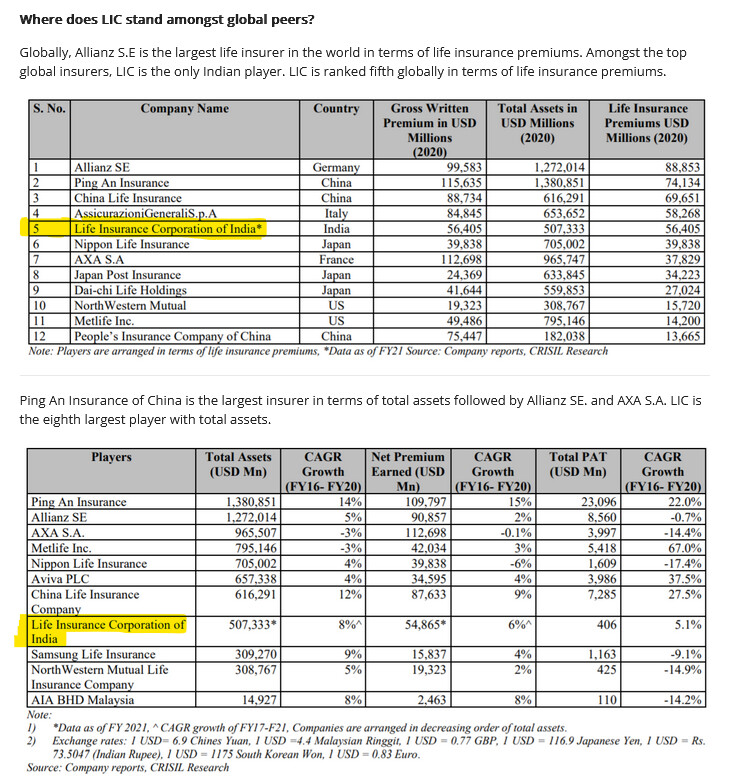
What surprised me was LIC and Bajaj Finance, never thought they could be in top 500 of the world. As the ranking is based in USD, currency depreciation of INR could also be against Indian Companies. Should start reading on Bajaj Finance…thought it was just another finance company…
This ranking is based on market cap. Is this the right parameter to measure, what about profits. Example a loss making company can still have a high market cap.
Also, this particular order of “Top-10 Indian companies in Global Top-500”
is amidst the chaos in various markets in recent times.
There are atleast another dozen Indian listed companies
in close proximity by market-cap,
that would feature in the global Top-500 by market-cap list,
depending on when one samples the list.
While market-cap, is a proxy for investor confidence/expectations,
a company’s profit is an even more easily manipulated proxy.
Can try browsing through the Financial Shenanigans by Howard Schilit for some of the well-known obvious methods. Hopefully, provides clarity into why it is foolhardy for individuals to believe that they can gain a good understanding of a company’s fundamentals by reading a few articles or even their financial statements.
Note: Not a dig at any attempts to do so.
Just highlighting that even upon doing so,
one doesn’t start thinking of it as something sure-shot with complete conviction.
By the way, since the above list of companies is based on market-cap,
these are by definition the top 10 large-caps in India.
Currently, comprising about 50% of NIFTY50,
investing in a NIFTY50 index already significantly exposes one to each of these 10 companies,
and will continue to do so due to periodic re-balancing,
even if the actual “Top-N companies” by market-cap change over time. (without one having to spend time researching companies to invest in)
I was reading about LIC. Another aspect which I learnt today (but through AI and I could be wrong) is that there is something called participating products. As per AI in participating products, the profits of LIC is shared with the policy owners. Just did not understand the logic, I thought the profits were always for the shareholders. It seems no. These policy holders take a share off the LIC net profit.
So went back to AI, it says out of the total revenue/product mix, 88% is participating products. So why should I even think of buying this share when the policy holder is taking away a portion of the profits
Even reading the balance sheet is an effort and not like a normal company balance sheet. Need to go into Varsity and read about this.
The policies marked “participating” are composite products that offer both insurance and investment.
Unlike purely insurance non-participating polices that have a guaranteed sum-assured,
participating policies have a variable component (LIC calls this the “Simple Reversionary Bonus”) that depends on the profits declared by the insurance company each year, over the years the policy is active.
The returns are for the risk (non-guaranteed assurance) borne by the policy holders of “participating” policies.
A participating insurance policy is like
a ULIP plan with the linked investment fund being the insurance company itself.
Another way to look at it is
for a given guaranteed sum assured,
participating policies charge a higher premium (compared to non-participating policies).
The additional premium acts as an investment in LIC itself,
and can offer non-guaranteed returns in years the company does well financially.
AFAICT, the bonus announced each year is not paid out immediately.
Also, it does not accumulate any compounding returns in subsequent years.
This doesn’t mean that policyholders received a higher rate-or-return than shareholders.
Rate-of-return for both the groups (policyholders, shareholders)
will depend on the number of individuals in each group
and the amounts paid/invested by them.
Returns from “Simple Reversionary Bonus” announced on participating insurance policies
are not necessarily equal to returns from holding Stock,
As a rough example (not actual numbers), compare
investing Rs.100 into the insurance company stock that returned say 5 rupees,
4 in stock price appreciation, and 1 as dividend.
The price of the stock also varies based on market-demand / future projections,
not just the most recently announced profits.
A participating insurance policy of a one-time Rs.100 premium that returned say 1 additional rupee
not paid-out immediately, but receivable on maturity/settlement of the policy
but also does not compound for the rest of the duration until settlement/maturity.
Zero-liquidity (lock-in) and no compounding,
make the SRB bonus a far less attractive proposition than it may seem initially.
Also, need to review any differences in taxation. Likely to be different as well.