I am an Indian tax resident and I am looking to trade US stock options. However, there is no clarity on whether Indian residents are actually allowed to trade in US stock options. I spoke to one of the brokers that provides this facility, and this is what they stated regarding it.
So, are Indian tax residents actually allowed to trade US stock options or not? And is there any official source or authority from which I can get a definitive answer on this matter?
The Foreign Exchange Management Act (FEMA) governs all foreign exchange transactions in India, while the Liberalised Remittance Scheme (LRS) is a specific provision under FEMA that allows residents to remit up to USD 250,000 per financial year for certain permissible transactions. Transactions outside the LRS may require prior approval from the Reserve Bank of India (RBI)
For transactions that exceed the LRS limit or are not covered under it, individuals must seek prior approval from the RBI. These may include
Direct investments in foreign businesses
Transfers for real estate purchases
Any other capital account transactions not permitted under LRS
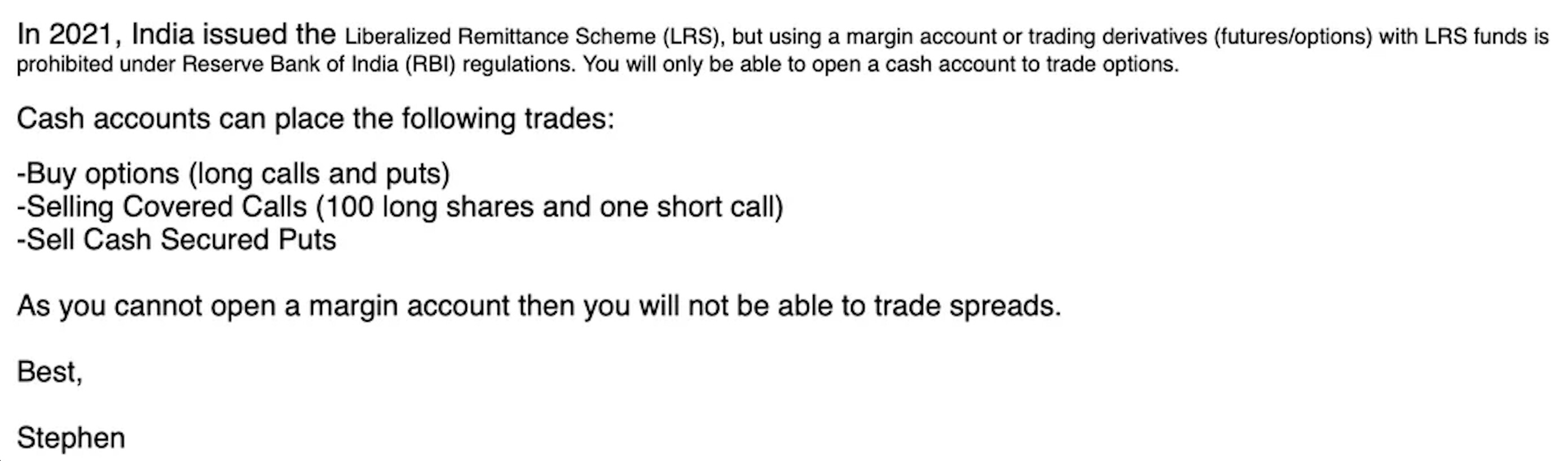
As posted in the screenshot under LRS only cash account is allowed no margin account, and buying options doesn’t require any margin, so can it be interpreted that buying options is permitted…?
All other transactions which are otherwise not permissible under FEMA AND those in the nature of remittance for margins or margin calls to overseas exchanges/ overseas counterparty are not allowed under the Scheme.
Margin is not exactly defined in the LRS master direction. But somewhere in other directions it says the below. This may or may not be applicable definition:
iv) “Margin” means the collateral that the parties to a derivative contract post with or collect from each other (whether directly or through a third party) to cover some or all of the credit risk that the provider of the collateral poses for the receiver of the collateral;
@BB789 I just a call from Charles Schwab and they are allowing both margin and cash account and unrestricted access to every tradable instrument for Indian tax resident
Makes sense. They don’t have a branch or business in India unlike IB. They don’t have to deal with RBI. But rules apply to residents anyway. The onus of compliance rests on you.
Technically it’s a FEMA LRS limitation so you could theoretically send the money for investment and then decide to do F&O. However, in practice Indian brokers for US investing don’t offer F&O so somewhat moot point
@BB789 Binance has launched US stock options is it somehow different than going thorugh a broker like IB, though they say the underlying is the actual stock with even the option to physically settle it. But the mode of buying is USDC
Having done that,
in future when the “facts of the case” clearly show that
a. outward remittance was executed as a resident of India
b. and subsequently the funds were used for trading in foreign derivatives
how do you plan to defend/prove your “intent” being otherwise ?
A. Next, add the drag of few lakh INR
that any half-decent tax-advocate would charge you to defend your position.
(Sure, since being scrutinised is not a guaranteed occurrence,
let us assign a small non-zero probability of this scenario occurring in future.)
Next,
Now, in addition to the uncertainties involved with trading in foreign derivatives as a resident Indian,
one also exposes oneself to complexities involved in VDA (Virtual Digital Assets) compliance
B. To begin with, a drag of 1% TDS on VDA (USDC).
Also,
Agreed. LRS is just one aspect under FEMA.
FEMA already prohibits residents from gaining exposure to foreign derivatives
unless to hedge one’s risk due to another permitted foreign investment.
3.Prohibition :-
Save as otherwise provided in these Regulations, no person in India shall enter into a foreign exchange derivative contract without the prior permission of the Reserve Bank. 4.Permission to a person resident in India to enter into a Foreign Exchange Derivative contract :-
A person resident in India may enter into a foreign exchange derivative contract in accordance with provisions contained in Schedule I, to hedge an exposure to risk in respect of a transaction permissible under the Act, or rules or regulations or directions or orders made or issued thereunder.
Q. At what expected volumes of investment (including any necessary exposure to the underlying)
and net rate-of-returns,
do foreign derivatives makes financial sense (i.e. a significant enough positive EV)
given the above uncertainties/risks involved and the costs associated with them?

 A. Next, add the drag of few lakh INR
