Our goal with The Daily Brief is to simplify the biggest stories in the Indian markets and help you understand what they mean. We won’t just tell you what happened; we’ll tell you why and how too. We do this show in both formats: video and audio. This piece curates the stories that we talk about.
You can listen to the podcast on Spotify, Apple Podcasts, or wherever you get your podcasts and watch the videos on YouTube. You can also watch The Daily Brief in Hindi.
In today’s edition of The Daily Brief:
1. How do you manufacture a medicine that keeps changing?
Moderna’s personalised cancer vaccine challenges traditional pharma manufacturing by creating a different treatment for every patient, shifting the advantage from mass-producing one drug to efficiently scaling the entire process of personalisation.
2. Can Meghalaya actually stop uranium mining?
Meghalaya cannot legally ban uranium mining on its own, but its unique land ownership system, local approvals and community rights give the state significant practical power over whether a centrally approved uranium project can actually proceed.
Cash & Copium #4
In the latest episode of Subtext, Abid, Bhuvan, and Aakanksha dissect the structural conflicts of interest in mutual fund distribution, the red flags hidden inside your CAS statement, and why keeping your portfolio simple will always make you more money than chasing “cute” thematic funds.
You can watch the full episode on YouTube.
How do you manufacture a medicine that keeps changing?
On August 19, Moderna and Merck announced positive results from the Phase 3 trial of their personalised cancer treatment. Moderna’s stock jumped 177% that day; Merck rose 12.6%. A one-day stock move tells us very little about what the treatment will ultimately be worth, but the market clearly thought something important had changed.
The trial was for melanoma, a skin cancer that becomes dangerous once it starts to spread. And every patient in the trial had already had their tumour surgically removed.
That sounds like the cancer should be gone. Often, it isn’t quite that simple.
Surgery can remove everything doctors can see. But microscopic cancer cells may already be left behind elsewhere in the body, too small to detect. Months or years later, those cells can grow again and cause a recurrence.
So after surgery, doctors sometimes use additional treatment to reduce the odds that the cancer comes back. For melanoma, one of those treatments is Keytruda.
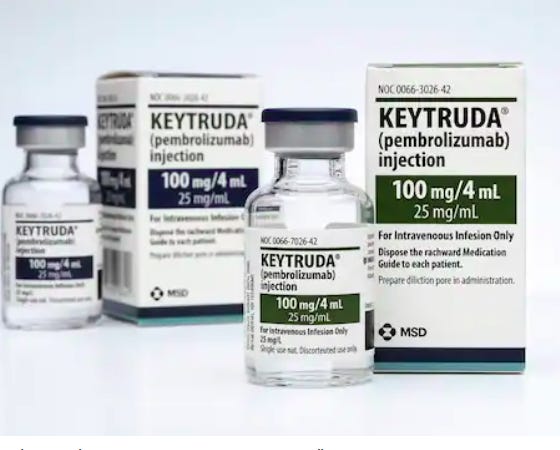
We’ve written about Keytruda before. In short, cancer cells are abnormal cells that keep growing when they shouldn’t. Normally, immune cells called T-cells can recognise and attack them. But some cancer cells use certain signals to switch those T-cells off.
Keytruda jams that switch. It keeps the immune system awake and able to attack.
But that only solves half the problem. You can wake the immune system up. How do you tell it exactly which cells to go after?
That is the part Moderna is trying to add.
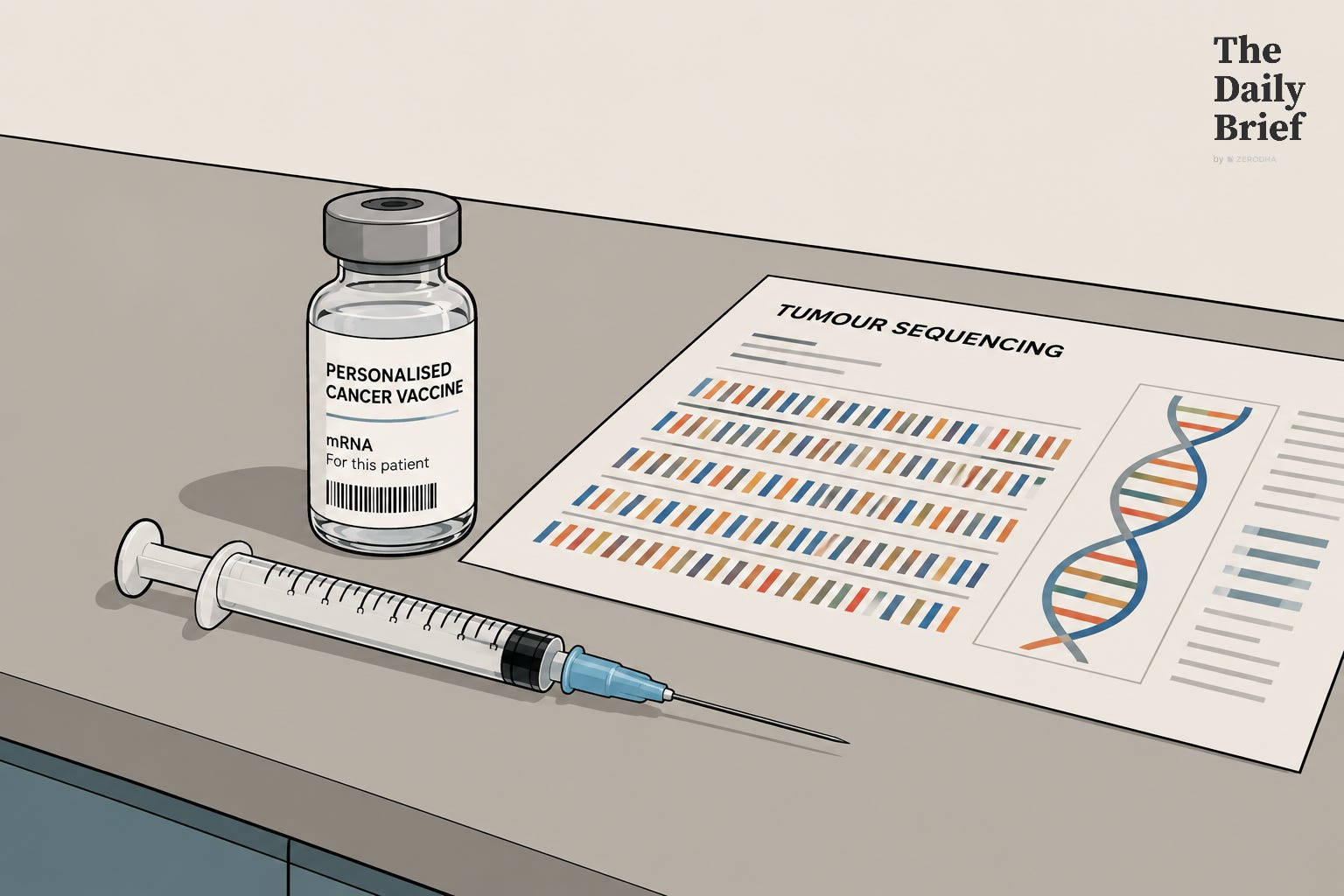
Its approach starts with the tumour removed during surgery. Doctors study the mutations inside it — the specific quirks that make this person’s cancer different from someone else’s… They then use those quirks to design a vaccine tailored to that one patient.
So the cancer itself ends up supplying the recipe for the medicine meant to destroy it.
At the expense of oversimplifying, the two treatments split the work. Keytruda keeps the immune system switched on. Moderna’s vaccine shows it a photograph of the enemy. And that makes this treatment unusual in another way.
Keytruda can be manufactured years in advance and in bulk. That does not make it easy to manufacture. Biologic drugs like Keytruda are notoriously difficult to make consistently. But once you crack the process, the goal is still to make the same drug again and again. Moderna’s vaccine is different. The final medicine itself changes with every patient. It does not exist until doctors have studied that person’s tumour.
Most of modern pharma was built around one idea: find a medicine that works, then make millions of identical copies of it. This treatment asks whether the industry can do the opposite — run the same manufacturing process again and again, but produce a different medicine for every patient.
A factory that makes one at a time
It starts with the tumour that was removed.
Doctors read its genetic code and compare it with healthy DNA from the same patient. They are looking for mutations that appeared in the cancer cells but are missing from the patient’s healthy cells.
Why? Because some of those mutations change the proteins a cancer cell makes. That can leave tiny abnormal markers on the cancer cell’s surface. These markers are called neoantigens, which T-cells can recognise.
Those markers are useful targets. But a tumour can carry hundreds or even thousands of mutations, and most will not make good targets. The challenge is figuring out which ones the immune system can actually see and attack.
And that answer differs from person to person.
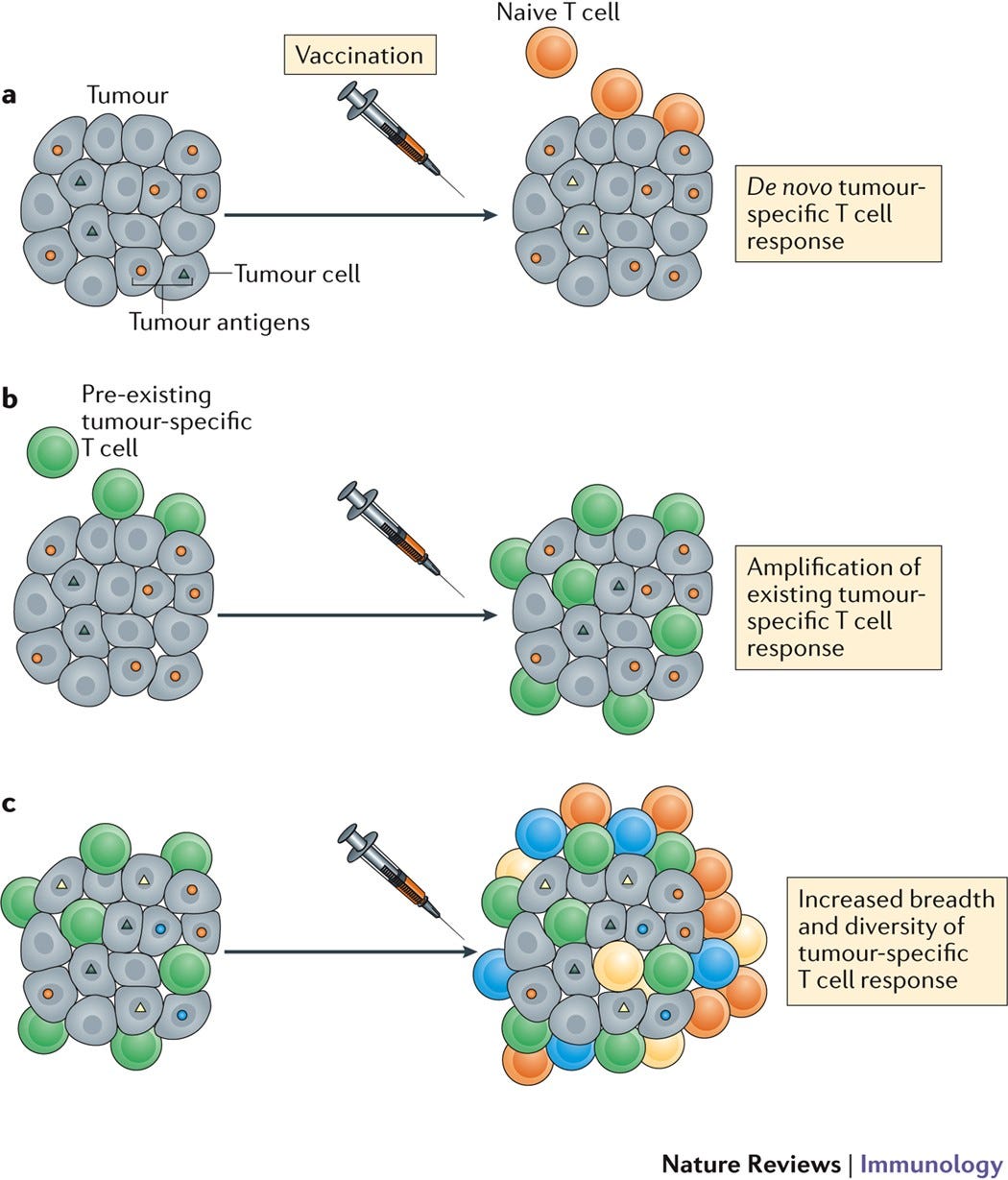
Our cells have their own machinery for picking up pieces of proteins and showing them to T-cells. But that machinery varies widely between people. So the same cancer mutation might give the immune system a clear target in one patient and be practically invisible in another.
Moderna therefore has to narrow the list down. Its system predicts which mutations in that particular patient’s tumour are most likely to produce useful targets. The treatment can encode up to 34 of them. That shortlist is then turned into mRNA.
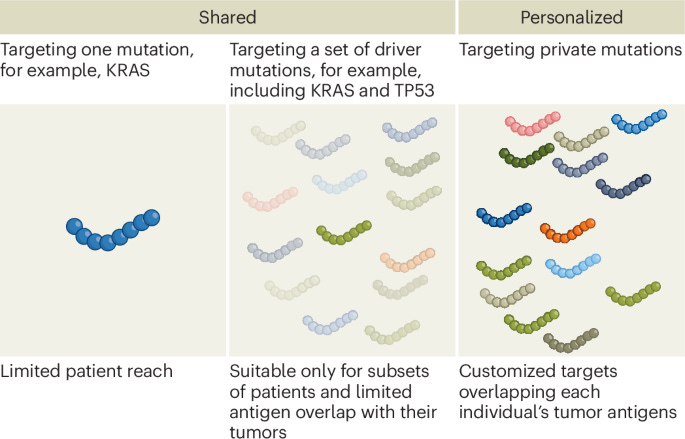
mRNA is simply a temporary set of instructions for cells. Here, those instructions tell cells to make copies of the selected cancer markers for a short period. That gives the immune system a chance to learn what they look like and build T-cells that can hunt cells carrying the same markers.
Melanoma is a useful place to test this approach because it often carries a large number of mutations, many caused by ultraviolet damage. That gives researchers a bigger pool of possible targets to choose from.
But that is also an important caveat. Cancers with fewer mutations, or cancers that suppress the immune system in different ways, may not be equally suited to the same strategy.
And this is where the manufacturing story changes.
Normal pharma gets scale by making bigger batches of the same medicine. A company might go from a 100-litre batch to 1,000 litres and keep going. The more it can make in one run, the cheaper each dose can become.
So instead of scaling up, Moderna has to scale out: make lots of small, different batches at the same time.
The advantage is no longer how much medicine you can squeeze out of one giant batch. It is how many different batches your factory can reliably push through the same process.
That also changes what the factory itself looks like. The tumour has to be analysed, the targets selected, the mRNA made, packaged and checked — separately for every patient. The sequence changes each time, but the machinery around it does not.
Moderna is therefore not trying to mass-produce one medicine. It is trying to mass-produce the process of making one-off medicines.
And once that is the model, speed becomes part of the product.
This treatment cannot be made before the patient arrives. The process starts only once doctors have the tumour. From there, the sample has to be processed and sequenced, the targets selected, the mRNA manufactured, and the finished dose checked before treatment can begin.
That still takes weeks rather than days, although the exact turnaround depends on the manufacturing setup.
The patent still matters. But so does the system connecting the hospital, sequencing, software and manufacturing. A company that can move from tumour sample to finished dose faster and more reliably has an advantage even if competitors understand the same underlying mRNA technology.
And that leads to the next problem. If every finished dose is supposed to be different, what exactly is a regulator meant to approve?
Regulating the recipe-maker
That creates a problem for regulators.
Drug regulation is built around consistency. A company develops one medicine, and then has to prove that it can make that medicine reliably, batch after batch. Personalised vaccines change what consistency means.
The Food and Drug Administration (FDA) still needs confidence that every dose is made safely and correctly. But it cannot simply compare one patient’s vaccine with another and expect them to match. So more of the scrutiny moves to the process behind the dose.
The FDA is already thinking about this. In draft guidance released in August 2026, the agency acknowledged that some of the usual quality tests may not make sense for a medicine produced separately for every patient. Testing each tiny, one-off batch in exactly the same way can be impractical.
Instead, companies may be able to rely more on proving that the manufacturing process itself works reliably, confirming that the right genetic instructions went into each dose, and using other checks to make sure the finished treatment meets quality standards.
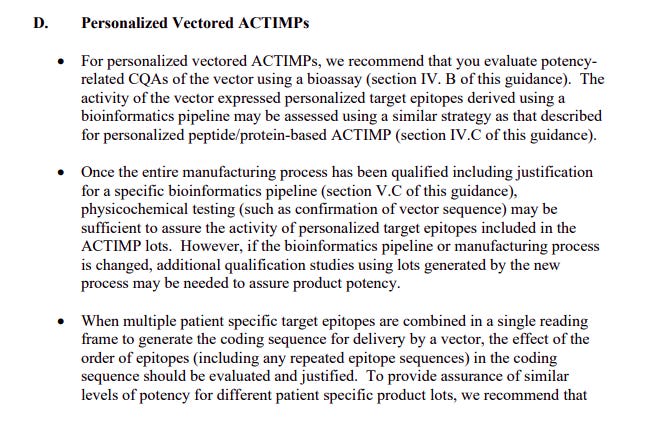
The software that chooses those instructions matters too.
Remember, Moderna starts with a long list of mutations in a patient’s tumour and has to decide which ones make the best targets. Software helps make that choice. So it is not sitting somewhere outside the medicine. Its decisions partly determine what actually goes into each patient’s dose.
And that creates another regulatory question: what happens when the company improves the software?
The FDA’s draft guidance acknowledges that changes to this system can change the final medicine and may therefore require additional studies. What looks like a normal software update can become a drug-development question.
This does not mean the FDA is approving an algorithm instead of a medicine. The guidance is still a draft, and its recommendations are not legally binding. Every finished dose still has to meet quality requirements.
But what regulators need confidence in is broader than before. They are no longer only asking whether a company can reproduce the same medicine. They also have to ask whether the system that designs and makes a different dose for every patient remains reliable.
And that matters for the business too. If more of the value sits in this entire system for designing and making the medicine, competing requires much more than knowing how to copy a finished drug.
The replication trap
That shift matters for India because it cuts against the model that made Indian pharma successful.
For decades, Indian companies built an advantage by taking medicines the world already understood and making them more cheaply. That is a big reason India came to be called the “pharmacy of the world.”
Generics fit this model neatly. The molecule already exists. Once patents expire, the challenge is to reproduce it reliably and at scale. India supplies roughly 20% of the world’s generic medicines by volume. Biosimilars are much harder but the basic logic survives: however difficult the process, everyone is still trying to reproduce the same medicine.
Indian companies are already good at this. Biocon, for instance, has announced biosimilar versions of major cancer drugs including pembrolizumab, sold as Keytruda, and nivolumab, sold as Opdivo.
Personalised medicines change what exactly needs to be scaled.
There is no single patient-specific vaccine waiting to be copied. But there is still a large industrial stack around every dose: sequencing the tumour, choosing the targets, making the mRNA, packaging it, testing it, moving samples and doses between hospitals and factories, and doing all of this quickly enough for an actual patient.
That creates a more interesting question for India. Can it make personalisation itself cheaper?
The advantage may not come from producing a cheaper copy of Moderna’s finished vaccine. It could come from doing parts of that surrounding process — sequencing, manufacturing, testing or logistics — at lower cost, or eventually stitching the whole thing together more efficiently.
That is a very different kind of scale from the one Indian pharma mastered with generics. Instead of making millions of identical pills, the challenge is to run the same complicated process across millions of different patients.
India does have some ingredients that could matter here. A large patient population could generate useful tumour and treatment data, while its pharma and manufacturing base gives it experience in driving costs down. But neither advantage works automatically. Hospitals would need to collect good clinical and genetic data, track patients over time and connect much more tightly with testing and manufacturing infrastructure.
There may therefore be an opening in affordability.
If personalised treatments remain too expensive for most patients, somebody will eventually have to make the whole system cheaper. Indian pharma’s old advantage was making known medicines cheaper. The next one may be industrialising personalisation itself.
A factory for millions?
For now, this is still a melanoma result, not a cure for cancer.
The earlier Phase 2b trial shows why people are excited. After five years, the combination was associated with a 49% lower risk of recurrence or death and a 59% lower risk of the cancer spreading elsewhere or death than Keytruda alone. But those are not the new Phase 3 results. Moderna and Merck have not yet released the detailed effect sizes from that trial.
Cancer can also still find ways around an immune attack. Giving the immune system several targets is meant to make that harder, not impossible.
So the trial is strong evidence that this personalised approach can work in melanoma.
The harder question is what comes next — whether it can be made fast, reliable and cheap enough to move from a promising melanoma treatment to something far more widely usable.

Can Meghalaya actually stop uranium mining?
The Meghalaya Assembly has unanimously passed a resolution opposing uranium exploration and mining in the state, largely over concerns about the environmental and health impact of uranium mining.
Chief Minister Conrad Sangma pointed to the effects seen around uranium-mining areas elsewhere while moving the resolution. The resolution urged the Centre, the Department of Atomic Energy and Uranium Corporation of India Ltd (UCIL) not to pursue uranium mining in the state.
That raises a basic question: can a state government actually stop a uranium mine?
Is mining a state subject or a central subject?
Mining is partly a state subject, but the Centre has already taken over much of its regulation.
Under the Constitution, regulation of mines and mineral development appears in the State List. But that entry itself says Parliament can regulate mining where it considers this necessary in the public interest. Parliament used that power to pass the Mines and Minerals (Development and Regulation) (MMDR) Act , which we covered very recently in The Daily Brief.
So states still do a lot of the actual administration of mines. This involves granting and executing leases, collecting royalties, dealing with land and local implementation. But, they do this inside a framework written by the Centre.
Over the last few years, that framework has become even more centralised for strategically important minerals.
For one, an amendment to the MMDR Act in 2023 created a new category of 24 “critical and strategic minerals” while giving the Centre the power to auction mining leases and licences for them . It also created a new exploration licence for critical and deep-seated minerals. At the same time, six minerals including lithium, titanium, beryllium, niobium, tantalum and zirconium were actually removed from the list of atomic minerals , so that private companies could participate more freely in their exploration and mining.
Then came another amendment in 2025. Among other things, it made it easier to add additional minerals found inside an existing mining lease. But it specifically preserved a wall around atomic minerals, saying that an atomic mineral above the prescribed threshold cannot simply be added to an ordinary non-atomic mining lease .
What that meant was that uranium did not get liberalised in the way lithium and some other critical minerals did. It remains an atomic mineral under a much tighter central regime.
And uranium has another constitutional layer on top of the MMDR Act: atomic energy and the minerals needed for it are specifically Union subjects. So uranium mining is governed both by the MMDR framework and by India’s nuclear-energy law.
Who decides whether a uranium mine can open?
Indeed, the Centre has the stronger hand over atomic minerals like uranium. The state does not have a clear legal veto over India’s uranium policy. But the state does not disappear from the process. The Centre can’t just point at a map and open a mine.
Under the atomic-mineral concession framework, several practical steps still involve the state government. Land has to be identified and demarcated — and land is exclusively a State subject under the Constitution. Mining leases have to be processed and executed. State agencies are involved in local approvals and implementation.
In fact, Meghalaya has already shown how powerful that lever can be for a state. The UCIL has tried for years to develop uranium deposits in the state. Projects received central-level approvals, but state-level issues around land, mining leases and other permissions remained unresolved. So the Centre may have the stronger legal power over uranium, but that has never automatically translated into a working mine.
Law of the land
In Meghalaya’s case, though, land is way more complicated than merely being a State List subject.
Unlike most states in India, Meghalaya has an unusual land system. Large parts of the state are governed by the Sixth Schedule of the Constitution. What that means is much of the land is owned and controlled by individuals, clans or local communities. Autonomous District Councils also have powers over the allotment, occupation and use of land.
Interestingly, because of this, unlike in other states, the Supreme Court has previously recognised that landowners in Meghalaya can hold rights over both the surface and the minerals underneath. But that does not mean they can mine those minerals however they want.
The Court has also made clear that mining in Meghalaya must still comply with the MMDR Act. The Sixth Schedule does not create a separate mining regime outside central mining law.
That creates an interesting split.
The Centre controls whether uranium can legally be explored and mined, and Meghalaya cannot necessarily stop uranium mining simply by passing a resolution. But the land sitting above that uranium may belong to tribal communities, clans or individuals and may be governed by Meghalaya’s special land laws, and the Centre can’t exactly override that.
A uranium project may have to deal with landowners, Autonomous District Councils, state agencies and get local political consent before mining can actually begin.
That is why the Assembly resolution matters even if it is not legally a ban. This split between the land and the minerals beneath the land was, as we’d covered earlier, one of the most important debates in the MMDR Amendment Bill that was passed earlier in August.
- This edition of the newsletter was written by Mridula, Kashish & Manie.
In the latest episode of Subtext, we host Dr Rohit Chandra, Assistant Professor at IIT-Delhi’s School of Public Policy, to trace India’s power sector and coal’s role in it. The podcast uses energy as a lens to explore the 2010s NPA crisis, how India’s biggest PSUs work, Cold War strategy, ministerial turf wars, and vertical integration.
You can watch the full episode on YouTube, listen on Spotify and Apple Podcasts, or read it here.
Tidbits:
1. BPCL explores buying Gulf oil on FOB basis, lifts Iraqi oil
Bharat Petroleum Corporation is preparing to receive its first Iraqi oil cargo of the fiscal year and is open to lifting more crude from the Gulf on a free-on-board basis. The refiner said it is willing to lift cargoes from inside the Strait of Hormuz if insurance costs, vessel availability and other shipping risks remain commercially viable.
Source: The Economic Times
2. Govt pulls plug on ECLGS just over three months after launch
The government has halted the Emergency Credit Line Guarantee Scheme (ECLGS) 5.0 just over three months into its operation. The scheme’s entire ₹2.5 trillion guarantee allocation was exhausted rapidly, leaving banks in a difficult position with several borrowers holding sanctioned but undisbursed loans.
Source: Business Standard)
3. Venezuela weighs OPEC exit as it deepens US energy ties
Venezuela is considering leaving OPEC, the oil group it helped found more than six decades ago, though no final decision has been made. The idea has been discussed with US officials as Caracas deepens energy ties with Washington.
Source: Bloomberg
4. Dream11 completes pivot to a global sports engagement platform
Following the nationwide regulatory ban on online real-money gaming, Dream11 has officially completed its transition from a fantasy sports operator into an AI-driven global sports engagement platform. The company has discontinued all prize-based offerings, shifting its focus entirely to live streaming, sports content, statistics, and community-building.
Source: Livemint
5. GST Council may cut 18% tax on mobile phones as handset demand slows
The GST Council may consider reducing the current 18% tax on mobile phones as smartphone shipments weaken. The proposal is aimed at supporting demand and ensuring the tax does not become a drag on India’s mobile-phone manufacturing ambitions.
Source: Livemint
Beyond Today’s Brief
There’s always more happening at Markets by Zerodha.
- The Chatter: What connects Indian Railways’ expansion to our power grid? How is TCS using its Porsche partnership to reshape European mobility? Plus, updates from Hexaware, Max Life, Tempsens, and Gokaldas Exports.
- Aftermarket Report: How did an IT rally help Nifty end its losing streak at 24,175? What drove Tejas Networks’ 13% surge after a ₹1,537 crore order? And what took forex reserves to a record $729.33 billion?
- Points & Figures: How did India’s microfinance sector recover after writing off 17% of its loan book? This edition looks at tighter regulation, falling delinquencies, and a two-speed recovery, with large NBFC-MFIs taking 98% of fresh borrowings.
- What we’re reading: How did ITC move from cigarettes to biscuits, and how can rogue AI be held accountable? This week’s list covers ITC, Anthropic’s AI findings, rogue AI regulation, SEBI regulators, “thick” art, and our offline reading club.
Join us on WhatsApp , where we share interesting soundbites from concalls, articles, and everything else we come across throughout the day. You’ll also get notified the moment a new video or article drops so that you can read or watch it right away.
Thank you for reading. Do share this with your friends and make them as smart as you are 