Our goal with The Daily Brief is to simplify the biggest stories in the Indian markets and help you understand what they mean. We won’t just tell you what happened; we’ll tell you why and how too. We do this show in both formats: video and audio. This piece curates the stories that we talk about.
You can listen to the podcast on Spotify, Apple Podcasts, or wherever you get your podcasts and watch the videos on YouTube. You can also watch The Daily Brief in Hindi.
We’re trying out something new
With each episode, instead of two stories, we’re trying one longer story. Along with that, we will have one chart created by our team, and some extra tidbits. We’d love to hear feedback and suggestions from you on what you feel about this format.
In today’s edition of The Daily Brief:
Story: How does the Indian government buy stuff ?
How did India’s Government e-Marketplace (GeM) transform public procurement? While it successfully digitized an opaque system to include millions of small sellers, the ₹5 lakh crore platform remains heavily dominated by massive buyers like coal PSUs. Ultimately, persistent issues with seller collusion, questionable vendor quality, and delayed payments prove that digital tools alone cannot replace strong institutional oversight.
Chart: What is driving India’s vehicle boom?
Why did India’s vehicle registrations jump 7x by FY26? While rising incomes played a role, the massive boom was actually fueled by easier credit, wider dealer networks, better roads, and weak public transport, driving huge demand for two-wheelers in smaller towns and rural areas.
How does the Indian government buy stuff?
Last week, the government marked ten years of the Government e-Marketplace (GeM) with a factsheet full of very large numbers. ₹20 lakh crore of cumulative purchases, 25 lakh sellers, more than ~10,000 categories of goods and 350 categories of services. When we looked at the website, the government was buying everything from vaccine doses to optical fibres to sanitary napkins.
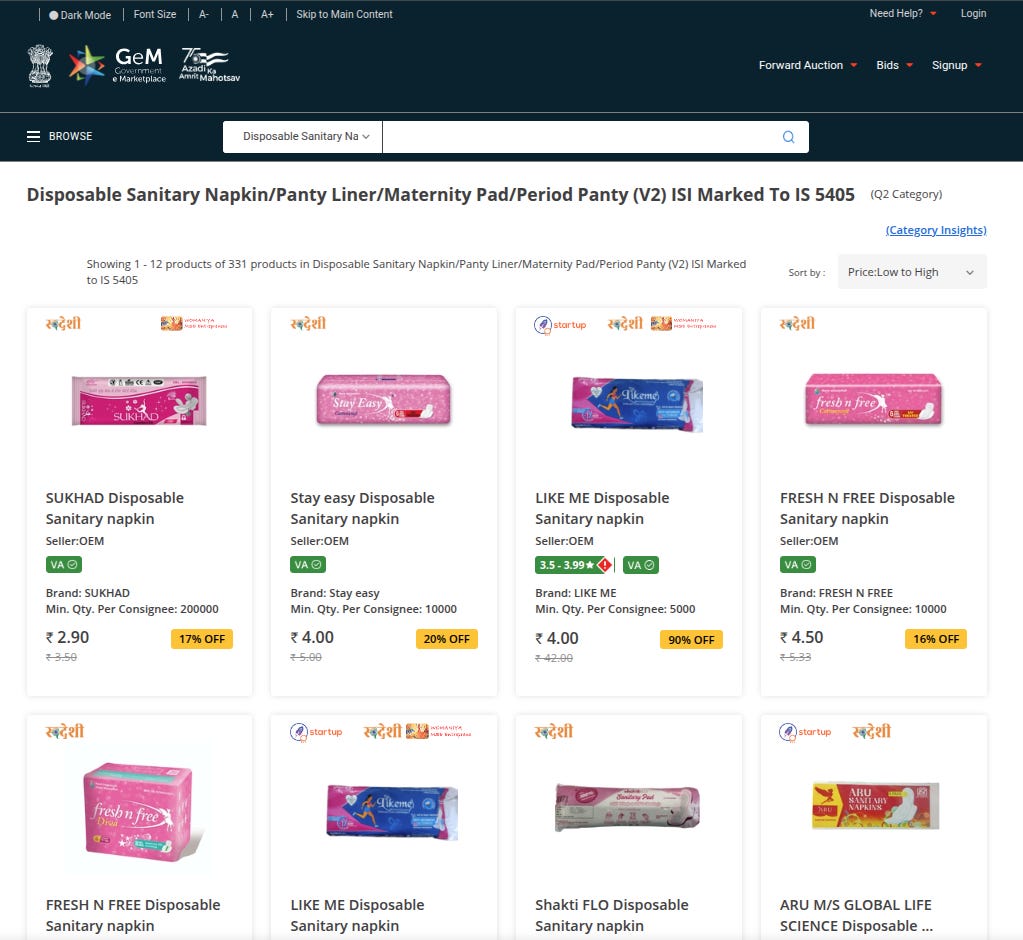
Put like that, it sounds like the government has built itself an Amazon.
Well, not exactly, but what it has built is one part of something much larger and much less discussed: public procurement . This is where a budget line stops being a number presented on 1 February every year and becomes a real thing the government spends money on.
It is one of the biggest levers the state has over the economy. India spends somewhere between one-fifth and one-third of its GDP on public procurement. It is large enough that governments everywhere use procurement as industrial policy too. India reserves 25% of its purchases for micro and small firms.
GeM itself is only a slice of that. It handles goods and services. Everything the government builds, from roads to bridges, runs through a separate system altogether called the Central Public Procurement Portal. The railways have their own, so does defense, but there are talks to integrate it all with GeM to create an interoperable public procurement system. Even at ₹5 lakh crore a year, GeM is just one rail in a procurement network nobody has mapped end to end.
So we went looking at how this machine actually works. Let’s dive in.
A very large tendering desk
What gives GeM the authority to be the way the government procures?
That power comes from Rule 149 in the General Financial Rules, the Finance Ministry’s rulebook for spending public money. It says that if something is available on GeM, central ministries, departments, public sector undertakings and autonomous bodies must buy it there. There is no minimum value.
The rule came in 2017, alongside the closure of the Directorate General of Supplies and Disposals (DGS&D), which had handled the government’s central purchasing since the 1950s. GeM inherited both its job and its mandate.
States are the exception, though. The Centre cannot force them to buy through GeM, so states join by signing agreements instead. And they are coming in fast. State purchases on the platform grew 38% last year. All this gives GeM roughly 1.37 lakh government organisations on the buying side.
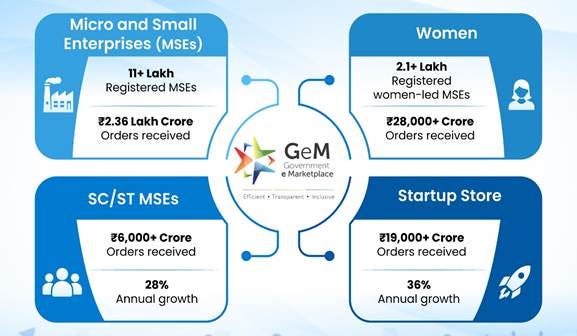
On the other side are 25 lakh sellers. Nearly 75% of the active sellers are micro and small enterprises. The platform also has women-led firms, SC/ST-owned MSEs and startups.
The process itself is simple. Someone decides they need something and writes down the specifications. GeM then decides how they can buy it based on the value.
Below ₹50,000, they can buy straight from the catalogue, much like any e-commerce platform you can think of. Between ₹50,000 and ₹10 lakh, they must compare at least three manufacturers and pick the cheapest. Above ₹10 lakh, they run a full bid or a reverse auction, where qualified sellers compete by undercutting each other live. Once the order is delivered, a receiving officer signs an acceptance certificate. Only then does the seller get paid.
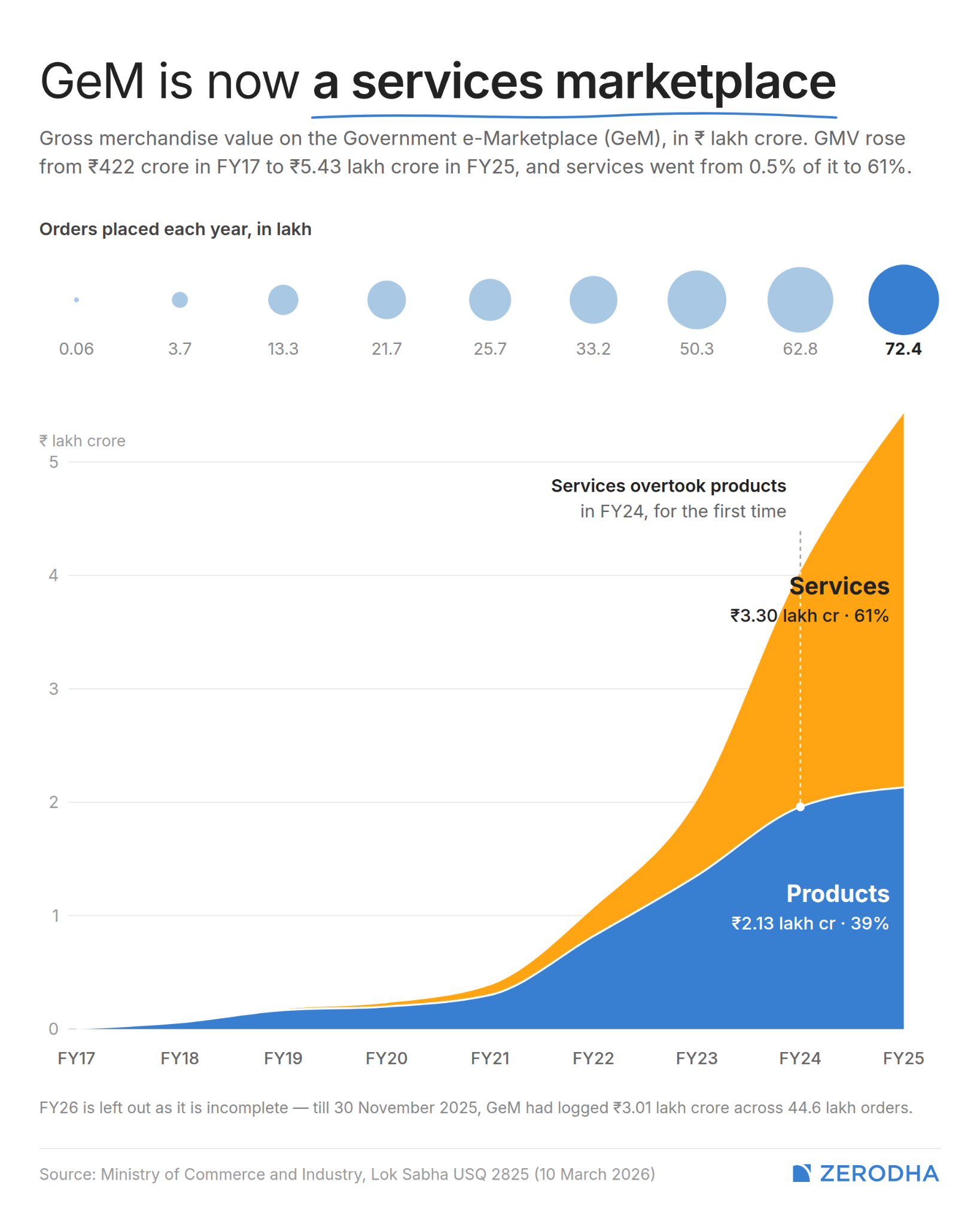
The growth has certainly been startling. GeM did ₹422 crore of gross merchandise value (GMV) in its first year. In each of the last two years, it has done more than ₹5 lakh crore. The first ₹10 lakh crore of cumulative purchases took more than eight years. The next ₹10 lakh crore took less than two.
But look inside those numbers, and the shopping-catalogue picture starts to fall apart.
Roughly half of everything bought on GeM by value is now services rather than goods . For central ministries, services make up closer to two-thirds of procurement. And central ministries and public sector companies together account for nearly 89% of the platform’s annual value. States and union territories make up only about a tenth.
Narrow the lens further and the picture gets even more concentrated. The single largest buyer in recent years has been the Ministry of Coal. Much of that comes from coal handling and transport contracts placed by coal PSUs — around ₹42,000 crore in one year alone. The largest order ever placed on GeM is NTPC’s ₹20,400 crore contract for mine development and operations.
What makes this truly surprising — and ironic — is that when GeM published its handbook in 2018, one of the categories the platform said it would never cater to was mining services . Today, some of its biggest orders are exactly that. These are not catalogue purchases. They are multi-year service contracts with labour rules, escalation clauses and penalties.
That also explains something odd that happened in FY26. GeM’s annual purchase value fell for the first time, down 7.4%. Not because the platform stalled or buyers walked away, but because coal PSUs placed fewer mining contracts. Coal’s share of the platform dropped from around 39% to about 20%.
Another way to look at GeM’s GMV is through small businesses. Micro and small enterprises win 68% of all orders placed on GeM, but only about 47% of the total value. The storefront — where a small firm sells chairs to a district office — is where the inclusion story mostly exists. The big money sits somewhere else entirely, in a handful of enormous contracts placed by a few enormous buyers.
What was GeM supposed to fix?
Putting procurement online was never the innovation, though. India already had electronic tendering portals before GeM, and still does. Contracts for roads, buildings and other public works have been published online for years.
GeM was trying to solve a different problem. And the handbook the government published in 2018 is unusually blunt about what that problem was. The old system was hardly well-coordinated. Different government departments followed different processes, often working in silos. A lot of procurement still depended on people manually moving things.
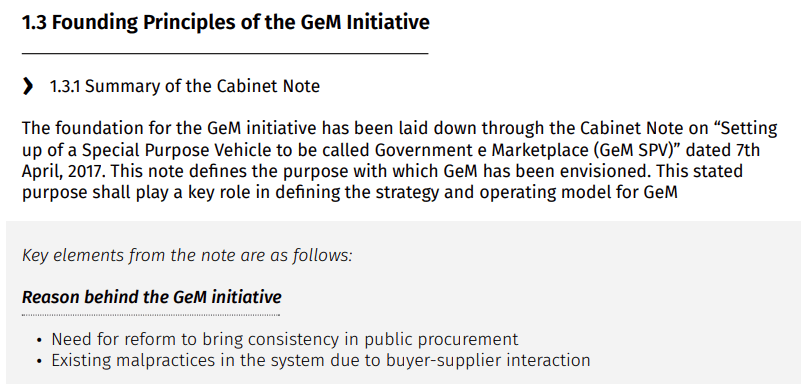
That created another problem: there was no mediation between buyers and sellers. The Cabinet Note that created GeM gave two reasons for reform. One was the lack of consistency. The other was, in the government’s own words, “malpractices arising from buyer-supplier interaction “.
Then, there was the old DGS&D rate contract system. Think of it as a pre-negotiated price list. The government fixed a price for a product, and departments could buy at that rate for a set period. But those prices did not move with the market. There was also a risk of sellers forming cartels. And only firms already registered with the DGS&D could really participate, making it difficult for new or small suppliers to get in.
GeM was meant to change all this. It even loosened procurement rules to move faster. The minimum bidding period fell from three weeks to ten days. The performance guarantee, which is the money sellers put up as security, fell from 5–10% of the contract value to 2%.
The theory was simple: standardise what the government buys, let more sellers compete and reduce direct dealings between buyers and sellers. If it worked, the government should pay less, get better goods and make procurement harder to manipulate. More suppliers should get a shot too.
And now, in ten years of operations, we may have enough data on how those promises held up.
The promises
Start with the biggest promise: savings. Ideally, a rate contract negotiated once a year with a closed set of vendors should lose to a marketplace where sellers compete on price. The official figure is ₹1.15 lakh crore saved. A new IIT Delhi study puts the monetised benefit over the last three years at ~₹86,000 crore.
But 99% of that savings is simply the gap between what the government estimated it would pay and what it eventually paid. And that is precisely the sort of calculation the CAG has questioned.
In 2020, the auditor found that GeM’s displayed “market prices” were effectively being set by sellers themselves, sometimes creating gaps as high as 93%. It concluded that the methodology “does not appear to be robust.”
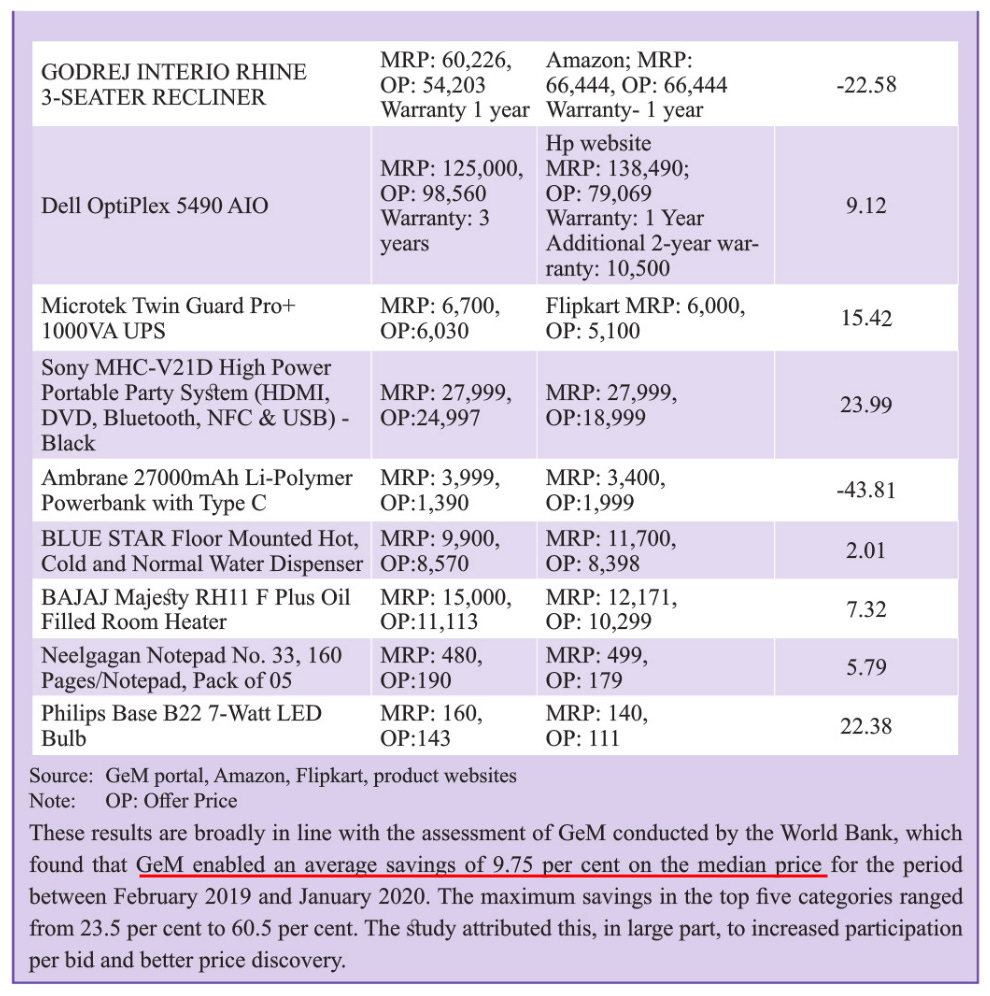
A cleaner test is to compare like with like. The government’s own Economic Survey matched actual products on GeM against Amazon, Flipkart and company websites. In 2021-22, GeM was cheaper on ten of the 22 products studied, by about 9.5% on average. The year before, the gap was 3%. The Survey also cites a World Bank finding of 9.75% median savings, largely because more sellers competed for each tender.
Similarly, in a study of e-procurement rollouts across India and Indonesia, there was no concrete evidence that going digital reduced prices at all . However, India got better roads and Indonesia saw fewer delays, largely because contractors from outside the local area could now compete.
So the stronger case for GeM may not be that it always made things cheaper. It may be that it made more sellers show up and even improve quality. But once you open the door to more sellers, another problem appears: how do you know what they deliver is any good?
GeM’s answer was to replace much of the old manual machinery — like centralized seller verification, advance sampling and physical inspection — with standard specifications, seller ratings and vendor assessments. That makes the system faster and more objective, but it also puts enormous weight on getting the specifications right because price only comes after that. The lowest bidder does not automatically win, but rather it’s the cheapest offer that actually meets the technical requirements.
That being said, in practice, the filter does not always work. For instance, the CAG found a compatible printer cartridge listed at ₹30, against a market price of around ₹9,000. In another case, the system picked a desktop seller rated just 1.37 out of 5 who had already been suspended once and disabled twice. Even applying the seller-rating filter did not change the pick.
And then there is the problem GeM was explicitly designed around: collusion among sellers .
The government’s original diagnosis was that malpractice grew out of buyers and sellers dealing directly with each other. GeM was supposed to take that interaction out. But taking people out of the room does not necessarily take collusion out of the system. In fact, last month, the Competition Commission fined HP India and its resellers over ₹141 crore for rigging bids across 36 GeM tenders.
The loophole was surprisingly simple, too. To prevent counterfeits, GeM requires resellers to get an authorization letter from the manufacturer. HP allegedly used those letters to decide which resellers could bid for which tender, while coordinating prices and arranging fake competing bids. The Commission called it a “façade of competition ”.
Buyers can bend the system too. The CAG examined 31,993 bids and found 256 that had been sent to exactly one seller, even for common products like desktops, paper and chairs where plenty of sellers existed.
So GeM did solve one part of the old problem. It opened government procurement to far more firms. But getting in is only half the battle. Once a seller wins, they still have to deliver, get the department to accept the order, and then get paid.
And at least in the platform’s early years, that could take a while. The CAG found that the average journey from order to payment took 136 days. GeM’s rule says sellers should be paid within ten days of acceptance, but just 3.79% of payments met that deadline.
That is 2019 data, and GeM has changed a lot since. But it gets at the limit of what a marketplace alone can fix.
Everyone’s procurement is broken
It would be easy to read all of this as an indictment of India alone, but it isn’t. The proof comes from the same auditor.
You see, the CAG also audits international organisations. At the FAO, it found procurement plans that looked little like actual purchases and missing documents in nearly 71% of direct procurement cases. At the WHO, competitive bidding was skipped during the pandemic, and emergency cholera kits reached Ethiopia after the outbreak had subsided. These problems sound similar to our own.
South Korea offers a more useful comparison. GeM studied its procurement system, KONEPS, before launching. KONEPS began as a pilot in 1996 and went live in 2002. But Korea also shows why savings may be the wrong thing to obsess over. KONEPS generates roughly 8 trillion won in annual benefits, but only 1.4 won trillion goes to the government. The remaining is saved by suppliers, who no longer have to travel to government offices or submit the same paperwork repeatedly.
That lines up neatly with what the India-Indonesia study found earlier. Maybe the real test of a procurement platform is not just how much cheaper the government buys, but also how much cheaper and easier it becomes to sell to the government.
The United States takes a very different approach. Its central catalogue awards contracts on best value, not the cheapest price, weighing alongside technical capability and past performance. More importantly, unlike GeM in India, using it is voluntary. Roughly 90% of federal procurement happens outside it.
A platform people can leave gets a clear signal when it stops working. GeM does not have that signal. Central government buyers have no choice but to use it. Despite that, the CAG finding found that only a quarter of registered buyers had ever placed an order.
What do we take from all this, then?
Well, the World Bank’s take here is perhaps the most sensible: the places that benefit most such public procurement systems are usually the ones that already have strong institutional capacity. Technology can make procurement faster, wider and more transparent. But it cannot write a good specification, it cannot make an official inspect properly, and it cannot force a department to pay on time.

What is driving India’s vehicle boom?
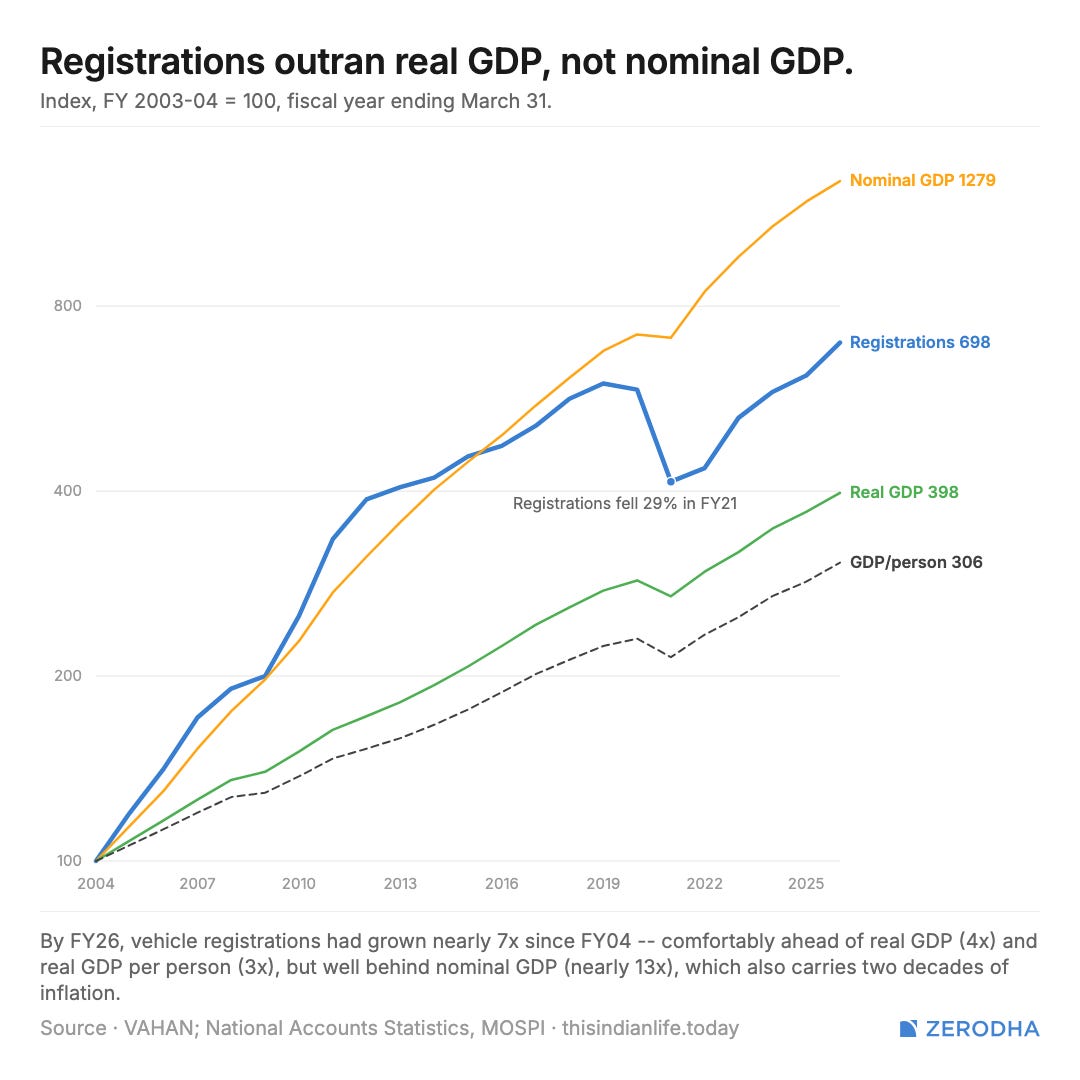
India registered about 4.4 million vehicles in FY 2003–04. By FY 2025–26, that had jumped to 30.8 million — nearly seven times as many. But was this simply because Indians got richer?
The chart compares vehicle registrations with three measures of income, with FY 2003–04 set at 100. By FY 2025–26, registrations had reached 698. Real GDP reached 398, while real GDP per person reached 306. So vehicle registrations grew much faster than both the economy and average income.
Nominal GDP grew even faster, to 1,279. But that includes inflation. In other words, part of that rise comes from higher prices, not just more economic activity. Still, people buy vehicles in today’s rupees and pay EMIs in today’s rupees, so nominal income matters too.
Income clearly helped. But it does not explain the whole boom. Easier loans, more dealers, better roads and weak public transport also made owning a vehicle easier and more useful. And much of this growth came from cheaper two-wheelers, especially in smaller towns and rural areas.
So rising incomes made more vehicle ownership possible. But credit, roads and the need for personal transport helped registrations grow much faster.
- This edition of the newsletter was written by Kashish.
Tidbits:
[1] The government plans to develop more than a dozen additional National Waterways over the next five to 10 years, with investments exceeding ₹10,000 crore. India currently has 32 operational waterways, while cargo traffic surged to 218 million tonnes in FY26.
Source: Livemint
[2] Corporate India reported 19.4% year-on-year revenue growth in Q1,its strongest in nine quarters. This is driven by automobile, banking, metals, and pharma sectors. However, net profit grew a more modest 11% as rising input costs squeezed operating margins.
Source: The Economic Times
[3] The Department of Atomic Energy has released draft SHANTI rules establishing a composite licensing framework for building, operating, and decommissioning reactors. The rules flesh out the SHANTI Act’s opening of the sector to private participation as India targets 100 GW of nuclear capacity by 2047.
Source: Bloomberg
[4] Space regulator IN-SPACe’s liability framework requires private launch operators to carry third-party insurance of up to ₹500 crore, covering risks from launch and orbital operations. The framework is designed to protect against potential liabilities India could face under international space law obligations.
Source: The Hindu BusinessLine
[5] Each of the four upcoming critical mineral processing parks under the National Critical Mineral Mission will be dedicated to a single element rather than a general mix of minerals. The initiative will begin with dedicated parks for lithium and nickel, aiming to concentrate the entire value chain and downstream industries in one location.
Source: PSU Watch
[6] The proposed sale of MTNL’s Mauritius telecom subsidiary has been paused as the Indian government reassesses the strategic value of maintaining a corporate presence in the island nation. The unit’s sale was initially planned to help the loss-making state-owned carrier pare its debt, but wider geopolitical interests in the Indian Ocean region have prompted a review.
Source: Livemint
[7] The government has set maximum LPG production levels totaling 63,810 tonnes a day across domestic refiners and upstream producers, to be activated during supply constraints. The framework was established to safeguard domestic cooking gas supplies following disruptions from the West Asia conflict.
Source: Business Standard
[8] The government’s proposal to introduce energy efficiency star ratings for electric two-wheelers has drawn resistance from industry body SIAM. SIAM argues that imposing star ratings at this stage could create additional operational burdens while the electric mobility sector remains reliant on government subsidies.
Source: Livemint
Beyond Today’s Brief
There’s always more happening at Markets by Zerodha.
- The Chatter: Why is the RBI Governor calling AI a structural shift on par with 1990s liberalisation? How is Canara Bank using foreign currency swaps to replace high-cost bulk deposits? And why did low-margin catering compress IRCTC’s overall profitability despite strong top-line growth?
- What We’re Reading: Everything from how equity market institutions transformed Indian finance to whether AI data center build-outs pose a real credit risk to why Deepseek is chasing AGI at one-twentieth the cost.
- Points & Figures: Why does Tamil Nadu lead India in factory jobs while Gujarat leads in gross output and Maharashtra in value creation? And what does state-level capital intensity reveal about how different regions build industrial ecosystems?
Join us on WhatsApp , where we share interesting soundbites from concalls, articles, and everything else we come across throughout the day. You’ll also get notified the moment a new video or article drops so that you can read or watch it right away.
Thank you for reading. Do share this with your friends and make them as smart as you are 