
Our goal with The Daily Brief is to simplify the biggest stories in the Indian markets and help you understand what they mean. We won’t just tell you what happened; we’ll tell you why and how too. We do this show in both formats: video and audio. This piece curates the stories that we talk about.
You can listen to the podcast on Spotify, Apple Podcasts, or wherever you get your podcasts and watch the videos on YouTube. You can also watch The Daily Brief in Hindi.
In today’s edition of The Daily Brief:
1. How effective is India’s PLI scheme, really?
At its halfway mark, India’s ₹1.91 lakh crore Production-Linked Incentive (PLI) program has disbursed roughly ₹35,400 crore, with 88% of payouts concentrated in just four sectors led by mobile phone assembly. While smartphone exports surged to ₹2 lakh crore, domestic value addition (DVA) lagged in sectors lacking local component ecosystems or technical know-how—leaving battery cell and upstream solar wafer schemes with zero payouts and direct job creation at just 28% of target. In contrast, white goods raised DVA from 20% to 55% by banning finished AC imports, barring assembly-only payouts, and pairing domestic firms with foreign engineering partners.
2. What happens to farm suppliers when crops fail?
The weakest monsoon since 2015 triggered a chain reaction across India’s agricultural input makers during the crucial July–September kharif quarter. Dry fields caused farmers to skip pesticide and herbicide spray rounds, leaving agrochemical firms like Sumitomo holding bloated, high-cost inventory, while seed companies such as Rallis and Advanta faced heavy dealer returns of unsold paddy and corn bags. Meanwhile, surging sulphur costs pushed complex fertiliser prices up by over 50%, prompting cash-strapped farmers to switch to price-capped DAP even as mining explosives cushioned diversified players like Deepak Fertilisers.
*Our latest Subtext episode is on UPI MDR and the various nitty-gritties of India’s digital payment infrastructure. We host Tanya Naik, who heads Pine Labs’ omnichannel business, and Naveen Chaluvandi, Chief Digital Officer of YES Bank. This is a technical conversation full of incredible insights into how UPI work.
Watch the episode on YouTube.*
How effective is India’s PLI scheme, really?
Plus: What happens to farm suppliers when crops fail
In 2020, the government launched the PLI scheme to increase domestic manufacturing. It now covers 14 industries, from phones and ACs to solar panels, batteries and medicines, with ₹1.91 lakh crore budgeted. Of that budget, just ~₹35,400 crore has been spent.
So far, that money has gone to very few places. Four schemes have taken 88%; electronics alone took more than half. Meanwhile, the schemes for batteries and solar panels, which hold over a fifth of the budget, haven’t paid out a rupee.
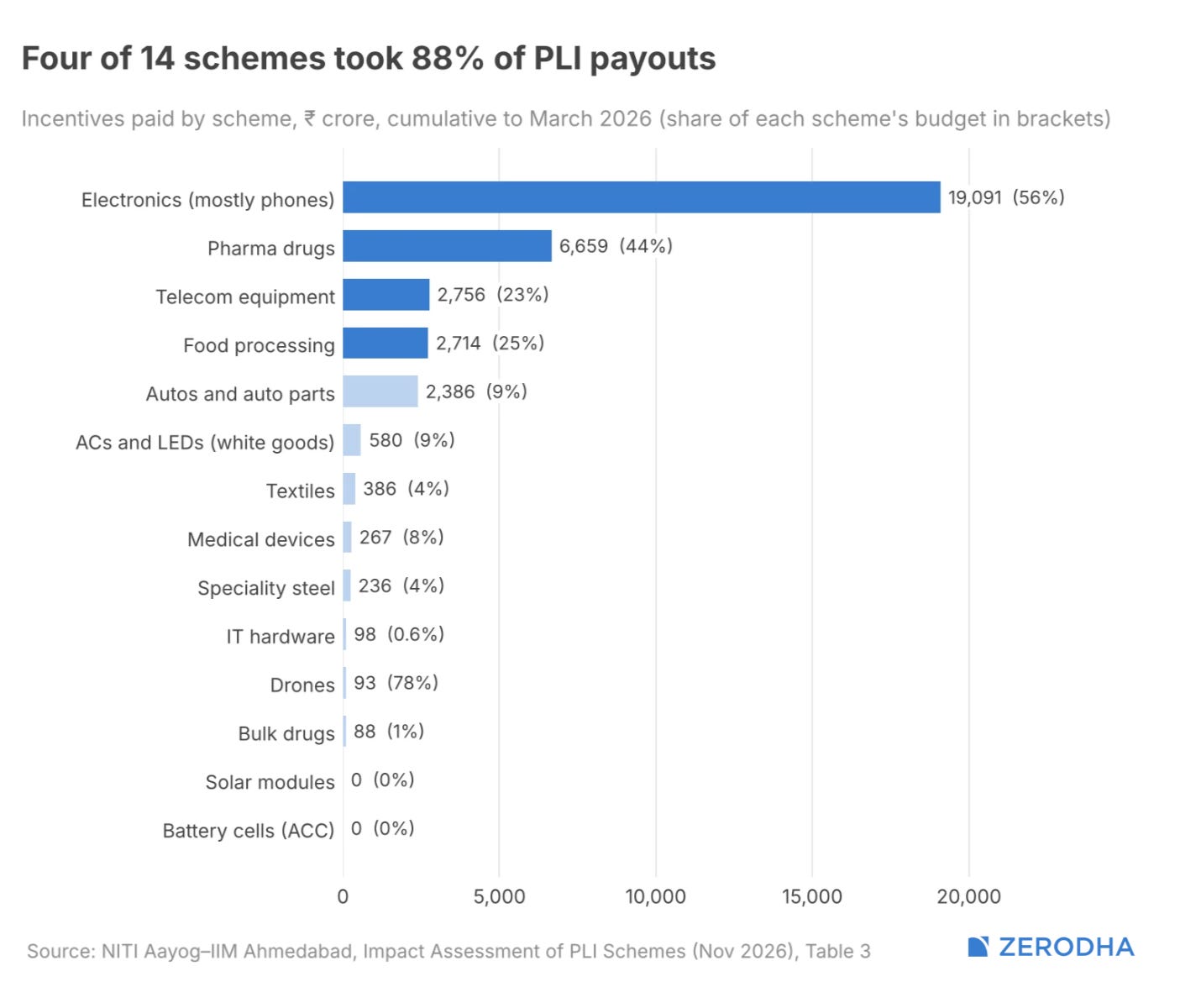
Now, with the schemes halfway through their combined tenure, we have a clearer picture of how they’re performing. Last week, NITI Aayog and IIM Ahmedabad published the first full review of all 14 schemes, using data up to March 2026.
Companies have met 76% of their investment target and 64% of their production target, but only 28% of their jobs target. NITI’s scorecard grades schemes on those three measures plus exports.
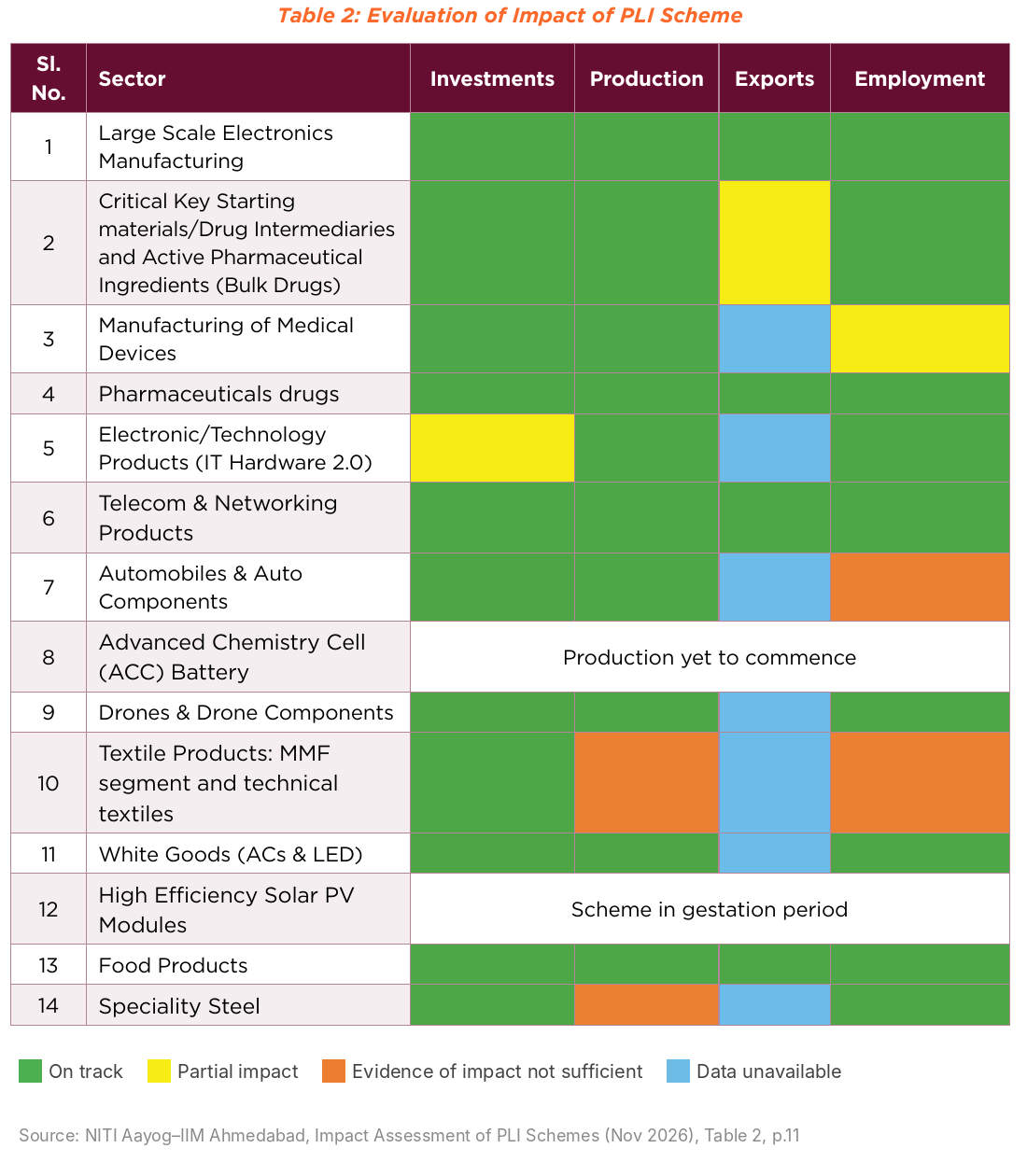
Yet, none of these tells us how much of each product is made in India.
A phone assembled here from imported parts counts as Indian production, but most of its value was created elsewhere. The metric used to track this is called domestic value addition (DVA), and it’s the lens we’ll also use to read the report.
In short, PLI worked where high operating costs were the main obstacle, making India a cheaper place to assemble products. But raising DVA happened only where companies also had the know-how. It sounds obvious, but several schemes weren’t designed around this.
We went through the report to see where the PLI got more of each product made in India, and why.
High production, low local value
The DVA lens can be understood in many sectors by two steps. First is assembling a product in India, and second is going beyond assembly.
As we’ve covered before, phones are the clearest case of the assembly step. In the report, the PLI incentives are termed Large-Scale Electronics Manufacturing (LSEM), but phones alone make up 98% of all LSEM production, sales, and exports.
When PLI began, global contract manufacturers like Foxconn were already assembling phones in China and Vietnam. What India lacked was a cost case: by industry estimates, making a phone here costs about 10% more than in Vietnam and 15% more than in China. The PLI incentive helped bridge part of that cost, and came right when Apple and others were looking to diversify beyond China. And assembly has boomed, with phone exports jumping from ₹22,868 crore in FY21 to ~₹2 lakh crore in FY25.
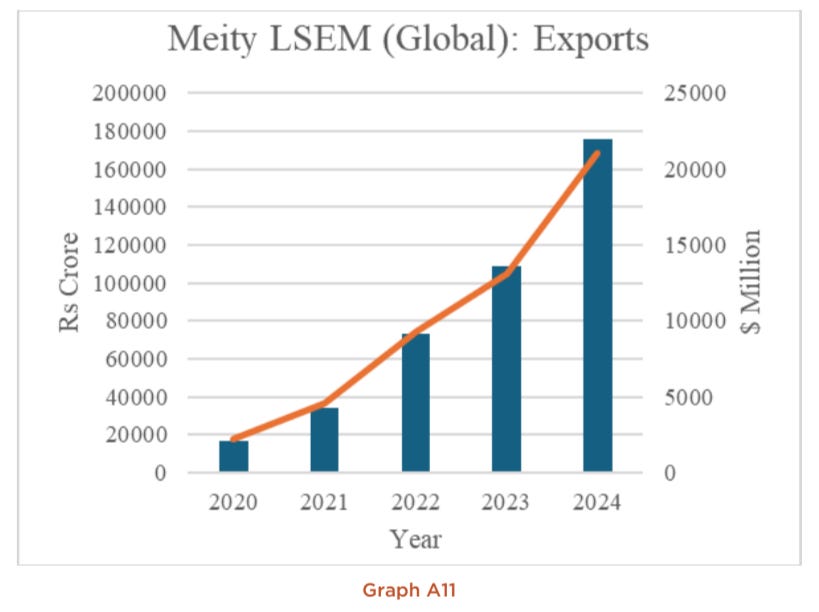
Source (Note: covers only global phone makers in the PLI scheme).
However, the scheme hadn’t set a mandatory DVA target. Companies were paid for selling finished phones assembled in India, even if most of the parts were imported. Across electronics, the government puts DVA at ~23%, up from 15%.
That doesn’t necessarily mean DVA couldn’t rise without a fixed parameter. Big assemblers also pull suppliers in behind them. As we covered in March, Apple’s suppliers in India now include foreign firms making cables, chargers, battery packs and casings, and Indian firms like Motherson and Aequs, and DVA in iPhones has risen to 15–20% from single digits a few years ago. Granted, most of that progress is in simpler parts, the same ones the duties targeted first. But you don’t get to the high-value layer without crossing these first steps.
Either way, if you are still importing most of a phone’s parts, assembling it in India remains structurally more expensive than assembling it in Vietnam, since Vietnam already has component suppliers nearby. Without a local parts network, the government payout and tariffs on imports do much of the work of keeping India competitive.
We saw this play out at Samsung. The company, which also runs its biggest phone factories in Vietnam, was among the first to complete its five years of PLI support in March 2025. In the very next quarter, its smartphone exports from India fell by ~20%, a drop industry executives blamed on the expired PLI payout.
Telecom equipment, the third-largest recipient of PLI payouts, followed the same assembly-first playbook, with global firms like Nokia and Cisco now assembling 4G and 5G network gear in India. Like phones, the scheme set no DVA floor, though it offered an extra 1% bonus for products designed in India. The report states that manufacturing remains concentrated in final assembly, with high import dependence for core components.
Beyond assembly: White goods & ACs
One scheme that clearly increased DVA is white goods, the industry’s term for large home appliances like ACs and LED lights. This represents ₹6,238 crores in the PLI’s budget.
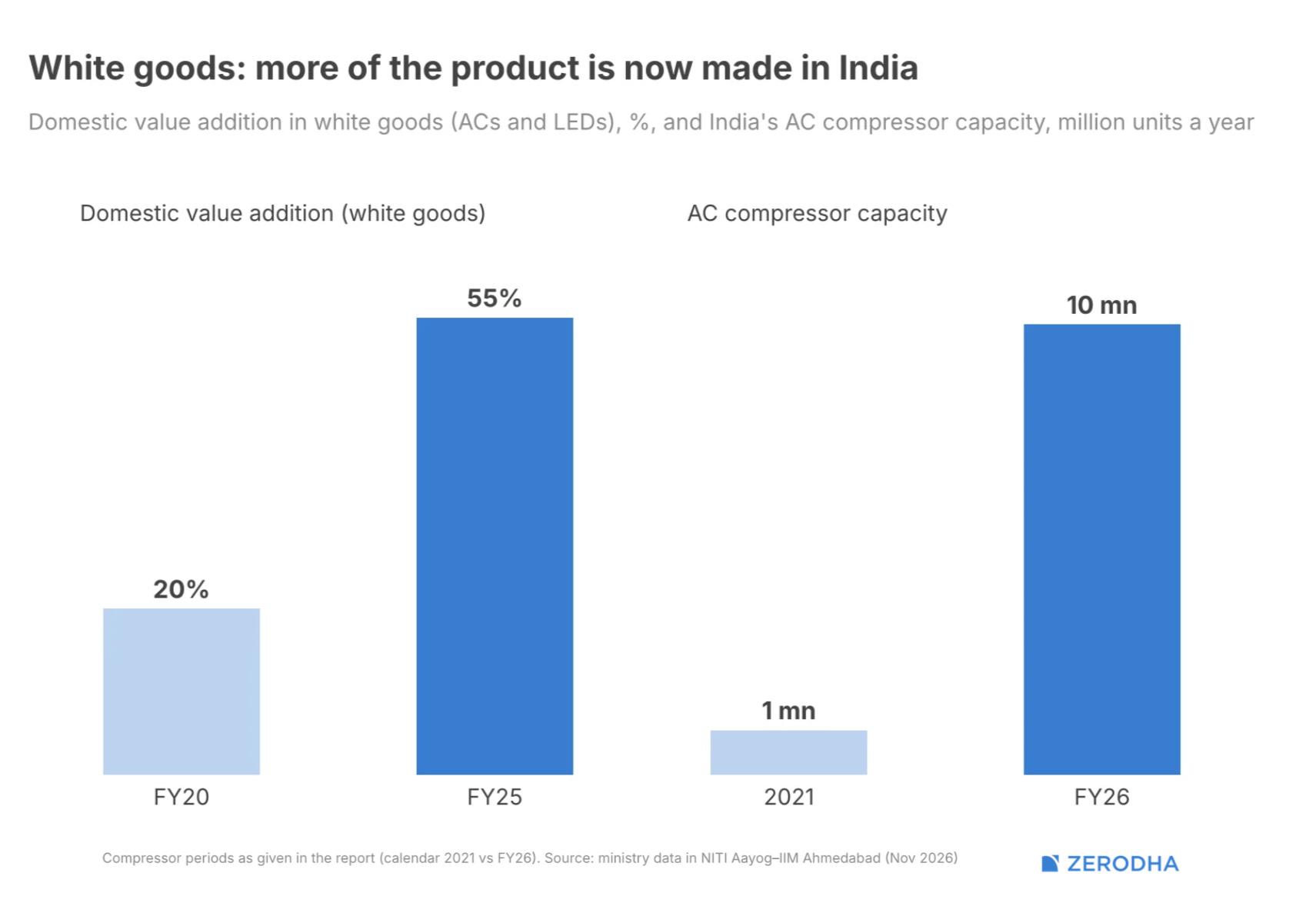
In 2020, only ~20% value of these products was created in India. Indian factories mostly assembled an AC’s outer shell, while importing the compressors to pump the refrigerant gas, the copper tubes that carry it, and the motors.
In April 2021, the government approved the White Goods PLI, where it said “mere assembly of finished goods shall not be incentivised”. While AC manufacturers asked for finished products to be included, the government did not budge.
Meanwhile, two other things helped white goods: First, six months prior to the PLI scheme for white goods, India banned imports of finished ACs filled with refrigerant. Brands had to assemble their ACs in India, giving local parts makers a ready customer base.
Second, foreign partners brought the know-how. Making a rotary compressor or drawing grooved copper tubing takes specialised engineering, and companies teamed up with Asian firms that already knew the process. One example the report points to is Daikin’s joint venture with Taiwan’s Rechi Precision to make compressors in India.
With all three forces in play, DVA in white goods rose from 20% in FY20 to 55% in FY25. The scheme has paid just ₹580 crore so far, about 9% of its budget. We can’t single out how much of that came from the PLI itself.
Batteries & Solar Panels
The government set similar DVA goals for batteries and solar panels, approved around the same time as ACs in 2021. But neither had what ACs had in its favour.
For EV batteries, there was no Indian company making lithium-ion cells at scale in 2021, and the government picked winners mainly on what they promised to build. But had the rules required cell-making experience, almost every Indian applicant would have been shut out, and the scheme would have ended up favouring foreign firms.
Consider an electric scooter’s battery pack. Indian firms already assemble packs from imported cells, but the scheme wanted them to make the cells themselves, which is a chemically intensive process that uses raw materials India barely produces. Yet, winners had to make 25% of a cell’s value in India within two years and 60% within five. These are unrealistic targets, and the report states that they were “misaligned with India’s current industrial base”.
Who won the PLI bids mattered too. In the 2022 bidding round, capacity went to Ola Electric, Reliance, gold jeweller Rajesh Exports, and Hyundai Global Motors. Somehow due to a quality mechanism, truly-established battery makers Exide and Amara Raja were actually waitlisted behind all the others.
Prior battery-manufacturing experience, it seems, was an afterthought. Rajesh Exports, which had no manufacturing experience in batteries, was the most cautionary consequence of that tale. This year, SEBI alleged in an interim order that the company had misrepresented about ₹15 lakh crore of revenue. Unsurprisingly, by March 2026, the winners had built 1.4 GWh of capacity against a 50 GWh target, with no commercial production, and no incentive had been paid.
Meanwhile, Exide actually licensed cell technology from China’s SVOLT and in September finished commissioning a 6 GWh cell plant near Bengaluru, outside the scheme. Indian firms chasing battery know-how keep running into the obstacle of getting Chinese partners to share it.
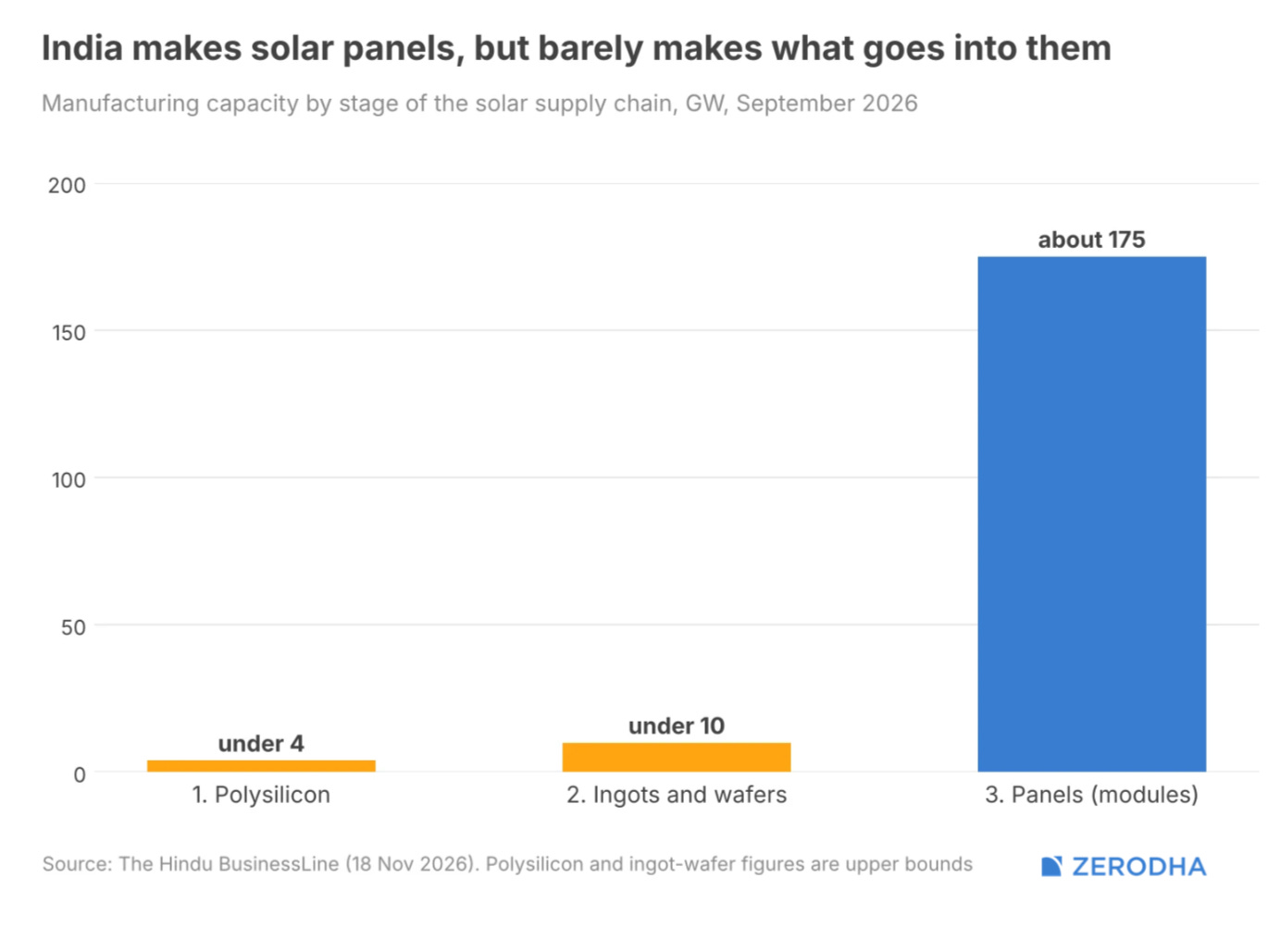
Solar shows the same gap further up the chain. A solar panel is the last step of a process that runs from polysilicon to ingots, wafers and cells. India has become very good at that last step: panel capacity grew from about 8 GW before the scheme to nearly 116 GW, and only about 24 GW of that came from PLI projects. By September 2026, panel capacity had reached about 175 GW, yet India still had under 4 GW of polysilicon and under 10 GW of ingot and wafer capacity.
Unlike batteries, solar had import protection with duties on imported panels and rules favouring domestic ones, yet it didn’t move upstream.
Making these components needs high-temperature furnaces and cheap round-the-clock power, plus Chinese equipment and know-how. Visa curbs on Chinese technicians slowed several projects. In 2025 the government gave the scheme two more years, but the scheme hadn’t paid out anything by March 2026. China’s export curbs will only make things harder.
Not every stalled scheme lacked know-how. Indian companies have made steel for generations, yet by March 2026, the scheme has paid out less than 4% of its budgets. Here, the report points to the rules themselves. In speciality steel, it says plainly that “the scheme design has been faulty”: high investment thresholds and slow guidelines meant it took three rounds, the latest in November 2025, to get it working. Only JSW Steel Coated Products had been paid.
What about employment?
Increasing DVA was one part of what PLI was meant to deliver. Creating jobs was another.
Four years ago, the government said PLI had the potential to create 60 lakh jobs. Now, the report measures them against a target of 30.19 lakh. As of March 2026, employment reported under PLI stands at 8.49 lakh, with 5.66 lakh indirect supply-chain jobs.
Food processing reports the highest employment levels, that too from just ₹9,207 crore of investment. But the report found that some large food companies reported PLI production “almost equal” to their entire production, even though they make many products the scheme doesn’t cover. This raises “a possibility of repurposing by beneficiary companies to claim PLI benefits”. If production is over-attributed, jobs likely are too.
Textiles, yet another labour-intensive industry, had a ₹10,683 crore scheme aimed at pushing mills into man-made fibres and technical textiles. But eligibility entailed a high minimum investment and turnover, a requirement to set up a new company just to apply, which tied to a narrow list of products. By this logic, only large firms would qualify, and most of India’s textile industry, which is made up of small and mid-sized firms, can’t clear those bars.
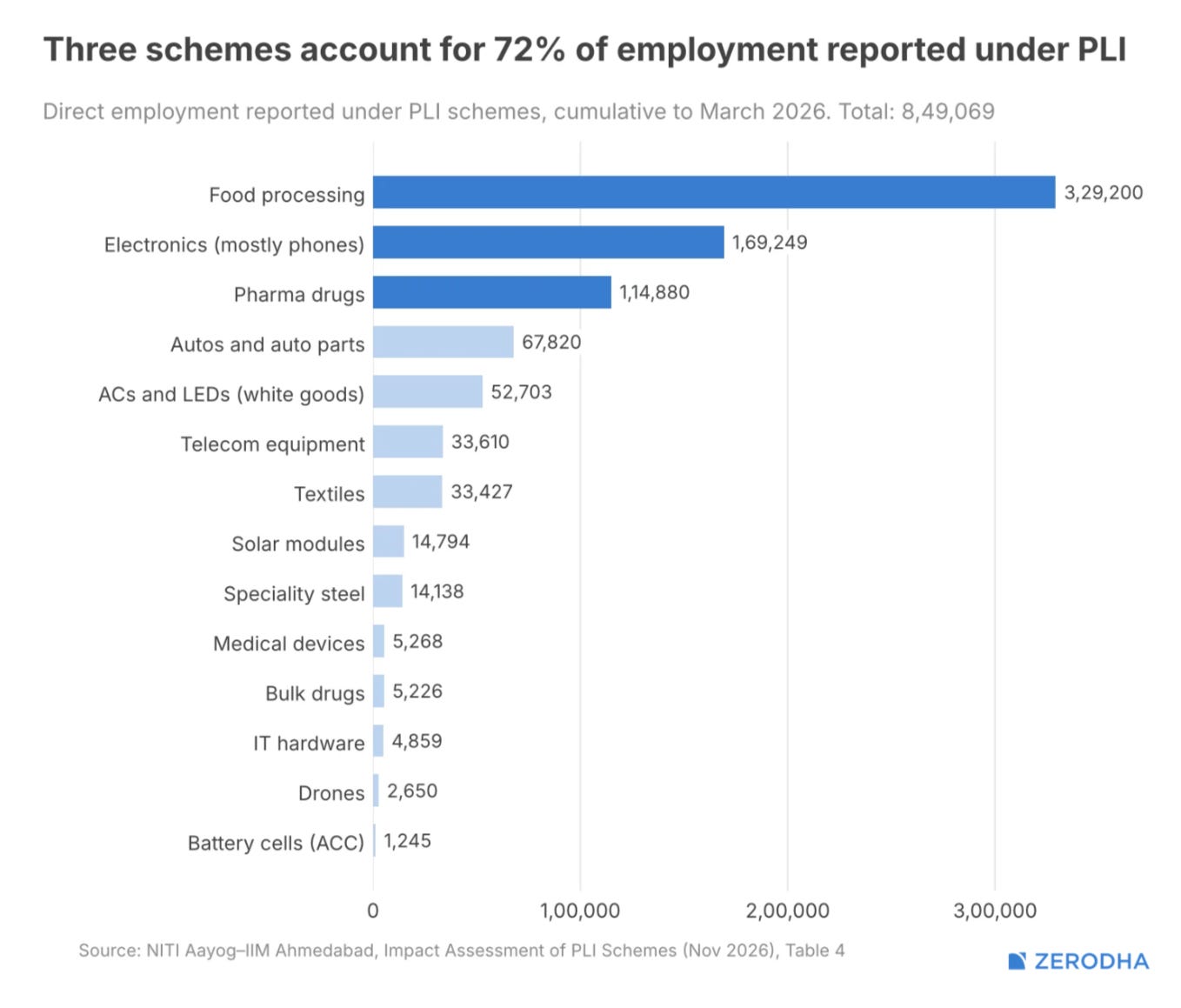
Why did ₹2.40 lakh crore of factory investment produce so few direct jobs? Partly because most of that capital went into heavy, automated plants where machines do the work. Solar factories, for instance, absorbed ₹64,873 crore, more than a quarter of all PLI investment in India, and created just 14,794 jobs. In fact, 7 of the 14 schemes generated fewer than 15,000 jobs each, and the report openly acknowledges that modern factory automation makes high job targets hard to hit.
What happens next
What comes after PLI, including its second leg, could play out differently. The new Mobile Phone Manufacturing Scheme approved in July 2026 still pays sales-based incentives, but adds up to 1.5% for sourcing key components in India and 3% for Indian brands that design their own phones. Alongside it, the Electronics Component Manufacturing Scheme, launched in April 2025, had its outlay raised to ₹40,000 crore in February. Together, they reward value addition far more directly than the first PLI.
The government is also easing access to know-how, particularly to Chinese technology. Since March 2026, foreign investors with up to 10% non-controlling ownership from countries sharing a land border with India no longer need prior approval, and proposals in components, capital goods, and polysilicon and wafers must be decided within 60 days.
But the door has to open from both sides. In October, China proposed restricting exports of 12 solar manufacturing technologies, some of which India critically needs now.
The new incentives give companies more reason to make components in India. But as batteries and solar have shown, that means little if manufacturers can’t access the technology, equipment and expertise needed to make them.

What happens to farm suppliers when crops fail?
Recently, we wrote about what a weak monsoon is doing to India’s food bill. That was the drought as seen by the people who buy food. Today, we look at the people who sell to farmers.
In a crop season, a farmer buys three kinds of things, together called agri inputs. Seed goes in first, just before sowing. Fertiliser feeds the soil the nutrients a plant needs to grow, like nitrogen and phosphorus. And through the season come the sprays, like herbicides for weeds, insecticides for pests and fungicides for fungal disease. The companies that make all this have just reported results for July to September. This is the heart of the kharif, or monsoon, season.
This was the weakest monsoon since 2015, and the quarter didn’t turn out the way it should have for these companies. But none of it was surprising.
Farmers skipped the sprays
Start with sprays, which are bought one round at a time, as the crop needs them. Unlike seeds, nobody stocks up on them in advance, so when demand goes away, it goes away cleanly.
This season, the monsoon took it away twice.
The first was timing. Weedkillers mostly go on just after sowing, and with sowing delayed and fields too dry for weeds to sprout, there was less to kill. Then, in August and September, farmers simply skipped spray rounds, as Sumitomo Chemical India told analysts.
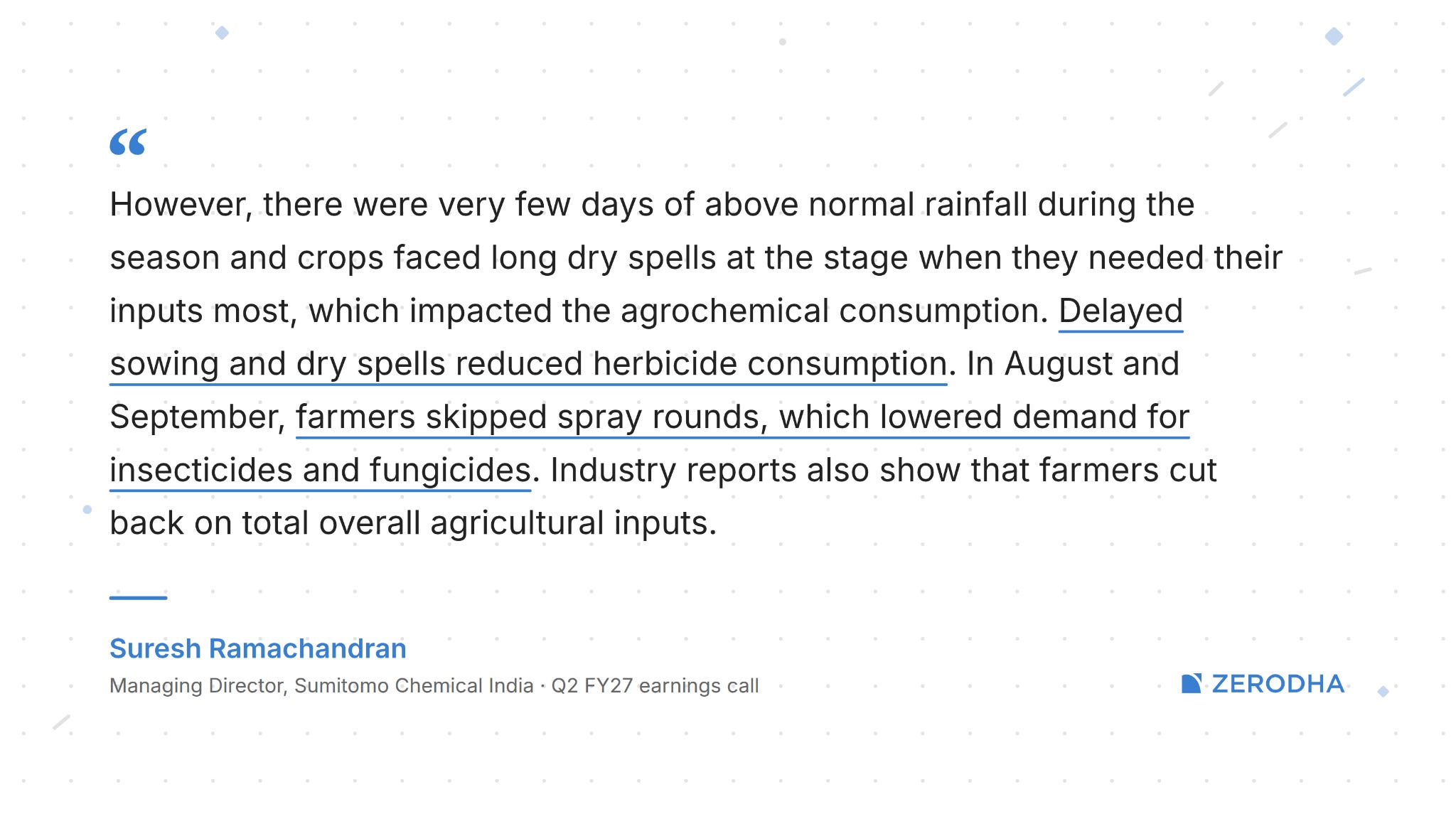
The second was the same story, carried over to pests. Insects and fungi like damp weather too, so dry fields had fewer of them, and farmers needed fewer insecticides and fungicides. PI Industries and UPL both said so.
You can see it in what still sold. At Sumitomo, insecticides, herbicides and fungicides all fell, while sales of metal phosphides rose 13%. Those are fumigants that protect grain in storage, after the harvest, when the weather has stopped mattering.
Where it rained mattered too. The southern states that are Coromandel International‘s home turf ran 20–30% short, while irrigated Punjab, Haryana and Uttar Pradesh held steady. As we’ve written before, wells and canals are what protect farms from a bad monsoon. This quarter, they also protected the companies selling to those farms, which is why sales teams are now being sent to irrigated districts for winter.
So who holds the sprays nobody bought? The companies, and they paid a lot for them. Between March and May, the war in West Asia and a weaker rupee pushed up raw-material costs, and companies raised prices to match.
The trouble came when the season soured, and some rivals began discounting to clear their shelves. Everyone else was left with stock bought at peak prices, in a market that wanted neither the stock nor the price. Sumitomo now holds about 115 days’ worth of inventory, up from 95 a year ago.
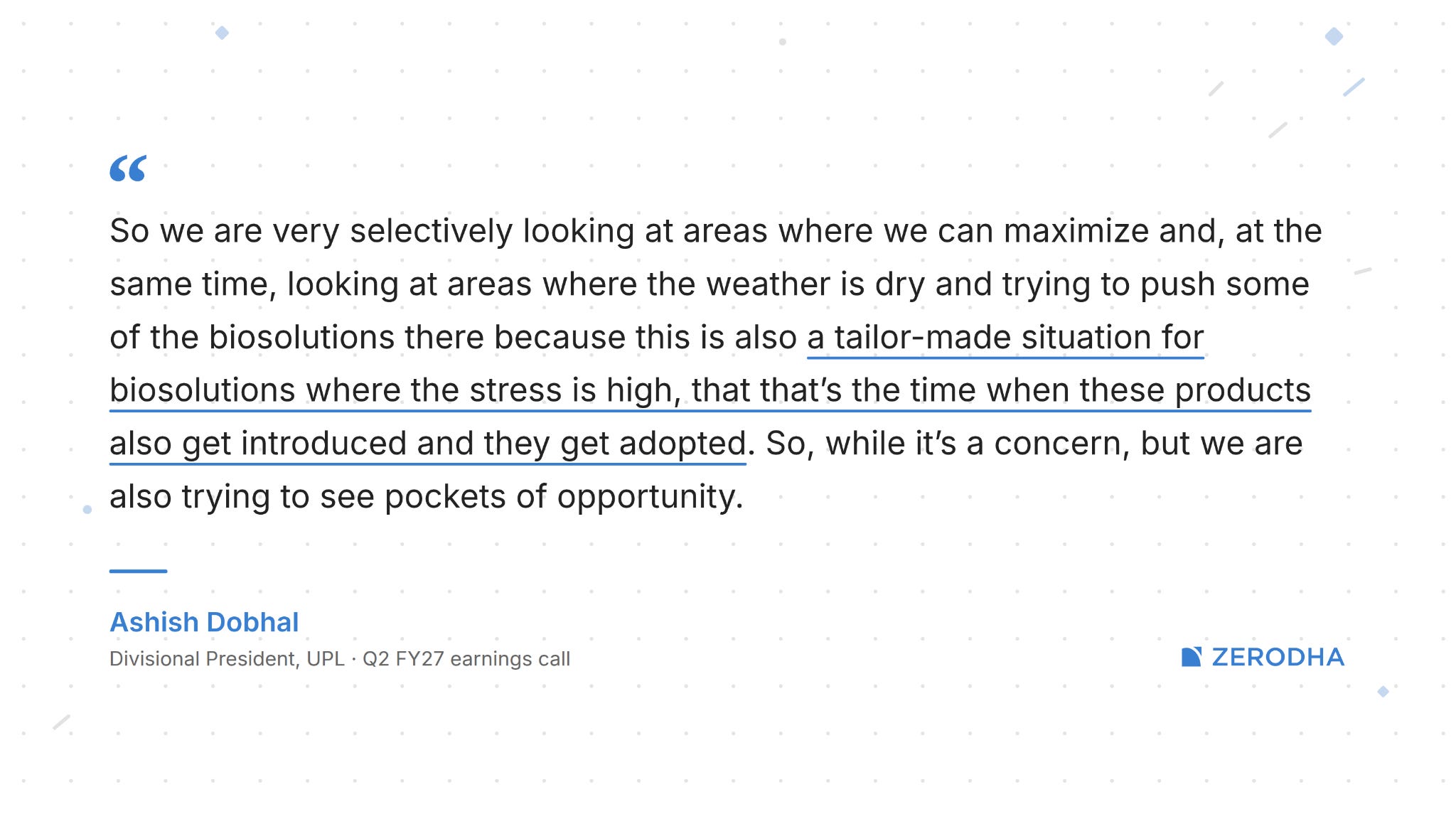
One more kind of product sold well: things that help a crop survive dry weather. Some are biologicals, made from microbes or plant extracts. They don’t kill pests but help the plants cope. Others are fertilisers that dissolve in water, so a farmer can use a little at a time.
PI’s domestic biologicals business grew 45%, and Coromandel said water-stressed farmers turned to its water-soluble and organic fertilisers. UPL said dry spells are when farmers are most willing to try such products, which makes sense. You experiment when the usual thing isn’t working.
Dealers sent the seeds back
With sprays, the company is left holding unsold stock, and it knows it. Seeds are trickier, because for a while the company thinks it sold them.
Seed companies ship bags to distributors and dealers before the season and book those shipments as sales. But if farmers don’t buy, the dealer can send the seed back. So a seed sale carries an asterisk until the season ends.
At Tata group’s Rallis India, the asterisk came due. Its seed business grew in the June quarter, as dealers stocked up on its seed ahead of sowing. In the September quarter, seed sales fell 31%. Fewer farmers bought paddy and cotton seed, more bags came back, and the business slipped into a loss.
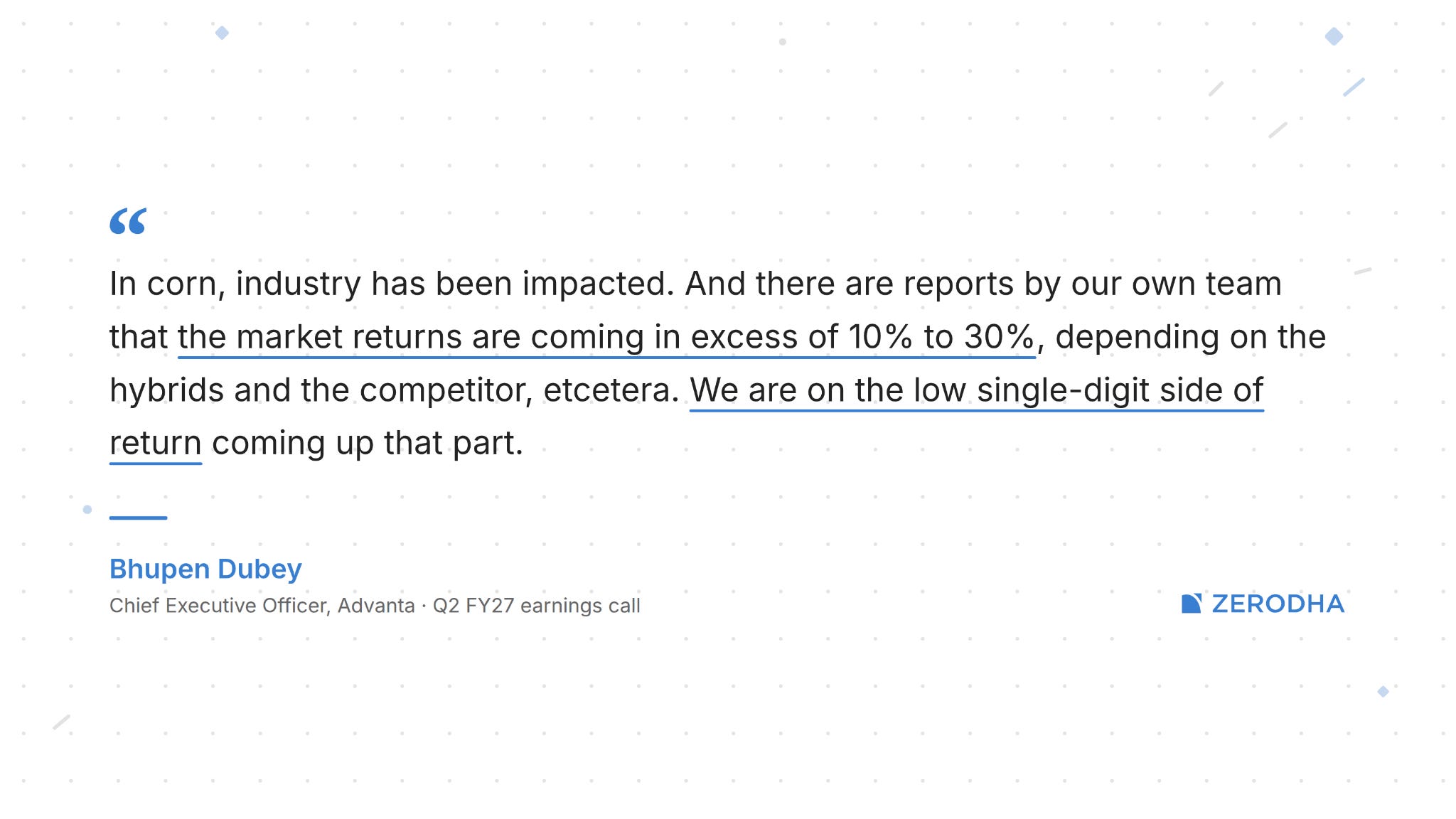
The head of UPL’s seed arm, Advanta, told analysts that 10–30% of the corn seed sold across the industry was coming back.
Bayer CropScience had the opposite problem, which is a nice problem until it isn’t. Seed companies grow their seed on contract farms, and Bayer’s farms had a good year. More seed per acre made each bag cheaper to produce, which lifted its profit by 9% even as revenue fell by nearly a fifth. But it also left Bayer with more corn seed than anyone wanted, and dealers short on cash took longer to pay for what they did take. So, Bayer is holding the extra seed and the unpaid bills from its customers.
A price cap picked farmers’ fertiliser
Fertilisers had a different problem.
Indian farmers mostly use three kinds. Urea supplies nitrogen. DAP supplies mostly phosphorus. Complex fertilisers, often called NPKs, blend nitrogen, phosphorus and potassium in set ratios. The government subsidises all of them, so what a farmer pays at the counter is partly a policy decision.
This quarter, industry sales of complex fertilisers fell 38%, while DAP sales didn’t fall at all. A drought can’t explain that gap. Price can.
The government effectively caps the price of DAP at ₹1,350 for a 50-kg bag. Complex fertilisers don’t have that cap. They get a fixed subsidy, and companies set the price. This year, the war made sulphur and phosphoric acid, raw materials for both, far more expensive. The subsidy didn’t rise to match, so companies passed the extra cost on to farmers through complex fertiliser prices.
Coromandel said the price of one popular complex fertiliser jumped from ₹1,350 a bag, the same as DAP, to ₹2,100. Both give the crop phosphorus. So farmers, already squeezed by a bad season, bought the cheaper DAP. Earlier, about 6 of every 10 bags farmers bought between the two were complex fertilisers. Lately, it’s been 3.
Farmers still wanted DAP. The trouble is that at the capped price, selling it barely pays. Most of India’s DAP is imported, and companies like Chambal Fertilisers earn only a thin, fixed margin on reselling it. So Chambal sold much less DAP, even with demand there. Coromandel, stuck with complex fertilisers nobody wanted, cut its sales by about 30% rather than pile up stock.
Urea barely noticed. Its price is fixed and low, so farmers buy it rain or no rain, and Chambal ran its urea plants flat out. As we explained in our piece on urea makers, a urea plant’s real customer is the government. Subsidy makes up most of its revenue, and its profit comes from using less gas than the government’s formula assumes. The catch is that the government pays late. As gas got costlier this year, Chambal’s dues piled up, and it is now owed over ₹4,000 crore, about double what it was owed in March. In urea, the drought shows up as an IOU from the state.
The government has since stepped in. It has begun reimbursing part of the spike in sulphur costs, and on November 11, it raised subsidy rates for the winter season.
The surest way to skip all this was to not depend on farmers. Deepak Fertilisers had its best quarter ever, thanks mostly to its mining chemicals business, which makes ammonium nitrate for explosives, and cheap gas from a long-term contract. Chambal’s new ammonium nitrate plant also turned a healthy profit in its first few weeks. This quarter, some of the best money in fertilisers came from selling to mines.
Winter looks dry, but crop prices are up
For agri input makers, winter will come down to where the water is. Rabi crops run largely on stored water, and reservoirs are about a quarter lower than a year ago. That’s why spray makers like Sumitomo are steering their sales teams towards irrigated districts. There, at least, farmers have a reason to spend: Advanta’s CEO says corn prices have nearly doubled this year.
Fertiliser makers are better placed. The new subsidy rates should cut complex fertiliser prices by 10–15%, and Coromandel expects buyers to come back.
- This edition of the newsletter was written by Zarieus & Kashish.
Tidbits:
1. Government invites fresh bids for duty-free import of 215,044 tonnes of raw sugar
The government has invited millers and refiners to apply for duty-free imports of 215,044 tonnes of raw sugar by November 27. The fresh allocation comes under the 10-lakh-tonne tariff-rate quota announced earlier this year to boost domestic supplies.
Source: Business Standard
2. Petrol pump dealers seek margin hike; Centre explores non-fuel revenues
Petrol pump dealers have again sought higher commissions to cover rising operating costs in a meeting with Oil Minister Hardeep Singh Puri. The government said the issue would be discussed with oil-marketing companies, while also exploring ways for fuel outlets to earn more from non-fuel businesses.
Source: The Hindu
3. CBT approves Systematic Withdrawal Plan for EPF members
The Central Board of Trustees has approved a Systematic Withdrawal Plan for retiring EPF members, allowing them to receive their savings in monthly, quarterly or half-yearly instalments instead of taking everything at once. The remaining balance will continue to earn returns, though the scheme still needs the required rule changes before it takes effect.
Source: The Hindu
4. NLC India Renewables files draft papers for IPO with ₹3,300 crore fresh issue
NLC India Renewables has filed draft papers with SEBI for an IPO comprising a fresh issue of up to ₹3,300 crore and an offer for sale of up to 10 crore shares by parent NLC India. The company plans to use ₹2,475 crore from the fresh proceeds to repay or prepay debt.
Source: Energetica India
5. Draft aviation health rules propose fines of up to ₹1 crore
The government has issued the draft Indian Aircraft (Public Health) Rules, 2026, which propose penalties of up to ₹1 crore for airlines and ₹25 lakh for airport operators that fail to comply with health protocols. The updated framework, which will replace 1954 regulations, also revises quarantine norms, including reducing the mandatory isolation period for unvaccinated travellers arriving from yellow fever-endemic zones from nine to six days.
Source: Livemint
Want more tidbits? Catch up on last week’s recap!

Weekly Tidbits #13
·
14 Nov
Beyond Today’s Brief
There’s always more happening at Markets by Zerodha.
-
The Chatter: Why is PM Modi urging corporate India to pivot toward pharma APIs, speciality metals, and Global South machinery, while CEA V. Anantha Nageswaran sees India nearing $1 trillion in exports and acting as a safe haven from global AI volatility? And how are IBM, Tata Technologies, KEI Industries, and Canara Bank navigating autonomous AI agents, 20% margin targets, and ₹30,000 crore data centre cable opportunities?
-
Aftermarket Report: How did Nifty and Sensex extend their winning streak for a fourth straight week, with Nifty rising 2.6% to 25,801 as Bank Nifty surged nearly 6% and FIIs poured ₹34,686 crore into Indian equities? And what do steep drops in gold and silver, 305 new 52-week lows, and a Fear & Greed reading of 71 signal ahead of monthly expiries?
Join us on WhatsApp, where we share interesting soundbites from concalls, articles, and everything else we come across throughout the day. You’ll also get notified the moment a new video or article drops so that you can read or watch it right away.
Thank you for reading. Do share this with your friends and make them as smart as you are 