Entropylite.in
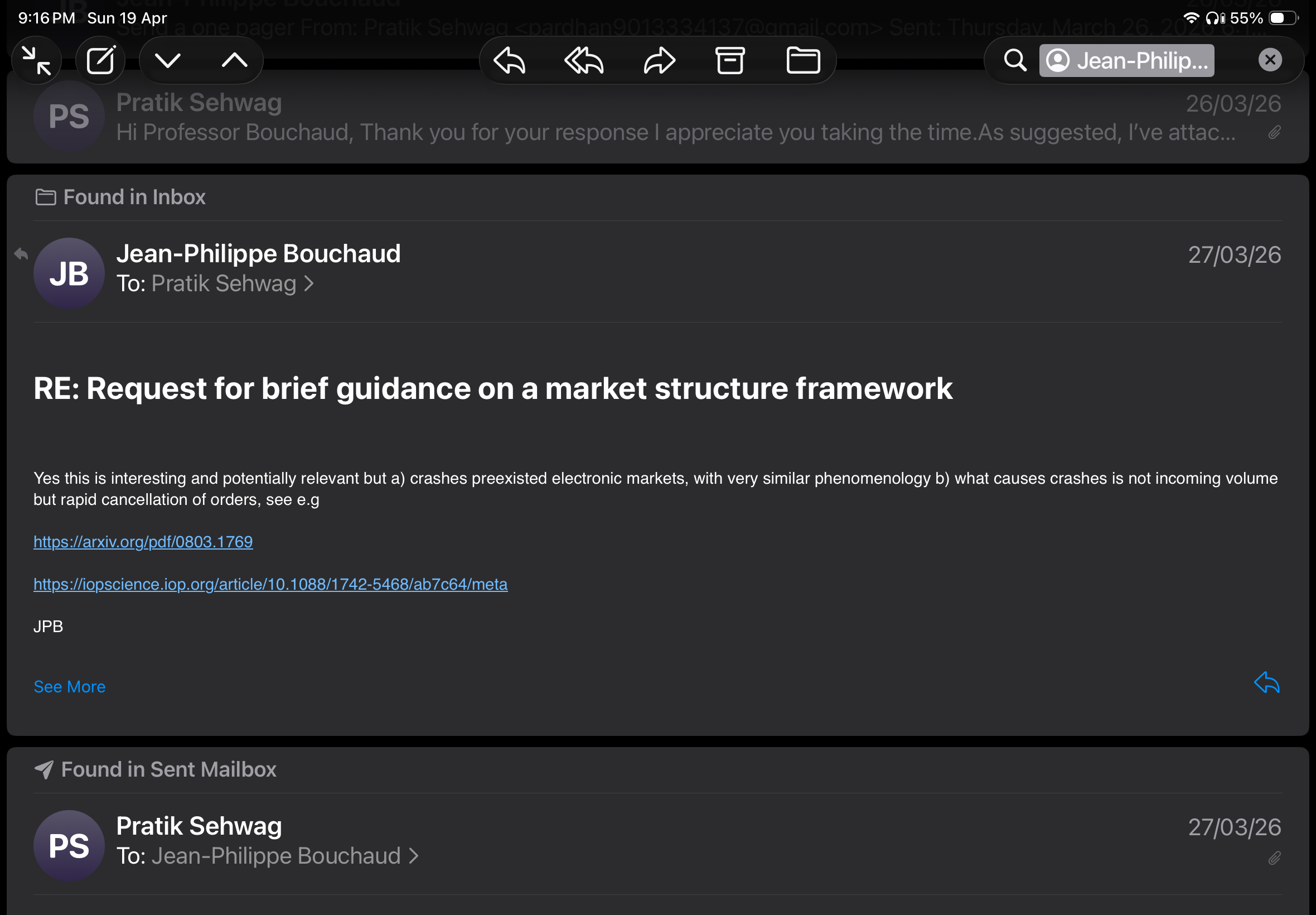
You can dress it up as you want. But in the end your conclusion is that you have certainty of movement in your favor, not just some tilt.
If so, why do you not make money of it ?
I don’t care what anyone says. Either it works or it doesn’t.
If it doesnt or you dont know for sure if it does, whats with the noise here, why are you shilling an amateurish website with a funny logo. If your interest is only academic, again why are you here ?
If it does, why aren’t you making money off it ?
There have been quite a few funny people here in recent months. Trading is not easy, not even once you have had success.
1 Like
Why so serious. Have some fun. 
2 Likes
@Pratikgo in the interest of time,
and since it is apparent that you have access to LLMs,
can you try sharing the text of the linked paper to an LLM
along with each of these prompts independently one at a time?
List all potential issues (including internal inconsistencies, and logical fallacies) in the following...
List practical challenges that limit and/or invalidate the approaches outlined in the following...
That should save a lot of time going back-n-forth in this topic-thread covering the same old ground that everyone with a “system to beat the market” fails to account for.
Right now, the paper fails to acknowledge the co-authors spherical cows in a vacuum et al.
After reviewing each of the flagged challenges
can maybe quote them one-by-one and provide rebuttals to each of them
to have further meaningful conversation here?.. 

On this aspect, i find that there are better quality alternative places online to have fun.
So, i have been looking for mostly serious discussions here.
Along these lines, any alternatives/suggestions for serious discussions on these topics online?
1 Like
But most of the posts are senseless. So better to accept it than fight against it. Just leave them without replying.
1 Like
Agreed.
However, any alternatives/suggestions where to have serious/meaningful discussions on these topics online?
(agreed, it’s subjective, but any personal favorites?)
Create a closed group on WhatsApp or telegram and discuss. You can ask over here who are interested in such topic. You can also have online meetings. You be the admin. If you feel people are speaking nonsense, just kick them out of the group.
just curious , If so why Zerodha created Trading Q%A
Not really sure.
Publicity brings clients. It increases transparency.
1 Like
well i too have no idea about it
my answer for you is same , well i too have no idea about it
Can we do something about it? No. Then why bother? Go with the flow.
1 Like
But one thing is sure, if you comment/ criticize Zerodha your Trading Q&A badge will change from “Regular” to " Member "
I strongly relate to this.
Recently posted my thoughts as some more “long shit” (diarrhea? ) 
??
At best this is TA and not FA. 
1 Like
Thrice it happened to me , there is one M factor which is very active , TA is Truth Table and i follow it
1 Like
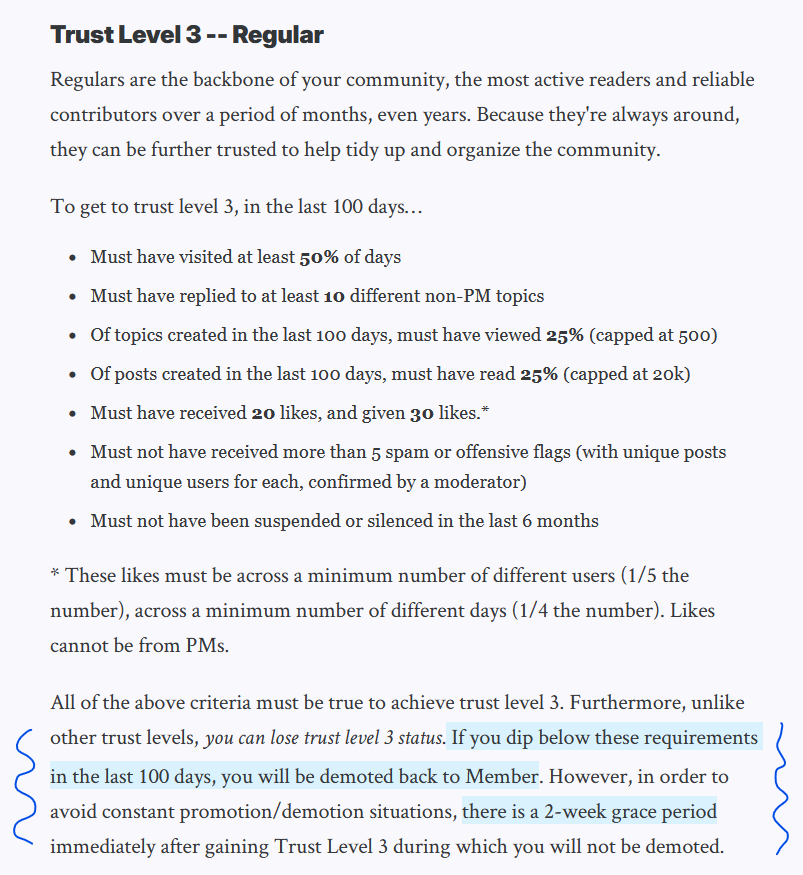
IMHO, it’s probably a coincidence, unless any specific posts were flagged (which would be visible to you as well.)
Anyway, how active one is on the forum
already determines these category badges automatically as well.
[ Source ]
Next Time i will share the screen shot , but not at all bothered if Trading QNA badge becomes Member to Basic
It’s concept of micro economics based on agents modelling bases I work with doctorates who knod on this concept because serves the purpose of helping us model independent agents in the market
With an example if you have a trend following fund and the correlation between thier assets breaks so they will with 100% certainty have to sell and it has been validated multiple times like 2008 crash.
Its not we trade with 100% accuracy which is impossible but we have a novel way that can help us understand those deterministic states better still skepticism is the mother of innovation
Respectfully you can conduct your own independent research and cite the paper.
Opus 4.7 smartest model on the planet
What CLANK Is
The paper proposes that complex systems — markets, organizations, supply chains, any high-dimensional system — are not always unpredictable. Under specific structural conditions, a system briefly transitions from probabilistic chaos into a state of near-certain, calculable outcomes. The author calls this a “CLANK state,” using the onomatopoeia of a gear locking into place.
The lifecycle and mechanism look like this:
Three conditions converge → CLANK state emerges
Latent Asymmetry (α)
Structural bias sets direction
Internal Pressure (Π)
Density / capacity ratio
Boundary Constraints (B)
Walls that prevent escape
CLANK State (C)
Diffusion collapses → single trajectory
Lifecycle of the deterministic window
Pre-Entry
Variance shrinks.
Signal forming.
Entry
Structural lock.
Trajectory fixed.
Persistence (Tᴄ)
Deterministic window.
Shocks absorbed.
Decay
Pressure vents.
Chaos returns.
Three key failure modes
Apophenia Error
Seeing a clank where none exists
Asymmetry Shift
Right clank, wrong direction
Boundary Breach
Pressure exceeds yield strength
Observer constraints
Non-Intrusive Observation
Observer must not add pressure
Latency Barrier (L ≪ Tᴄ)
Must act before window closes 1. Summary of Core Ideas
The theory rests on three structural conditions that must simultaneously converge:
Latent Asymmetry (α) — Every system has hidden fault lines: imbalances in power, resources, or information flow. In noisy, probabilistic regimes these are invisible. A CLANK state forces the system to follow these fault lines exactly, making the direction of movement predictable.
Internal Pressure (Π) — Defined as the ratio of interaction density to throughput capacity. When Π crosses a critical threshold (Πcrit), components can no longer act independently. They get “jammed” into collective, rigid behavior. Think of rush-hour traffic suddenly locking into one lane.
Hard Boundary Constraints (B) — The walls that prevent the system from simply bleeding off pressure through expansion or reorganization. These must have a higher “yield strength” than the pressure itself, or the system just deforms instead of locking.
When all three are present, the stochastic noise term in the system’s equations effectively collapses to zero. The system enters a deterministic window (Tᴄ) — a temporary island of certainty in a probabilistic sea. The author models this as the system’s state space collapsing from n dimensions down to m dimensions (m ≪ n), making future states calculable with precision.
The lifecycle runs: Pre-Entry (signal forming, variance dropping) → Entry (the structural lock) → Persistence (the window of opportunity) → Decay (pressure vents, chaos resumes). The decay phase is flagged as the most dangerous moment, because an observer who misses the transition will act on a system that is already chaotic again.
These aren’t fatal — they’re honest limits. Every theory has them. But they’re worth understanding clearly.
The pressure gauge doesn’t exist yet. The central variable — internal pressure Π — is defined as “how busy the system is relative to how much it can handle.” That’s intuitive. But there’s no universal way to actually measure it. In a highway, you can count cars and know the road’s capacity. In a corporate boardroom during a crisis, what’s ρ? What’s κ? You’d have to make judgment calls, and different people making different judgment calls would get different answers. Without a standard gauge, the theory can’t be applied consistently.
You can’t know the critical threshold until you’ve already crossed it. Π_crit — the pressure level at which the lock occurs — can only be calculated from past CLANK events in the same system. For systems that haven’t been through a documented CLANK before, you have no way to know when you’re approaching the threshold. The most important CLANKs to predict are usually the unprecedented ones. Those are exactly the ones the theory can’t calibrate for.
The detection tools require data that usually doesn’t exist. The specific early-warning signal the paper proposes — an anomalous spike in the leading eigenvalue of the covariance matrix — requires dense, simultaneous, high-frequency observations across many parts of the system at once. Stock markets have this. Traffic networks have approximations of it. An organization navigating a merger, a government managing a sanctions regime, a supply chain under stress — these do not. The most mathematically elegant prediction in the paper is only testable in the domains where you have the least need for a new theory.
The signal might arrive after it’s already too late to act. Even if you can detect the pre-signal, you then need to: verify pressure is above the threshold, map the structural asymmetry, check the walls are strong enough, calculate the trajectory, and act — all before the lock closes. In fast-moving systems, the window between “detectable” and “over” may be seconds or milliseconds. The paper acknowledges that latency is a problem but doesn’t account for the time the detection process itself takes.
You need a history that often doesn’t exist. The protocol says to test your model of the directional lean against “multiple historical pressure cycles.” This is sensible advice. But new markets, new institutions, new technologies, and new geopolitical configurations don’t have multiple historical pressure cycles. The first time a system goes through a CLANK is, by definition, the one you have no calibration for.
The yield strength of walls is only revealed when they break. The theory’s safety condition is: make sure the pressure doesn’t exceed the strength of the walls. Good advice. But the strength of institutional walls — political commitments, regulatory rules, corporate policies, alliances — is almost never known in advance. It’s revealed at the moment of failure. You can’t stay safely below a threshold you can’t measure until after you’ve exceeded it.
You can’t tell “locking” from “locked” in real time. Pre-entry (approaching the lock) and persistence (inside the lock) look nearly identical from the outside — low variance, high correlation, rigid behavior. The difference is that in one you’re still at risk, and in the other you’re safe to act. The theory says you should act at the precise transition point. But distinguishing that transition in real time, without knowing the baseline variance (see problem 4 above), is essentially impossible. You’re trying to identify the exact moment a door clicked shut — from inside the room, without being able to see or touch the door.
Knowing when to stop is as hard as knowing when to start. The theory correctly identifies the decay phase — when the lock releases — as the most dangerous moment. It says to exit as soon as pressure starts venting. But pressure venting is invisible in most real systems. The algo completing its sell order, the central bank quietly shifting policy, the organizational crisis silently resolving — these are not announced. You’re trying to exit based on an exit signal that doesn’t broadcast itself.
The clearest example barely counts as a real-world test. The SIR epidemic model — which the paper uses as one of its four empirical anchors — is a mathematical model invented by researchers to study threshold dynamics. Of course it exhibits a CLANK-like transition. It was designed to. Using a mathematical model as evidence that your mathematical theory applies to reality is not quite the same as applying it to reality. Real epidemics have heterogeneous populations, behavioral responses, interventions, superspreaders, and measurement errors that the SIR model deliberately strips away. The gap between the clean example and the messy world is enormous.
Walls are almost never truly hard. The theory’s boundary constraints are binary — they hold or they break. Real constraints are graded. A regulatory rule can be selectively enforced. A contractual obligation can be renegotiated. A central bank commitment can be quietly softened before it’s formally abandoned. A competitor’s capacity constraint can be partially relieved. Most real-world “walls” are more like membranes — they resist pressure proportionally rather than holding absolutely until sudden failure. The theory doesn’t have a vocabulary for this gradual softening, which means it would systematically misclassify slow-motion Boundary Breaches as stable persistence phases until the moment of visible collapse.