Our goal with The Daily Brief is to simplify the biggest stories in the Indian markets and help you understand what they mean. We won’t just tell you what happened; we’ll tell you why and how too. We do this show in both formats: video and audio. This piece curates the stories that we talk about.
You can listen to the podcast on Spotify, Apple Podcasts, or wherever you get your podcasts and watch the videos on YouTube. You can also watch The Daily Brief in Hindi.

In today’s edition of The Daily Brief:
-
Inside Manipal Health IPO
Manipal Health’s IPO offers a closer look at the economics of India’s hospital business, showing how efficient operations, acquisitions, and debt management shape growth in a sector with rising healthcare demand. -
Why does “manufacturing” now look like “services”?
Modern manufacturing is no longer just about assembling products. As services such as engineering, testing, software, and supply chain management become integral to production, India’s real opportunity lies in owning more of the value chain, not just making products.
Inside Manipal Health IPO
Hospitals are a strange business. We don’t visit them because we want to. We visit them because we have to. When a family member is critically ill, you don’t ask the receptionist for a price list or compare rates across different hospitals on your phone. You simply hand over your credit card.
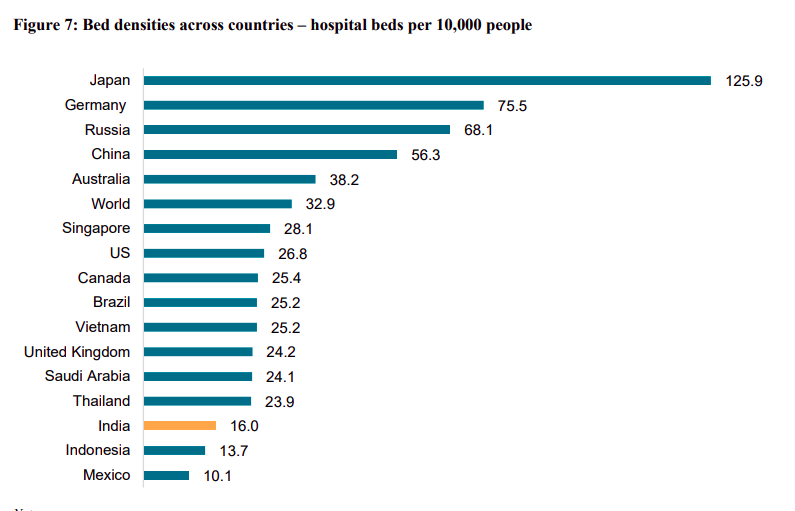
That urgency exists because access to quality hospital beds can make all the difference. And India doesn’t have enough of them. The country has just 16 hospital beds for every 10,000 people. The global average is almost double, at nearly 30. Even Vietnam has more hospital beds per person than India.
Now, India does have a vast public healthcare system, with government hospitals spread across the country. But that doesn’t reduce the need for a strong private healthcare system to share the burden of caring for our population.
That’s where large private hospital chains come in. Several are already listed, and another is on its way to the stock market. We’re talking about Manipal Health, whose ₹9,700 crore IPO closes for subscription today. So if you’re planning to apply, or you’re simply curious about how the hospital business works, this story is for you.
How does the business actually work, and where does the money come from?
A hospital’s business can broadly be split into two parts: the Out-Patient Department (OPD) and the In-Patient Department (IPD). While both treat patients, they operate like two very different businesses.
The Out-Patient Department (OPD) is where patients come for routine consultations, blood tests, X-rays, or other minor procedures before heading home the same day. Naturally, this department sees a lot of footfall. But despite the high volume, it isn’t very profitable.
That’s because most OPD treatments aren’t specialized enough to command high prices, while the costs are substantial. Hospitals need to maintain clinics, hire large administrative teams to manage patient flow, and pay doctors to be available throughout the day. At the same time, the DRHP points out that hospitals have very little pricing power here. Charge too much for an OPD consultation or diagnostic test, and patients can simply walk across the street to a standalone clinic or lab, because the competition is too fragmented.
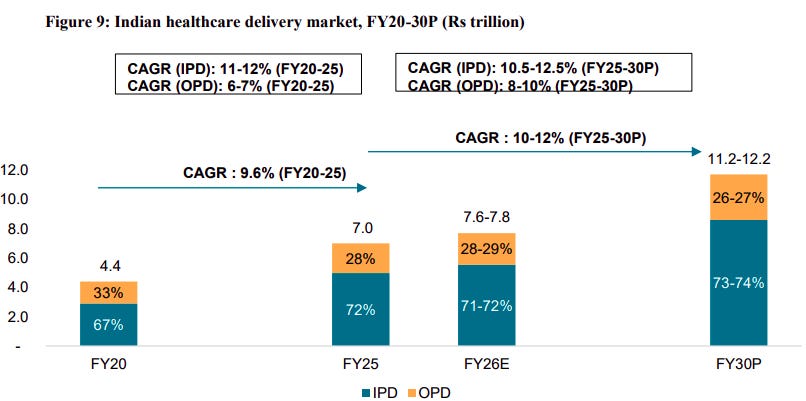
The In-Patient Department (IPD) is a completely different story. This is where patients are admitted overnight for surgeries, intensive care, or longer treatments. It’s also where hospitals make most of their money. Around 70% of hospital revenue comes from IPD services, and this segment is growing much faster than OPD.
The reason is simple. Once a patient is admitted, every part of the treatment becomes billable. Hospitals charge for room rent, nursing care, operating theatre time, anaesthesia, diagnostic scans, and they also earn from drugs, implants, and consumables such as stents and sutures.
More importantly, inpatient admissions are often driven by emergencies or serious medical conditions. At that point, the priority is getting the treatment right, not comparing prices. That gives hospitals far greater pricing power than they enjoy in the OPD.
Now, coming back to Manipal. Like most hospital chains, it doesn’t run its OPD to make money on a standalone basis. Instead, the OPD acts as a funnel into the much more profitable IPD. For instance, a doctor may diagnose a complex condition during an OPD consultation and schedule a surgery. What began as a low-ticket outpatient visit can then turn into a high-value inpatient admission.
Once a patient enters the IPD, Manipal further optimizes its economics in two key ways.
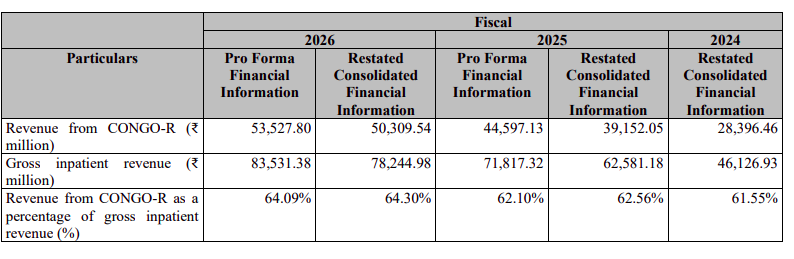
First, it avoids filling expensive hospital beds with patients who only need basic monitoring. Instead, it focuses on six high-value specialties: Cardiac Sciences, Oncology, Neurosciences, Gastroenterology, Orthopedics, and Renal care—the “CONGO-R” mix.
These six specialties account for roughly 60% of Manipal’s inpatient revenue. They also tend to involve more complex procedures that command higher margins. More importantly, this share has been steadily increasing over the past two years.
Second, a hospital bed costs almost the same to maintain whether someone is using it or not. The lights stay on, the room needs cleaning, and staff still have to be paid.
So the goal isn’t just to keep beds occupied throughout the year. It’s also to free them up quickly for the next patient.
The DRHP offers an interesting insight here. A patient typically generates the highest revenue during the first 48 hours of admission. That’s when surgeries happen, expensive medicines are administered, and most diagnostic procedures are carried out. If the same patient stays for another week, they continue occupying a bed but contribute relatively little additional revenue.
In other words, a longer stay isn’t necessarily better for the hospital. It’s far more efficient to treat the patient well and discharge them as soon as they’re medically fit.
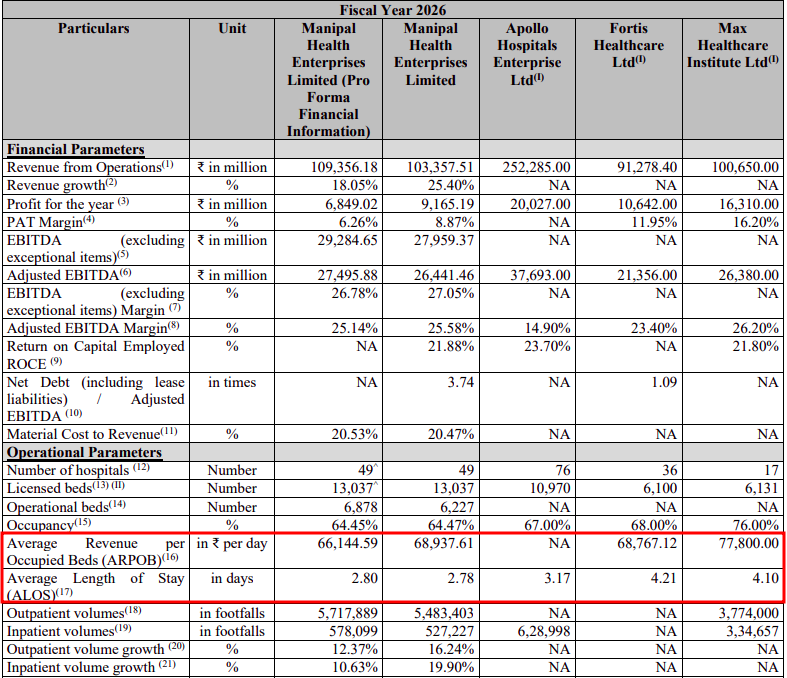
That likely explains why Manipal has one of the shortest Average Length of Stay (ALOS) in the industry. On average, patients are discharged in under three days.
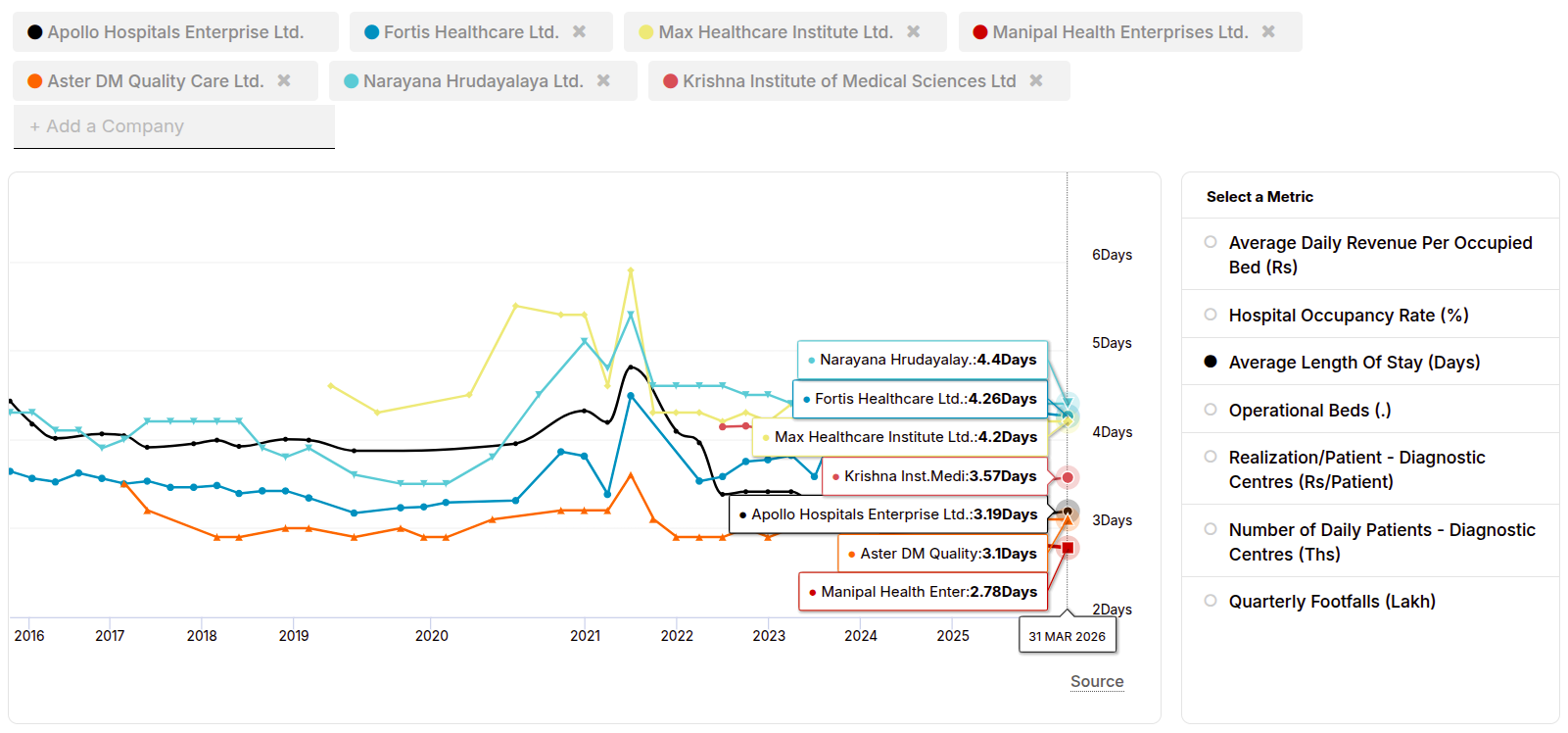
This also helps explain another important metric: Average Revenue Per Occupied Bed (ARPOB). Manipal earns around ₹69,000 per occupied bed each day. While that’s among the lower figures in the industry, it also reflects its faster patient turnover. Simply put, Manipal may earn less from each bed on any given day, but by treating and discharging patients faster, it can serve more patients with the same number of beds.
But running a clinical machine does not guarantee easy cash. That’s because hospitals don’t always get paid the same way. Manipal collects its revenue through three distinct channels.
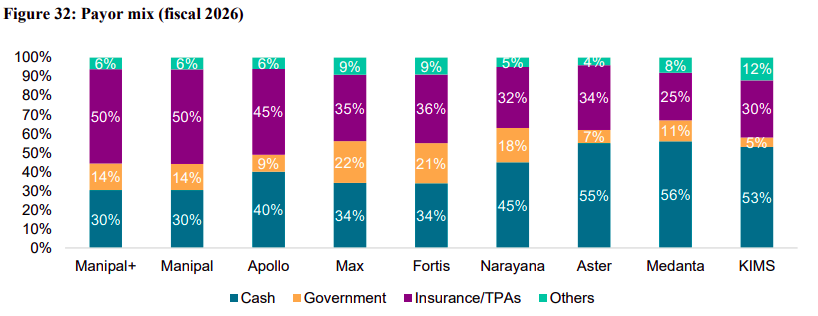
The ideal scenario is when patients pay the bill themselves before discharge. The hospital gets its money immediately, with no middleman and no discounts. Naturally, this is the most profitable channel. But since FY24, its share has been declining as insurance and government-backed payments have grown.
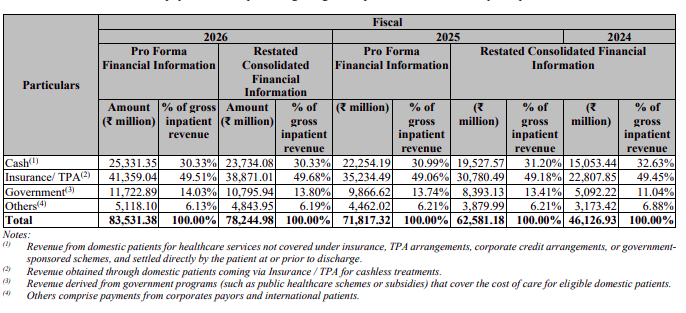
The second channel is insurance. Here, the patient doesn’t pay—the insurance company does. That’s a bit more complicated.
As insurance penetration has increased, insurers now represent thousands of patients. That gives them the bargaining power to negotiate steep discounts, often 10–20% below standard rates, something an individual patient could never do. They also don’t pay immediately. Hospitals often wait 45 to 60 days before the money arrives.
There is another problem. Sometimes the money never arrives at all. If an insurer rejects a claim after the surgery has already been performed, the hospital may have to absorb the loss. Manipal wrote off around ₹78 crore of bad debts in FY26, after an even larger write-off of roughly ₹119 crore in FY25.

The third channel is government schemes such as Ayushman Bharat. Here, hospitals treat eligible patients and are later reimbursed by the government. This helps keep hospital capacity occupied, but it comes with its own challenges.
The biggest issue is pricing. A private patient might pay close to ₹3 lakh for a heart bypass surgery. Under a government scheme, reimbursement for the same procedure may be capped at around ₹90,000.
At those rates, the hospital may barely recover the cost of the surgery, medicines, and consumables. On top of that, reimbursements are often delayed. As a result, Manipal has a significant amount of money tied up in claims that are still awaiting government approval, putting pressure on its day-to-day cash flows.
In the end, running a hospital is a constant balancing act.
Cash-paying patients are the most attractive because they pay the full amount immediately. But they no longer account for the bulk of admissions. To keep beds occupied, hospitals also need insurance and government patients. The trade-off is lower prices, longer payment cycles, and a higher risk of delayed or disputed payments. Managing that mix well is a critical part of the business.
What about the costs?
If Manipal has built such an efficient operating machine, you’d expect it to be highly profitable. But once a patient leaves, a different battle begins—getting paid while keeping costs under control.
The company is caught in a constant squeeze. On one side are star doctors demanding a larger share of the economics. On the other are insurance companies pushing for deeper discounts. The result is that hospital margins remain tighter than you might expect.
The biggest cost is doctors.
In India, patients are often loyal to their surgeon, not the hospital brand. If a star doctor leaves, many patients leave with them. That gives leading doctors enormous bargaining power. Hospitals typically compensate them with a share of the revenue generated from consultations, tests, and surgeries. In FY26 alone, Manipal paid roughly ₹2,300 crore in professional fees to doctors — about 23% of its operating revenue. It’s a cost management can’t easily reduce without risking patient volumes. Nurses, administrative staff, support staff, and senior management are accounted for separately under employee benefit expenses.

You can see this pressure in the margins.
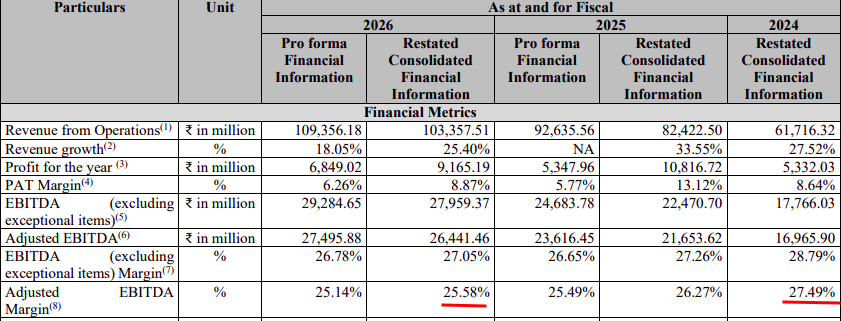
Manipal’s EBITDA margin has steadily declined, from 27.5% in FY24 to 25.6% in FY26. Interestingly, this wasn’t because medicines or medical supplies became significantly more expensive. Those costs remained relatively stable. The bigger drag came from rising payouts to doctors.
That also explains why hospitals rarely rely on margin expansion alone to grow.
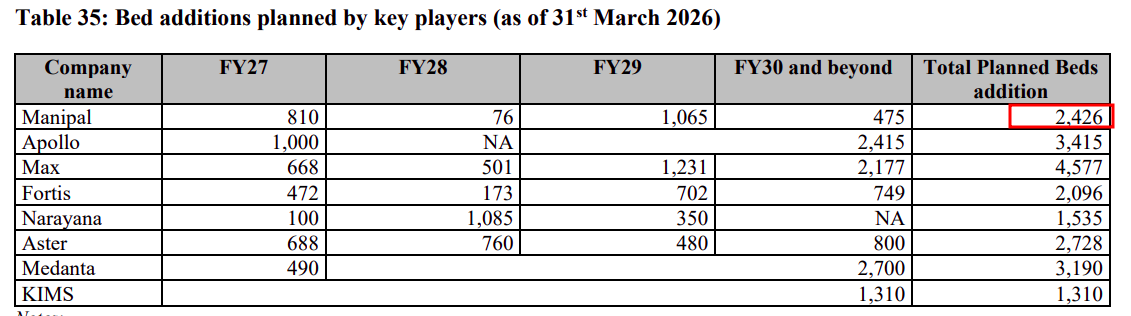
If you can’t extract much more profit from each bed, the obvious answer is to add more beds.
The problem is that building a premium hospital is painfully slow. It can take three to five years to construct one, followed by another three years before it reaches break-even. Acquiring an existing hospital is much faster.
That’s exactly the route Manipal chose.
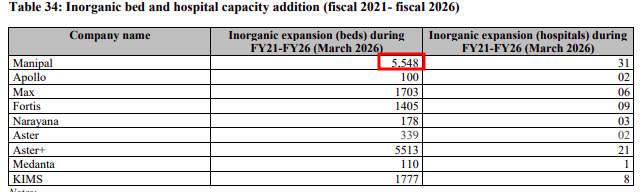
Between FY21 and FY26, the company went on an aggressive acquisition spree. During those five years, it added 6,079 beds in total. Of these, 5,548 came through acquisitions rather than new construction. Alongside Aster, Manipal has been one of the industry’s most aggressive consolidators.
Of course, acquisitions only create value if you buy the right assets at the right price and integrate them well.
Manipal paid premium valuations for many of these hospitals. That has left its balance sheet carrying a large amount of goodwill - an accounting asset that represents the premium paid above the value of the acquired buildings, equipment, and other tangible assets.
Today, Manipal has around ₹8,100 crore of goodwill on its balance sheet, almost three times what it carried two years ago.

Goodwill isn’t inherently bad. It simply reflects what a buyer believes the acquired business will be worth in the future. But if those expectations don’t materialize, the company has to write down that goodwill and recognize the loss.
That’s exactly what happened in FY24. After the HealthMap Diagnostics acquisition underperformed because of delayed payments and unprofitable pricing, Manipal wrote off ₹114 crore of goodwill. For context, the company had originally recorded about ₹305 crore of goodwill from that acquisition. In other words, nearly 40% of that premium had to be erased.
Whether the current goodwill on Manipal’s balance sheet is justified is ultimately for investors to judge. But one thing is clear: the fewer goodwill write-downs a company has to take over time, the better.

What is this IPO about?
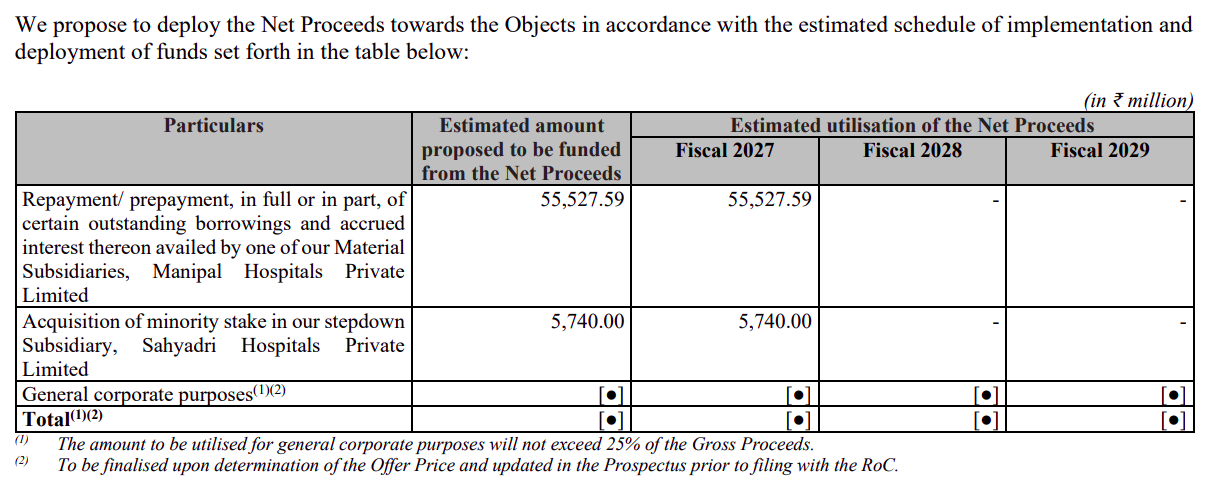
Coming back to the IPO itself, one thing stands out. This ₹9,700 crore issue isn’t really about building new hospitals, setting up clinics, or buying cutting-edge medical equipment.
Instead, it’s largely about cleaning up the balance sheet after Manipal’s acquisition spree that we talked about earlier.
The biggest example is Sahyadri Hospitals.
When Manipal acquired Sahyadri, it financed the deal by issuing Non-Convertible Debentures (NCDs) carrying an interest rate of about 9%. That pushed total borrowings to nearly ₹10,500 crore and drove interest costs up 69% in FY26.
This IPO is largely meant to unwind that financing.
Around ₹5,553 crore—nearly 70% of the fresh issue—will be used to repay the debt taken on for the Sahyadri acquisition. Another ₹574 crore will be used to buy out the remaining minority shareholders in Sahyadri.
In simple terms, Manipal first bought a competitor using borrowed money. It is now using IPO proceeds to replace that expensive debt with equity capital.
Repaying the Sahyadri debt will reduce Manipal’s borrowings by almost half. The company won’t become debt-free, but its leverage will move much closer to peers like Apollo and Fortis.
Alongside the fresh issue, existing shareholders are also selling part of their stake through an Offer for Sale (OFS). Early private equity investors such as TPG, Temasek, and Novo Holdings, along with the promoter group (MEMG), are collectively offloading over 21 million shares.
Conclusion
Manipal knows how to run hospitals. It fills beds, turns them over quickly, and focuses on the procedures that make the most money.
The IPO, however, isn’t really about expanding that business. It’s largely about paying down debt from past acquisitions. That will improve the balance sheet and free up cash for future growth.
So the question isn’t whether Manipal is a good hospital operator. It’s whether you’re comfortable paying today for growth it has already bought, and might continue buying in the future.

Whose car is it anyway?
Last August, Prime Minister Narendra Modi flagged off a car in Gujarat: Maruti Suzuki’s e-VITARA.
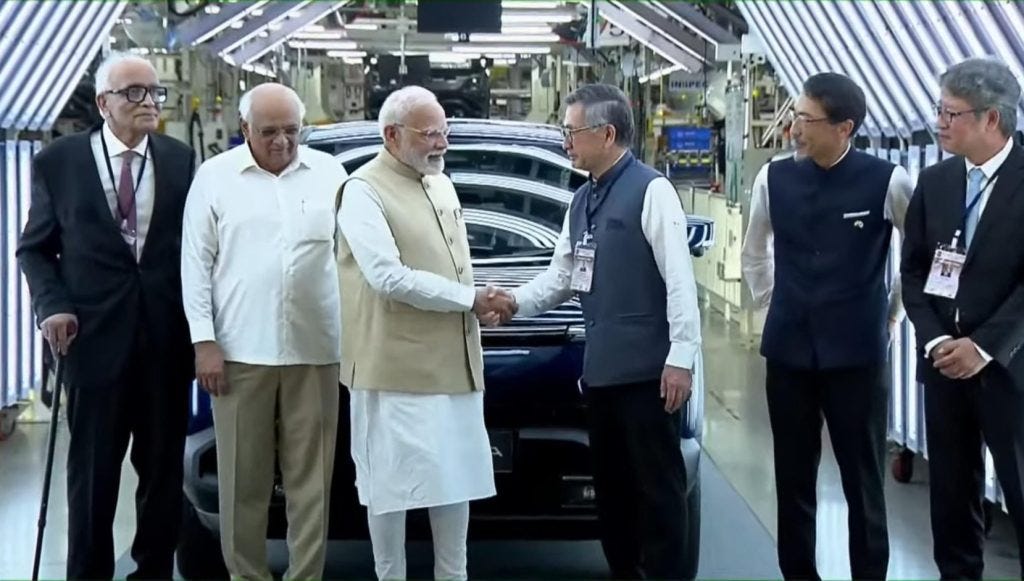
The car was built exclusively at the company’s Gujarat plant. From there, it shall be exported to more than a hundred countries, from the United Kingdom to Japan. According to Maruti, it is slated to become the largest mass-produced electric vehicle exported out of India.
For all that, it isn’t an Indian car , though. It runs on a platform Suzuki developed. Both the global product and the brand belong to a Japanese company.
There’s a tension here: in some ways, the e-VITARA is “made in India”. The plant, the workers, much of the supply base, the crash-testing, the logistics, the domestic service network — everything physical and concrete — sits in India. Suzuki controls rights : over the platform, the global product and the brand. But it isn’t clear who the engineering can be attributed to, at least from public disclosures. Chances are, some of it happened in Japan, some at Suzuki’s Indian R&D operation, and some, within Maruti itself.
Whose car is it, then? It is tempting to claim, simply, that this is a Japanese car, manufactured in India. But that isn’t true. Ultimately, the car was not simply designed in Japan. The “manufacturing” happening in India can’t be untangled from the “services” around it that India provides. The line between the two is blurred. The car is at once Indian and Japanese.
This is emblematic of a shift economists call the servicification of manufacturing.
From outsourcing components, to outsourcing value-creation
Modern industry is a terribly complex thing. Rarely is a modern car, phone or machine made in one place. There’s a massive bundle of tasks that go into making one — and more often than not, these are pulled apart, and outsourced to a range of suppliers. A company could design a widget in one country, then source components for it from a dozen countries scattered around the world, assemble it all in a country that offers cheap labour, and service it from an entirely different location.
Of course, manufacturers have been buying components from other countries for ages. What’s new, however, is that an increasing part of making something revolves around purchasing services . Where you would once coordinate with different factories to buy supplies — like gaskets, or ball bearings — companies now coordinate with new types of entities, like laboratories, engineering teams or service networks.
This elaborate dance — what is called a “global value chain” — can all be coordinated at scale, today, because the designs are often modular, different suppliers have common technical standards, and digital coordination is easy and cheap.
This marks a genuine evolution of how manufacturing happens. With these advancements, smaller tasks, which would serve as support functions within a company, could be separated out. The software that decides how a machine works, the testing and certification necessary to export, data collection to iteratively develop the next model — all of these, now, are treated as distinct parts of production, and are optimised in themselves.
Economists call this servicification .
These services fit into different parts of the value chain.
Some services are proprietary : they shape the very product itself. Think of the core technology underneath a product, the industrial design that shapes it, the software that helps it run, or the branding that ties it all. These are all fundamental to a product. They determine what it is, and how it behaves. If you have control over these, in a sense, you own the product.
Other services, in contrast, are operational . Think of the testing necessary to catch defects, or the supplier-development teams that help component-makers meet standards, the logistics that keep parts moving, or maintenance and after-sales services that keep things running. These might not shape the product, but they decide whether the product, and the business around it, runs smoothly.
According to the OECD, 37% of the value of “manufacturing” exports in the countries it studied were actually services like these. Add service-like functions within a manufacturing set-up — like engineers, planners or IT staff — and that share reaches 53%. If you include value-added services, it rises higher still.
The benefits of services
Picture two factories.
One imports components and simply bolts them together. The other does more: it adds a services layer on top. It adapts its product to local conditions, tests components, helps its supplier network pass a foreign buyer’s audit, runs production software, diagnoses failures, and feeds its learnings into the next iteration.
In the beginning, both their outputs might look exactly the same. But over time, they’re likely to diverge.
Chances are, the first remains a replaceable assembly site, which can easily be swapped out for another. The second factory, meanwhile, runs a continuous learning loop. It might cut defects and development time over production runs. Its suppliers could slowly qualify for bigger contracts. It could learn what breaks after a sale, and develop valuable insights on what subsequent production runs must fix. This sort of a factory, with the knowledge it has built up, is far harder to replace.
In other words, services aren’t separated from manufacturing. In fact, they help build manufacturing capacity itself, giving a factory stickiness in global value chains.
There’s clear evidence for how much the output of a factory floor depends on non-physical factors. The economists Arnold, Javorcik, Lipscomb and Mattoo, for instance, looked at what happened when India opened up industries like banking, telecoms, insurance and transport in the 1990s and 2000s. As they found, manufacturers that depended most on those sectors grew 12% more productive. Similarly, in another study, economists found that when Indian textile plants introduced basic systems for quality control, inventory and delegation, their productivity went up by 17% in a single year.
There’s one complication, however.
Sometimes, as the economists Grover and Mattoo found, manufacturers don’t take on services to become stronger . They may do so because competitors are eating into their core production work, and they’re falling back on services in order to just survive. Imagine a phone manufacturer that gets overwhelmed by Chinese imports. They might diversify into repair-work to survive. On paper, this might make it look more “service-heavy”. But that doesn’t mean the company is growing more sophisticated — just that it’s keeping its head above water.
What India makes, and what it owns
With this framework in mind, what does India’s manufacturing sector look like? To what extent are services wrapped within it, and what services do we perform?
Let’s start with smartphones.
According to Anirudh Shinghal from CSEP, of the manufacturing sectors he has seen, the computers and electronics we make carry the highest share of domestic services. Over a quarter of their export value comes from services work. While India’s electronics manufacturing sector is often derided as simply ‘doing low-value assembly’, these operations are building genuine capacity — in things like process engineering, testing, supplier management — which shall compound over time.
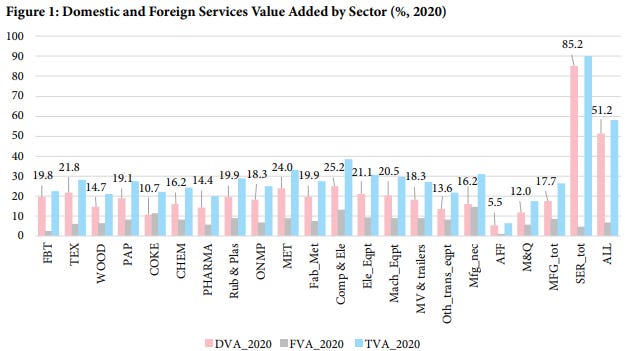
That said, the proprietary services embedded in those products — brands, architectures, operating systems — usually remain with foreign companies.
We’ve come further along with automobiles. Over decades, India has built dense networks around vehicle manufacturing. India has an auto-component industry worth over $80 billion in FY25, with exports worth $22.9 billion. Cars also come along with a large repair-and-spare parts economy. Maruti alone, for instance, saw almost 3 crore service visits last year. This domestic aftermarket, in itself, is worth $11.8 billion — a huge service economy in its own right. This has given India a large base of engineers, suppliers and dealers, and a great deal of operating know-how.
That said, we don’t yet own the slice of services that gives us ownership . It isn’t Maruti, but the Japanese parent Suzuki, that owns the platforms its cars are built on, as well as their architecture and brand. The e-VITARA needs India, and depends on our substantial manufacturing and service ecosystem. But it is a Japanese firm that controls the car.
Widening our notion of “manufacturing”
When policymakers think of manufacturing and services, they see two separate worlds. Factories receive one set of incentives, and are governed by one set of laws. Services — software, testing, logistics and engineering — seem to sit in a different bucket altogether.
Modern products, however, don’t divide themselves so neatly.
If we intend to reach aatmanirbharta in manufacturing, we can’t afford to live by these false binaries. We need to look at everything at once. The competitiveness of our factories might be determined by things happening outside the factory gate — from the health of our testing laboratories, to restrictions on logistics and warehousing, to the availability of trained technicians.
By the same token, it is foolish to congratulate ourselves merely when a product is “made in India”. It makes more sense to ask whether that production has taken root here, through the wider network around the factory floor, and how much control we actually have.
If modern industry no longer stops at the factory gate, neither should industrial policy.
Tidbits
- Private Labs to Handle Smart Meter Bill Disputes. To address growing consumer complaints about inflated electricity bills following smart meter installations, the government is introducing rules that allow consumers to challenge meter accuracy.
Source: Livemint
- Electric Car Market Competition Widens in H1 2026. The electric passenger vehicle market in India is seeing increased competition as new entrants start to establish a strong foothold. In the first half of calendar year 2026, companies like Maruti Suzuki, VinFast, and Tesla captured an 8.1% share of the segment, driving 18% of the incremental vehicle registrations.
Source: Business Standard
- Cotton Imports Expected to Hit Record 60 Lakh Sales. India’s cotton imports are projected to jump to a record 60 lakh sales this season as the domestic textile industry seeks cheaper raw materials from overseas. This surge is driven by a drop in domestic production and higher local cotton prices, forcing spinning mills to rely heavily on imports to maintain their margins.
Source: The Hindu BusinessLine
- India Seeks Sunflower Oil Alternatives Amid Black Sea Crisis. With ongoing attacks in the Black Sea delaying sunflower oil shipments from top suppliers Russia and Ukraine by up to 60 days, India is scrambling to secure alternatives. Importers are turning to South American suppliers for sunflower oil, while also increasing purchases of substitute oils like palm, soy, and canola to bridge the gap.
Source: Bloomberg
- India Lost 11% of Solar Power During Peak Summer. Despite record-high electricity demand this summer, India lost roughly 11% of its generated solar power. This massive energy loss is primarily due to severe bottlenecks in the national grid’s transmission infrastructure, which lacks the capacity to effectively store or transport the surge in renewable energy.
Source: Reuters
- This edition of the newsletter was written by Mridula & Pranav
Beyond Today’s Brief
There’s always more happening at Markets by Zerodha.
- The Chatter: Why is BEL betting big on Project Kusha? Why is HUL turning cautious on demand? And what does L&T see in India’s private capex cycle?
- Aftermarket Report: How did Indian markets brush aside weak global cues? And why did IT stocks lead yesterday’s rally?
- Subtext: Sagar Lele breaks down how professional analysts read quarterly results and separate the signal from the noise.
- Points & Figures: Is India getting healthier? Why are Indians eating less rice and dal, but more packaged food?
Join us on WhatsApp , where we share interesting soundbites from concalls, articles, and everything else we come across throughout the day. You’ll also get notified the moment a new video or article drops so that you can read or watch it right away.
Thank you for reading. Do share this with your friends and make them as smart as you are 