Investment-Focused Browser – Would this improve your workflow?

Hi everyone :wave:

I recently joined this group, so I’m not sure if this is the right place to share this, but I’d love your thoughts.

I’ve been an investor (not an active trader) for two years. While using Zerodha’s tools like Kite, Coin, Console, and also platforms like Smallcase, Varsity, etc., I often felt like the investor experience could be more streamlined, especially on desktop.

That got me thinking:

What if we had a Chromium-based browser — built specifically for investors — but that still works like a regular browser?


:bulb: Here’s the Concept:

Imagine a browser where every new tab is an investor dashboard, showing:

  • :bar_chart: Your Watchlist, Top Movers, NIFTY/SENSEX, Sector Performance
  • :bell: Economic calendar & market alerts (e.g., US Fed meetings, RBI policy)
  • :books: Passive learning cards from Varsity or Console
  • :gear: One-click access to Kite, Coin, Console, Sensibull, Smallcase, Quicko, etc.
  • :paperclip: Market News & Updates
  • :memo: Notes panel to jot down trade ideas or learnings
  • And of course, it’s still a normal browser — you can open Gmail, YouTube, ChatGPT, anything else

Here’s a screenshot of a sample new tab page I’ve been working on as a POC:

:thinking: Why I’m Sharing This:

This is a concept I’ve been exploring out of personal interest — more of a proof-of-concept than a product pitch.

As someone who invests regularly, I’ve often felt that our tools could be better aligned with how we research, track, and learn, especially on desktop. So I started prototyping an investor-focused browser experience to see if it might enhance that workflow.

Now I’m curious to hear from others:

  • Would a setup like this actually help streamline your investing process?
  • What would you want added, removed, or done differently?
  • Do you think this is a useful direction, or just unnecessary complexity?

Thanks so much for reading :pray:
I truly welcome any thoughts, suggestions, or even counterpoints — they’d really help refine the idea.

— Shilad

5 Likes

I think it’s a great idea! However, a regular trader/investor often holds accounts with multiple brokers. Maybe we can explore an option to allow quick access to all those platforms too. I believe this could be done using some kind of template-based approach.

Also, to be honest, the ss you uploaded look really good. Hopefully, I’ll get a chance to use that kind of template too!

May I know how you have done that ?

Hey Keshav,

Thanks a lot for the kind words — I really appreciate it!

Yes, you’re absolutely right — supporting multiple brokers with a flexible, template-based structure is something I’ve been thinking about too. It would be great for power users who use more than one platform.

Regarding the UI you mentioned — I’ve actually built this as part of a custom Chromium-based browser project. It’s still a POC, but you can check out a quick demo here:
:point_right: https://youtu.be/j_PZQdA_Y4E

Would love to hear your thoughts or ideas!

Thanks a lot for sharing the demo video, it looks interesting, but it will be better if you can update this as an add-on that can be added by anyone from the Chrome add-on page

Hey Keshav,

Thanks again — glad you found the demo interesting!

You’re absolutely right, a Chrome extension can be more accessible and easier to adopt. I actually considered that route initially, but many of the features I’ve built (like deep UI integration, custom navigation flow, and browser-level privacy controls) aren’t possible through a standard Chrome extension due to API limitations.

That’s why I went with a custom Chromium build — it gives full flexibility to reimagine the user experience for traders/investors.

That said, I’m exploring ways to bring some of the core features into an extension version too — will keep you posted if I manage to get something working in that direction!

Hey Keshav,

Just wanted to follow up — I’ve actually incorporated the exact idea you suggested about supporting multiple brokers with quick access dials! The new design now includes shortcuts to all major platforms like Zerodha, Groww, Upstox, Angel One, ICICI Direct, and more. Plus, users can add their own custom shortcuts too.

On top of that, I’ve added several new features:

  • A smart search bar with engine selector (Google, Screener.in, Google Finance)
  • An AI assistant section powered by Perplexity

Here’s the updated demo if you’d like to check it out:
:tv: https://youtu.be/sT1cAOHcnbc

Would love your thoughts on the latest version!

8 out of 10 investors wont use it due to privacy concerns. If you market it as an “investment browser”, investors and traders will suspect that you are collecting data and will not use it at all.

Hi Pinpong,

Thanks a lot for your honest feedback. I completely understand your concern, and I genuinely appreciate you pointing it out.

Privacy is extremely important, especially when it comes to anything related to investing. Honestly, I’m still fairly new to investing compared to many of the knowledgeable folks in this group. But inspired by the ideas and insights shared here, I decided to build something that combines investor productivity with a strong focus on security.

For a bit of background, I’ve worked for over 9 years as a Technical Lead with a privacy-centric browser company, so data protection and user trust have always been core principles in everything I build.

This custom browser project actually started off as a Zerodha-themed prototype, with shortcuts to their platforms like Kite, Console, Varsity, etc. But based on helpful feedback from another member here, I realized that most investors use multiple brokers — so I reworked it into a multi-broker new tab dashboard, and renamed it FinIndia to keep it neutral and inclusive.

Just to clarify — everything in the current build runs right inside the browser. Your shortcuts, watchlist, notes, and preferences are saved locally. There’s no backend, no tracking, and nothing ever leaves your device. It’s simply a personal proof-of-concept I created to explore how such an interface could work for active investors.

That said, I totally get that even with the best intentions, trust takes time, and especially in fintech, perception matters as much as technology.

Thanks again for your honest feedback — it’s exactly the kind of input that helps me refine both the concept and how it’s positioned. And if you (or anyone else here) have suggestions on improving the design or layout, I’d love to hear them.

Hi @Shilad_Kumar_Devaram I completely agree with your point. Privacy shouldn’t be an issue here since you’re not fetching any data from a broker via API and displaying it on the home dashboard. You’ve provided a clean, basic, and to-the-point dashboard that gives traders a quick sense of the market which is quite useful.

That said, I do have a few questions:

In the screenshot you’ve shared, on the middle-right side, there’s a section labeled with buttons like “View Portfolio”, “Option Chain”, etc.

  • When a user clicks one of these buttons, which broker’s platform will be opened?
  • Considering that many users have multiple accounts across different brokers, will there be an option to set a default broker?
  • If yes, how will this default selection and redirection mechanism work?

Hi Keshav,

Thanks for your valuable feedback and questions! I’m glad you find the dashboard useful and appreciate the clarity it offers.

Regarding your questions about the “Quick Actions” section:

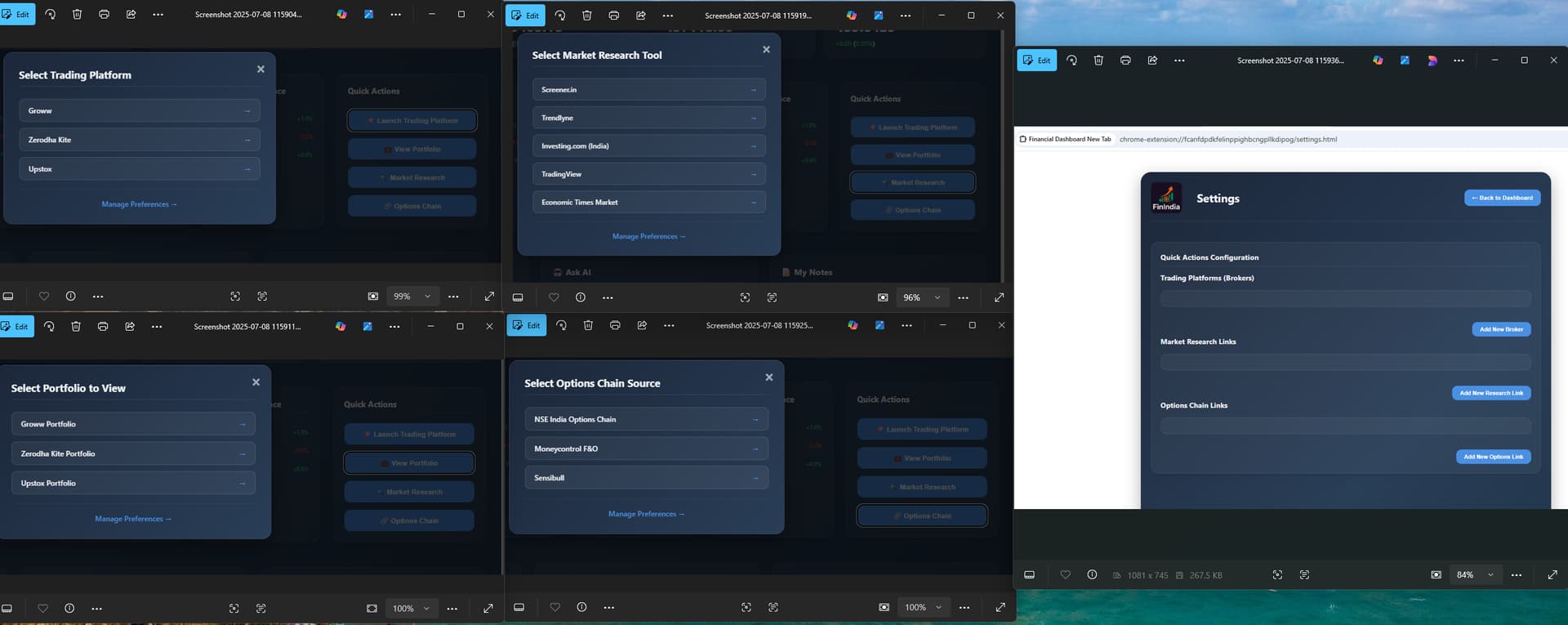
When a user clicks on buttons like “Launch Trading Platform”, “View Portfolio”, “Market Research”, or “Options Chain”, they will be presented with a modal (a pop-up window) to select their preferred platform or tool.

Launch Trading Platform: As shown in “Screenshot”, clicking this will bring up a “Select Trading Platform” modal, allowing the user to choose between “Groww”, “Zerodha Kite”, and “Upstox” (and potentially more brokers if added).

View Portfolio: Similarly, “Screenshot” illustrates that clicking “View Portfolio” opens a “Select Portfolio to View” modal with options like “Groww Portfolio”, “Zerodha Kite Portfolio”, and “Upstox Portfolio”.

Market Research: For “Market Research”, “Screenshot” shows a “Select Market Research Tool” modal, offering choices such as “Screener.in”, “Trendlyne”, “Investing.com (India)”, “TradingView”, and “Economic Times Market”.

Options Chain: “Screenshot” demonstrates that clicking “Options Chain” will present a “Select Options Chain Source” modal with options like “NSE India Options Chain”, “Moneycontrol F&O”, and “Sensibull”.

Regarding setting a default broker/platform:

Yes, there absolutely will be an option to set a default! As you can see in all the “Select…” modals (e.g., "Screenshot), there’s a “Manage Preferences” link at the bottom.

How this default selection and redirection mechanism will work:

User Preference Storage: When a user clicks on “Manage Preferences” from any of these selection modals, they will be taken to a dedicated “Settings” page (as seen in “Screenshot”).

Settings Page: On this “Settings” page, under “Quick Actions Configuration”, users will be able to configure their preferred “Trading Platforms (Brokers)”, “Market Research Links”, and “Options Chain Links”.

Default Selection: We will implement input fields or dropdowns within these sections on the “Settings” page where users can specify their default choice for each category. For example, under “Trading Platforms (Brokers)”, they could set “Zerodha Kite” as their default.

Seamless Redirection: Once a default is set, the next time they click the corresponding Quick Action button (e.g., “Launch Trading Platform”), the system will bypass the selection modal and directly open the link for their pre-selected default broker/platform. If no default is set, the selection modal will continue to appear.

Adding New Links: The “Add New Broker”, “Add New Research Link”, and “Add New Options Link” buttons on the settings page will allow users to add additional platforms or tools beyond the pre-configured ones, further enhancing customization.

This approach ensures both flexibility for users with multiple accounts and efficiency for those who prefer a single default.

Let me know if you have any more questions!

Best,
Shilad

Hey @Shilad_Kumar_Devaram
Thanks for the clarification.
The quick action flow seems good. Excited to see what else can be added to this project.

1 Like

1 Like

Hi everyone :wave:

Over the last few months, I’ve been trying to understand how Indian investors actually learn, research, and keep track of markets.
One pattern keeps coming up in these discussions:

Serious market work often gets mixed up with everyday browsing — emails, shopping tabs, notifications, social feeds — and the research workflow becomes messy, scattered, and hard to manage.

This is more of an observation than a complaint, but it made me curious:

:question: Would a dedicated, distraction-free space help investors?

Not a trading platform, not an analytics tool —
but simply a clean workspace where:

  • research tabs don’t get buried under unrelated browsing
  • market tools stay grouped together
  • learning resources (educators, explainers, basics) are easier to access
  • privacy isn’t compromised by trackers or ad engines

I’m exploring this idea in an experimental project called GainGo — but this post isn’t for promotion.
I’m more interested in hearing your real-world experience with this problem.


:mag: A related thing I’m working on (community-driven, not commercial)

I’ve been curating a list of reliable financial educators on YouTube — free, non-sponsored, and based purely on content quality.
The only goal is to help beginners avoid misinformation and find channels that explain concepts well.

If you have suggestions or channels you personally trust, I’d love to add them.


:dart: What I want to learn from the community

If you’re open to sharing:

1) How do you manage your research workflow today?

(Tabs? Apps? Notes? Bookmarks? Something else?)

2) What makes staying focused difficult while researching markets?

(Notifications? Too many tools? Switching context?)

3) Would you find value in a cleaner, finance-only workspace — or is the normal browser setup enough for you?

4) Any financial educators or YouTube channels you trust and regularly watch?


I’m not selling anything here — just trying to understand real user behaviour and avoid building in a bubble.

Would really appreciate your thoughts :pray:

I believe a website would be a better choice. I don’t feel your comparison chart has much merit. Browser is for browsing the web. You cannot make it one concept themed. Has it ever been done with any other concepts successfully?

1 Like

Thanks for sharing your thoughts — I genuinely appreciate the perspective.

You’re right that mainstream browsers are designed to be general-purpose, and that’s exactly why most investors (including me) end up mixing serious market work with everything else. To clarify, the idea isn’t to restrict the web or “theme-lock” a browser. Users will still be able to open any website they want — nothing is blocked or limited.

What I’m exploring is whether a finance-focused browser can provide a cleaner, distraction-free environment for market research without interfering with normal browsing.

A small analogy:
Even though Chrome, Firefox, and Safari already exist, many organisations still build their own enterprise browsers. Not because general browsers are bad, but because a specialized environment sometimes improves workflow, privacy, or security.
I’m simply trying to see whether a similar approach could help with financial workflows.

My experimental prototype includes a few privacy/security defaults that a normal website can’t achieve:

  • No user data collection — trading/browsing data stays fully local on the user’s machine
  • Third-party cookies disabled — no cross-site tracking
  • Some fingerprinting techniques blocked
  • WebRTC disabled to prevent IP leaks
  • No background pings or telemetry
  • No trackers or ad-tech of any kind

The goal is a separate, clutter-free workspace — not a replacement for anyone’s primary browser.
In fact, I personally recommend:

  • Chrome for all Google-related workflows
  • Perplexity or similar for everyday browsing / AI tasks
  • A privacy-focused browser for sensitive financial work

In that sense, GainGo is just an experiment to see if isolating financial tasks can reduce distractions and keep data private — nothing more.

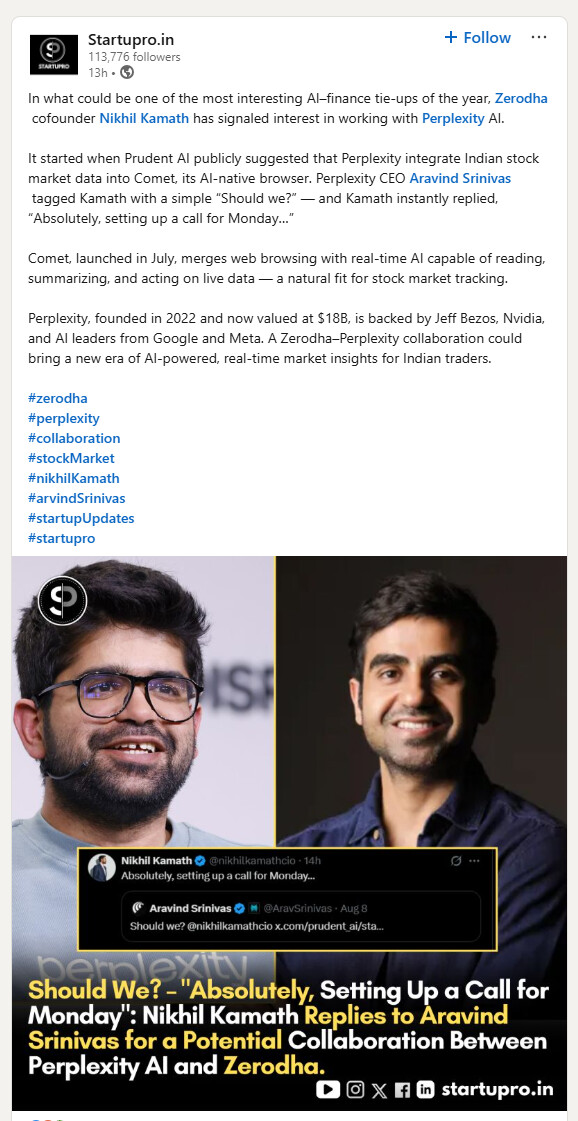
Also, browsers are evolving quickly, and new security vectors keep emerging. For example, Brave recently wrote about a new kind of “agentic browser prompt injection” in Perplexity Comet:

This isn’t about criticizing any browser — it simply shows how rapidly the landscape is changing and why secure, specialized environments may become relevant.

I’m still very early in this journey, which is why feedback like yours is extremely helpful.
Would love to hear more of your thoughts on whether financial workflow isolation makes sense — or if you feel a standard browser setup is already sufficient.

Just create a new browser profile. For privacy-conscious folks, use Firefox or Zen browser.

1 Like

Thanks for the suggestion — using a separate browser profile or Firefox/Zen is definitely helpful for privacy and basic separation.

The idea I’m exploring comes from talking to a lot of Indian retail investors — especially beginners — and I found two very different user groups:


:one: Beginners entering the markets

India has a huge financial literacy gap:

  • Only ~27% of Indians are financially literate
  • Even among educated professionals, only 1 in 4 understands SIPs, inflation, diversification, insurance, etc.

I went through the same journey myself when I got my first job —
no clarity on tax planning, SIPs, long-term saving, or insurance.
And when I finally tried learning, everything was scattered across 10–20 tabs — YouTube for basics, different websites for research, news on another site, and brokers in separate tabs.

For this group, even a new browser profile doesn’t solve the core issue:

They need a clean, unified, distraction-free workspace where learning, research tools, market information and important links stay organised together rather than getting buried among unrelated tabs.


:two: Seasoned investors / analysts

They typically want:

  • a consistent workflow
  • an organised research space
  • fewer distractions
  • strong privacy by default

For them, the idea is not to replace their main browsers, but to provide a separate, stable, finance-focused environment that sits alongside Chrome/Firefox/Zen — similar to how many traders already use multiple tools in parallel.


Why profiles/extensions don’t fully solve it

Browser profiles help, but they still share:

  • the same general-purpose browsing behaviour
  • notifications
  • the same tab patterns
  • no workflow isolation
  • no unified layout for learning + tools + market data

They don’t offer a workspace designed specifically for markets.


A light analogy (NOT a comparison)

In global markets, professionals already had browsers, spreadsheets, and news websites.
But Bloomberg still built a dedicated, isolated environment because sometimes the workspace itself makes the difference — not just the tools.

Not because other tools were weak,
but because focus, workflow consistency, and isolation matter in financial decision-making.

GainGo is exploring a similar idea on a much simpler scale:

A focused, clutter-free space where learning → research → market updates → tools → decisions all happen inside one secure environment, without mixing with everyday browsing.

Not competing with Firefox, Chrome, or any platform —
just experimenting with whether isolation + unified tools improves the user experience.


Would love to hear your view if you’ve tried multi-browser workflows or profiles for market work — your perspective would really help me refine the idea further.

@Shilad_Kumar_Devaram

Interesting angle. One thing you could explore is task-based workflows instead of just a clean space.
For example:
• Learning mode that auto-collects basic dashboards
• Research mode that pulls filings, charts, news, and lets you save quick notes
• Execution mode that keeps only broker links and alerts visible

Another idea is a timeline view of everything you checked for a stock filing, videos watched, and notes taken so beginners don’t forget the logic behind their decisions.

Also consider a noise filter. Most beginners get confused because Twitter, YouTube, and news hit them with too many opinions. A simple filter that surfaces only factual data can help a lot.

If you build around workflows and noise reduction, it solves more than just tab clutter that what i think .

1 Like

@keshav_02

These are really great points — thanks for sharing them.

A lot of what you mentioned (learning mode, research mode, noise filters, timelines, etc.) definitely adds value to the overall workflow. Since Gaingo is being built as a privacy-first browser, the only constraint is that we won’t collect or analyse any user data on the server side.

So the challenge is to see how much of this can be done locally on the user’s system, without tracking or storing anything externally. Within that boundary, I’ll explore what’s feasible — especially the noise-reduction and workflow modes you mentioned.

Really appreciate the direction you’ve suggested — it helps refine the product in the right way.

What about zero day vulnerabilities? Do you plan on having active teams to pull security changes regularly from chromium and release it? Maintaining a browser comes with lot of other factors than the one you’re focused on. Do you want to take all that additional burden?