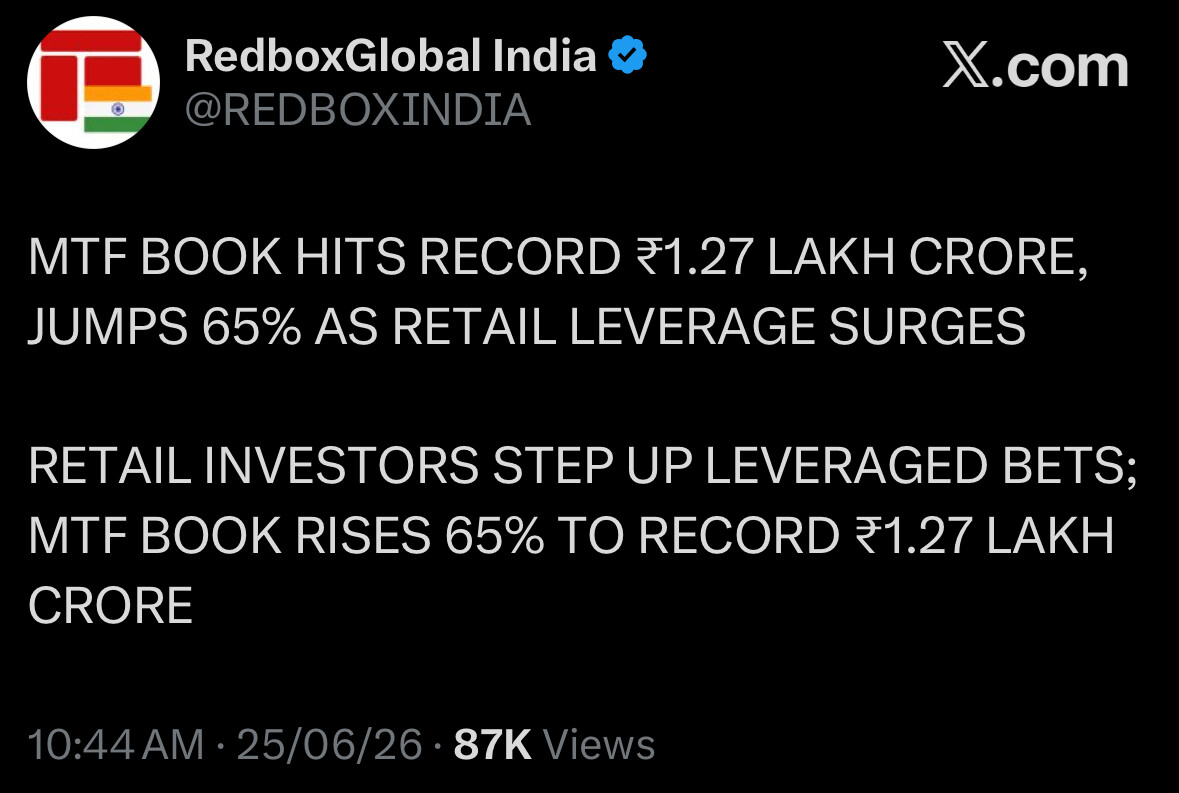
The industry’s Margin Trading Facility (MTF) book has touched a record ₹1.27 lakh crore, up 65% YoY. That’s a significant jump and suggests retail investors are increasingly using leverage to build equity positions.
What do you think is driving this trend? Is it growing confidence in the markets, lower interest rates offered by brokers, or are investors simply becoming more comfortable using leverage?
Might be a disaster waiting to happen. MTF artificially increases bullish bias in the market by adding extra money that isn’t there. If bears were to reign anytime in the future, a forced unwinding of MTF will crash markets well below fair price. Leverage cuts both ways.
The short answer is NO. Last year’s tweet for ref. Link
Eventually, we may start analysing Indian equities with a bigger focus on leverage. Tracking total leverage, liquidation levels, and follow-up selling cascades, MTF is slowly becoming a serious part of the market structure.
It may still be small compared to the overall market, and regulations are strict, so it’s not a big worry, yet it will add some bias, and when the next serious correction comes, broker RMS teams will definitely have sleepless nights. Competition makes it even harder; no broker can afford to ignore MTF. That’s the business risk you take as a broker. So the entire ecosystem will just have to evolve around this new risk profile. This is a personal view, but ya I’m very curious to see how this plays out.
SLBM - I don’t think near term implementation feasibility , these are my assumption
F&O stock - Those who sell , they can easily / may be low cost choices are there like stock futures / option . They are more liquid , no GST on borrowing fees .
Other stocks - finding a few large investors easy than bargain with small retail investor like me . This is already there in Zerodha and other players . Not sure How much volume it have .
If the share default happens then capital gain tax liability due to the treating as selling - In this situation the exchange’s clearing corporation may steps in to financially reimburse the lender
I don’t think SLBM may offer financial feasibility for brokers due to low volume supply in the retail customers . These are my views , May be You have better knowledge on this.
Note : Happy to know that majority of the users are in profit using MTF , MTF help brokers to offset the revenue loss happened in options . More revenue means better service , product offering .
It’s 50% not majority and that’s excluding interest. Interest would be the biggest cost. I expect the numbers to drop significantly if/when @nithin discloses net profits/profitable players - net of interest costs. Don’t most people suck at choosing individual stocks? Don’t most fund managers underperform index? Isn’t that why index funds were recommended for new players? If fund managers can’t beat index when starting at 0%, I would be really surprised, if most retail players are beating those fund managers YoY, when starting at a negative -14%(interest cost pa). For context, Index returns on average is 12%. if they borrow at -14% and invest in index(best case), on average they will get -2%pa(12-14%). Not to mention brokerage costs also increases with MTF. And now, the most important factor, Tax. Apparently, the predominant view is that you can’t deduct interest costs in capital gains(unless you classify that as business income):
So, in this case, interest costs are almost 50% AND they would pay 20% tax on 25k instead of 9k. Net return comes out to 9k-5k=4k. 4k/25k=That’s 84% expenses after profit. If you classify as business income to avoid tax on income that you actually didn’t earn, that opens a whole new can of worms especially if you are a small player - for example, your turnover shoots through the roof, almost certainly makes presumptive taxation infeasible.
All in all, I expect some deep red for MTF retail as far as net profits, especially after tax and compliance costs are considered. Win win for market prices, Tax department and Brokerages and government(STTs are paid at 3X-5X), lose lose for retailers.
Surprisingly, the numbers don’t change much when interest costs and other costs are included (around 45% in the money). It’s probably because our MTF product is just 1.5 years old, and during that time, the markets haven’t moved much.
Btw, this is very similar to the profitability of futures traders, around 40-50%.
Still 45% is surprising. Capital gains tax will be on the gross profit without stt and interest charges and so it will still put many on the border into the negative. A daily brief with zerodha (@Meher_Smaran ) article with exact charts and numbers would be very interesting.