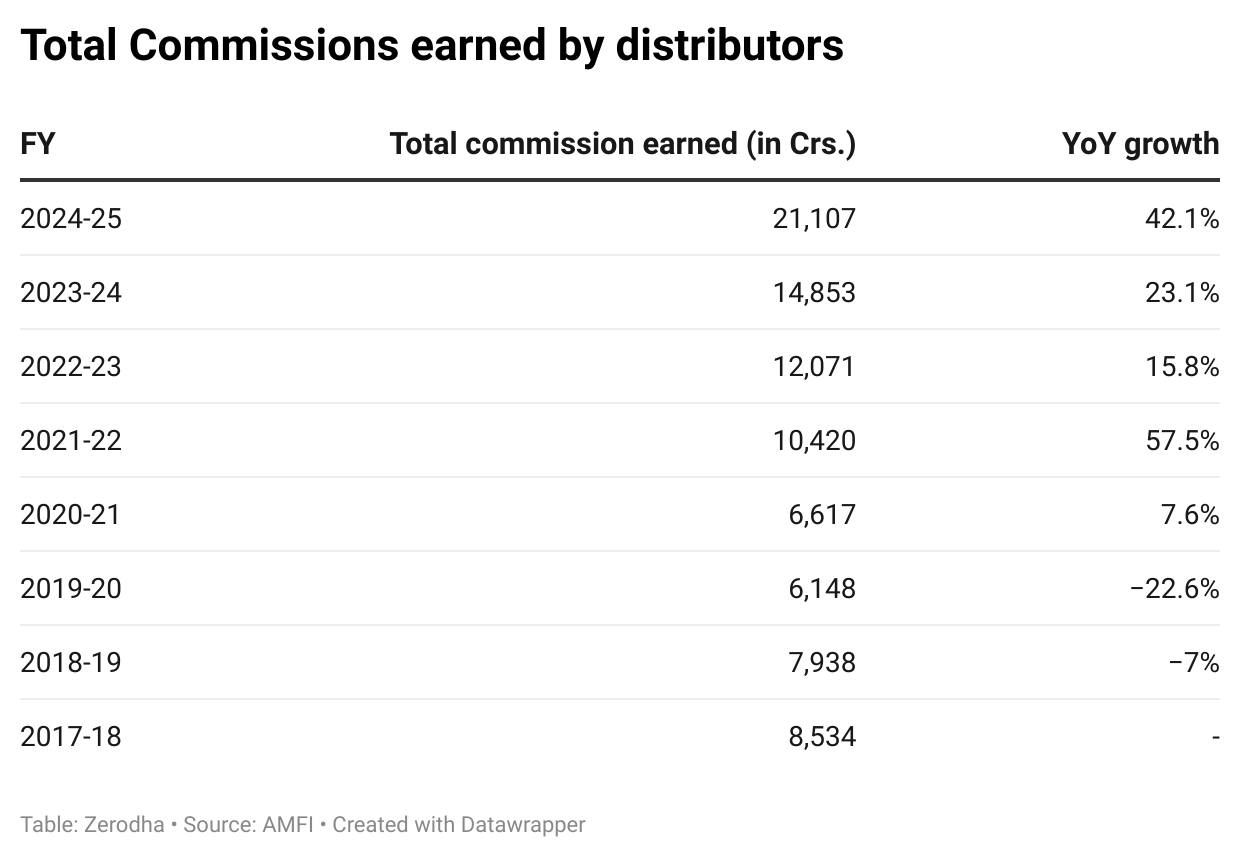
Mutual fund distributors earned a staggering Rs. 21,107 crores in mutual funds commission in FY24-25

Every year, AMFI (Association of Mutual Funds in India), releases a report on commissions earned by mutual fund distributors. In the financial year 2024-25, the commissions earned by mutual distributors increased to Rs. 21,107 crores, a staggering growth of ~42% year-over-year.
When you invest in mutual funds, you can choose between regular and direct plans. If you opt for regular plans, you have to pay commissions, which can be as high as 1%, charged every year on the invested amount, as long as you’re invested.

If you opt for direct plans, you have to pay no commissions. Btw, on Coin, we offer zero commission direct mutual funds.


Many investors think that 1% makes no difference and opt for regular plans instead of direct ones. It may not make a difference in the short term, but it surely does in the longer term. Commissions compound over time, the more your corpus grows, the more you pay in commissions. If you’re a DIY investor, it makes no sense to invest in regular plans.

It is important to keep the costs of your investments low. Costs are the biggest drags in the performance of your investments in the long run.
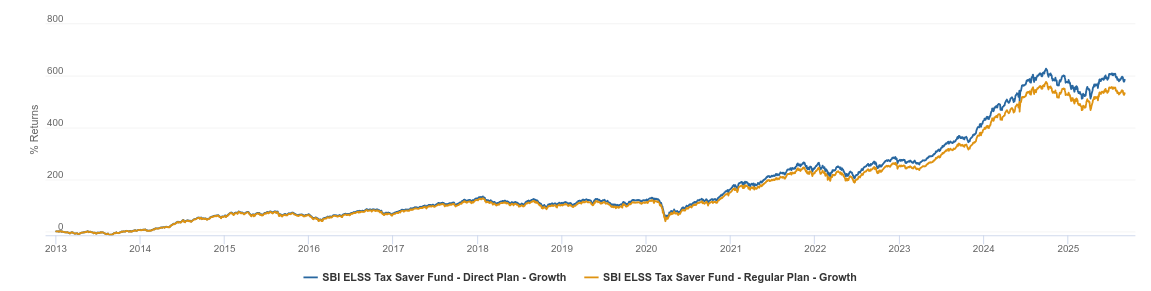
Here’s an example of the performance of direct (blue line) and regular (yellow line) plans of the SBI ELSS Tax Saver Fund over the last 12-years. The direct plan has outperformed the regular plan by ~49%.


Commissions earned by top distributors

Commissions earned by top 20 distributors (Rs. crores).

Name of the ARN Holder Gross Amount paid (Cr) in 2024-25 Gross Amount paid (Cr) in 2023-24
NJ IndiaInvest Pvt Ltd 2,608.08 1,881.81
State Bank of India 1,513.65 1,039.33
HDFC Bank Limited 1,083.38 790.31
Prudent Corporate Advisory Services Ltd 1,058.38 736.24
Axis Bank Limited 765.72 596.62
ICICI Securities Limited 679.46 521.38
ICICI Bank Limited 511.58 399.90
ANAND RATHI WEALTH LIMITED 453.51 291.21
Kotak Mahindra Bank Limited 416.69 324.48
Hongkong & Shanghai Banking Corporation Ltd. 226.99 168.63
360 ONE DISTRIBUTION SERVICES LTD 219.13 147.47
Standard Chartered Bank 194.04 140.44
HDFC Securities Ltd 193.31 127.05
Julius Baer Wealth Advisors (India) Private Limited 183.90 139.27
Bank Of Baroda 176.34 123.58
Bajaj Capital Ltd. 151.73 116.95
Geojit Financial Services Ltd 128.49 94.90
JM Financial Services Limited 128.25 89.08
Wealth India Financial Services Pvt Ltd 112.54 86.24
Scripbox.Com India Pvt Ltd 103.05 79.35

Source for the above data: https://www.amfiindia.com/commission-disclosure


If you are new to investing in mutual funds and all of this seems gibberish, Don’t worry, you can learn all about investing in mutual funds on Varsity:

2 Likes

Many of these will be 3 in 1 type salary accounts and people will pay commissions unnecessarily.
Over multiple decades its a big drag on returns.

I know people who wouldnt even think of switching to direct, they feel like they wouldnt have any control. They look teriffied when I suggest they can get rid of the clutter and commission drain by consolidating and moving to 5 multi asset/Debt/hybrid funds (and the odd small/mid cap) via Direct mode. Some of them have invested in 20+ MFs, all commission wala :upside_down_face:

Tell them they will lose 20-30% or more of what they make over next few decades. Give some approx numbers in lakhs/crores that they will lose. All this for fake convenience and lethargy.


One problem with hybrid funds is that their expense ratio is usually similar to equity but debt funds usually can have a lot lower ratios. Even Zerodha passive fund seems to have pretty high ratio, with the fof itself taking > 0.2% which seems a but high considering it will invest in Z funds. I guess premium for doing something new or for low base.
Vanguard expense ratios are so low.

And if you need to withdraw from hybrid funds, then you take out from equity too.

ofc, plenty of advantages too and convenience.


So i have been out of touch and don’t have equity. I used to like Prashant Jain, but he left. ICICI guy Naren is good, also Andrade. And PPFAS seems to be popular.

Anyway, which Hybrid funds do you recommend ? Do they hold gold or plain old debt + equity ? I don’t think i have ever invested in these funds.

If one is interested in conservative funds with a history of good returns and year-year consistency without barely a negative year- the following are good

Hybrid/Multi Asset
ICICI Prudential Asset Allocator Fund (balanced hybrid)
SBI Multi Asset Allocation Fund (50% equity, with half of those in mid/small, and remaining 50% in debt and commodities)

Debt/Arbitrage Funds
HDFC Income Plus Arbitrage Active FoF (??)
ICICI Prudential Income Plus Arbitrage Active FoF

I like the hybrid funds because they have allocation styles that helps them have good consistency year on year, and since 2015, their annual and 3 year rolling returns are good.

Here is an example

Fund 2015 2016 2017 2018 2019 2020 2021 2022 2023 2024
ICICI Prudential Asset Allocator Fund (FOF) - Direct Plan 2.93 13.05 15.40 8.62 11.14 14.79 18.07 9.49 19.54 14.55
Fund 2015 2016 2017 2018 2019 2020 2021 2022 2023 2024
SBI Multi Asset Allocation Fund - Direct Plan 10.86 9.96 11.96 1.83 11.16 14.95 13.96 6.96 25.50 13.85

Add Index Funds whenever they fall 8% from ATH, add Lumpsum Midcap Funds when the MidCap index has fallen 20%, SmallCap when the SmallCap 250 Index has fallen 25-30%, Gilt Funds at the top of an interest cycle.

I added Small/Midcap in 2018-2019 (sold the last of em in 2024, too early it appears), and added Gilt Funds 1.5 years back…

2 Likes

Nice work in both. Did you test gilt data or just out of discretion ?
Thanks for funds recommendations.

HDFC Income Plus Arbitrage Active FoF (lil aggressive debt fund)

This one is a mystery. Returns seem very high for just debt. 11.5%! over 10 years. 16.6% over 5years as per official site.
It fell 17% in 2020 crash and recovered well. This looks like it held equity in past ? I haven’t seen this category so will have to look but neither arbitrage nor debt will generally fall that much quickly and in 2020 gilt yields i don’t think spiked hard to cause that kind of drop in long term debt.
Maybe they renamed a fund that held equity in past ? How long have you invested in it ?

Best debt fund i have seen so far long term has been ICICI all seasons, which gave around 10% over 10 years but probably in future will give a bit lower since yields overall are going lower.


FoF def reduces volatility and risk while giving decent returns + much better taxes vs pure debt.

But they still have some risk, some of them fell 10-20% in 2020 crash. We just got lucky and bounced right back so yearly returns doesn’t show it.

But that’s fine, its part of the risk and combined with trading and buy on crash - good options to have.
These fof have much lower expense ( like 0.03% ) on top vs Zerodha. Hopefully Z will reduce once they get more AUM under the fund + Z has a better mix i think with gold. SBI one has silver and gold too.

2 Likes

HDFC income plus arbitrage went through a change in 2019, until then it was called dynamic PE ratio fund…

The scheme currently aims to invest dynamically in units of Arbitrage and Debt Mutual Fund Schemes with less than 65% of its total assets in units of Debt Mutual Fund Schemes.

Zerodha’s offering will likely take a few months b4 it becomes pledgeable…

I haven’t yet invested in either of the Income plus arbitrage funds, needed more research, and was considering - already invested in the icici asset allocator and sbi multi asset funds.

Edit:
The ICICI Prudential Income Plus Arbitrage Active Fund of Fund (FOF) was previously known as the ICICI Prudential [Income Optimizer Fund (FOF). Change of name and methods in 2025

Thanks for the heads up @SpacemanSpiff

1 Like

Like you said, returns are diminishing with this fund…
My Cash equivalent allocations (for pledging) are full with liquid funds and gilt funds. So in non-cash I look for others with more strength and 10 yr consistency if possible…

1 Like

This is 2025 too.

Yeah so all of them changed together, because of taxation rules. FoF with debt and arb will have much better taxation.
Ideally they should scrap past data after such a major change. Previously benchmark included Nifty50TRI.
So its basically a different fund now and past data is not relevant. Future returns will definitely be lower.

Anyway, need to see what their mandate is for debt. Idea seems fine as i should get returns similar to debt ( also arb) but taxed at 12.5% after 2 years. Much better than giving up more than a 3rd of returns.

But at the same time, there wont be much variation in arbitrage side of things, so all of them will have this as a common factor. And if everyone starts putting money into Arb, its possible that arbitrage returns could get lower. Dunno.


And taxed at slab, which negates all of the advantage when we sell. Else i would be happy with it.

Mine is 100% debt - overnight +liquid / money market / gilt. All of them get taxed at slab, not great but i plan to hold them forever for now and use for trading.

Then i started looking at taxes, put some into Arbitrage as it should get taxed as equity ( so will also have 1.25L tax free every year ). Ill use these for selling when needed.

Now need to see where to put fresh money. Debt + Arb looks like a decent option or ill have to look at equity again direct or these multi asset/FoF types. Also waiting for Z FoF to become pledgable.

1 Like

A conservative multi asset fund, with less history, only 30% allocation to Equities
https://www.valueresearchonline.com/funds/43501/whiteoak-capital-multi-asset-allocation-fund-direct-plan/#fund-portfolio