You have always been very transparent about your views on the market dynamics and that has helps us understand what’s really going on.
Given the significant evolution of the Indian options market—moving from the pandemic-era surge to daily expiries, and now to a tighter regulatory environment—we would love to get your insights on a few key areas:
Future of Derivatives: Where do you see the Indian derivatives market heading? Do you anticipate retail participation will continue to decline, or are we approaching a plateau?
Drivers of Lower Participation: Would you attribute the recent dip in retail activity primarily to stricter SEBI regulations, Nifty’s relatively lackluster performance over the past two years, or a combination of other factors?
Zerodha’s Strategy: Looking at a five-year horizon, is Zerodha pivoting its strategic focus more toward Margin Trading Facility (MTF) or continuing to double down on Futures & Options (FnO)?
I guess this is completely dependent on the overall markets; if the market continues to be in a range, I don’t see what will be the trigger to get more people interested in trading. If you look around, given that we are on the wrong side of the global AI trade, I don’t see what will cause India to be in a bull market again. So yeah, if you were to ask me, at best, it is a plateau.
2/3. Within the team, I was giving an example of ITC, of how they pivoted into everything else, and they did it right in 1980. Because I think they figured that, we are essentially a socialist country, and they will not be able to keep selling tobacco, considering how harmful it is for people. It hasn’t been banned yet, but taxes on this keep going up every year.
In the same way, I think the issue with F&O trading is that it isn’t good for 99% of the people. As long as this is the scene, I think regulations will keep tightening or making it tougher for people to trade, or taxes will keep going higher.
So yeah, we are also, like, diversifying our business. But the issue is, whatever else we do, doesn’t add up to our F&O brokerage income Be it Ditto for Insurance, Zerodha Capital for LAS, Zerodha AMC, or the tons of other investments that we are doing through Rainmatter.
SEBI hasn’t really made it any harder to trade F&O. I think it is a combination of higher taxes and the market’s general lacklustre performance over the last 2 years. While as a country we are supposed to have 15-odd crore accounts, most of the activity still comes from maybe 1 to 2 million.
The parallel reference to the tobacco industry above, reminded me of how
competitors in an extremely regulated market (leading to very similar products)
can transition to virtue-signalling to make their brand stand out from the rest.
Sharing dramatic recreations,
as i find them entertaining to watch
and in case the analogies spark any further thoughts/ideas relevant to the broking industry in the near future.
The “It’s toasted” campaign from the tobacco industry in the 60s.
“Patterns of public-discourse and social-media campaigns” from more recent times
Right. Sounds like cycles out of one’s control.
i am reading it as - “Not a smart move to try to force the growth issue right now”.
(and a reminder that Z* has once again “lucked-out” as not in a position that Z* needs to force the growth issue, unlike some of the other competitors, who will try and either succeed and grow, or fail and be forced to consolidate (and effectively grow).)
@nithin Is the “issue” =
currently limited to how fast and how much one can diversify
without it looking like a financially unjustifiable decision ?
If yes,
to me this sounds like an uncharacteristic self-doubt/concern.
Newly discovered/evolved thresholds/limits of contrarian stances being productive
in the business (or the evolving world) ?
I think he just means F&O income is too big. Nothing else comes even close. It’s a big cash cow and other businesses won’t or can’t give that kind of margin.
…and for most others, that would be the end of it.
But, since Zerodha/Rainmatter has never relied on “more money” as a justification
why is it an “issue” now when it comes to trying to diversify off of a “cash cow” ?
a. Hitting limits (time? trust? …??) when trying to productively deploy into diversified assets more than what already have?
b. Discovered way more opportunities to diversify, and thus need way more capital?
c. Something else?
@nithin, am curious to understand the nuance behind this otherwise seeming inconsistency. PS: In case this is not an ideal medium/forum for this (and such) discussions, please let me know where else might be a good place to pick your brains about stuff like this.
It is not really an issue, like the way you are making it out to be. All I said was, whatever we are doing, it is almost impossible to reach where our F&O business is at, at least for now.
All businesses are there to make money. “Make the world a better place?” Sure! But you can’t do that without money - it’ll be an existential crisis, if you can’t also make money while doing that. if your values are at odds with money, At what point do you give up your values? Maybe lose the battle to fight an another day? Or is the value too precious to compromise now? There are very very few who didn’t compromise - Recently read about Lavabit, who shutdown their business to avoid government making use of their encryption keys. Huge respect. That’s not to say values would be the right decision all the time. Heard that Elon had to apologize to their SEBI equivalent admitting wrong doing to prevent his company from dying. He compares it to having a gun to their child head and he was forced to admit guilt even though he wasn’t. But he did that and his company survived and he gets to talk about “those bastards” publicly. What’s the right decision? Like everything in life, no one really knows!
PS: Personally, I believe Zerodha compromised on many values, latest being when they implemented MTF, and may continue to do so. Again, may be the right decision or may not be.
I don’t think offering MTF is compromising values. We offer buying options, which are exponentially more dangerous.
Our value, as you can call it, is that whatever you can trade on, you should be able to do it at Zerodha at reasonable rates. And generally, our vision, in a way, is: don’t do to others what you don’t want done to you. So we never push MTF or use dark patterns to induce greed and make you click on MTF order, etc.
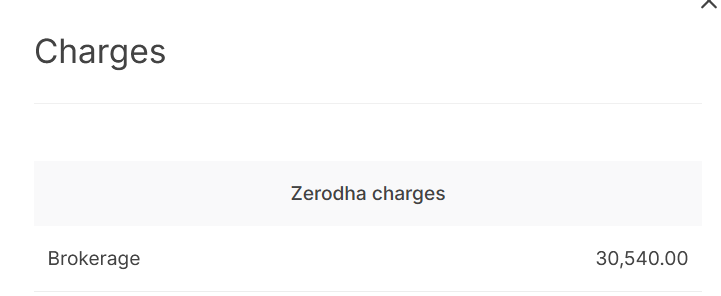
I would sincerely request Zerodha to look at this “one price for all” approach to this facility. In Last 1 year (Aug to aug), I paid Zerodha 30,540 Rs in F&O brokerage charges alone. That amount is more than i have spent on any software or tool for personal use, including AI and Tradingview combined.
If a user is paying so much as charges to Zerodha through transactions, shouldnt a 500 rs separate fee for this product be waived off? It should be complimentary to those users that drive the tail end of your business income as a mutual thanks. I totally am grateful to Zerodha’s services. I wish Zerodha also shares gratitude towards us too! Otherwise F&O income drivers get nothing additional in return to the extra money they leave on table, apart from , the platform to do F&O trades on, which is fantastic and nice, though sometimes short of glitch free experiences on volatile opening days. Also recently Zerodha altered how cash shortfalls or negative balances are treated (only attracted delayed payment interest (18% p.a.) vs additional transactional costs.)
When all these extra costs are paid, some extra benefits that help in same work would be nice for us. I would thus request this pricing be rethought! I know it has been in past reduced from 2000 to 500 Rs, but still one price for all.
We had added this Rs 500 as a way to stop people from using this, unless they are actually trading with us. But what you say makes sense. From now on, we will run a process at the end of every month to check whether a customer has paid Rs 2000 as brokerage for the month, and then not charge him the Rs 500 for the next month if they have.
@nithin
I recently came across an old video from around 2015 where you mentioned that Kite would soon have preset watchlists. I noticed that this feature has actually been launched in 2026.
I am curious if the idea was already identified 11 years ago, what made it take so long to implement?
 Be it Ditto for Insurance, Zerodha Capital for LAS, Zerodha AMC, or the tons of other investments that we are doing through Rainmatter.