Hi All, I recently sold some US Mutual Funds like Kotak and ICICI Nasdaq 100 funds. How will the gains be taxed ? In Zerodha Tax P&L statement of mutual funds, it is showing under LTCG [Debt] head.
24m, 12.5%, Slab
Based on
1 Like
Thank you soo very much sir… This information helped me a lot to understand the basics… I will review this with my CA and then file for ITR…
By the way, I wanted to also understand at very high level how the taxation works for equity and debt funds, so that I can plan and redeem my investments in a tax efficient manner in upcoming years.
I am currently not working and hence, no salary component for me. I’ve booked a profit of approx 12+L in stock market. Off this, approx 2.5L is coming from direct equity stock selling (LTCG) and remaining 10L is coming from selling of above Mutual Funds like KOTAK and ICICI NASDAQ 100 FoFs which are both classified as DEBT Funds in India. Off the total 10L profit, approx 7.05L is classified as Long Term Gain for Debt Mutual Fund and remaining as “Debt - Purchases post 2023-04-01”. Also, I have approx 4L income from FD investments.
Total = 12.5 + 4 = 16.5
12.5 Breakup = 2.5L (LTCG Equity Shares) + 7.05L (LTCG DEBT MFs) + 2.95L (“Debt - Purchases post 2023-04-01” in Zerodha Statement) + 4L (FD Interest).
If possible, and you can help me understand very high level taxation breakup of above numbers, it would be extremely helpful for me.
Regards,
Deepak
They are not debt MFs. Read section 50AA and my previous post comments regarding 50AA. They are still equity if they don’t invest >=65% in debt. Like I said before it’ll be 12.5%(if >24m) else slab.
@siva Are you giving reports stating icici nasdaq mf as debt? It should be equity or NonEquity(your temporary label for things you are not sure of) but not debt.
Will do FAQ once we are close to release, but will inform team about this point.
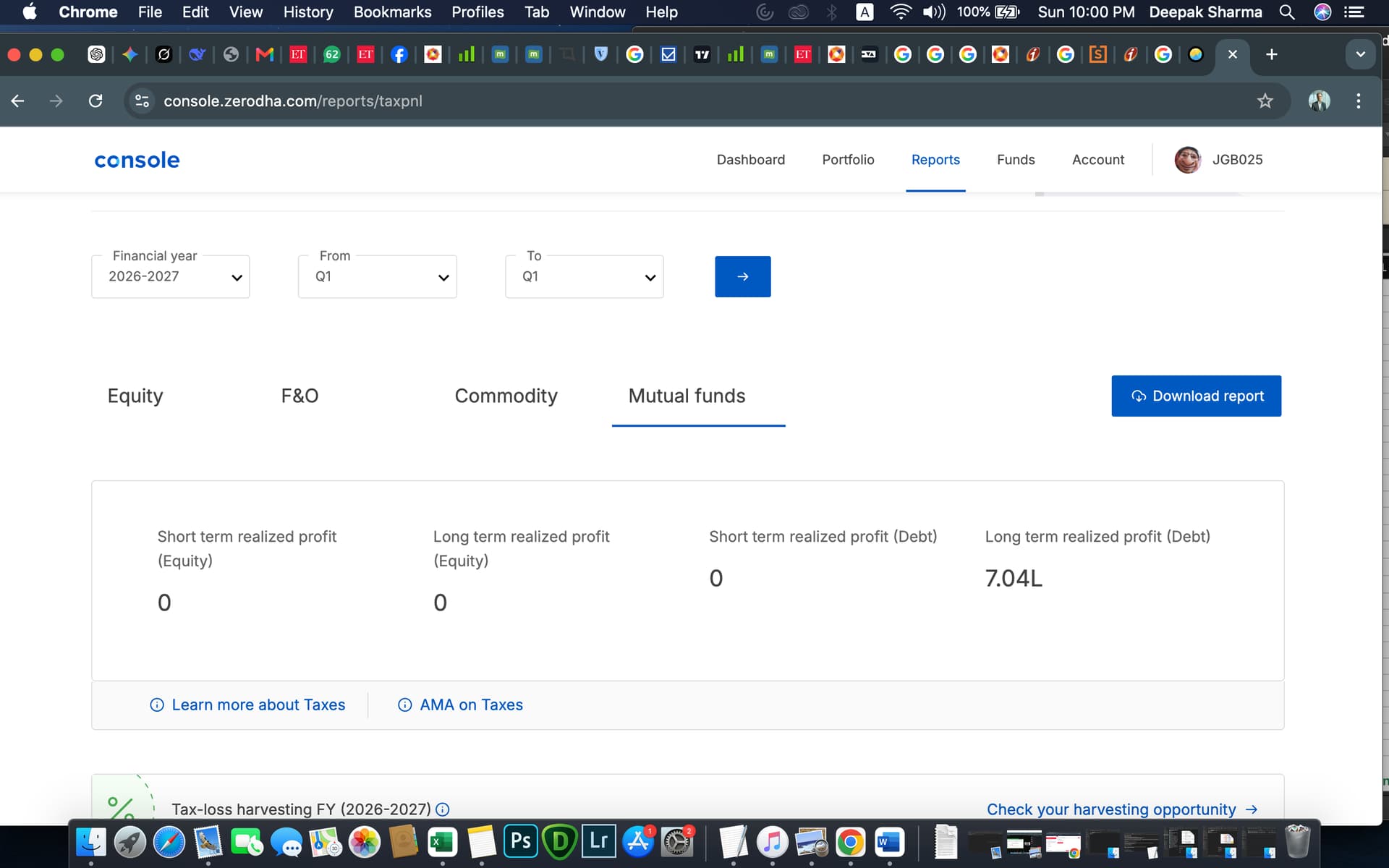
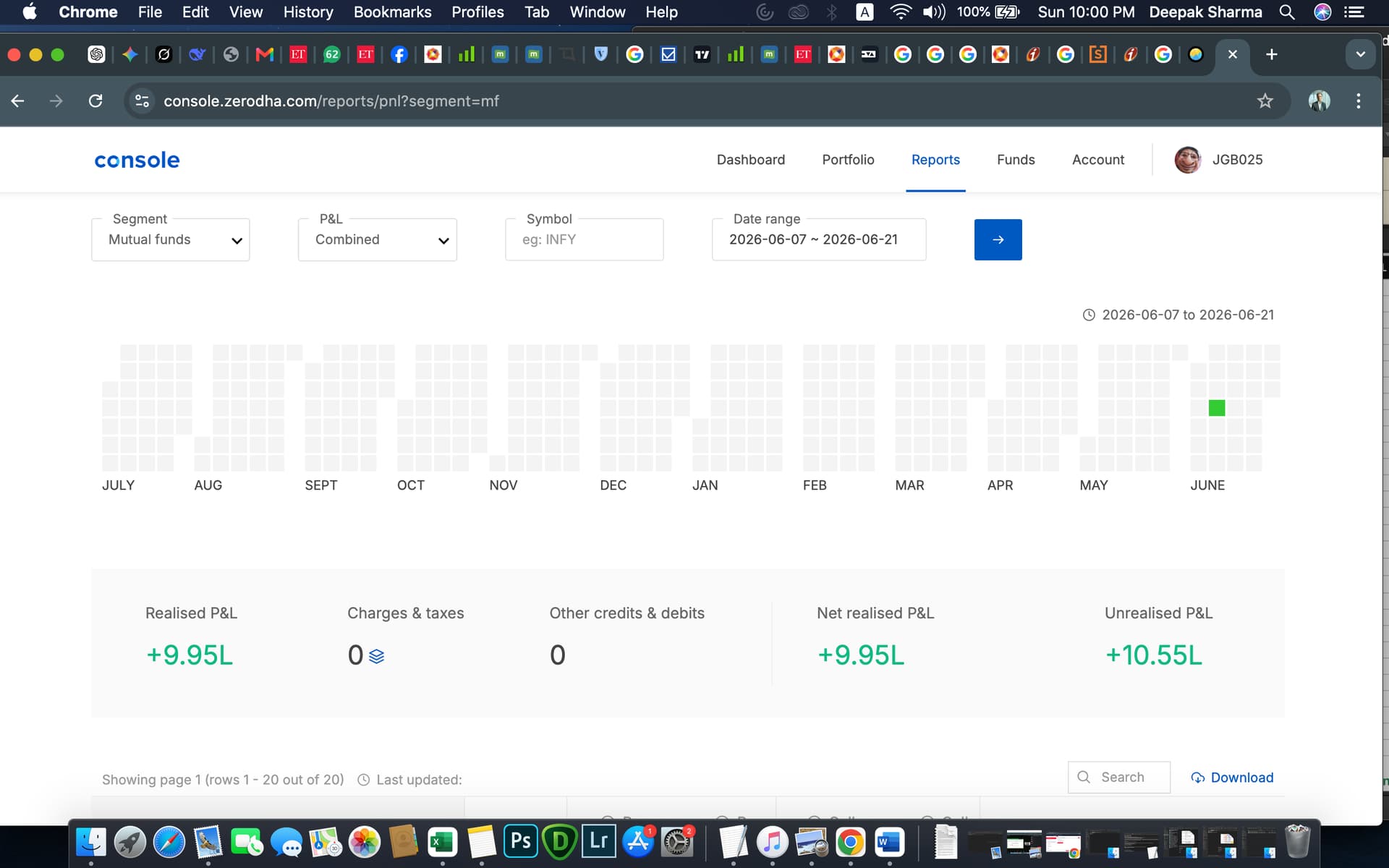
Hi @siva and @BB789, I will keep checking the Tax P&L Reports and share an update in case the labels change for MF Profits. Attaching here the current screenshots of P&L and Tax P&L statements, for reference. As a new user, I will be able to attach only 1 media item as a new user - so will upload it one by one…
What is your query?
Hello @siva please read the thread above. Below are key points :
I sold 2 Mutual Funds - that I held for approx past 2-4 yrs. ICICI Prudential NASDAQ 100 Index Fund Direct Growth and Kotak US Specific Equity Passive FOF couple of weeks ago.
After selling them, I noticed that the amount of profit booking that is coming in “Realised P&L” is 9.95L. And the amount of profit booked that is coming in “Tax P&L” is 7.04L under the head - Long Term Realized Profit (Debt). Please check both screenshots shared above for quick reference.
When I created the thread here, I got to know from @BB789 that these are not debt MFs but equity MFs (due to some government rules which I did not understand personally). and then he asked a question from you on the same about 5 days back.
I am not sure, whether to treat the P&L and Tax P&L reports that are generated and shown in Zerodha Console as the source of truth ? OR take feedback of @BB789 sir into account and consider that reports in Zerodha Console are incorrect and label in Tax P&L Report is also incorrectly marked as “Long term realized profit (Debt)” when it should be treated really as “Long term realized profit (Equity)”.
Now coming to my questions : I just have below 3 questions ::
- Why is there a difference in the amounts mentioned under Tax P&L [mentioned as 7.04L] and P&L which is correctly showing the Realised P&L as 9.95L.
- Second question is, if this is indeed a defect as identified by @BB789 that needs to be fixed in coming days ?
- Last question is what is the Tax Treatment for these gains - Tax needs to be paid on profit shown in which of the 2 statements ? Realised P&L amount of 9.95L OR Long Term Realised Profit (Debt) of 7.04L. This question assumes that current implementation on Zerodha Console is correct and it means that ideal response to my second question is - that this is not a defect and correct implementation.
Requesting your kind help to please clear my doubts. It would help me a lot.
Regards,
Deepak Sharma
Tax year is april 1 to march 31.
The tax implication for Indian funds that invest in US market is that they are considered as other than equity funds and not debt mutual funds. The period of holding is to be considered as 24 months. If they are held for more than 24 months than they are considered as LTCG and taxable at 12.5% otherwise it treated as STCG and taxable at slab rates.
Thank you!
Please refer the below article link that was published by TATA Capitals and updated just couple of weeks back. It is not as straightforward, due to the Grandfathering Clause - as per below article… @Quicko team.
How to calculate capital gains tax on international mutual funds in India?
The step-by-step process to calculate capital gains tax on international mutual funds in India is as follows:
- Identify the type of fund: Most international mutual funds are treated as non-equity funds in India, so they do not receive equity tax benefits and are subject to debt-fund taxation rules.
- Check your purchase date: Tax treatment depends on whether you invested before or after 1 April 2023, as indexation is mostly removed for newer investments.
- Determine the holding period: If you hold units for up to 24 months, gains are short-term. If held for more than 24 months, gains are considered long-term.
- Calculate capital gains: Subtract the purchase cost and any allowed expenses from the sale value. This is your capital gains amount.
- Calculate taxes: Short-term gains are added to your total income and taxed according to your income-tax slab rate. For long-term gains, you need to calculate taxes at 12.5% without indexation.
6. Check grandfathering benefits: You can apply indexation rules and earlier tax rates to older investments (those purchased before 1 April 2023).
I am not sure, whether to treat the P&L and Tax P&L reports that are generated and shown in Zerodha Console as the source of truth ? OR take feedback of @BB789 sir into account and consider that reports in Zerodha Console are incorrect and label in Tax P&L Report is also incorrectly marked as “Long term realized profit (Debt)” when it should be treated really as “Long term realized profit (Equity)”.
Now coming to my questions : I just have below 3 questions ::
- Why is there a difference in the amounts mentioned under Tax P&L [mentioned as 7.04L] and P&L which is correctly showing the Realised P&L as 9.95L.
- Second question is, if this is indeed a defect as identified by @BB789 that needs to be fixed in coming days ?
- Last question is what is the Tax Treatment for these gains - Tax needs to be paid on profit shown in which of the 2 statements ? Realised P&L amount of 9.95L OR Long Term Realised Profit (Debt) of 7.04L. This question assumes that current implementation on Zerodha Console is correct and it means that ideal response to my second question is - that this is not a defect and correct implementation.
Requesting your kind help to please clear my doubts. It would help me a lot.
The date range is different in both your screenshots. It should be
Essentially, all gains are booked within this year - in month of June only - June 2026. First screenshot shows default configuration of this year and second one is manually selected for the month of june [the date range when I booked the profit].
Doesn’t matter. It should be Apr1 2025 to mar31 2026 only. Your tax and p/l should be based on that timeframe only
To clarify, yet again, for the nth time - Note that all above screenshots are from this financial year - These mutual funds were sold in JUNE 2026 and both screenshots that I shared are from the same timeframe. Please check the images once again, properly. Note that the INCOME TAX REPORTING for the gains will need to be done in the ITR that I file next year [AY 2027-28, FY 2026-27].
Hello Team, Good Morning. Is there an update on this thread ? Looking forward for the clarification.
Regards,
Deepak
Will it have to be reported under FA schedule of ITR ? Will the gains have to be reported as income from foreign assetts ?