Our goal with The Daily Brief is to simplify the biggest stories in the Indian markets and help you understand what they mean. We won’t just tell you what happened; we’ll tell you why and how too. We do this show in both formats: video and audio. This piece curates the stories that we talk about.
You can listen to the podcast on Spotify, Apple Podcasts, or wherever you get your podcasts and watch the videos on YouTube. You can also watch The Daily Brief in Hindi.
In today’s edition of The Daily Brief:
- Reliance opens the year on the front foot
- Who decides if you should answer the call?
Amit Tripathi noted on CNBC that India’s largest AAA banks were paying 225 basis points over the repo rate for three-month money, spreads that show up in a crisis. We sat down with him, CIO for fixed income at Nippon, to unpack why the repo rate isn’t really how banks fund themselves, why liquidity sets real borrowing costs, and why shrinking CASA deposits are pushing securitisation back to the centre of Indian banking. Watch the full podcast episode below:
You can also listen to the full conversation on Spotify and Apple Podcasts. The full transcript of the podcast is below if you prefer to read.
While The Daily Brief covers structural macro trends, Aftermarket is our quick, noise-free daily wrap-up tracking how Indian markets moved, top sector drivers, and key trading stories. Subscribe to Aftermarket to get our daily market recap delivered straight to your inbox every evening.
Reliance opens the year on the front foot
Reliance had a strong start to FY27.
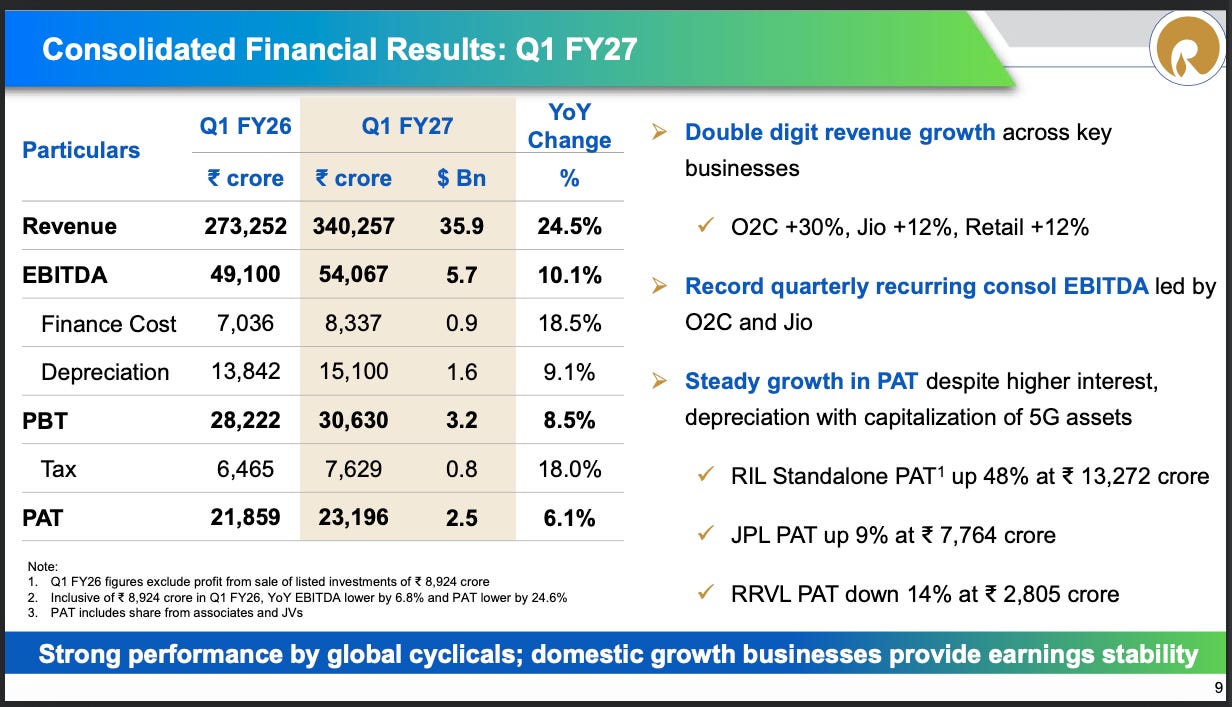
In the first quarter, their revenue grew 24.5% year-on-year to ₹3.4 lakh crore, recurring EBITDA rising 10.1% to a record ₹54,067 crore and recurring profit increasing 6.1% to ₹23,196 crore.
But the profit figure needs some context.
On paper, RIL’s profit fell nearly 25% from the same quarter last year. That is because Q1 FY26 included a one-time gain of ₹8,924 crore from the sale of its stake in Asian Paints. Once this exceptional gain is removed, giving us a fairer comparison of the underlying businesses, RIL’s profit actually grew by 6.1%.
So, the reported profit was lower, but largely because it was being compared with an unusually high base. The individual businesses themselves have performed better.
As always, the story doesn’t change significantly between two consecutive quarters. But the nuances of the individual businesses have certainly become more interesting especially as the external environment has changed.
O2C (Oil to Chemical business)
Let’s start with Reliance’s core business: oil-to-chemical, which is where it converts oil to oil products like naphtha, ethane and other products that feed into plastics and polymers.
O2C revenue grew by 30.4% compared to last year, while EBITDA rose 17.2% to ₹17,010 crore. This is the segment’s highest quarterly EBITDA in four years, and management themselves described it as an extraordinary quarter.
But, in their own words, it was hard-fought as it was impressive.
After all, last quarter, the EBITDA for this business fell 3.7% y-o-y. Getting crude oil to the refinery itself had become extremely expensive because of the closure of the Strait of Hormuz. Reliance had to pay heavy crude premiums per barrel. Freight rates for cargo ships increased nearly tenfold, while insurance costs also multiplied. The company had no choice but to work around the clock to source crude from alternative regions.
On top of this, shipping blockades disrupted India’s imports of LPG, the cooking gas used by millions of households. To prevent a domestic shortage, the government asked Indian refineries to maximise LPG production. Reliance responded by increasing its LPG production fourfold, which also took away resources from their petrochemicals business.
Reliance also faced a disruption to its ethane supply. With the Suez Canal route unavailable, the company’s specialised ships carrying cheap ethane from the US had to take the much longer route around Africa.
So, what went right?
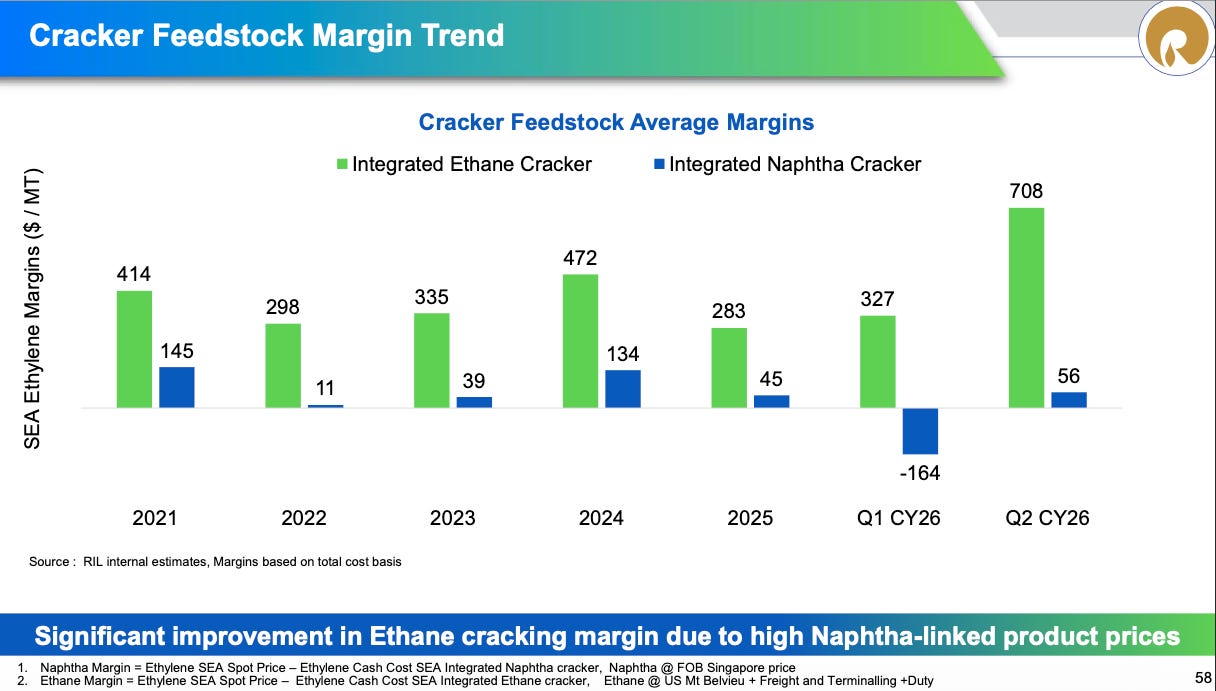
One big advantage came from Reliance’s ability to switch between ethane and naphtha. To make plastics and other petrochemicals, companies need to feed their chemical plants with raw materials such as naphtha or ethane, a gas that Reliance imports from the US, and is a cheaper substitute of naphtha.
During the quarter, crude oil prices rose sharply while US ethane prices actually declined. Reliance is among the few companies globally with the specialised infrastructure needed to import ethane and use it in its plants. This allowed the company to replace some of the expensive oil-based feedstock with cheaper ethane, saving significantly on raw-material costs. Reliance has also added three new very large ethane carriers to its fleet.
The second advantage came from a change in the geography. Reliance rerouted its exports away from Europe and towards fuel-starved, higher-paying markets in Asia, including Singapore and Australia, which actually earned them better margins per barrel. At the same time, reduced its dependence on Middle Eastern crudes by sourcing more discounted crude from Latin America, Canada, Africa, and Russia.
Reliance Retail
Now, we tackle the fast-growing retail business.
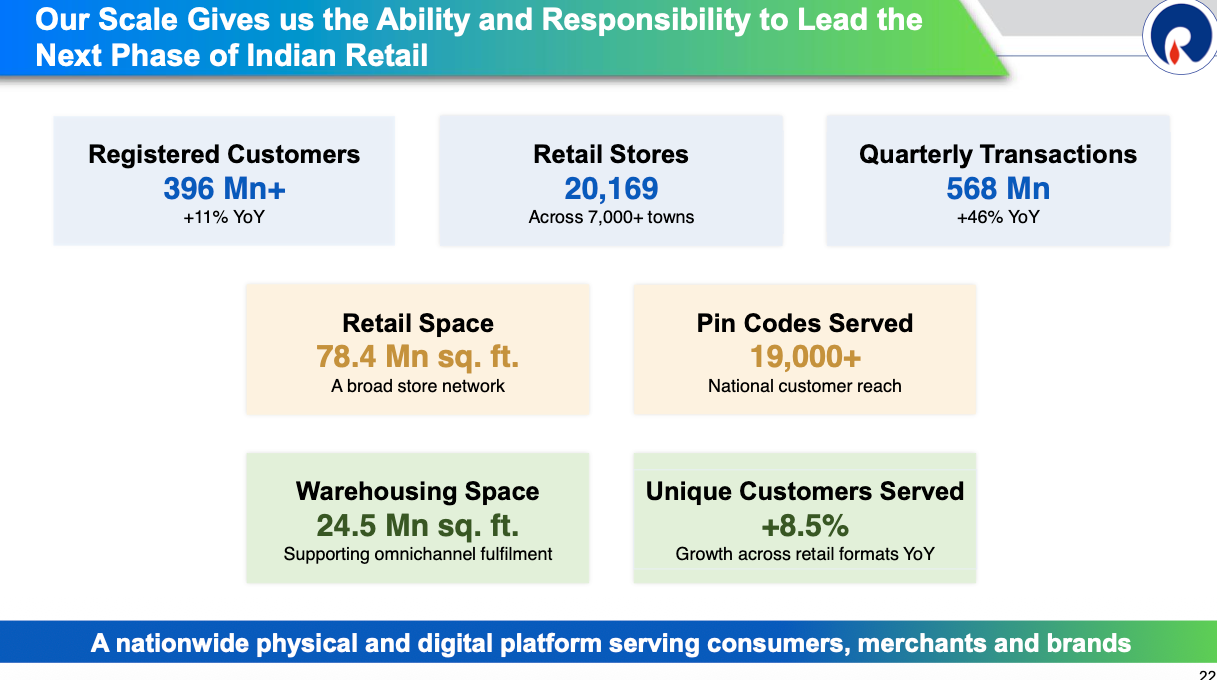
Reliance Retail’s distribution numbers don’t look real, with its physical stores spread across more than 20,000 physical stores in over 19,000 pincodes across India. And it isn’t limited to physical stores. Its digital platforms, JioMart and Ajio, allow customers to order doorstep service for everything from a packet of milk to a pair of jeans.
Source
However, while its gross revenue grew by 7.4% year-on-year to over ₹90,400 crore, its net profit actually declined 14.1% year-on-year .
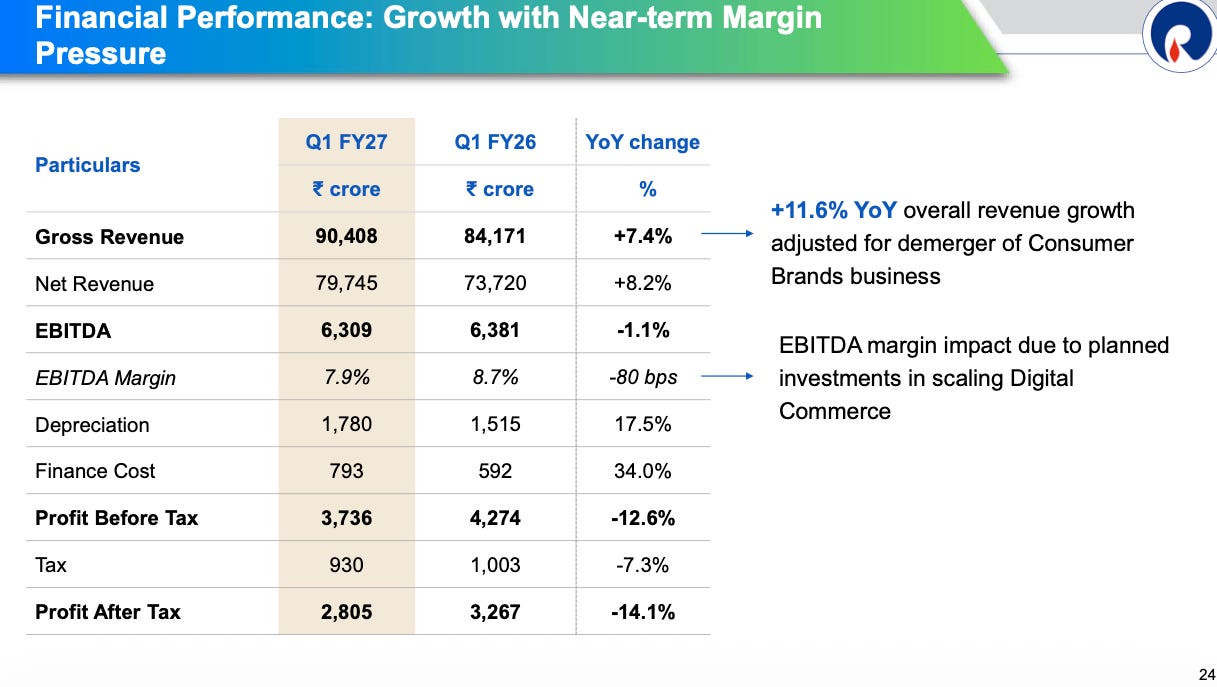
There may not be massive cause for alarm in this profit decline, though. It appears to be part of a deliberate investment phase.
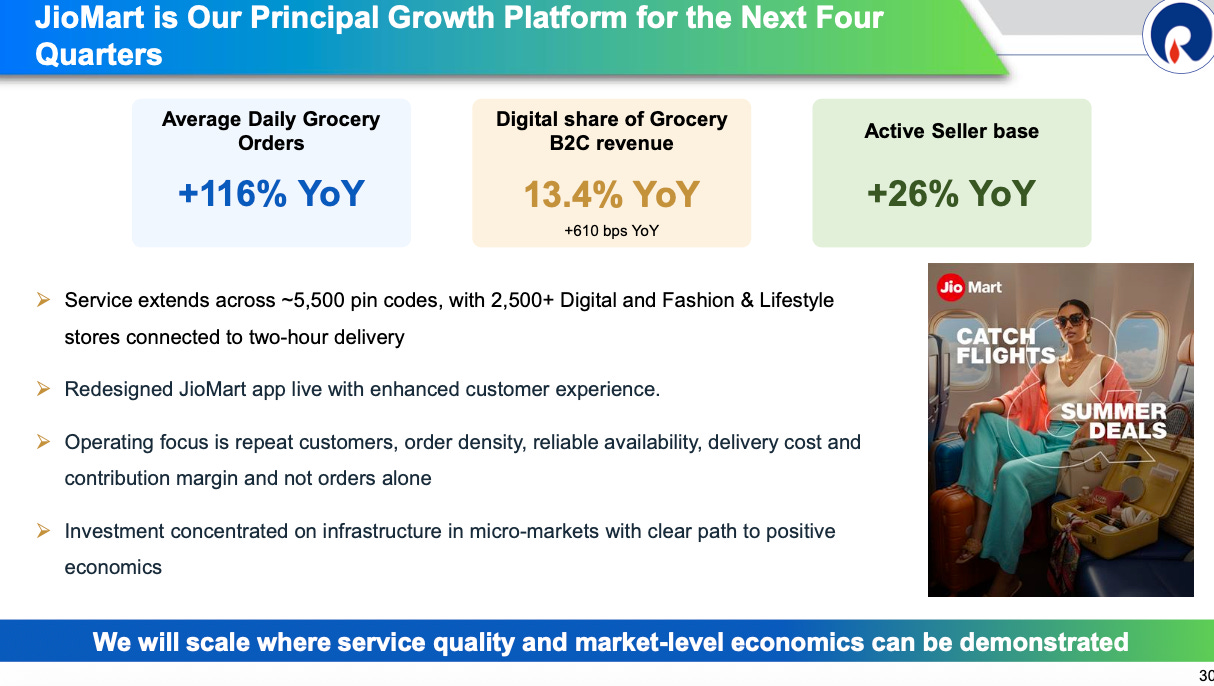
For one, Reliance is spending heavily to build dark stores for its quick-commerce business, ad wants to get to scale before monetizing it. Interestingly, that’s a subtle shift from their old strategy of relying heavily on their physical stores as delivery hubs. This obviously requires upfront investment, but it also increases depreciation expenses, putting pressure on short-term profits. Its grocery business is already expanding rapidly, with average daily online orders growing by 116%.
When it comes to Reliance’s physical business, things look healthy. Its electronics business recorded an impressive 16% like-for-like (LFL) growth. LFL measures sales growth only at stores that were already operating last year while excluding newly-opened stores. What’s more, this came at a time when the world has been facing high prices and shortages of memory chips. Reliance’s scale and strong relationships with global manufacturers helped it secure inventory earlier than its peers.
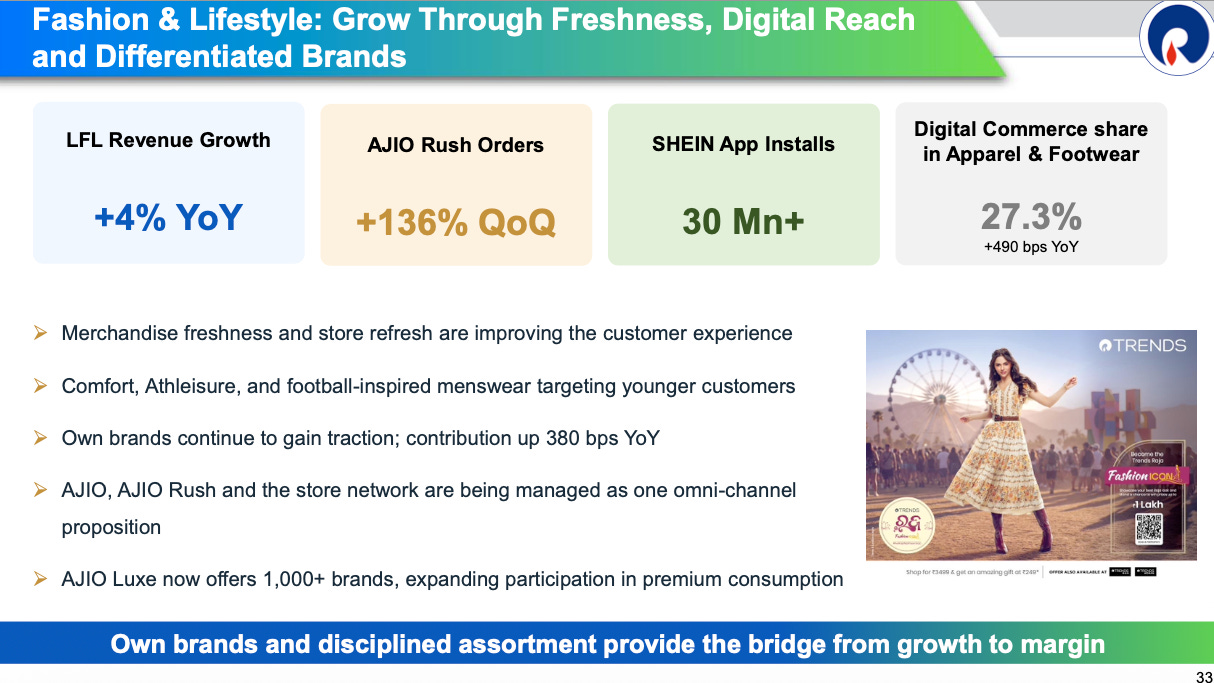
Meanwhile, Reliance also relaunched the global fast-fashion platform Shein in India through its retail ecosystem. The app has already crossed 30 million downloads. Meanwhile, Ajio Rush, which promises to deliver fashion products within four hours, recorded a 136% quarter-on-quarter increase in orders.
There is one catch in the overall growth numbers, though. Last year, Reliance’s consumer-brands business, which includes Campa, was counted under Retail but has since been demerged into a separate company. Once this is adjusted for a fair comparison, Reliance Retail’s underlying revenue grew 11.6%, rather than the reported 7.4%.
Jio Platforms
From retail, we move on Jio.
Jio has only recently launched their IPO — we broke down their DRHP. It is only natural that India’s largest telecom operator has its own ambitions separate from the parent company, and requires its own independence. During the quarter, Jio Platforms reported revenue of ₹45,961 crore, with its PAT increasing by 9.2% to ₹7,764 crore.
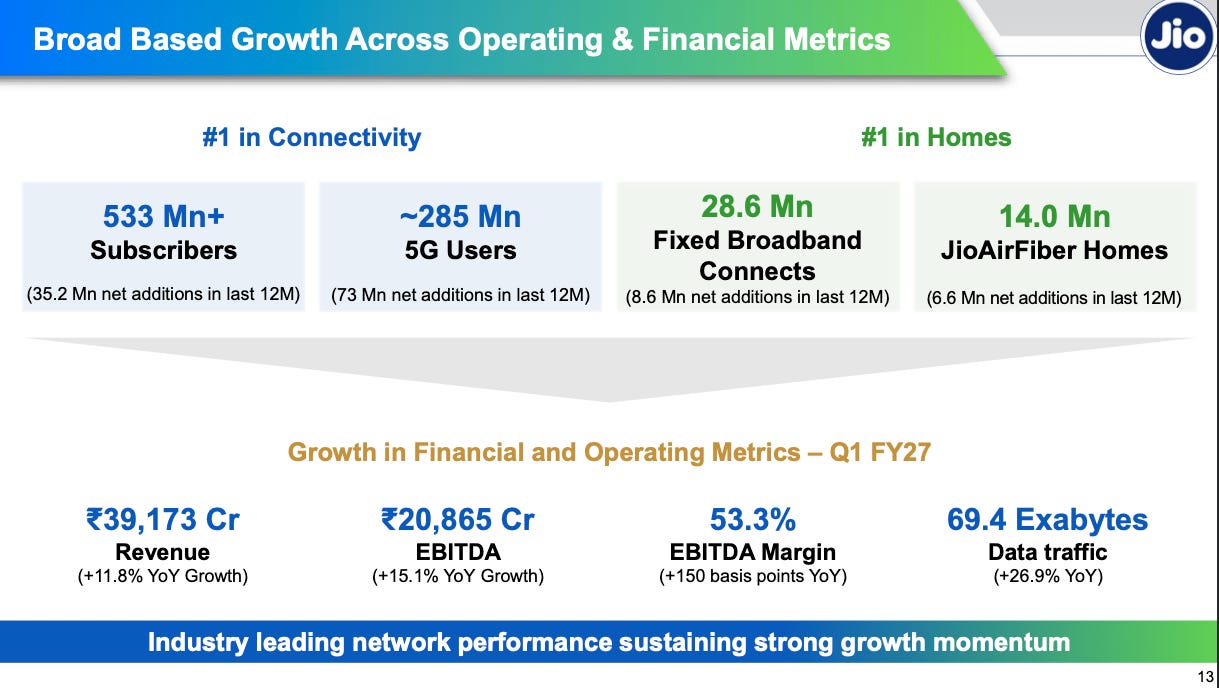
But, of course, the most important indicator in the telecom business is average revenue per user (ARPU).
Jio’s ARPU increased by 3% year-on-year to ₹215.6. Notably, in the past 12 months, Jio did not introduce a tariff hike. Customers actually spent more by upgrading to higher-tier 5G plans, consuming more data and using more services within Jio’s digital ecosystem.
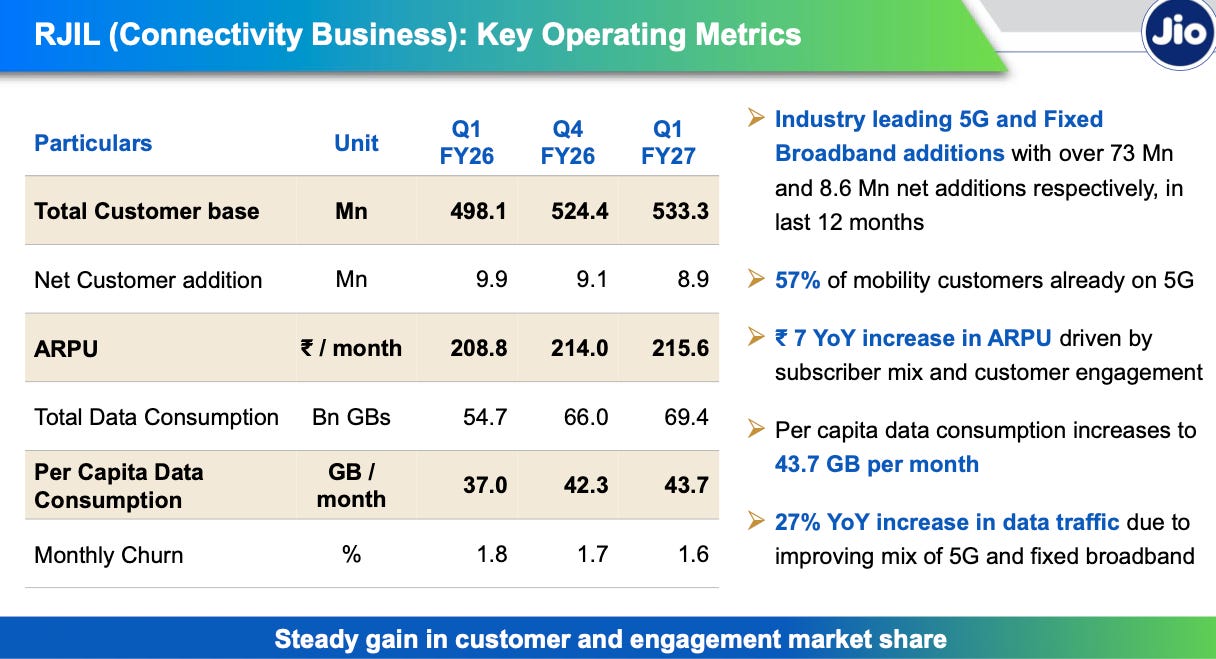
One growth engine Jio is relying on is home broadband through JioAirFiber. Traditionally, providing high-speed home internet requires companies to dig up roads and lay fibre-optic cables directly to individual homes. Fixed wireless access, or FWA, avoids much of this work by transmitting internet from a nearby 5G tower to a receiver installed at the customer’s home. JioAirFiber has now reached around 14 million homes and accounted for 78% of India’s new fixed-wireless home connection.
Jio’s main competitor, Airtel, has a higher ARPU of ₹257 on account of its subscriber base leaning heavily towards premium. Airtel has recently tried to push for priority 5G access to persuade customers to upgrade to costlier postpaid plans — this, as we covered recently, led to a tussle with TRAI. We recommend taking a look at The Ken’s recent story on Airtel’s survival strategies.
Oil and Gas
How is Reliance’s oil and gas mining business faring?
The business line primarily revolves around KG-D6, a deepwater oil and gas block located in the Krishna-Godavari Basin off India’s eastern coast. Reliance operates the block with BP, extracting natural gas from reservoirs located deep beneath the seabed.
During the quarter, the oil and gas segment reported revenue of ₹6,298 crore, up 3.2% from last year. EBITDA stood at ₹4,973 crore, translating into an exceptionally high operating margin of 79%.
However, KG-D6 is now experiencing the natural pressure decline that occurs as an underground reservoir matures. KG-D6 produced 7.4% less gas during the quarter than it did a year ago. These lower volumes placed some pressure on the segment’s earnings.
During the quarter, the government lowered the price ceiling for deepwater gas to $8.90 per MMBtu. Reliance consequently realised an average price of $8.89 per MMBtu, down from $9.97 in the same quarter last year.
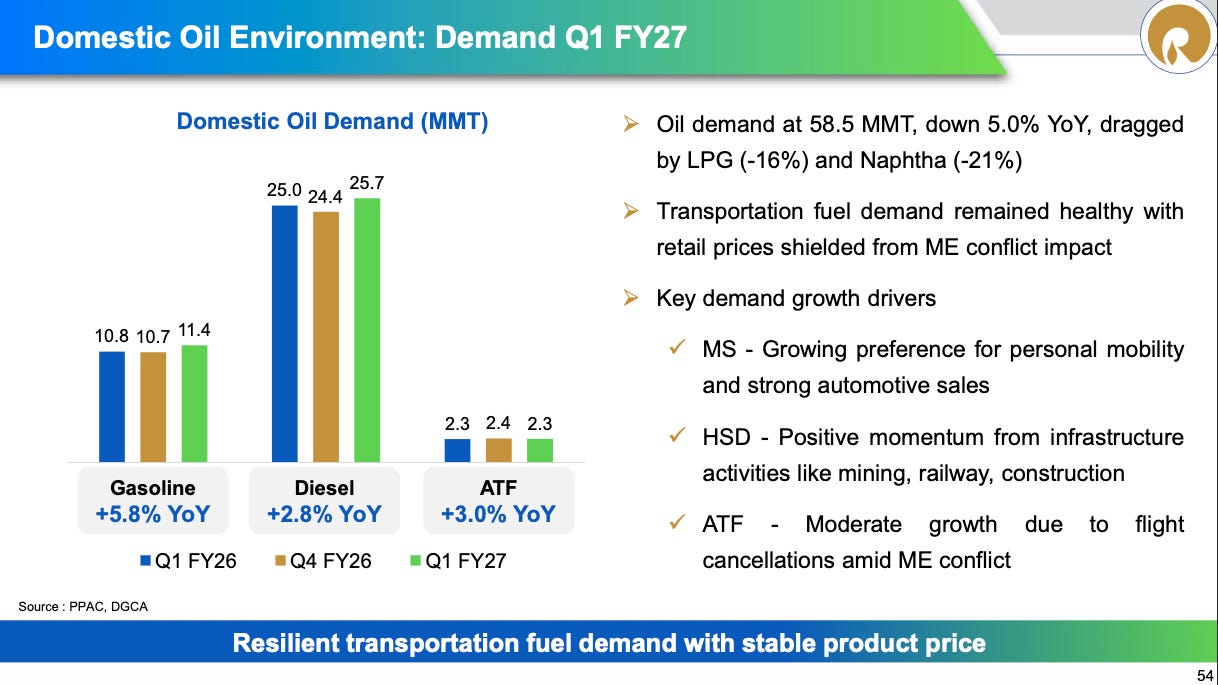
Reliance partly offset this pressure through condensate, a light form of crude oil produced alongside natural gas. Unlike deepwater gas, condensate was not subject to the same price ceiling. As global oil prices surged during the West Asian shipping crisis, Reliance realised an average price of $107.40 per barrel for condensate, 53.6% higher than last year.
The company also benefited from its coal-bed methane operations on land. This is natural gas extracted from coal seams, and its price is not restricted by the deepwater gas ceiling. Reliance was therefore able to capture more of the increase in market prices, selling this gas at an average of $12 per MMBtu.
New Energy
New Energy is hardly the biggest of Reliance’s divisions, but they keep calling it one of the most important parts of Reliance’s future. And, as we’d mentioned in our coverage of their Q3 results, Reliance has been making a strong push to move to higher value-add products in solar.
Within solar, the company is placing a major bet on heterojunction technology, or HJT. Reliance became the first Indian manufacturer to have HJT cells included in the ALMM List-II, which is the government-mandated list of Indian solar cell suppliers that has come into effect since last month. This is one of Reliance’s biggest bets to move up the solar value chain and reduce dependence on Chinese upstream imports.
Most solar panels today use cell technologies such as PERC or TOPCon. PERC, the older technology, reflects unused sunlight back into the cell to improve output but is now nearing its efficiency limits. TOPCon adds a thin oxide layer that reduces energy loss and has become the industry’s mainstream upgrade because existing PERC factories can be converted to manufacture it relatively easily.
HJT is a newer design that combines different layers of crystalline and amorphous silicon to capture sunlight more effectively.
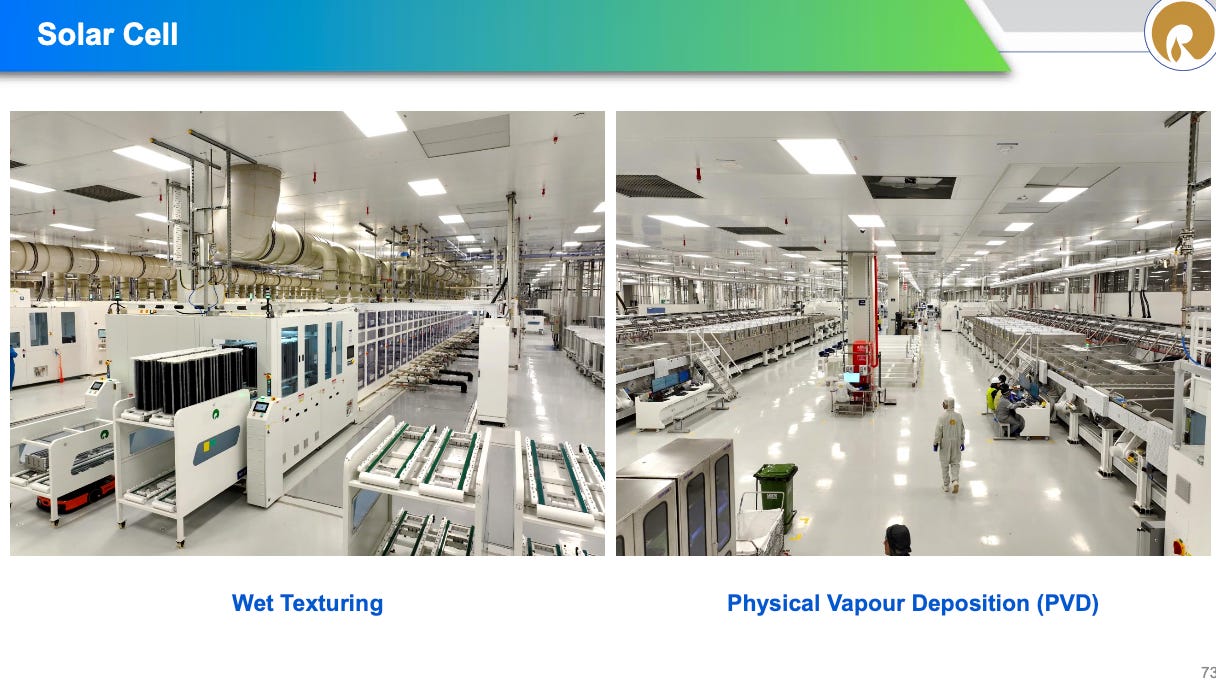
The biggest advantage of HJT is efficiency, which measures how much of the sunlight falling on a panel is converted into usable electricity. While conventional commercial panels generally operate at around 20–23% efficiency, Reliance says its HJT cells have achieved efficiencies of up to 25.6%. This allows them to produce more electricity from the same amount of land.
HJT panels are also better suited to hot climates. Solar panels become less efficient as their temperature rises, which is a major concern in a country like India. HJT cells have a better temperature coefficient, meaning their electricity output falls less sharply when they heat up under intense sunlight.
But this has some downsides too.
HJT is more expensive and complex to manufacture than TOPCon, and existing PERC factories cannot be converted as easily. It has also historically consumed more silver and indium, both of which are expensive materials exposed to global supply risks. Manufacturers, including Reliance, are working to replace silver with copper, but this still needs to be proven at scale.
Conclusion
Despite facing several operational challenges, Reliance delivered a strong quarter. What do we look out for in the next quarter?
For one, can O2C sustain its margins as global energy markets change. Then, can Reliance’s dark stores help take away share in the quick commerce industry from incumbents? For Jio, watch its ARPU, AirFiber additions and progress towards the IPO. In Retail, look for signs that its investments in quick commerce are beginning to improve profitability. And in New Energy, the focus will be on the scale-up of HJT manufacturing and whether it begins generating meaningful commercial revenue.

Who decides if you should answer the call?
Most of us decide whether to answer an unknown call based on what appears on our phone screen. If it says “Spam” or the screen turns red, we usually don’t pick up. Those very spam labels are now at the centre of a regulatory tussle over two specific number series in India.

On July 10, TRAI said that calls from numbers starting with 140 and 1600 must not be tagged, blocked, or filtered, whether by a caller ID app or a telecom operator’s own network-level filtering. The regulator had spent years making these numbers trustworthy by design, and spam labels would defeat that purpose.
Truecaller pushed back within days, saying its own users were flagging calls from these series as spam anyway, and that hiding those warnings wasn’t protecting anyone.
This may sound like a small fight over two obscure number prefixes. But the story goes back almost two decades.
Why do 140 and 1600 numbers exist?
In the 2000s, as phones reached more and more people, telemarketing took off. TRAI had built a Do Not Disturb registry to block spam calls, curb unwanted promotional messages, and protect consumer privacy. But it barely worked. Nothing stopped telemarketers from simply calling from ordinary phone numbers instead of registered ones.
TRAI’s fix to this was giving commercial callers their own dedicated number series, a phone number that anyone could recognise on sight as coming from a commercial entity, and not a stranger.
Getting one of these numbers isn’t as simple as buying a SIM card. A business first has to register itself as a “Principal Entity” with a telecom operator, declaring who it is and how it plans to use the number. That registration is recorded on DLT (Distributed Ledger Technology). Think of it as a shared Google Sheet that every telecom operator can access, instead of each maintaining its own separate records. Everyone sees the same information, making it a single source of truth.
Once registered, businesses who want to make promotional calls can be assigned numbers from the 140 series. The 1600 series is meant for service and transactional calls, only from entities regulated by bodies such as RBI, SEBI, IRDAI and PFRDA, as well as government-to-citizen calls.
Now, customers can use their DND preferences to block selected categories of 140 promotional calls, but 1600 calls are intended to remain reachable because they may contain important account or transaction-related information.
TRAI also runs the DND app, where consumers can report unsolicited commercial calls. Separately, the Department of Telecommunications runs a portal for reporting suspected fraud. Complaints through these platforms have led to lakhs of phone numbers being disconnected.
So, TRAI does a lot of the heavy lifting to verify who’s calling. Apps like Truecaller don’t. They don’t rely on registrations or telecom operators to identify callers. Instead, they rely on crowd behaviour like how many people report a number as spam or block it. Over time, their algorithms pick up these patterns from millions of phones.
That’s where the two systems begin to clash.
Take an example of a bank’s recovery team calling about an overdue payment. Annoyed customers may report the number as spam, even though the call is perfectly legitimate. The same goes for a loan EMI reminder. People might label it as spam on a third-party app, even if it’s a genuine 1600 number being used for a legitimate transaction-related call.
TRAI vs Truecaller
TRAI created the 140 and 1600 series so these numbers would be trusted by design. If an app can still slap a spam label on a verified 1600 number, that trust breaks down at the very moment it’s supposed to matter. That’s why, on July 10, TRAI ordered that these numbers must not be tagged as spam.
The problem is that TRAI can’t order Truecaller around the way it can order a telecom operator. Telecom companies like Airtel and Jio operate under licences issued by the government and must follow TRAI’s rules or risk losing those licences. Truecaller doesn’t operate under such a licence. Instead, it falls under the Ministry of Electronics and Information Technology (MeitY), which oversees internet companies and apps in India.
So, to make apps like Truecaller comply, TRAI has asked MeitY to designate them as “authorised agencies” under India’s IT Act. That would give TRAI the legal authority to act directly against apps like Truecaller, Hiya, and Whoscall — something it currently cannot do.
Beyond this, TRAI has also proposed changes to its own telecom rules that would impose two more requirements on caller ID apps.
The first is relatively straightforward. Today, if users report a number as spam on an app like Truecaller, that information mostly stays within the app’s own system. TRAI wants those complaints to be shared with its official Do Not Disturb (DND) platform as well, so telecom operators and regulators can use the same data while taking action against spam.
The second proposal is more significant. Under India’s IT laws, apps like Truecaller are generally not legally responsible for information posted or generated by their users, as long as they follow certain rules. This protection is known as safe harbour . TRAI’s proposal says that if a caller ID app repeatedly ignores its directions, it could ask MeitY to start the process that may strip the app of this protection. That wouldn’t automatically make the app liable, nor can TRAI revoke safe harbour on its own. But losing that protection would expose the app to much greater legal risk for the content and labels it displays.
This hasn’t gone down well with the industry either. The Internet and Mobile Association of India, which represents these apps, has objected on three counts.
First, it argues that TRAI simply has no legal authority over internet apps like Truecaller, so trying to regulate them amounts to regulatory overreach. Second, it says forcing apps to share their spam data would mean handing over information they have spent years collecting and refining. That data is a key part of how these apps work and a valuable commercial asset. Third, it argues that whether an app should lose its legal protection is a question for India’s IT laws, not telecom laws. In other words, TRAI shouldn’t be able to use telecom regulations to influence protections that exist under an entirely different legal framework.
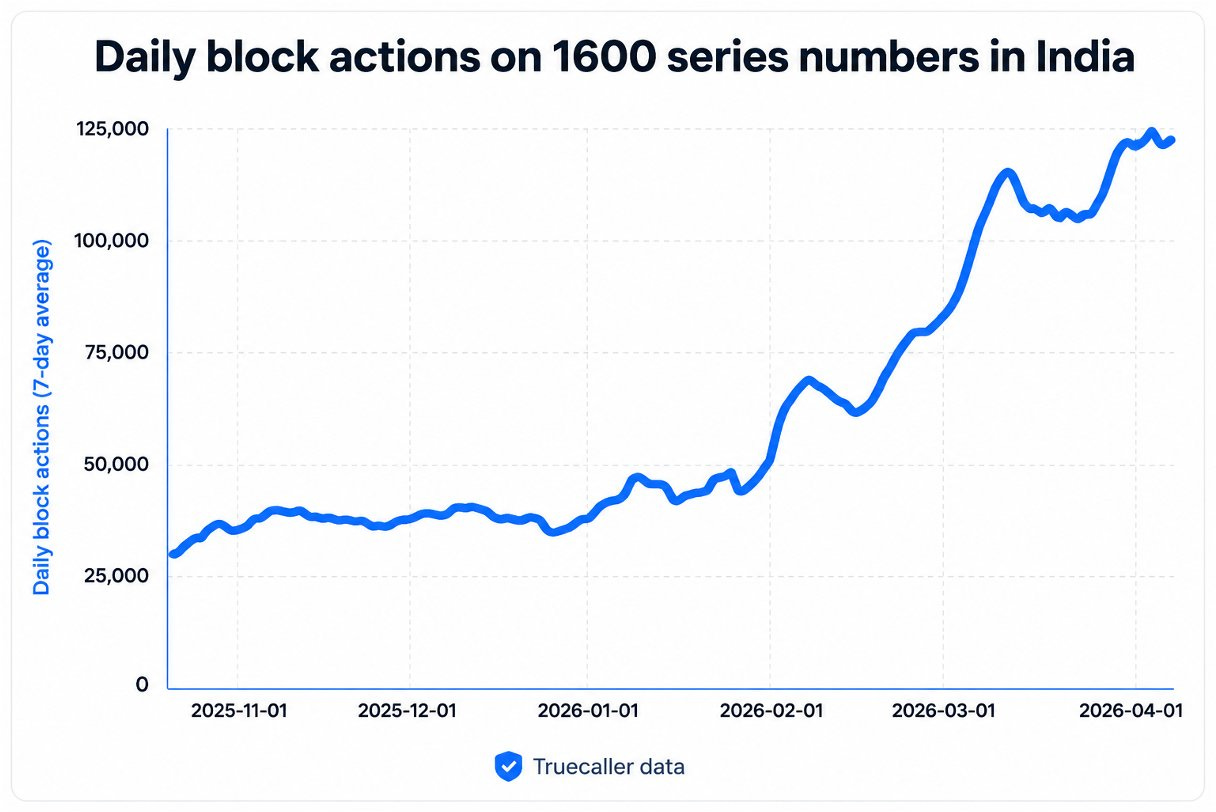
Truecaller’s own argument is that its users block more than five lakh calls from these two series every day, and suppressing that signal is the real consumer harm. CEO Rishit Jhunjhunwala also argued that forcing an app to hide user-generated warnings is MeitY’s job, not TRAI’s. The company also says, by its own count, over 5.1 crore calls from these ranges go unanswered daily. It’s proof that people already distrust these lines regardless of tagging.
Who else this affects?
Truecaller isn’t the only player here. Airtel has taken a different approach with a feature called Business Name Display. Instead of waiting for users to report bad numbers, it verifies legitimate businesses beforehand and shows the company’s name on your screen before you decide whether to answer.
Google’s Phone app and Hiya — whose spam database also powers caller ID on many Samsung phones — also rely on user reports to identify spam, although their data sources and algorithms differ from Truecaller’s. TRAI’s order protecting 140 and 1600 numbers applies to them just as much.
There’s also an entirely different route that bypasses TRAI’s numbering system. Truecaller sells a paid product called Verified Business Caller ID. Businesses that subscribe get a green verified badge, their name, logo, and even the reason for the call displayed before you pick up. In effect, businesses are paying Truecaller to establish trust directly with its users, regardless of whether they’re using a 140 or 1600 number.
You can see why that might bother TRAI. The regulator spent years building a system where trust comes from a number verified by telecom operators. But if people trust Truecaller’s badge more than a TRAI-assigned number, that shifts the centre of trust away from the regulator and towards a private app. In that sense, Truecaller’s verification system competes with the one TRAI has spent years trying to build.
Where this leaves us
This isn’t an abstract regulatory fight. A 1600-series call could be your broker warning of a margin shortfall or your bank asking you to update your KYC before your account is frozen. These are exactly the time-sensitive calls the series was created for.
Both sides have a point. TRAI spent years building a system where these numbers could be trusted by design, so a crowd-sourced spam label undermines that effort. But apps like Truecaller aren’t creating the distrust either. They’re reflecting what users experience.
The deeper issue may lie elsewhere. In practice, the line between a genuine service call and a promotional one has become increasingly blurry. Many calls may be perfectly legitimate under TRAI’s framework, but they don’t necessarily feel that way to the person receiving them. Users aren’t judging whether a call complies with telecom regulations; they’re judging whether they wanted it in the first place. That’s why they mark these numbers as spam. Going after caller ID apps addresses where that frustration shows up, not necessarily what causes it.
Tidbits:
- Amazon has laid off employees within its Artificial General Intelligence (AGI) division as part of an ongoing corporate restructuring. The tech giant stated these targeted cuts will help redirect resources toward the most important AI projects.
Source: Reuters
- The government has officially approved QDENGA, India’s first-ever dengue vaccine, for individuals aged 4 to 60. The two-dose vaccine protects against all four virus strains and can be given without the need for prior dengue testing.
Source: The Hindu
- HCLTech is investing ₹730 crore to build its first company-owned, AI-optimised data centre in Bhubaneswar. This major digital infrastructure project is expected to create 6,000 high-skilled tech jobs in the state.
Source: Business Standard
- The Indian government has dedicated a massive ₹40,000 crore fund to safely and scientifically close exhausted coal mines. The reclaimed land will be repurposed for renewable energy, eco-tourism, and agriculture to support local communities.
Source: The Hindu BusinessLine
- German automaker Volkswagen is in advanced talks to sell a majority stake in its Indian business to the Sajjan Jindal-led JSW Group. This potential deal aims to inject fresh capital to boost the company’s local manufacturing and electric vehicle ambitions.
Source: Business Standard
- This edition of the newsletter was written by Kulsum & Vignesh.
The Chatter by Zerodha
Our team at Markets spends a lot of time reading earnings call transcripts and listening to management interviews. Along the way, we come across plenty of interesting insights that are worth sharing.
That’s what The Chatter is for.
It’s a weekly newsletter where we dig through what India’s biggest companies are saying and bring you the most interesting insights into businesses, industries, and the wider economy.
What we’re reading
Our team at Markets is always reading, often much more than what might be considered healthy. So, we thought it would be nice to have an outlet to put out what we’re reading that isn’t part of our normal cycle of content.
So we’re kickstarting “What We’re Reading”, where every weekend, our team outlines the interesting things we’ve read in the past week. This will include articles and even books that really gave us food for thought.
Join us on WhatsApp, where we share interesting soundbites from concalls, articles, and everything else we come across throughout the day. You’ll also get notified the moment a new video or article drops so that you can read or watch it right away.
Thank you for reading. Do share this with your friends and make them as smart as you are 