Last year, NSE revised tick sizes for stocks below ₹250 and their futures contracts. From November 3, 2025, the same rule will apply to stock options:
-
For stocks below ₹250: tick size will reduce from ₹0.05 to ₹0.01
-
For stocks at ₹250 or above: tick size remains ₹0.05
The change will apply to all option expiries, with NSE reviewing prices at the end of each month to decide the tick size for the following month.
Why does this matter?
In trading, the tick size is the smallest price movement allowed for a security. For instance, if the tick size is 5 paise (₹0.05), prices can only move in steps of ₹0.05—₹1.25, ₹1.30, and so on.
Stock options usually trade with wide bid-ask spreads. And because lower-priced stocks often have larger lot sizes, even a small tick adds up to a high trading cost.
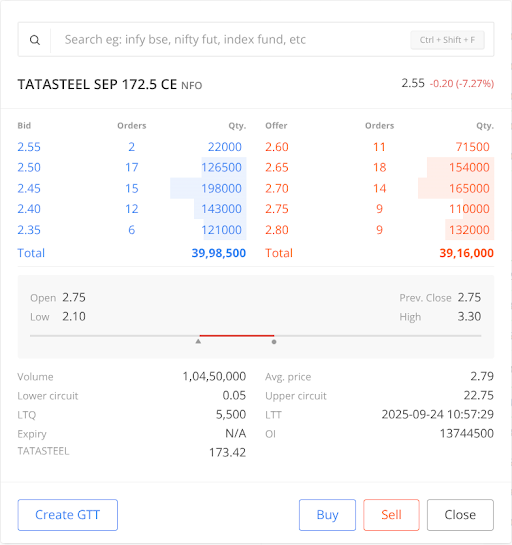
For example, Tata Steel trades at around ₹172, with an F&O lot size of 5,500. Its at-the-money option is quoted at ₹2.55–₹2.60. That 5-paise spread equals an impact cost of ₹275 per lot (₹0.05 × 5,500).
From November, with a 1-paisa tick, the spread could be ₹2.55–₹2.56, resulting in an impact cost of ₹55 per lot (₹0.01 × 5,500).
Smaller ticks mean tighter spreads and lower impact costs for traders.