Hi
If SEBI bans recent charts display , during education, how is anyone suppose to learn trading ??
Can anyone suggest list some good trading courses that are legal??
Can anyone tell list of who provides stock market mentoring leggally??
After Avidhut sathe incident ,dont know is who is legal ??
SEBI has come up with the strict regulations and restrictions on unregistered financial influencers who provide investment advice or stock recommendations under the guise of education. SEBI prohibits them to use the real-time stock price data and the names of the scripts, either directly or indirectly. It is anticipated that this action would put an end to the illicit consulting firms that many finfluencers run without registering with Sebi.
You can learn from varsity… Zerodha Varsity: Free Stock Market & Trading Courses Online for charts, there is a module technical analysis Technical Analysis – Varsity by Zerodha
6 Likes
Continue to learn with the help of charts (just not realtime or recent ones).
Assuming one is looking for education, and not manipulative “buy-sell-tips” masquerading as education.
1 Like
@Renuka_Mishra @cvs
While i agree to bith the above replies …
But there are lot of people who need hand holding and mentoring …
I have seen the basic technical analysis available on varsity …its good only for begineers …i went through it years ago …also most of techninclqq analysis is good in hindsight …
When actually tr a ding on hard right side of screen …its completely different …
Some people want to afvance knowlege and skill
Which could o ly come by learning from another who is experienced …
and also market keeps changing…lots of manipulatio. Etc
To be a fulltime trader …profesional. we need some mentoring …
That is why i ask the same above questions again …
AFAIK, education, hand-holding, and mentoring is NOT being restricted.
What is being restricted is participating in the market, while simultaneously claiming to be an educator and using real-time data to sell tips of using specific levels to place trades. Basically, generating losing counter-parties for one’s trades. All in the name of education.
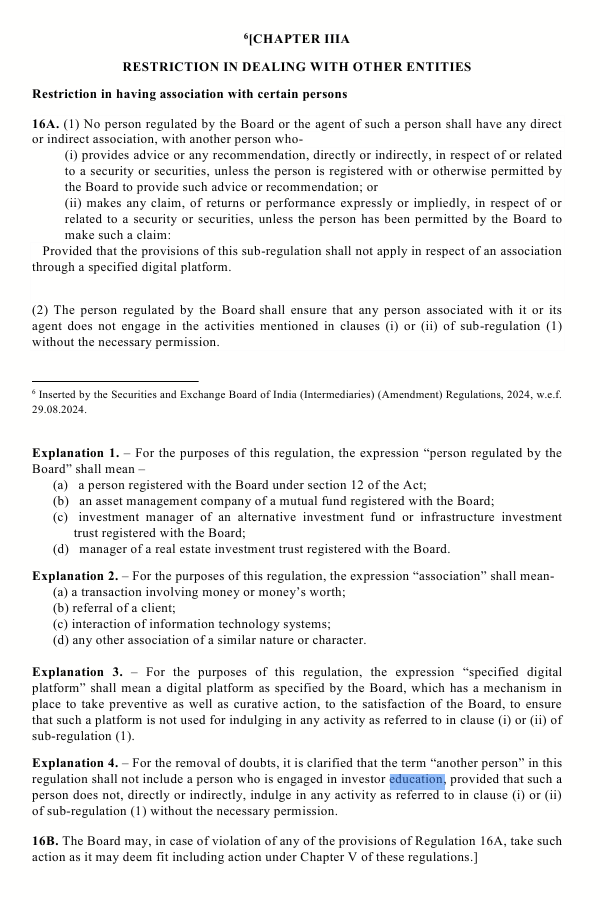
Source: The amendment (dt. 29-Aug-2024), to the SEBI regulations,
and the circular (with clarifying FAQs) (dt. 29-Jan-2025).
Even the existing “educators” can continue to use charts and teach how to place trades.
It is just that they will need to use delayed/deferred data - for example use snapshots of chart data from 2024 to show how to go about applying the knowledge they want to share. Alternately they could use mock data to simulate a specific scenario they would like to teach (presumably as it is very relevant in the current market in 2025).
Now that there is a larger market for this (educators looking to provide realistic scenarios, but not using real-time data), hopefully tools to perform mock trading will be more popular for educators to use in their training sessions to mentor and handhold the students.
Students would be expected to apply their learnings from such mock sessions, to trade in the actual markets. The hope being that since the education was not on real-time/recent chart data, students new to the market cannot blindly copy the lesson without understanding it in a real market (and risk losing real money, especially if the “educator” was simply using such students to dump the “educator’s” holdings).
Note that these restrictions mostly affect unregistered individuals or entitites that claim to be educators and not investment advisors nor analysts, who are held to a slightly higher standards.
Do you still see any scenarios/examples of what was previously possible for someone to teach/educate, and is now not possible using the permitted alternatives? 
With the recent updates to the regulations, anyone continuing to provide training/education in trading in the markets, be can be expected to have a higher likelihood of NOT scamming their students.
IMHO, one can continue to rely on the guideline to
avoid anyone promising guaranteed returns, or a foolproof system, or quick returns.
4 Likes
Anyone outside India could still probably do it, as SEBI has no authority outside India. Maybe even GIFT city…
Even folks in India could continue to do it.
By it, i mean using real-time chart data to “educate” others.
IIUC, unregistered “educators” were (and continue to be) unregulated by SEBI.
By restricting regulated entities (eg. fund managers, asset management companies, …) from associating with such unregistered “educators”, these regulations attempt to ensure that anyone using real-time/recent data to “educate”, cannot profit by trading as a counter-party to their own education (either directly or indirectly).
Which is why the updated SEBI regulations (linked in previous post above),
apply restrictions on SEBI-regulated entities
to limit their association with folks who may engage in education.
Theoretically, this better aligns the incentives of the educator and the students, as the educator no longer stands to profit from pushing loss-making strategies to their student. As the educator now cannot profit (either directly, or indirectly) by being a counter-party to any losing trades of their students.
Unfortunately, the state of mass-media being what it is (not about informing, but optimized for engagement/outrage, as that sells ads), this nuance is lost, and we have folks thinking “If SEBI bans stock education, …” which is the opposite of what has actually happened.
1 Like
Can’t believe I read all that legalese and didn’t get that first line…
Thanks for all the details >>
but got a few questions …
1>You mean that SEBI registrered entities can educate with live charts and current charts ???
2>SEBI registrered entities can conduct live or show recent market review ??
3>very impt part of mentoring is trading at right side of screen on todays charts …
and to explain nuances and details …
basic setups and rule s for any trade might be taught in past …But “variations” posiible of any setup , can never be taught only based on past …market keeps giving new “Varisations” of any type of setup etc …that can only be taught in real time chart …
As a student everyone wants to know whether the trade they are going to place is having any techinical problem etc …but how are they supose to get an answer , if the educator cant tell them any thing based onthe current stock or chart …???
I would never pay for a course that only teaches hindsight data …i would rather read online websites an dbook ds and learn these basics,…but if pay for a course or mentoring ,iwould obviously want the mentor to cross check my trades and hand hold me before , durign and after each tradethat i take …
@cvs
Sidebar commentary on this regulation being unusually full of obtuse legalese.
I believe, one of the reasons why this regulation is somewhat obtuse, is because this entire situation is a tricky one to regulate for a market regulator like SEBI, without overstepping their authority. I mean how does one regulate something beyond one’s scope/responsibility.
Also, coming-up with regulations is just one aspect,
coming-up with regulations that are practically enforceable
that too in time to prevent undesirable behavior. Super-Tricky!
I found it impressive how this was achieved with a combination of -
-
clearly defining the scope of financial-advice
- something that was already being regulated
- to match the changing times/technology
-
leaning on existing regulated entities for enforcement
- in a preventative manner (not punitive/reactive).
All said, with the huge amount of financial incentive to continue exploiting the unsuspecting masses (until financial awareness catches-up with the average investor), i expect “Finfluencers” and “FinTech” are busy finding the next level of loopholes to exploit.
Regulatory arbitrage anyone?
TL;DR: According to the latest regulations, providing any recommendations (direct/indirect), or any implications on the performance of, or the returns from any security in the market, is explicitly considered as NOT education. So, one must not comment on real-time data, especially implying something about the value of a security in the near immediate future (on a chart, or otherwise) without being regulated, but instead in the name of education.
On the topic of - Is real-time data really required for teaching/learning ?
Strictly speaking, am not quite sure why this needs real-time data.
Agreed that looking at historical charts is not the same as live-charts with the current candle being updated tick-by-tick. However, one doesn’t need real-time data to teach/learn/practice trading on live charts. What one can use is tick-by-tick historical data. One can replay that on a chart and teach all the nuances one is interested in, without providing any form of “blindly copy-paste-able” trade-calls / stock-tips on real-time data.
Trying to teach/learn unprecedented specific patterns/behavior in the markets that was never before seen in historical tick-by-tick data? Use synthetic/mock data with the necessary patterns instead.
On the topic of - Difference between regulated Advisors/Analysts and Educators
IMHO, sure.
Registered Investment advisors, Research Analysts, that follow the respective relevant compliances/audit regulations could engage in such advisory initiatives. What they do not do is skip regulatory compliance by labeling themselves unregistered educators.
NOTE: Any registered analysts/advisors reading this,
please chime-in to clarify/correct anything that i might be missing here.
Note: Maybe it is just the way it is written here that makes it sound like one is looking for stock-tips.
If learning is indeed the genuine concern, please refer to the last point below.
IMHO, in this specific scenario, what one is looking for is not education, rather specific investment advice. Registered investment advisors or research analysts should fit the bill here.
On the topic of - How do these regulations affect me, a student of the markets?
Sounds Good 
a. Registered individuals and entities can continue to provide advice/services they are qualified/certified for, and are being regulated.
b. Unregistered educators can respond to specific queries that an individual poses.
- while remaining compliant with SEBI guidelines to not provide any direct/indirect recommendation, or imply any performance/returns of any security.
With these recent regulations clarifying educating vs. advising, one can be more assured that a legal mentor one picks (either an unregistered educator, or a registered advisor, or a registered analyst, …) is now more likely to have their incentives aligned with oneself (student).
(Reminder that IANAL, this is not financial/legal advice)
As an example, i believe,
an unregistered educator
when asked about a proposed trade in the real-time market,
that their student is planning to enter into -
- could point to similar scenarios in the past on how some security had behaved.
- should NOT make future projections on real-time data,
nor imply that identical behaviour from the past is guaranteed now.
1 Like
@cvs thanks for your patience …and detailed reply …
answered a lot of questions …
Still would be nice to hear opinions of more people , if anyone want s to add anything …
1 Like
I believe registration is not easy to obtain. To start with, you need a degree in something finance related. So, pure chart readers are out of luck in areas under SEBI.
Not trivial for sure.
So not something that one can simply spend money on marketing and advertising,
to become an “expert” with a flashy social presence, overnight.
Update: Added updated information based on latest revised Research Analyst (RA) regulations.
- Either a graduate/post-graduate degree or diploma holder in financial disciplines from an accredited institution.
- or an equivalent NISM certification
- or a CFA charter.
In addition, to apply, one would need to submit proof of adequate net-worth.
The qualifications to apply to be an Investment Advisor (IA) are even more stringent.
Source: https://www.sebi.gov.in/legal/regulations/jul-2023/securities-and-exchange-board-of-india-investment-advisers-regulations-2013-last-amended-on-july-4-2023-_74007.html
1 Like
That’s the thing… To be a derivative trader and give calls based on charts, these degrees are useless. In fact according to SEBI study, teenagers were the most profitable derivative traders. So, the needed qualifications and the real world results do not match. Registered advisers may give stupid calls, while unregistered teenagers might give excellent calls, and they can’t register.
1 Like
True. Education lagging the industry. 
Do you have a handy source for this?
Atleast the famous SEBI report Analysis of Profits & Losses in the Equity Derivatives Segment (FY22 - FY24) claims that lower age groups faced a higher percentage of loss makers. This is not specifically teenagers though, who were clubbed together with folks in their 20s, into a single “<30” group, that performed the worst. (Reference. Section 5.9).
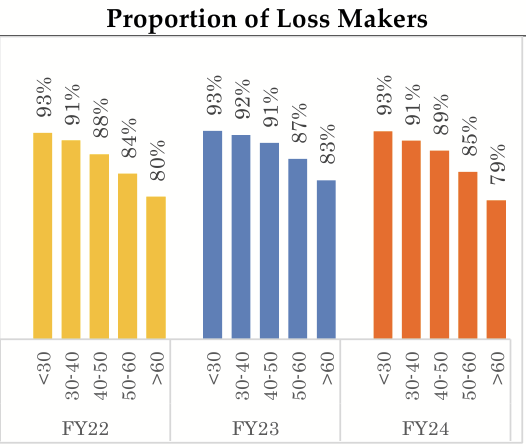
That was based on FY22 report, which had the <20 age group separately in Page 13: SEBI | Study - Analysis of Profit and Loss of Individual Traders dealing in Equity F&O Segment
In FY22 and FY19, they had the highest profit among profit makers. In FY22, they had the lowest loss among loss makers(but not in FY19). They also observed
- The average profit earned by profit makers belonging to the youngest age group (with
below 1% share in participation) was highest as compared to all other age groups during
both FY19 and FY22.- During FY22, the average loss made by loss makers was significantly low for the
younger group (<30 years) of individual traders, …
2 Likes
Note: Please do not read this as nitpicking of data, or trying to push a preconceived narrative.
Just trying to highlight some additional aspects to consider, before we jump,
…from a valid observation…
…to a certain conclusion.
IMHO, even if the above conclusion is true, the above observation doesn’t quite prove it.
The following is an exercise to highlight where we might be making a logical leap of faith
between the above observation and the above conclusion.
(Please feel free to add to it, or poke holes in it. Hopefully the latter.)
Combining the data from the 2 reports
- Age-wise Avg. profits of profit-makers and losses of loss-makers (report dated Jan 2023).
- Age-wise % loss-makers and profit-makers (report dated Sep 2024).
The out-performance by the <20 and 20-30 age-groups is noticeable.
However, on an average, the entire age-group is still in losses (just as the other age-groups).
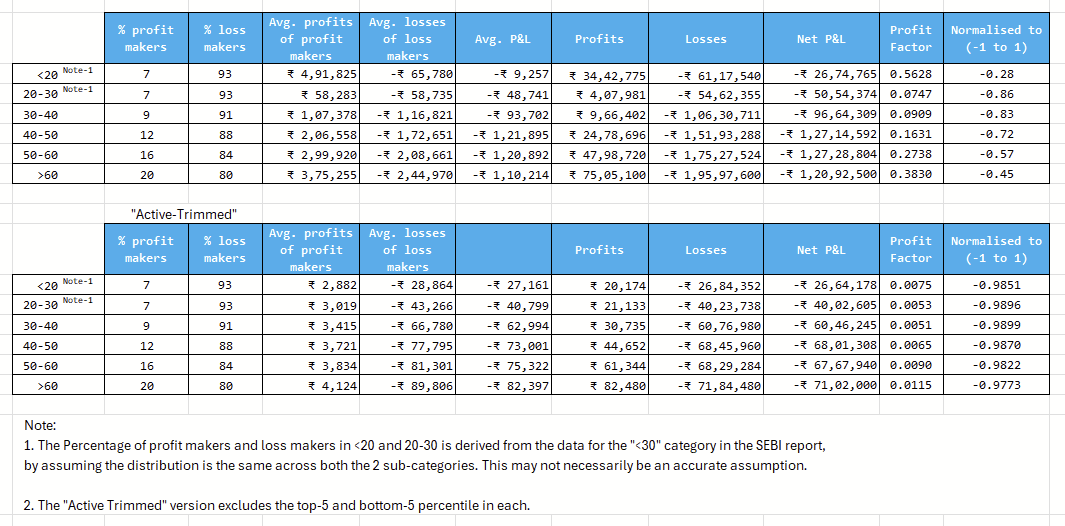
Also, trimming the 5% outliers for each age-group,
(as the data for this is available the SEBI report dated Jan 2023)
the above observed out-performance of younger age-groups no longer exists.
Basically,
- The best teen traders in FY 2022 noticeably outperformed the older traders.
- The average teen trader in FY 2022 fared somewhat worse than the average trader in the older age-groups.
Without additional details…
- of whether the outperforming teen traders were consistent or one-off flukes,
- and whether their out-performance was reproducible,
…it remains to be seen
whether such out-performance could translate into mentoring/advice worth subscribing to?
or whether the out-performance was simply due to the ability/tendency to take outsized risks?
The raw data (behind these SEBI reports) might shed light on these aspects.
However, am not sure how to access that, or derive that from the processed summaries in these reports. 
Some things to ponder:
- I don’t think % profit makers/%loss makers(Sep 2024) can be retroactively applied to FY22 - mainly because there was no <20 classification given in this report.
- The best average P/L -9257(even though it’s loss) belongs to <20 group
- Even after active trimming, the edge remains. They still have the highest average P/L
- The edge is shown in 2 different financial years for it to be coincidence.
- There is clearly a linear relationship between age and average P/L shown in this study.
- When considering options, the average was a profit. SEBI notes:
Page 23:
Only the youngest group of individual traders(<20 years) made an average profit in index options during both the years i.e.FY19 and FY22, whereas individual traders from all other age groups incurred average losses during both the year
Further, the average profit earned by the youngest profit makers was significantly higher than other age groups with average profit of Rs. 5.4lakh in stock futures followed by an average profit of Rs. 3.8 lakh in index options and Rs. 1.7 lakh in index futures during FY22
Anyone who played derivatives knows it’s very easy to make a loss, but making consistent profit takes years of real hard work(Note that this is the average P/L over the whole year. It’s not a one off). That’s why the teens making profit(or less loss than others) is very significant. That edge is somehow lost with age.
2 Likes
Hi, thanks for sharing your views.
I have 20+ years of experience, and have mentored few students on Stock Market and Trading. I never gave BUY/SELL calls or tips. I just make them understand Trading. is that still not legal according to SEBI?
what’s the equivalent NISM certificate that one should have so that we can start teaching stock Market and trading.
Thanks,
Ensure your mentoring is generic and conceptual, avoiding all stock names, price levels, or targets. Use historical data for this.
Mandatory Certifications:
- NISM Series-X-A: Investment Adviser (Level 1)
- NISM Series-X-B: Investment Adviser (Level 2)
1 Like