
Our goal with The Daily Brief is to simplify the biggest stories in the Indian markets and help you understand what they mean. We won’t just tell you what happened; we’ll tell you why and how too. We do this show in both formats: video and audio. This piece curates the stories that we talk about.
You can listen to the podcast on Spotify, Apple Podcasts, or wherever you get your podcasts and watch the videos on YouTube. You can also watch The Daily Brief in Hindi.
In today’s edition of The Daily Brief:
1. SECI wants to make India’s industries electric
Why is SECI pooling renewable power demand for factories? While grid cleanup handles basic electricity, Indian factories rely on fossil fuels for heating, with electricity supplying under 19% of their energy. SECI aims to aggregate small factory demand into bulk tenders to lower green tariffs. However, high equipment conversion costs, grid surcharges, and high-heat technical limits mean cheaper power alone cannot drive full electrification.
2. Why auto ancillaries are looking beyond the car
Why are Indian auto ancillaries expanding into aerospace and defence despite record auto sales? Suppliers like Sansera and Bharat Forge are deploying precision-engineering skills into new sectors to hedge against vehicle cycles and capture higher margins. While buffering against EV transition risks, entering non-auto markets requires navigating multi-year client validations and strict international quality certifications.
SECI wants to make India’s industries electric
When we talk about decarbonising the economy, we usually focus on electricity: building more solar and wind projects or adding batteries.
But the economy does not run on electricity alone. Factories also burn coal, gas and oil directly to produce heat. They need steam to process textiles and chemicals, furnaces to melt metals, and kilns that reach well above 1,000°C to make cement.
This is a huge part of global energy use. According to the International Energy Agency, heating across industries and buildings consumes nearly half of the world’s final energy and produces 37% of energy-related carbon emissions. Yet electricity met just 4% of global industrial heat demand in 2024. The IEA expects that to rise to 12% by 2030.
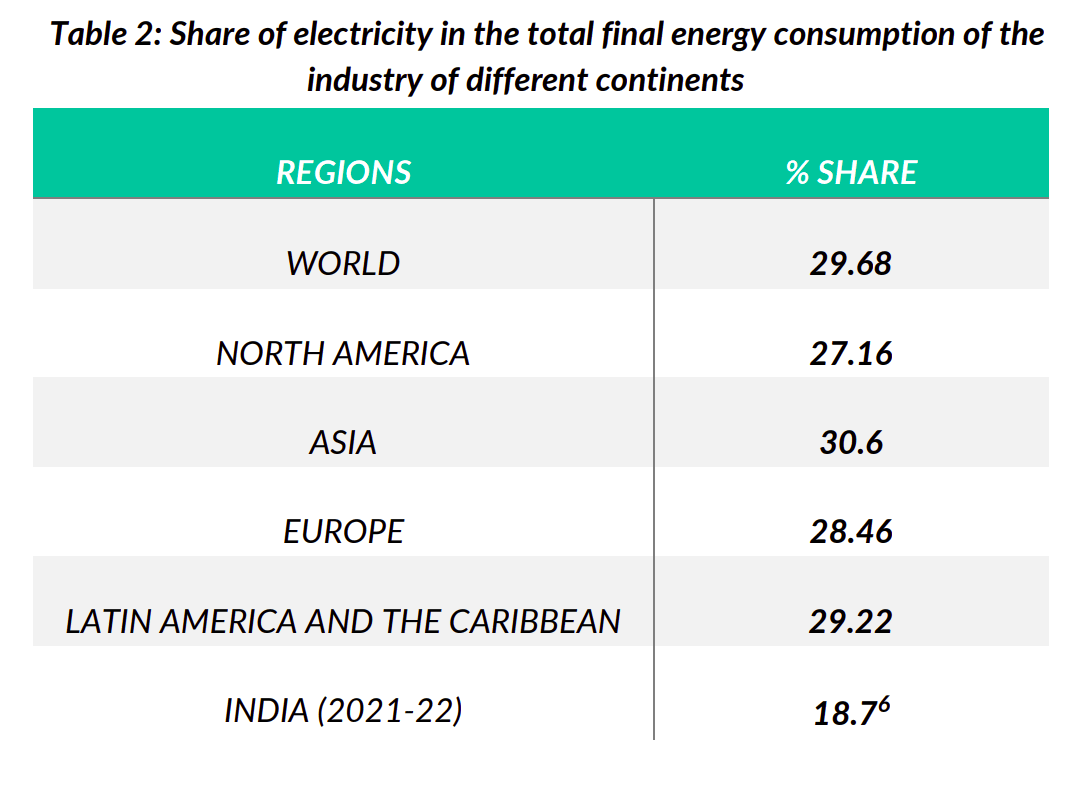
India has an especially large gap to close. Industry consumes nearly half of the country’s final energy, but electricity supplies only around 19% of it in 2021–22. The rest largely comes from fuels burned at factories.
This is why industrial heat matters. India cannot decarbonise its economy merely by cleaning up the electricity factories already consume. It must also replace at least some of the coal, oil and gas that factories burn directly.
The Solar Energy Corporation of India, or SECI, now thinks it can help.
SECI wants to pool the demand
Industrial production in India is not limited to giant factories run by Tata Steel or UltraTech Cement. Thousands of smaller foundries, forging units, textile processors, chemical plants and food-processing units operate in industrial clusters spread across Punjab, Gujarat, Rajasthan, Tamil Nadu and Maharashtra.
Many of these businesses need heat. But switching from a gas boiler or coal-fired furnace to an electric alternative creates several problems. One of them is simple: where do they get large quantities of cheap, preferably renewable, electricity?
A big company has options. It can build its own solar or wind project or invest in a captive power plant. Ultratech Cement has done this by commissioning more than 1 GW of renewable-energy capacity for captive use by March 2025.
Large companies can also use group-captive arrangements, where they partly own a renewable project and buy power from it under a long-term contract. Tata Steel, for instance, agreed to source 379 MW from a solar-wind hybrid project being developed by Tata Power Renewable Energy. Tata Steel will own 26% of the project company.
Smaller companies usually cannot pull this off so easily. Legally, they can buy green power through open access. This allows them to negotiate with a power producer instead of buying all their electricity from the local DISCOM, where industrial consumers often pay higher tariffs to cross-subsidise agriculture and households.
In 2022, the government lowered the eligibility threshold for green open access from 1 MW to 100 kW. This meant that even an industry with a sanctioned load of 100 kW could buy renewable power from a developer and use the grid to carry that electricity to its factory.
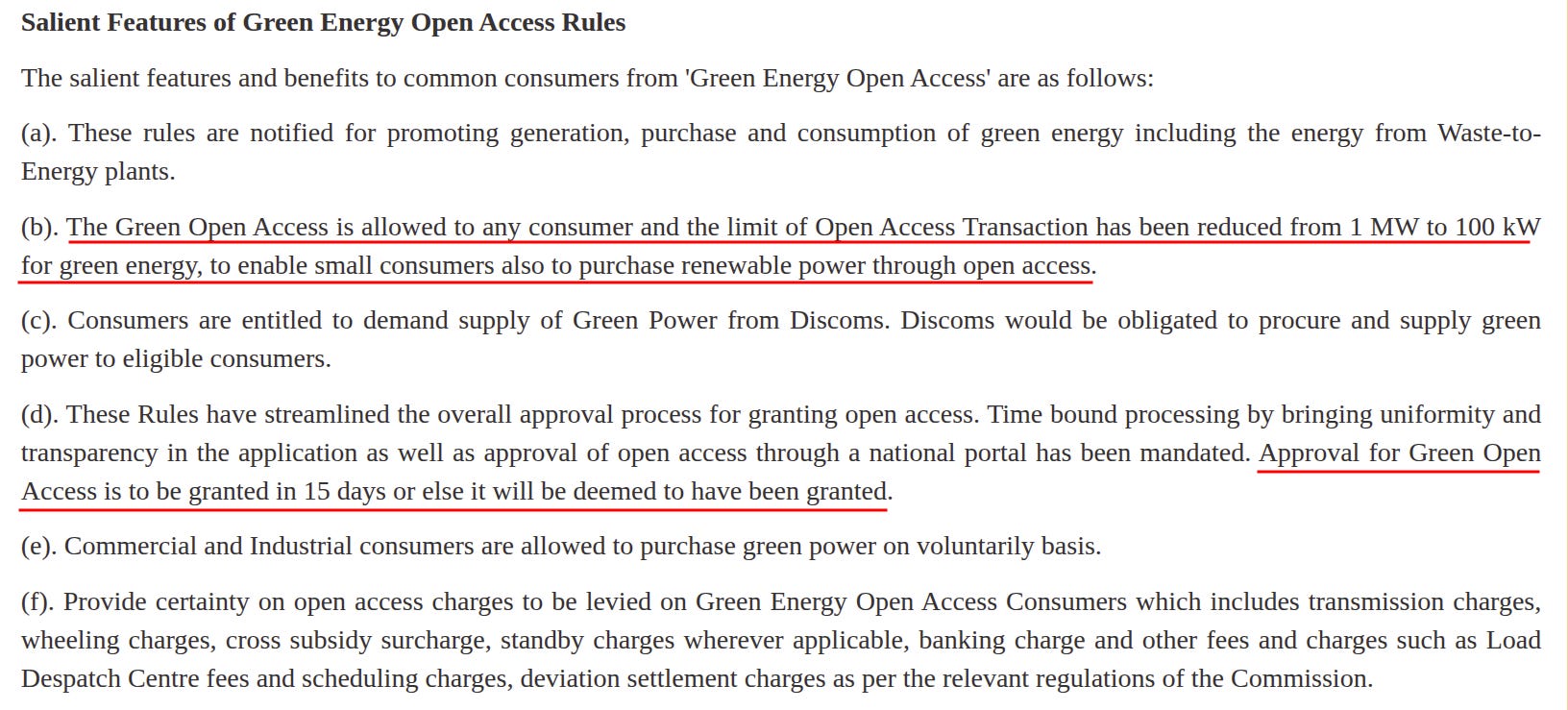
The rules also created a national application system and a 15-day approval timeline. We previously unpacked the open-access system with VoltSeal founder Mudit Narain.
But being legally allowed to do something does not make it commercially easy.
A renewable-energy developer may not want to negotiate separate long-term contracts with 100 small factories, each requiring perhaps 1 MW. Every customer must be assessed, contracted, billed and chased for payment. From the developer’s perspective, that is a lot of paperwork and credit risk for a series of tiny orders.
SECI’s proposed answer is demand aggregation or, in plain English, bulk buying.
Imagine 100 factories separately asking for 1 MW each. SECI could pool their requirements and offer developers one 100 MW opportunity. It could assess their combined demand, structure the contract and run a competitive auction. A large developer would now see one meaningful order rather than a pile of tiny ones.
The exact structure has not yet been announced. According to The Financial Express, SECI is still assessing industrial heating demand and working on the mechanism. There is no final scheme, tender or tariff yet.
But we know roughly how SECI usually operates. SECI does not necessarily build the power plant itself. It first brings together demand from electricity buyers and then floats a large tender inviting renewable-energy developers to compete. The developers bid the tariff at which they are willing to supply power, and the lowest suitable bids are selected.
SECI then sits between the two sides. It signs a power purchase agreement with the developer to buy the electricity and a separate power sale agreement with the DISCOM or other buyer that will consume it. Once the project starts operating, the developer supplies the power, SECI pays the developer and recovers the money from the buyer.
This middle layer matters. A developer may hesitate to build a large solar or wind project if it has to depend on several uncertain buyers. SECI’s size, credit rating and payment-security arrangements make the contract more bankable, helping the developer raise financing at a lower cost. At the same time, combining demand into one large auction creates competition and can bring down the electricity tariff.
It has already taken demand aggregation beyond ordinary electricity. Under the National Green Hydrogen Mission, SECI combined green-ammonia demand from 13 fertiliser plants and ran auctions covering 724,000 tonnes of annual supply. Now it wants to apply a similar idea to industrial heat.
The auction tariff is not the final tariff though
A larger tender can attract more developers and lower costs. SECI could also combine different demand patterns and procure a mix of solar, wind and storage suited to the factories’ needs.
This could matter because electric heat is starting to look economically attractive in some applications. A study by Energy Innovation estimated that electric heating in India could already be cheaper than using natural gas or oil across all the temperature ranges it studied. It was also cheaper than coal in three of five temperature bands, together covering about 55% of India’s industrial heating requirement.
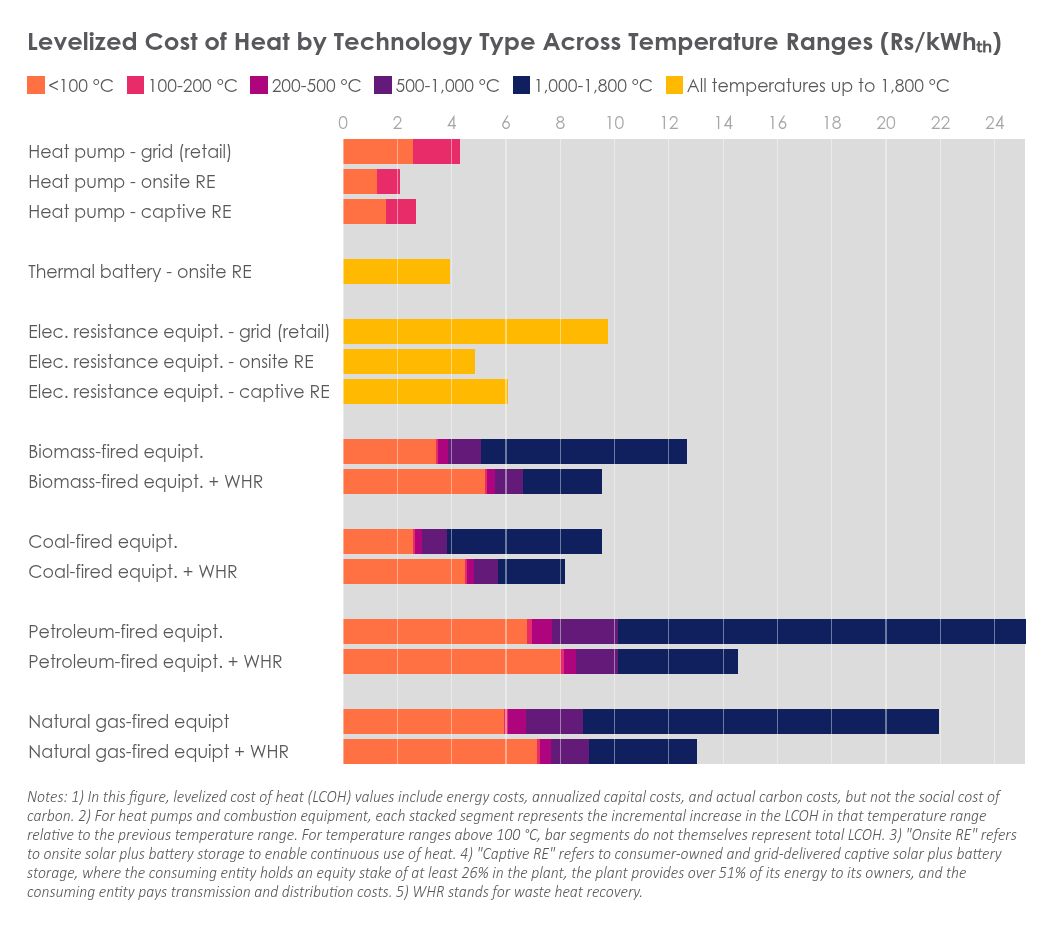
Still, the headline auction tariff is not the factory’s final cost. An open-access buyer may also pay transmission and wheeling charges, cross-subsidy surcharge, banking charges and standby charges. Transmission and wheeling charges pay for using the grid, while the cross-subsidy surcharge compensates the DISCOM for losing a higher-paying industrial customer. Banking and standby charges cover services such as balancing surplus power and providing backup supply.
The exact charges depend on the state and the procurement structure. They can materially erode the savings from cheap renewable power. Aggregation may improve the base tariff, but it cannot remove the regulated charges added on top of it.
There is another difficult question: who carries the risk if one of the participating factories stops buying power?
A separate July 2026 document shows the conditions SECI currently expects from the buyers. It set a minimum requirement of 50 MW, while allowing smaller requirements where aggregation with other consumers was feasible. It also limited eligibility to buyers rated BBB+ or above and allowed for letters of credit, bank guarantees and escrow arrangements. It also evaluates each buyer’s payment history and ability to meet a long-term commitment.
If SECI wants the industrial-heat model to include smaller MSMEs, it will need a way to accommodate businesses without formal credit ratings or the ability to provide large guarantees. Combining many buyers does not eliminate payment risk.
Cheap power does not electrify a factory
SECI can aggregate electricity demand only after factories are willing and able to use that electricity. But many of them still run coal, oil, biomass or gas equipment.
Replacing that equipment requires money. The factory may need a new electric boiler, heat pump, induction furnace or electric arc furnace. It may also need new wiring, meters, transformers and a larger grid connection. Installation can force production to stop temporarily. The new equipment must deliver the same product quality without upsetting the factory’s existing process.
Cheaper electricity alone may not justify replacing a working furnace. Industrial equipment often operates for decades, so an early replacement can mean writing off an asset that still has value.
There is also no single machine called an “electric industrial heater” that works everywhere.
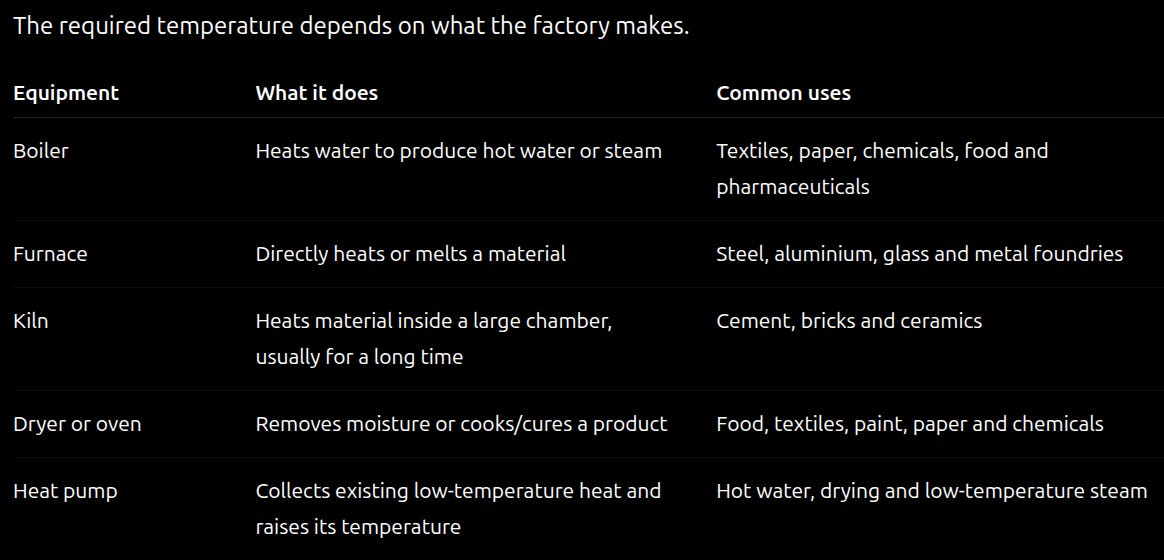
Lower-temperature requirements, below roughly 200°C, can increasingly be met through heat pumps, electric boilers and vapour-recompression systems. These may suit textiles, food processing, pharmaceuticals, paper and chemicals.
High-temperature production is harder. An electric arc furnace cannot simply replace a blast furnace. A blast furnace makes iron from ore, while an electric arc furnace melts scrap or direct-reduced iron into steel. Switching routes therefore also means changing the raw material and other parts of the production process.
Cement is tougher still. Its kiln must reach around 1,450°C. And even if the kiln’s heat becomes electric, cement would continue producing carbon emissions when limestone is chemically converted into clinker. Clean electricity can remove fuel-related emissions; it cannot remove those process emissions by itself.
So “electrifying industrial heat” is really dozens of separate transitions. Some are commercially ready. Some need demonstrations. Some may ultimately require green hydrogen, cleaner fuels or carbon capture rather than direct electrification.
The power must also arrive when the factory needs it
A furnace cannot always wait for the sun to come up.
Many factories need stable power for long production runs. A sudden interruption can damage equipment, spoil material or force an expensive restart. Solar power, meanwhile, arrives mainly during the day. Wind generation changes with weather and season.
SECI could tender for a mix of solar and wind, add battery storage or procure firm renewable power that promises supply during specified hours. Factories could also move flexible work to solar-heavy periods or store energy as heat instead of storing all of it in batteries.
But every layer of reliability costs money. A plain solar contract may look extremely cheap. Solar combined with storage, backup supply and stronger grid connections will cost more.
The local network must also handle the additional load. A cluster that currently burns gas onsite may suddenly require tens or hundreds of megawatts from the electricity system. The transmission line may have enough capacity while the local substation or distribution transformer does not. Those upgrades require investment and coordination with the state utility.
A useful solution, but to only one part of the problem
SECI is addressing a real problem. Smaller factories often lack the scale to negotiate attractive renewable-power contracts, and aggregation could lower procurement costs and simplify contracting.
But the proposal addresses only the buying problem. Electrifying industrial heat will also require finance for new equipment, stronger local grids, workable open-access charges, reliable clean power and technologies suited to each industrial process.
Without those pieces, a cheaper power tender may not produce much actual electrification. SECI can make clean electricity easier to buy. It cannot make factories ready to use it.

Why auto ancillaries are looking beyond the car
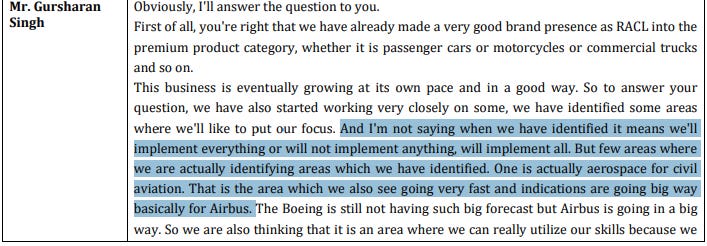
In its recent earnings call, RACL Geartech, a small auto ancillary, told investors that it had begun identifying new industries for its manufacturing.
RACL makes gears for motorcycles, passenger and commercial vehicles. But the new targets were civil aerospace, micromotors and actuators, eventually robotics, and potentially defence. Industrial manufacturing for companies like BHEL was already at pilot stage.
RACL is not alone in this. Sansera Engineering, another ancillary, has seen its aerospace, defence and semiconductor business grow more than 3x year-on-year. Meanwhile, Sundram Fasteners is scaling wind-energy and aerospace businesses.
This is also true for the biggest companies in the industry. Bharat Forge has built defence and aerospace businesses worth hundreds of crores, while Motherson has expanded into aerospace and consumer electronics.
None of this is necessarily happening because the automobile industry is collapsing. India’s auto-component industry hit a record ₹7.59 lakh crore turnover in FY26, and most of these companies reported strong automotive demand in their latest results.
So why would profitable auto suppliers spend money entering industries where specialised manufacturers already exist?
Competitive advantage
Let’s start with what an auto-component company really does.
RACL cuts gears, heat-treats them, finishes components to extremely tight specifications, and traces every batch so that if something goes wrong, they know exactly which parts are affected. That capability was built for automotive customers. But gears are also needed for actuators, robotic joints and aircraft systems. The materials and profiles may change, but the underlying manufacturing principles may not need to.
The same logic runs through the others. Sansera has spent years learning to shape and machine metal parts to tight specifications for engine components like crankshafts. This gives it a starting point for aerospace. It’s not the full learning curve, because the company is also entering machining techniques and materials it had not previously handled. But without a starting point, the mere conviction to enter wouldn’t have existed either.
Sundram’s strength is fastener engineering and metal forming, which has allowed it to extend into wind-energy, aerospace and railway applications, supplying customers like GE Aviation, HAL and ISRO. Motherson applies tooling, wiring, structures and plastics, which were developed for automotive interiors, to aircraft electrical systems and medical-device assemblies.
These companies aren’t building capabilities entirely from scratch. They are finding new buyers for skills they’ve spent decades developing. For instance, Bharat Forge said its new forging, machining, heat-treatment and ring-rolling assets were not built for any single industry and could serve several different end markets.
The difficulty is consistently doing the same thing at large-scale volume, relying on process capability and traceability strong enough that when a deviation occurs, you can tell the customer exactly which batch is affected. That kind of industrial manufacturing system is what these companies already possess.
Why bother diversifying at all
If automotive is growing, why look elsewhere?
The clearest answer comes from Sundram Fasteners, who said that the pursuit of non-auto businesses was meant to “avoid or beat the cyclicality “ of automotive markets. Selling to automotive, wind, aerospace and railways means exposure to genuinely different demand cycles, while hedging against a potential slowdown in future vehicle production.

There is also a margin argument, though it needs qualification. Sansera says its aerospace-defence-semiconductor businesses operate at roughly 25–30% EBITDA margins, well above its blended 19.2%. Sundram says non-auto profitability runs 100–200 basis points above automotive. But this is not universal, as we’ll see eventually.
Then there is the EV transition, whose impact on auto ancillaries we’ve covered in a past story.
EVs don’t destroy India’s component industry; EV components still represented only 4.6% of domestic OEM supplies in FY26. But they do change which mechanical parts matter over time. They also make the average four-wheeler more oriented towards power electronics and software.
For companies whose strength is forging, gear-cutting or machining engine and transmission parts, aerospace or industrial equipment can sometimes be a more natural extension than trying to become a company dealing with electronics and software.
Whether it’s hard, and whether it has worked
If entering these industries were as easy as pointing the same machines at a different drawing, every auto supplier would already be an aerospace company.
For one, industries like aerospace and defence supply chains bring their own qualification barriers. Suppliers commonly need aerospace quality-management systems such as AS9100. Here, manufacturing processes like heat treatment and chemical processing can require separate Nadcap accreditation : an industry-run approval system that certifies a factory’s ability to perform those processes correctly. Sansera itself says its new surface-treatment facility was seeking Nadcap validation.
Beyond certifications, individual customers of ancillaries run their own validation programmes, which can take years. Bharat Forge says some of the critical industrial products it supplies can take 3-5 years merely to get validated and approved. Its advantage today exists because it has already been supplying those types of products for 15-18 years.
So, while diversification makes strategic sense, the evidence on whether it has generated actual returns so far is more mixed.
Bharat Forge offers the longest track record. Its FY15 annual report formally recorded entry into aerospace with four major customer contracts. A decade later, aerospace revenue has reached around ₹400 crore and management expects it to double within roughly two years. This strategy took a decade to produce visible results.
Sansera is the strongest current growth story. Revenue for its combined aerospace-defence-semiconductor vertical reached ₹145 crore in Q1 FY27, more than three times what it recorded last year. Including other non-auto businesses, total non-auto revenue reached ~₹200 crore, or 20.8% of company sales.
Meanwhile, Sundram’s broader non-auto bucket, which also includes tractors and aftermarket alongside aerospace, wind and rail, rose from roughly ₹922 crore in FY21 to ₹1,674 crore in FY25, reaching about 32% of standalone revenue. Wind-energy fasteners alone hit an annualised ₹350 crore run-rate.
Motherson’s evidence, though, is a little more mixed. Its aerospace division delivered ₹2,447 crore revenue and ₹203 crore EBITDA in FY26, showing real scale. Its healthcare venture, though, generated just ₹19 crore revenue against a ₹74 crore EBITDA loss.
Possessing transferable manufacturing skill turned out to be necessary for a sensible adjacency, but not sufficient for attractive returns.
What comes next
The pattern across these five companies suggests we are past the point of asking whether Indian auto ancillaries can enter non-auto industries. The unknown variable is how many more will manage the transition, and how long it will take.
For areas like aerospace, today’s exploration by companies like RACL could still take years to translate into meaningful revenue because customer qualification itself can be lengthy. For Sansera and Sundram, the next test is whether their non-auto margins hold as volumes scale and whether customer concentration in new sectors creates the same vulnerability they were trying to escape in automotive. For Motherson, the question is whether the divisions that haven’t worked get fixed or wound down.
But these companies grew up as auto-component makers.
- This edition of the newsletter was written by Kashish & Vignesh
Tidbits
1. Adani Airport Holdings raises about $1 billion from Temasek, BlackRock and others
Adani Airport Holdings has signed binding agreements to raise ₹9,825 crore, or about $1 billion, in primary equity from Alpha Wave Global, Premji Invest, Temasek, and funds managed by BlackRock. The capital will fund airport infrastructure expansion, Airport City development, and non-aeronautical businesses such as ground handling.
Source: Bloomberg
2. Volkswagen and JSW explore broader India joint venture
Volkswagen Group and JSW have signed a non-binding memorandum of understanding to explore a strategic joint venture in India focused on new products, deeper localisation, manufacturing, and research and development. The talks cover multiple powertrains, including internal-combustion, electric, hybrid, and plug-in hybrid vehicles.
Source: Reuters
3. DCC approves satellite-spectrum pricing and allocation framework
India’s Digital Communications Commission has approved the pricing and regulatory framework for satellite spectrum, including a proposed charge of 5% of adjusted gross revenue. The move clears a major policy hurdle for Starlink, Eutelsat OneWeb, and Jio, though Cabinet approval and final operational clearances are still required.
Source: The Economic Times
4. Indian Express Group partners with OpenAI to bring journalism into ChatGPT
The Indian Express Group and OpenAI have announced a partnership allowing select summaries and excerpts from Express Group publications to appear in ChatGPT with attribution and links to the original reporting. The agreement covers live and archived content across seven languages and will explore the use of OpenAI tools in areas such as research, translation, and data analysis.
Source: Financial Express
5. Notebook makers seek minimum import price and anti-dumping probe
The All India Notebook Manufacturers Association has asked the government to impose a minimum import price on finished notebooks and investigate alleged dumping from Indonesia. The industry asserts that zero-duty imports from ASEAN countries are hurting domestic manufacturers and has also sought GST-rule changes to ease working-capital pressures.
Source: The Hindu
Want more tidbits? Catch up on last week’s recap!

[
Weekly Tidbits #3
](Weekly Tidbits #3 - The Daily Brief by Zerodha)
·
5 Sept
Beyond Today’s Brief
There’s always more happening at Markets by Zerodha.
- The Chatter : How is HUL driving volume growth via structural premiumization and a Horlicks nutrition pivot? How is Shiprocket leveraging commerce data across 42 couriers to scale D2C brands? Plus, updates from Arcil, Fortis, and Sandhar.
- Aftermarket Report : Why did $100 Brent crude drag Nifty below 23,450 as the Rupee hit 95? How are Middle East tensions fueling inflation fears? Plus, ₹20,804 Cr railway expansion and $1B Adani Airports funding.
Join us on WhatsApp , where we share interesting soundbites from concalls, articles, and everything else we come across throughout the day. You’ll also get notified the moment a new video or article drops so that you can read or watch it right away.
Thank you for reading. Do share this with your friends and make them as smart as you are 