SGB: Is my Gain interest free even if I buy SGB from Stock Market?

Let’s consider the following scenario:

  1. I bought 1 unit of SGB issued in some tranche in 2016.
  2. I made a purchase through Zerodha in 2021.
  3. The SGB is going to mature in 2024.
  4. I hold the SGB till maturity in 2024.

Will my gain on SGB from 2021 to 2024 be taxable? Because technically my lock-in period is only 3 years(2021-2024) as opposed to if I would have bought in 2016 it would have been 8 years(2016-2024).

Interest income will be taxable, Capital gains is exempted from tax.

3 Likes

If you bought the SGB in 2021 through the secondary market and hold it until its maturity in 2024, your capital gains are 100% tax-free.

The exemption applies to whoever redeems the bond with the RBI at maturity, regardless of how long they held it.
You’d only pay tax if you sold the SGB before maturity on the exchange.

The 2.5% annual interest is still taxable as regular income.

I personally track my different SGB tranches and maturity dates using a gold-tracking app because I’ve purchased SGBs in multiple years, and it helps me keep everything organized.

Bottom line:
Your gains from 2021 to 2024 at maturity will be completely tax-free.

1 Like

This is because capital gains are only calculated on “transfer” of an asset(selling). Government specifically excluded SGB redemption from definition of “transfer”. Even if you buy in secondary market and hold it for 1 day and redeem it with RBI, the gains are tax free. But so are the losses. If you have losses it’s essential to sell it in secondary market to claim capital gain loss, as selling it elsewhere would make it a “transfer”.

1 Like

Alright, here we go!

I have been trying to wrap my head around the topic of SGB taxation for a long time, though I don’t own any SGB.

I have been reading many articles/posts/threads/FAQs and what not on SGB’s taxation. More precisely, when the capital gains tax arising on redemption are exempt.

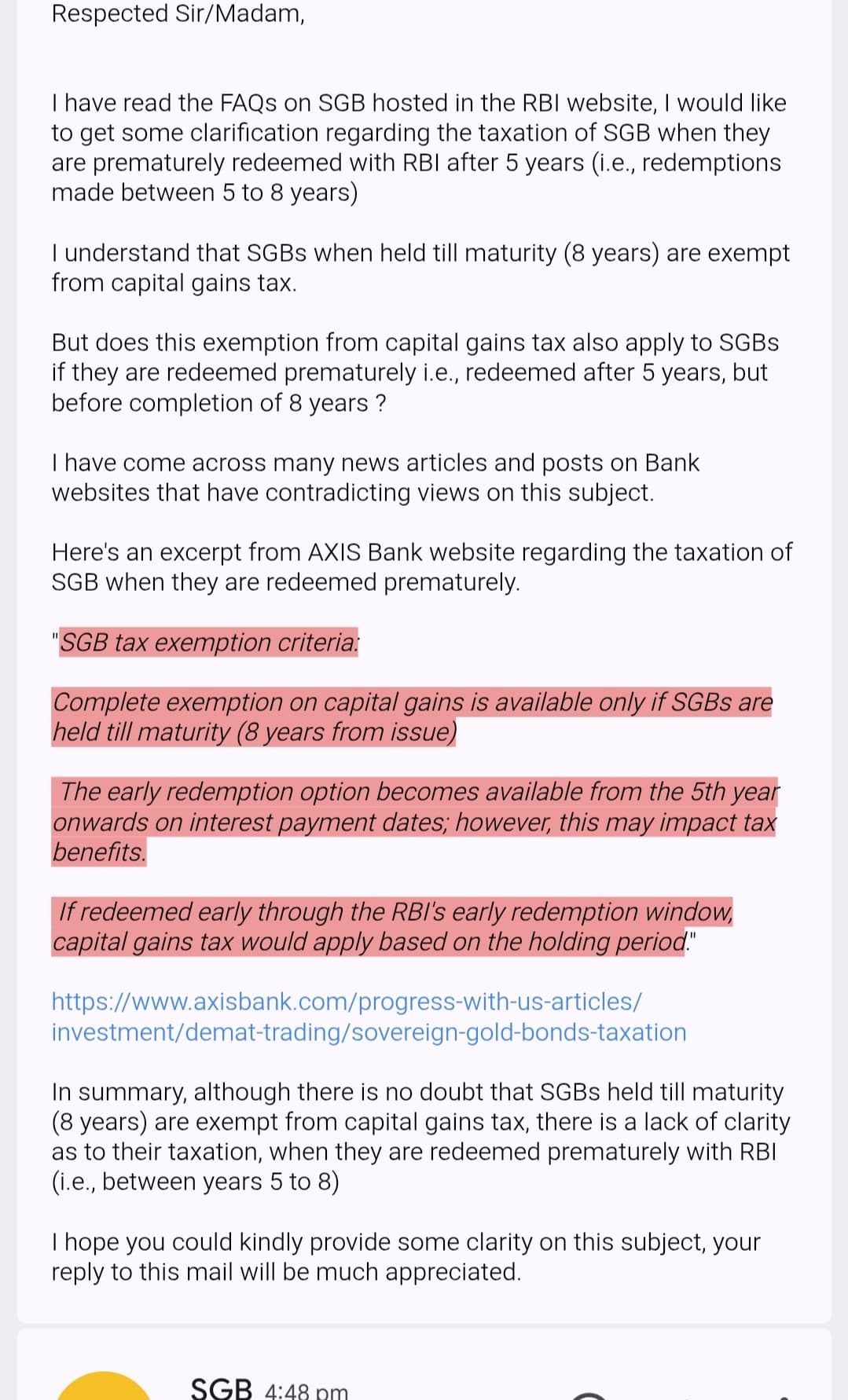
Unfortunately, after going through most of the contents on this topic, I couldn’t arrive at a conclusion as to when the SGBs are fully exempt from capital gains tax. This is because, there are contradicting views on this, some 1 2 say that redemption with RBI at any time after 5 years (premature redemption) are tax-exempt, while others 3 4 say that the capital gains are exempt only if they are held till maturity and redeemed at the end of 8 years.

So, there seems to be no unanimous opinion/interpretation as to when the capital gains arising on SGB redemption are exempt from tax.

I was hoping that the RBI’s FAQs on this topic would provide some indisputable clarity, however, the answers seem ambiguous, as it simply states “The capital gains tax arising on redemption of SGB to an individual has been exempted”.

IMO, the only clue here is the word redemption (which i interpret as redemption on maturity i.e., 8 years). I say this because, the FAQs seem to differentiate redemption from premature redemption.

They could have mentioned that the capital gains tax arising on both redemption and premature redemption are exempt from tax, but they didn’t. IMO the word redemption can’t be considered to also include premature redemption in its definition.

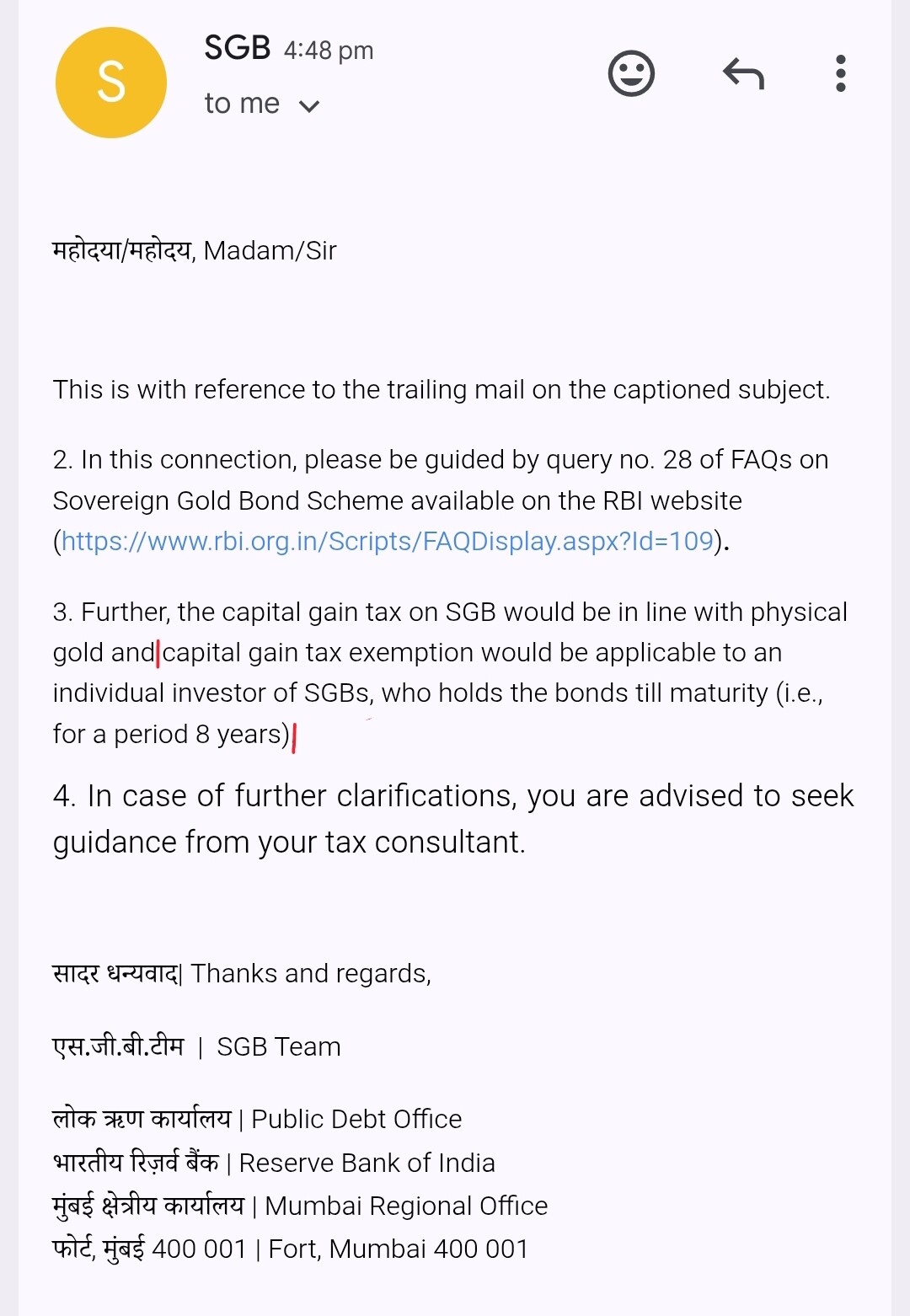
Anyway, since I was not getting any clarity on this topic, i decided to reach out to RBI’s SGB team which was created to address any queries on SGB, and this is the reply i received.

As per their reply, it is certain that the capital gains tax on redemption of SGBs are exempt only if they are held till maturity (8 years), and therefore any premature redemption with RBI between years 5 to 8 would be subject to tax.

PS:

With regards to OP’s query of buying from the secondary market and holding for a term less than 8 years, although redemption with RBI on maturity is exempt from tax, i believe such exemption is available only if the person is the primary investor of the SGB, who subscribed to the SGB directly with RBI. I say this because, the holding period too matters, anyone buying from the secondary market will have a holding period of less than 8 years, the word held till maturity normally implies that you bought it on day one and held till the due date, and only the primary investor gets the certificate of holding.

IMO, anyone purchasing from the secondary market will not be eligible for any tax exemption, because the holding period is not something that gets transferred from one person to another, we need to consider the holding period of each individual to determine if the bonds were held for 8 years. Buying from secondary market and redeeming on the due date/maturity date doesn’t mean the bonds were held till maturity, they are simply redeemed on maturity, not held till maturity.

We can’t just hold a bond for any period less than 8 years and still enjoy tax exemption simply by being the last person holding the bonds and redeeming it with the RBI.

Unfortunately, since i didn’t read OP’s query while drafting the mail to RBI, I couldn’t include this query in my mail.
1 Like

I had similar doubts. After reading other articles, I read all the acts myself and came to the above conclusion. It’s important to know how the government excluded SGBs from capital gains. What is the exact wording used? If you know how. Then the rest becomes clear. . To quote,

Basic definition tions:

Section 2:

(14) “capital asset” means—
(a) property of any kind held by an assessee, whether or not connected with his business or profession;

42A) “short-term capital asset” means a capital asset held by an assessee for not more than 9[twenty-four] months immediately preceding the date of its transfer :
Provided that in the case of a security 10[***] listed in a recognized stock exchange in India or a unit of the Unit Trust of India established under the Unit Trust of India Act, 1963 (52 of 1963) or a unit of an equity oriented fund or a zero coupon bond, the provisions of this clause shall have effect as if for the words 11"[twenty-four] months", the words “twelve months” had been substituted:

42B) “short-term capital gain” means capital gain arising from the transfer of a short-term capital asset ;

29AA) “long-term capital asset” means a capital asset which is not a short-term capital asset ;
(29B) “long-term capital gain” means capital gain arising from the transfer of a long-term capital asset ;

Note that the keyword is the definition of short term capital asset in Section 2 42 (A): transfer

Section 45 is the start of capital gains, which says how capital gains should be taxed.

  1. (1) Any profits or gains arising from the transfer of a capital asset effected in the previous year shall, save as otherwise provided in sections 54, 54B, 54D, 54E, 54EA, 54EB, 54F , 54G and 54H, be chargeable to income-tax under the head “Capital gains”, and shall be deemed to be the income of the previous year in which the transfer took place.

Certain transactions are excluded from “transfer”. This is defined in Section 47.

  1. Nothing contained in section 45 shall apply to the following transfers :—

    (viic) any transfer of Sovereign Gold Bond issued by the Reserve Bank of India under the Sovereign Gold Bond Scheme, 2015, by way of redemption, by an assessee being an individual;

This is how government excluded SGBs, by removing it from the definition of transfer in 47(viic). Since it says “redemption” and doesn’t explicitly exclude premature redemption, I believe all type of redemption is included.

@SG_13

Source: Tax Laws & Rules > Acts > Income-tax Act, 1961

Like I had mentioned, this is the reply from RBI’s SGB team, they have clearly pointed out that the capital gain tax exemption is available only to individual investors, who holds these bonds for a period of 8 years (till maturity).

I would argue that since the definition of redemption doesn’t explicitly mean to include premature redemption, they aren’t considered as redemption which are eligible for tax exemption as per RBI.

It is just a window for early redemption, not for tax exemption.

The intent behind giving tax exemption is to ensure that the funds are locked in for a fixed period of 8 years (till maturity) as confirmed by RBI in their reply.

Even if you take that stand, redemption is fully exempt, even if you hold it for 1 day. Holding period is completely irrelevant as per the act. Act supersedes any RBI support team replies.

There are both schools of thought with regards to premature redemption. That’s why there’s 2 banks replying differently. I doubt you’d be contested, if you chose a favorable approach for you. To me, It is clear that “redemption” is “redemption”. There is no “mature” or “premature” redemption. Premature redemption is “redemption”. Redemption is the act of reddeming your money in exchange for the extinguishing of bonds, which happens in both mature and premature redemption. The banks taking the opposite view are clearly wrong. Nevertheless, Holding period is irrelevant regardless of their intent, if the act didn’t specify it. That is ironclad.

1 Like

It is ultimately the RBI that frames the rules around SGBs and their taxation.

They would be the authority to decide what constitutes redemption and what they mean by held till maturity, and which redemptions are eligible for exemption.

The Income Tax Act contains the general provisions for taxation of capital gains, any specific provision regarding SGBs comes from the rules framed by the RBI, like excluding redemption of SGBs from the definition of transfer etc.

If someone wrongly claims exemption for capital gains on premature redemption of SGB, what do you think the AO/ITO would do, they would first try to read the rules around SGB framed by the RBI, and if they lack clarity, they would ask the RBI to clarify what constitutes redemption according to it.

The Income Tax Act can’t overrule something for which the rules are framed by the RBI, they would simply interpret these rules to modify the Income Tax Act where necessary, they can’t supersede it.

True.

Anyway, as you had mentioned, this topic is always open for interpretation, unless there are any case laws/judicial ruling around it or a detailed circular/post by RBI on this topic, i believe this will continue to remain ambiguous.

I welcome opposing opinions/disagreements, and I’m open to change my view if the evidence/facts are persuading enough.

Hopefully we will get some clarity in the future through many such conversations.

No. Taxation is a federal subject and it’s exclusively determined by the Government of India. RBI has no jurisdiction or authority on taxation. Even your own RBI reply post asks you to consult a tax advisor in (4). The bonds itself is issued by Government of India via RBI. The Bond is issued by Reserve Bank on behalf of Government of India. That’s why it’s “Sovereign”. If RBI had framed rules, you should cite them. A FAQ post or a reply email is not a rule. Even if they had some rule and I don’t think they do, the income tax act supersedes it. I’m pretty sure all redemption by individual is tax free and holding period is irrelevant. AO would cite the income tax act in case of contest and not RBI. But there’s nothing to contest, IMO.

1 Like