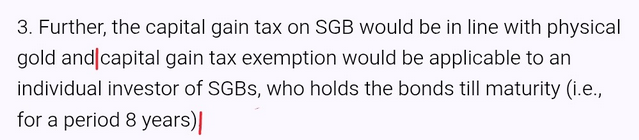
The RBI email response above was inconclusive from one angle. It said -
Capital gain tax exemption would be applicable to an individual investor of SGBs, who holds the bonds till maturity (i.e., for a period of 8 years)
There can be two set of people, who can be holding the bonds till maturity of 8 years (final redemption) -
Who bought from IPO
Who bought from secondary markets
The “holds” here means - you are holding the bond at maturity not the period you held it for - and points towards the final maturity. Not early redemption.
This query required a further follow up email regarding purchased from.
Anyhow, it is clear that this capital gain exemption was available for people who bought from secondary markets -
That’s why the 30% premium.
That’s why the Budget 2026 had to change so many rules to apply it.
That’s why it is applicable from 01-Apr-2026.
The applicable date (01-Apr-2026) is important. Otherwise, this opens up all the previous SGB redemptions for AO reassessment. People have actually enjoyed EEE on SGBs.
Really sad state though. I understand their shortfall but all they had to do was to back up the scheme with actual gold (like any ETF) and this would have been an amazing thing for the country and rupee stability.
@BB789 my understanding is based on
the email discussion with RBI and screenshots
that you have (Update: SG13 had) shared earlier in this topic thread.
They explcitly called out the holding period of 8 years as a key factor in taxation/tax-exemption of SGB.
The way i see it, the amendment was to remove the ambiguity. (evident from the inferences one had to draw by reading mutiple sections, for example earlier in this thread.)
Sure, that is one interpretation.
One that has been recently clarified as NOT following the spirit (or even the letter) of the law.
The RBI email that @BB789 shared above, states “hold … for a period of 8 years”, not just till maturity.
This appears to be a failure to understand the reasons why the SGB scheme was introduced in the first place -
To eliminate/control the weakening of the rupee in the global markets due to demand for physical gold.
Backing-up SGBs with physical gold would have defeated one of the stated goals of introducing the SGB scheme.
Ultimately, my point being
if one had not accounted for such uncertainties before investing in SGBs,
(evidently most retail traders did not) one only has oneself to blame.
How might one have accounted for this?
One way might have been -
Instead of assuming a 100% guarantee that one would not be taxed upon redemption,
maybe assign a <100% probability
and estimate the effective returns from an SGB based on that (to decide whether to opt for an SGB or some alternate instrument)
In any case, looking at similar such clarifications to financial acts in the past, that were unfavorable to a majority of individuals, personally i feel that there is a small but significant chance of relief by relaxing the SGB taxation to grandfather folks that have purchased/sold SGBs prior to a certain date. Let’s see…
@cvs - Are you for real? Spirit of the law! Letter of the law! They changed the law. It is punishing people who diligently followed the law and invested in a disciplined manner for all these years.
@abhiwin123 Sure man. You are entitled to your opinion.
i continue to believe that investing in an instrument without accounting for the uncertainities involved, is not diligence/discipline.
I did not find your argument against it flawless, and pointed it out above.
But, that’s just my opinion, Not a fact.
PS: to be very clear, i am not claiming that i personally knew this all along. I did not.
All i knew was that there was some uncertainity involved.
After the recent announcment, looking back with 20-20 hindsight,
the holding requirement for 8 years and not just upon maturity
was right there in front of our eyes in BB789’s screenshot of RBI’s response email.
In fact, SG_13’s subsequent response in this thread above is foreshadowing the recent announcement.
Like i said above, i agree that since the intention is not to be punitive, if it is perceived as such by a significant majority, there is a chance that further relaxation of the law to grandfather-in a larger fraction of affected folks is likely to occur.
Now, thinking of the repurcussions -
a. in the secondary market, reduces demand for (and value of) SGBs maturing after 1 Apr 2026.
(proportionally to the CG-tax, right?).
Any drop beyond that is over-correction? An opportunity to buy?
b. no direct competition between existing SGB traches on the secondary market and any fresh issue of an SGB. A fresh issue of an SGB uniquely qualifies for taxation benefit (unlike purchasing from the secondary market), so likely to be at a premium (if any such tranche were to be announced in future).
It’s not mine. It’s SG_13. And I was always against their explanation. It was not in the law either.
There was no ambiguity though.
Without reading anything else, Just see the act that states that what transactions are not considered transfer and therefore no capital gains.
Before
any transfer of Sovereign Gold Bond issued by the Reserve Bank of India under the Sovereign Gold Bond Scheme, 2015, by way of redemption, by an assessee being an individual;
After
“(x) by way of redemption, of Sovereign Gold Bond issued by the
Reserve Bank of India under the Sovereign Gold Bond Scheme, 2015 or
any subsequent Sovereign Gold Bond Scheme, if held by an individual from
the date of original issue till maturity
Now by reading not just that, buy also reading something else as well,
i.e. the clarification from RBI on this topic shared above in this topic-thread in Nov 2025,
(Note: Supposedly from RBI as we just have a screenshot, and not the actual email.)
what the quoted sections of the Income-Tax Act state
apparent to you (atleast now in hindsight) ?
Note: This does not make one of our prior attempts to interpret, suddenly more valid than the others.
Just as another clarification/update announcement would not suddenly validate the other interpretation.
Am trying to highlight how we (collectively all of us who have been in this topic-thread) have likely underestimated the risk/uncertainty involved in SGB (in this matter due to taxation). Of course, only those of us who have an exposure to SGB stand to be affected monetarily, and others can benefit from paying attention to this scenario.
PS: If you are reading this, and you genuinely believe that in this case of SGB-taxation, the “rules of the game” were retroactively changed unfavorably for retail individuals, fine. You are welcome to your world-view on whether this was unfair. However, irrespective of that, please consider taking into account such possibilities, when looking to play any other “games” - i.e. assess risk accordingly - Basically, 99% is not equal to 100%.