Hello. Can someone please help me in understanding the way to calculate the return while i am not able to differentiate between the different way of Return Calculations.
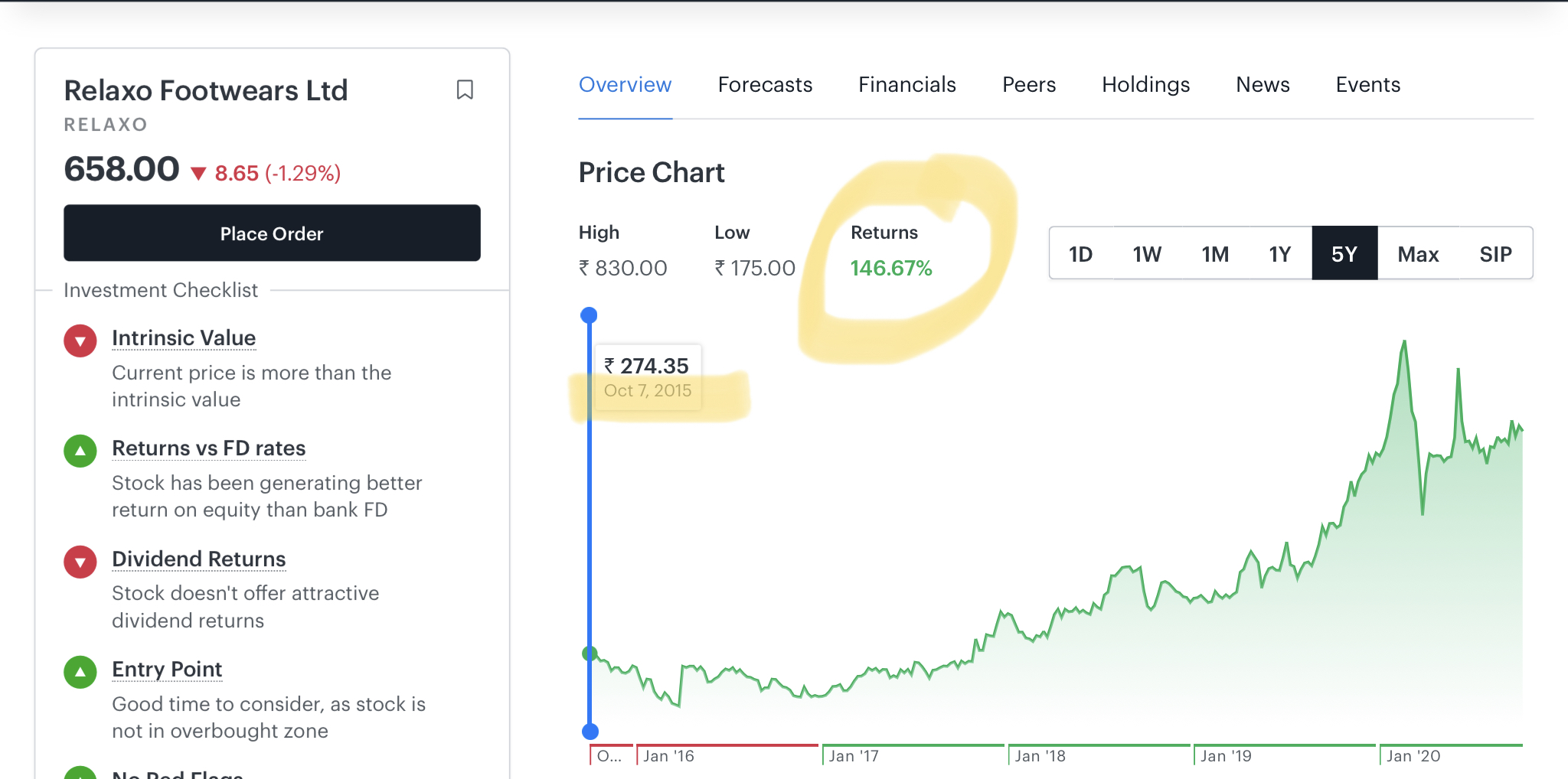
Here in the first screenshot where it’s mentioned that the 5 Return Of Relaxo is 146.6% (looks so Great) .
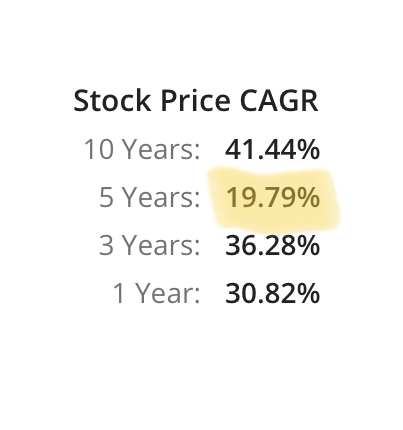
But in the second screenshot, where it is mentioned that 5year CAGR is just 19.79%. Which means my money grew every year with 19.79% for 5 year?
which return is to be taken to compare 2 stocks? CAGR?
And If we are selecting CAGR, then why in the website it is showing return as 146%.
The 5 year return is indeed 146.6% i.e. after a period of 5 years the stock had incread by that much. Now, 19.79 is the compounded return of that stock over 5 years. Its just another way to look at things. If you want calculations then -
Investment amount - Rs100 CAGR - 19.79%
CAGR means that 19.79% will be added to the principle each year but the principle would be considered the resultant capital of previous year. So-
After 1 year - 119.79 (100+19.79%)
After 2 years - 143.49 (119.79 + 19.79%)
After 3 years - 171.88 (143.49 + 19.79%)
After 4 years - 205.9 (171.88 + 19.79%)
After 5 years - 246.65 (205.9 + 19.79%)
So, profit earned = 246.65 - 100 = 146.65
Which if you calculate is 146.65% return. Difference of 0.01 percent is there because i ignored the decimals after first 2 places while calculating.
But you get the idea. It’s the same thing written in 2 different ways. You can take whichever you want.
To compare two investment which has different absolute return and holding period, why can’t we use annual absolute return (absolute return/holding period) to compare two investment rather than CAGR?
Both numbers are right — they’re just answering different questions.
146.67% = Absolute Return
This just says: “If you invested ₹100 in Oct 2015, you have ₹246.67 today.” It tells you the total gain but ignores how long it took.
19.79% = CAGR (Compounded Annual Growth Rate)
This asks: “What consistent yearly rate would produce that same result over 5 years?” The answer is 19.79% per year.
Quick maths to verify: ₹100 growing at 19.79% every year for 5 years = 100 × (1.1979)^5 = ~₹246. Same result.
Which to use when comparing 2 stocks? Always CAGR.
Here’s why absolute return misleads you: Stock A gave 200% in 10 years, Stock B gave 150% in 4 years. By absolute return, A looks better. By CAGR: A = 11.6%/yr, B = 25.7%/yr. B is far
better.
CAGR puts every stock on the same clock, so comparisons are fair. Absolute return is fine for a single stock to understand total gain, but useless for comparing two stocks with different
time periods.
One thing CAGR still doesn’t handle well: if you bought in multiple tranches (SIP-style) rather than one lumpsum. For that you’d need XIRR. But for a single buy → hold → compare scenario,
CAGR is your number.