STT impact on overall market volumes

If you trade even a bit and look at your contract note, STT is the one that takes the most, most of the time.

Every Budget day without fail, someone in my office says "maybe they’ll finally reduce STT this year”

We all laugh because we know they won’t, but yeah, we still hope. :sweat_smile:

@nithin just tweeted this:

Securities Transaction Tax (STT) is the biggest tax that traders pay, and it’s much higher than brokerage fees.
At Zerodha, the STT we collect and pass on to the government is higher than the brokerage we earn.

Trading volumes are highly sensitive to the STT. The level of STT also affects whether traders trade more in cash equities, futures, or options. There’s a lot of concern that Indian options volumes have exploded; I don’t think it would be a stretch to say that STT is a big factor in this.

Until 2008, the STT on options was based on contract value, making it impossible for anyone to trade options. After that, STT was charged on the premium, and options became more cost-effective compared to futures, and volumes shot up.

By the way, the idea of Zerodha came about when the STT for options was brought down to a premium value. The bet was that people would trade more options. It did play out the way we had thought it would. :grimacing:

We’ve had several STT changes over the years. This has had a more significant impact on cash and futures than on options because STT was on premium value, and on cash/futures, it was on total value. And yes, the introduction of weekly expiry and restriction on intraday leverage for stocks added a lot of fuel to the fire of option trading volumes.

So yeah, I wish we had no STT, but I guess that’s not a solution. :smiley: But if STT were brought down for cash and futures and intraday leverage were increased (from the minimum 20% now to as much as futures), I think the trading volumes in cash and futures would automatically go up.

It is a much better strategy to increase cash/futures volumes than to reduce trading volumes in options.
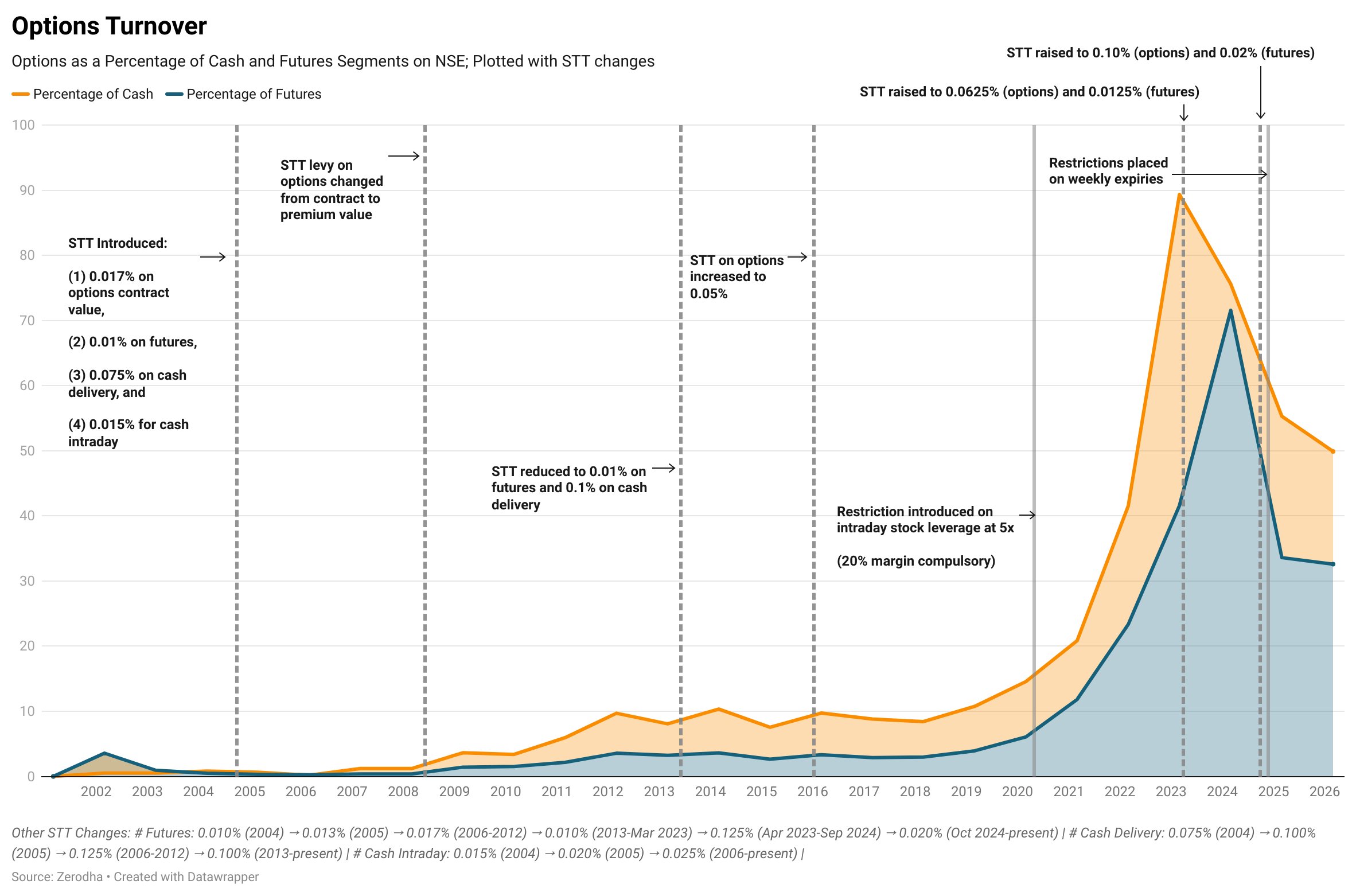
STT rates and the way they have changed over time.

2 Likes

STT for cash intra is very high, and cash overnight is even more.

That’s a big potential roadblock for trading stocks for only few days. Even reducing that, considering we have LTCG now, should help.

Investment guys wont feel much, but its a big impact on trading.

3 Likes

@nithin shared this on STT and F&O business.

I don’t know the exact reasoning behind the increase in STT. Having said that, if the goal was to reduce speculative activity in F&O, then I’m not sure this will do anything.

95% of trading is already in options, and this STT increase will only push that share higher. Why? Because the impact falls mostly on futures, while options are far more speculative than futures.

If the govt wants to reduce speculation, then establishing product suitability (who can trade) criteria is the way to go. I know it’s an unpopular opinion, but this will remove a lot of uncertainty among brokers and traders. It’s a much better approach than a death by a thousand STT hikes. :grimacing:

The other problem with the uncertainty from steady STT hikes is that, at some point, you’ll start seeing a material impact on trading volumes because transaction costs make trading unviable. You’re already kinda seeing that with futures.


1 Like

No way i will touch Futures for intraday now.
Stock futures maybe somebody can manage ( but still with heavy STT expenses), but Indices don’t even move that much.

So probably we will have noobies + arbitrage and lower frequency traders/hedgers. Market makers will also need more space, so perhaps bigger spreads.

1 Like

No options on ETFs, STT increased even for delivery option trades, arbitrary lot sizes for stock options, equity futures too prohibitively expensive for hedging… :grimacing:

… It’s almost as if the govt wants peeps to gamble on far OTM shorter dated options and lose their shirt :tshirt::face_exhaling:

If there’s a silver lining to this, maybe commodity futures might pick up some of that volume. :2nd_place_medal: :pouring_liquid::arrow_up:

Well then there is next year budget to fix that !

2 Likes

SEBI introduced physical delivery in FNO to reduce volatility and to encourage investors , but now the Government forced STT on exercised Options also , in a way Government or Finance minister don’t want the traders

1 Like

Govt fixing means increase in capital gain taxes, trades taxes to earn extra revenue. This is the Xtra revenue by which they earn whether stt, ltt, ltcg, stcg wherever nothing left being investors.

E. G. In long term suppost 10yrs u invested 50Lakhs & u earn 1.5Cr in MF.

Total Gain: ₹1,00,00,000
Exempt Gain: ₹1,25,000
Taxable Gain: ₹98,75,000
Tax (12.5%): ₹12,34,375
Cess (4%): ₹49,375
Total Tax Payable: ₹12,83,750

Total Long-Term Capital Gain: ₹1,00,00,000
Exemption Limit: ₹1,25,000
Taxable Gain: ₹1,00,00,000 - ₹1,25,000 = ₹98,75,000
LTCG Tax Rate: 12.5%
Tax Payable: ₹98,75,000 X 12.5% = ₹12,34,375
Net Gain after Tax: ₹1,00,00,000 - ₹12,34,375 = ₹87,65,625

So ur total gain reduces + extra cess & surcharges if applicable for will again reduce ur net gains increase in tax burden

1 Like