Tata motors DVR conversion

During the process of TATA MOTORS AOS to NOS conversion of shares, As On 1 st september, 2024 , I had 40 DVR shares bought at avg. price of 662 each ( short term) , I got 28 NOS shares of value 1111.75 ( as declared by company through mail) And Total deemed dividend amount 8025 ( as mail from company).

If I calculate capital gain , (28x1111.75)- ( 8025)- ( 40x662) = 31129- 8025 - 26480 = -3376 i.e. short term capital loss.

Where and how can I show this Short term capital loss during filling of ITR for AY 2025-26???

PLEASE REPLY…

The new buy average will be calculated by dividing the total investment by the number of shares received after the swap. In this case, ₹26,480 (40 × 662) divided by 28 shares gives a revised buy average should be around ₹945.71 per share.

The capital gain will depend on the holding period of the stock and the selling price. Your gain will be calculated using the revised buy average. In addition, the deemed dividend component will be treated as Income from Other Sources and taxed as per your applicable income tax slab. Since the dividend amount exceeds ₹5,000, TDS at 10% would have been deducted, which you can adjust against your overall tax liability, including the capital gains.

I also found this explanation from their support article on the Taxation part on TATA MOTORS DVR, You can check this out as well.

@Quicko, please check once.

@keshav_02 @Quicko

Here I have CAPITAL LOSS due to conversion of DVR to NOS shares. I haven’t sold any allotted/ converted ordinary shares from dvr and still holding, Do I require to show the capital loss in ITR as I haven’t sold any converted NOS shares?

However The deemed dividend is added prefilled in my ITR as “income from other sources”… . Do I require to show the deemed dividend even I haven’t sold any NOS shares.???

Please reply …

Yes, you are required to report the capital gain or loss arising from conversion of AOS (i.e.,DVR) shares into NOS shares.

Your understanding is correct, this is how you calculate the capital gain/loss for the conversion of AOS (DVR) into NOS.

Capital Gains = Value of consideration received of AOS – Deemed Dividend Income – Original Cost of Acquisition of AOS

Value of consideration received of AOS =

(Number of NEW ordinary shares * 1111.35).

To determine if the gains are short-term or long-term, you can use the 01-Sep-24 as the reference date, i.e., if on 01-Sep-24 you held the DVR shares for more than 365 days, then it is long-term, else it is short-term.

The deemed dividend is to be reported as IFOS

It doesn’t matter if you haven’t sold the NOS, when there is a capital reduction, (i.e DVR shares gets cancelled), this capital reduction is considered as a transfer for the purpose of Income Tax.

So, even if you still hold all the NOS of TATA Motors, you still have to report both Capital gains and deemed dividend for the FY24-25.

In the future, when u sell the NOS, the cost of acquisition for these NOS shall be ₹1,111.35.

So in future, if you sell these NOS for say ₹2000, the capital gains will be ₹888.65.

In general u report the total capital gain/loss made during the year in the ITR. So if you have any other short-term capital gains during the year, you can adjust this loss against such gains and report the net capital gains/loss. if you don’t have any other gains or loss during the year, then you can report this as your capital loss for the year in ITR.

Check out this video and PDF for further clarity

Here’s the clarification from _quicko from another thread, on the taxation.

@Meher_Smaran @nithin_kumrr

I believe this Zerodha support article relating to the tax treatment of DVR shares needs some correction.

  1. How does this affect your purchase price?

Before the merger, you held 100 Tata Motors DVR shares bought at ₹300 each, making your total investment ₹30,000. Based on the 10:7 swap ratio, to calculate the new average price per share, divide your total investment by the number of shares resulting from the swap.

New average price = ₹30,000 ÷ 70 shares = ₹428.57 per share.

This is not a typical merger, it is a capital reduction scheme, where DVR shares gets cancelled and new ordinary share are issued. So unlike merger, irrespective of whether the new ordinary shares are sold or not, we are required to report the capital gain/loss and moreover, there is no need to determine the new average price, as all DVR shares held on 1/Sep/2024 are assumed to be transferred on that day.

The price of new ordinary shares will be ₹1,111.35, with the new holding period starting from 1/Sep/2024.

  1. How will taxes work when you sell your shares?

Let’s say you sell your 68 Tata Motors shares in October 2024 at ₹1,100 per share

Again, there is no need for any assumption as to when the shares are sold.

On the date of capital reduction (1/Sep/2024) by default, all DVR shares are considered to be transferred in lieu of consideration in the form of New ordinary shares.

So, we don’t need to actually sell the shares to attract capital gains, everyone holding DVR shares on 1/sep/2024 are required to determine and pay the capital gains tax, the conversion of AOS into NOS is considered as a transfer, so there is no requirement for actual sale here.

@SG_13 @Quicko

Thanks for clarification.

But how to find out the price of acquisition of DVR shares?

Where can I show this particular capital loss in ITR? is there any particular section regarding conversion capital loss . My short term capital gain is 1998 rs in this year. How to adjust and declare in 111(A) in ITR???

please reply

Having this checked. @SG_13

@nithin_kumrr @SG_13

Due to conversion of shares from TATA MOTORS AOS( DVR) to NOS( ordinary) shares, there is short term capital loss of rs _3375 .

On which column of ITR I can show this, can it be subtracted and to be shown with my short term capital gain which is rs 1995 for this FY.

Is there any particular section of IT rules or column to show this kind of deemed capital loss?

Pl reply…

You can report it u/s 111(A)

Yes, you have to report only the net gain/loss

Just add the total consideration received from all shares sold during the year (make sure to reduce the deemed dividend from this consideration) and report it under gross consideration. (i.e., consideration from DVR + all other stocks sold during the year)

Next, enter the total cost of all shares sold during the year under the cost of acquisition. (i.e., cost of DVR + all other stocks sold)

Ensure that at the end, the net short-term capital loss is ₹1380 (3375-1995)

And you can report the deemed dividend under Income from other sources.

1 Like

@Subho_de Could yu please DM me your Client ID?

@nithin_kumrr & all here
I too was thinking of Reporting Cap Gains on the TML-DVR (AOS) shares on the date of Conversion (which i have computed as per their data for the particular account) + the STCG on the NOS Share/s sold to fund the TDS on Deemed dividend. As per MUFG the NOS share/s was/were sold on 17-Sep-2024 at Rs.969.74 (whereas elsewhere I have seen it as 967.xx.
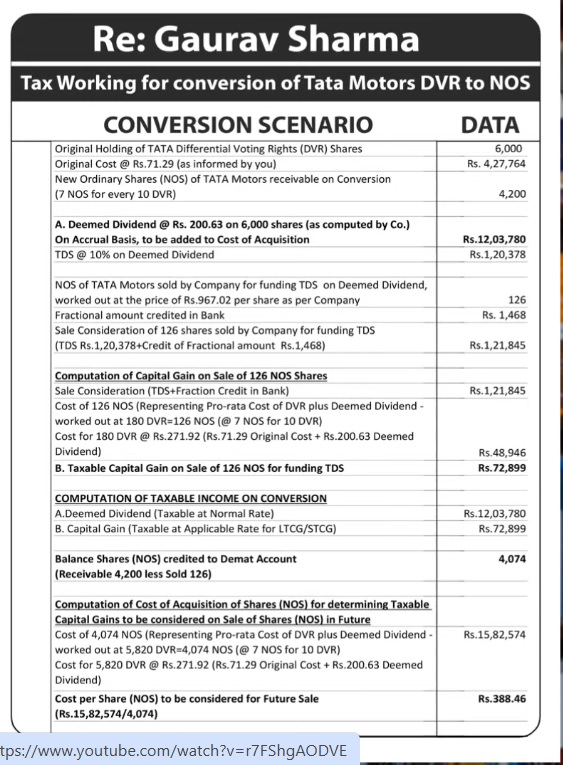
Now I came across another interesting Youtube Video on the Topic by TaxGuru - Mukesh Patel - which discuss the case with specific case study. Here is the link for the same:
TML-DVR Conversion CGain Video-TaxGuru-MPatel

(it is a long one - but interesting findings & computations given - esp the screen shots.

Requesting experts as well as Zerodha team to Comment on the same
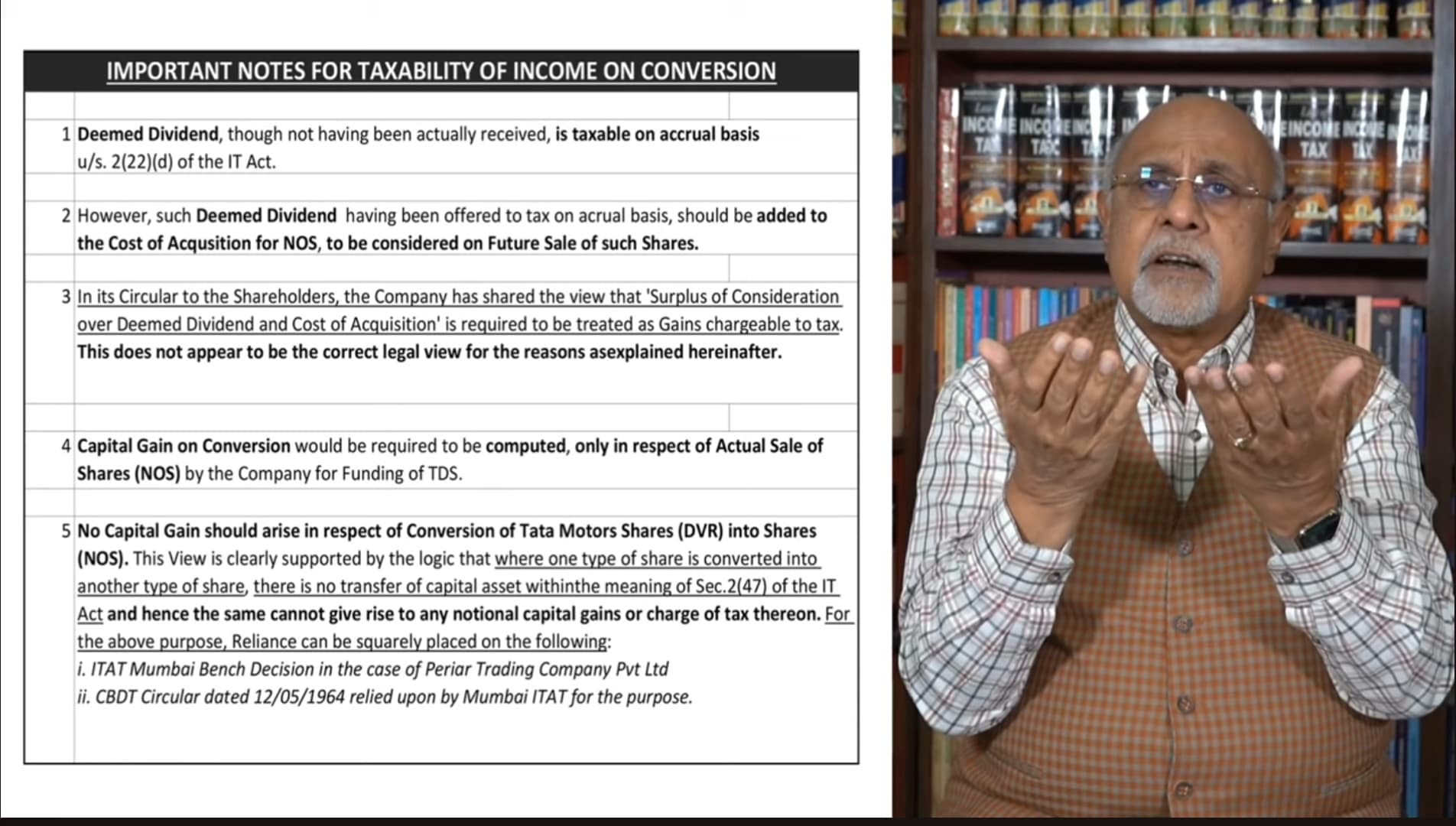
Here are the two screenshots captured from the video


Am sorry, I wanted to share another image of Important Conclusive Notes in the Video - but am limited to only one image at present. It is available in the video at time of 21 mins.6 secs.

1 Like

I understand that sometimes due to ambiguity, the tax laws can be open to multiple interpretations, however, in the case of TATA Motors DVR, i believe there is no ambiguity, and the views expressed by the Host in this video is misleading and most probably wrong for the following reasons.

I believe this :point_up:was the conclusive notes that you were referring to.

As you can see in Note 3) in the video, the host, seems to disagree with the circular issued by TATA motors to its shareholders regarding the tax implications of cancellation of the DVR shares.

He seems to contest with the capital gains taxation part of the circular, stating that the views expressed by TATA Motors doesn’t appear to be legally correct

And supports that by Note 5) saying that this is merely a conversion of DVR into NOS and therefore there is no transfer of shares and so, the capital gains will arise only at the time when the NOS shares are sold.

IMHO, the above argument is absolutely wrong

  1. He is indirectly implying that the legal team of TATA Motors were wrong in interpreting the tax laws and has mislead the shareholders by stating incorrect facts. Do you really believe that a company as big as TATA Motors would not have hired professional CA/consultants before issuing such circulars ?

Here’s the official video issued by TATA Motors explaining the tax implications of cancellation of DVR shares.

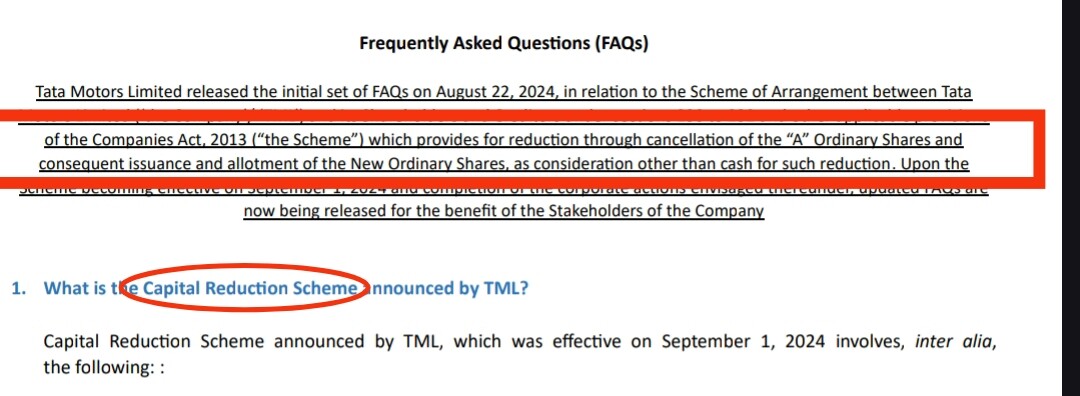
  1. The scheme is called capital reduction,not conversion, the key word here is capital reduction and cancellation of DVR shares through consideration other than cash

  2. Capital reduction is generally considered a “transfer” under the Income-tax Act, 1961, specifically within the meaning of section 2(47). This is because the reduction of share capital, whether through a reduction in face value or by paying off a portion of the share capital, results in the extinguishment of the shareholder’s rights to that extent

  3. Extinguishment of Rights:
    When a company reduces its share capital, it essentially cancels out some of the shareholder’s rights associated with those shares. This can include the right to dividend payments, the right to share in the company’s assets upon liquidation, and potentially the right to vote.

Transfer under Section 2(47):
Section 2(47) of the Income-tax Act defines “transfer” in relation to a capital asset. It includes not only sale, exchange, or relinquishment, but also the extinguishment of any rights in the

The cancellation of Tata Motors DVR (Differential Voting Rights) shares and their conversion into ordinary shares involves the extinguishment of certain shareholder rights. Specifically, the DVR shares, which had lower voting rights and a different dividend structure compared to ordinary shares, are being canceled and replaced with ordinary shares. This means the unique rights associated with the DVR shares, primarily related to voting and dividends, are being eliminated.

The expression ‘extinguishment of any right therein’ is of wide import. It covers every possible transaction which results in the destruction, annihilation, extinction, termination, cessation or cancellation, by satisfaction or otherwise, of all or any of the bundle of rights, qualitative or quantitative, which the assessee has in a capital asset, whether such asset is corporeal or incorporeal.

So, in conclusion, the views expressed the host in that video is misleading and contradicts not only with the circular issued by TATA Motors, but also with the Income tax act, when it comes to the taxation of the capital gains of DVR shares upon cancellation.

TL;DR
Irrespective of whether the new ordinary shares are
sold or not, we are required to report the capital gain/loss on cancellation of DVR shares, as all DVR shares held on 1/Sep/2024 are assumed to be transferred on that day.

1 Like

@SG_13
Thanks very much for the clarifications with explanations - especially as I was wondering regarding the point in his first screenshot the computation of Capital Gain on the Sale of the NOS. I will go with your suggestion.
Anyways I have already computed the Cap Gains in our case based on the circular / data provided by Tata Motors & their Video - for both the sale of 1.the original DVR/AOS as well as 2. the NOS share for funding the TDS - filled in the Online ITR & in Draft state ready for filing / submission.
Actually in our case the qty is low at 30 DVR shares held & 1 NOS share sold.
However to clarify that the date of sale of NOS for funding the TDS was after the conversion date (01Sep2024) - i.e. 17-Sep-2024 (as clarified by the RTA MUFG in their email to me (which means a ST Cap Loss). But the NOS share rate they mentioned there was 969.74 (which needs to be cross-checked - as everywhere else this value is being talked of as 967.02 - also matching with the amount of excess Cash credit I received).
Thanks again.

1 Like

Furthermore, however the Cost of acquisition of the converted TML NOS shares in our Zerodha Portfolio should reflect the Rate of Purchase of NOS as declared by TML as 1111.35 per share & date as 01-Sep-2024 (not the original cost & date - which we already consider in our Cap Gains computation.
Zerodha team - please clarify & correct this as already highlighted by other members here.
Thanks

1 Like

Can someone summarize the procedure to be followed… here is what I understand from this thread

  1. Deemed dividend - Show as Income in OS and claim TDS if any deducted
  2. CG Event 1 : Conversion of TATAMOTORS DVR - TATAMOTORS, calculate the STCG/LTCG as per purchase date and Sep 1, 2025 price of 1111.35 and show as income
  3. CG event 2: When TATAMOTORS shares are sold, calculate the new CG based on Sep 1 date and 1111.35 as cost price.

Question

  1. Is this procedure correct or am I missing anything.
  2. How about deemed dividend, should i subtract from CG Event 2?

In addition to above queries, request someone to clarify:

  • the selling price of TML for funding deemed dividend: 967.02 or 969.74 as on 17-Sep?
  • the buy price for this as 1111.35 as on 31-Aug?

For (2) CG Event 1: What should be considered as the selling price? Should it be zero as shares were cancelled?