We were having a somewhat similar discussion on this thread: Nifty valuations discussion – #3 by ema200wizard.
So I thought, let me put together some of the things I’ve been observing about our markets and share them here. It turned out a little longer than I expected, so apologies in advance 
If you look at what happened after 2020, the first phase was pretty straightforward. 2020-21 was basically a liquidity and reopening story.
Central banks were pumping liquidity into the system, rates were extremely low, economies were reopening and money was moving back into risk assets. At the same time, retail participation in India started exploding. RBI’s data shows how quickly the market recovered after the March 2020 crash, and then NSE’s investor base went from roughly 4 crore investors in March 2021 to 10 crore by August 2024. RBI,NSE
Then 2022 came along and the environment completely changed.
Inflation picked up, the Russia-Ukraine war pushed commodities higher and the Fed started aggressively tightening. So naturally, the easy-liquidity trade started getting hit. Nifty corrected around 18%, but what’s interesting is that the correction stopped there. It didn’t turn into one of those prolonged bear markets.
And from the June 2022 low, the market basically started another leg higher.
Over the next two years, Nifty went from around 15,000 to above 26,000. And this time, I don’t think you can explain the move just by saying “liquidity.” There was a lot more going on, earnings were improving, domestic institutions were buying, banks were in a much better position, capex was picking up and India’s relative economic story was looking pretty strong.
The IMF actually puts some interesting numbers around this. Between 2021 and 2024, MSCI India returned about 78%, compared with -17% for MSCI Emerging Markets and 57% for the S&P 500. It also points to the improvement in Indian corporate earnings and the expansion in valuations. IMF
But then, around September 2024, the character of the market started changing again.
Nifty had reached around 26,300, and from there we saw roughly a 17% correction. And what’s interesting is that this wasn’t happening in isolation.
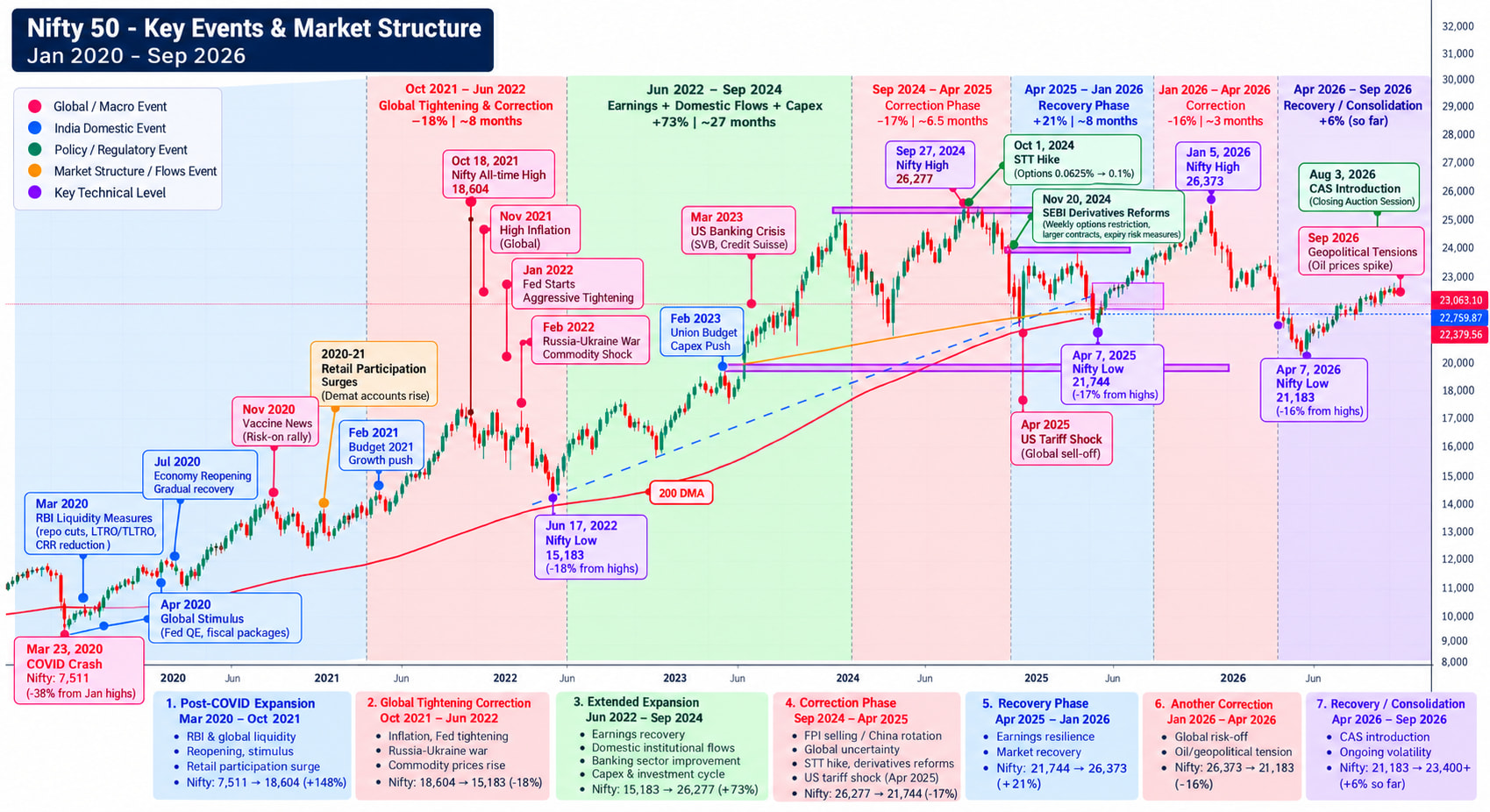
At the same time, India’s derivatives market was going through a pretty big structural change.
SEBI started tightening the framework around weekly expiries, contract sizes, expiry-day risk and position monitoring. And when you look at the numbers, you realise just how big the derivatives boom had become. Individual index-options turnover had grown at roughly an 82% CAGR between FY20 and FY25. SEBI
And that brings me to something I think is worth watching “leverage”.
Because F&O is one form of leverage, but MTF is another.
And MTF has become much more relevant now. SEBI’s 2026 consultation itself talks about the growth in MTF volumes and the risks around funded positions and the collateral supporting them. SEBI
At the same time, the other side of the equation has changed quite a lot too, domestic money has become much bigger.
Just look at SIPs. Annual SIP contributions have gone from roughly ₹96,000 crore in FY21 to around ₹3.5 lakh crore in FY26. AMF
So when I compare today’s market with something like 2008, I don’t think we can really treat them the same way.
Back then, global capital flows were a much bigger part of the story. Today, we have a massive domestic investor base constantly putting money into the market.
But that doesn’t mean the market can’t fall.
It probably just means the way a correction plays out can be very different.
Thanks for reading, guys! What’s your take on it? Would love to hear your thoughts…