"Sustainability” is slowly catching up to corporate priorities, driven by corporate social responsibilities (CSR initiatives) and growing focus on long-term impacts. How important is the synergy between ESG principles and corporate governance? Can the integration of good corporate governance and ESG funds truly balance financial returns with positive societal impact?
ESG & Corporate Governance*- ‘Do Good, Be Good’*
A strong foundation of corporate governance is essential for any successful business of any scale. Corporate governance combined with the ESG– environmental, social & governance– principles aim to ensure that businesses uphold both sustainability and profitability.
Combining ESG principles with corporate governance transcends mere compliance. It signifies a genuine commitment to sustainable and ethical business practices. Companies that embed ESG factors within their governance frameworks can better foresee and mitigate risks, leading to enhanced stability and growth.
Moreover, investors are increasingly prioritising sustainability filters in their investment decisions. In fact, 77% of individual investors worldwide express interest in businesses or funds that pursue both market-rate financial returns and beneficial social and environmental effects.
The following shows how sustainable investments will increase in individual portfolios over the course of the next year.
This shift in investor’s interest is driving corporate boards to place ESG considerations at the forefront of their strategic planning. Research shows that in nearly half of the companies surveyed, the CEO shoulders the responsibility for sustainability, with a dedicated Chief Sustainability Officer often following suit.

Source: KPMG Pg11
Traditional governance models, which focused primarily on shareholder value, are evolving to embrace broader, more inclusive approaches. This transformation not only helps companies mitigate risks but also unlocks opportunities for innovation and leadership. Studies reveal that global leaders who prioritise such practices see an average yearly return of 12.9%, which is higher than the 8.6% return of businesses that lag behind in ESG indicators.
ESG-driven corporate governance cultivates a culture of transparency and accountability. Ethical decision-making and responsible leadership become ingrained in the corporate DNA, enhancing trust and loyalty among stakeholders. This approach enables companies to pursue sustainable growth while maintaining a competitive edge in the market.
ESG funds are instrumental in promoting such sustainable and responsible investment practices. Previously seen as a niche market tailored for institutional investors with specific investment criteria, ESG investing has now entered the mainstream.
An Exposition on ESG Funds
ESG funds, as the name suggests, are designed to support companies dedicated to ESG principles. These funds meticulously select investments through the lens of sustainability, making sure their portfolios reflect high governance standards.
Thematic by nature, ESG funds focus on specific sectors and companies that adhere to stringent ethical guidelines. This focus narrows their investment scope compared
to traditional funds. Investors drawn to ESG funds typically prioritise both ethical and societal benefits alongside good financial returns.
Companies are assessed on their ESG adherence through scores provided by agencies like MSCI or Morningstar.
For example, MSCI categorises firms from CCC to AAA, with AAA denoting superior management of ESG. These ratings help investors identify sustainability leaders and laggards.
In the second quarter of the cycle year 2024, sustainable based open-ended and exchange-traded funds received around USD 4.3 billion in net new investments. However, the overall influx of these investment vehicles has slowed down globally.

Source: IEEFA
Yet despite the challenges these have outperformed traditional funds last year in 2023.
An analysis found that a hypothetical $100 investment in a sustainable fund in December 2018 would have grown by 35% over five years, compared to 25% for a traditional fund.
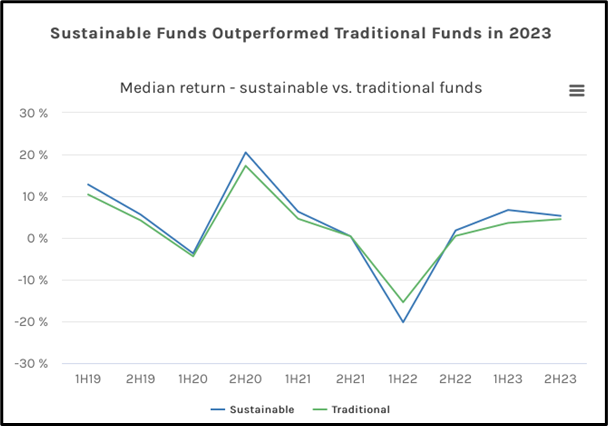
Source: Morgan Stanley
The above graph is only for representation and understanding purpose and does not assure any promise or guarantee of same in the future.
ESG Funds in India
In India, ESG theme-based funds have shown notable returns over the last year, ending July 30, 2024. They yielded an average return of 35.32%6 over one year and 20.36% over five years. In contrast, large-cap funds delivered 35.40% for one year and 19.17% for five years.
These figures suggest that ESG funds not only adhere to ethical and sustainable practices but also compete effectively with traditional funds like large-cap funds, offering financial performance and long-term growth potential.
The impact of ESG investing is clear in the Nifty100 ESG Index. This benchmark evaluates Nifty 100 companies on their ESG risk scores. For the year ending 30 July 2024, the index achieved a 31.4% return, surpassing the Nifty 50’s 25.8% return.

Source: Nifty Indices
Final thought
ESG funds represent a fusion of ethical responsibility and financial performance. As sustainable investing moves from niche to mainstream, the evidence supports its viability.
By supporting companies dedicated to sustainability, social responsibility and strong governance, investors foster transparency and accountability. ESG funds prove that profitability and principled investing can coexist, paving the way for a sustainable future that benefits both investors and the broader community. Remember, ‘Do good, be good’!
Disclaimer: The views expressed here in this Article / Video are for general information and reading purpose only and do not constitute any guidelines and recommendations on any course of action to be followed by the reader. Quantum AMC / Quantum Mutual Fund is not guaranteeing / offering / communicating any indicative yield on investments made in the scheme(s). The views are not meant to serve as a professional guide / investment advice / intended to be an offer or solicitation for the purchase or sale of any financial product or instrument or mutual fund units for the reader. The Article / Video has been prepared on the basis of publicly available information, internally developed data and other sources believed to be reliable. Whilst no action has been solicited based upon the information provided herein, due care has been taken to ensure that the facts are accurate and views given are fair and reasonable as on date. Readers of the Article / Video should rely on information/data arising out of their own investigations and advised to seek independent professional advice and arrive at an informed decision before making any investments. None of the Quantum Advisors, Quantum AMC, Quantum Trustee or Quantum Mutual Fund, their Affiliates or Representative shall be liable for any direct, indirect, special, incidental, consequential, punitive or exemplary losses or damages including lost profits arising in any way on account of any action taken basis the data / information / views provided in the Article / video.
Mutual Fund investments are subject to market risks, read all scheme related documents carefully.
Morgan Stanley- Sustainable investing on the rise
Kroll- ESG and global investor returns study
Morning Star-Global sustainable fund flows: Q2 2024 in review
Morgan Stanley- sustainable funds performance 2023 full year