Welcome to the first edition of the In The Money Podcast by Zerodha. I’m Sandeep Rao.
Since the time I started trading and was looking for data-driven insights, Tastytrade was the place to go.
Over the years, I’ve watched countless Tastytrade/Tastylive videos, and Tom Sosnoff has genuinely been an inspiration. Everybody wants to do “Tom-like” content, but there’s only one OG.
So when I got the opportunity to invite him to In the Money on the Zerodha YouTube channel, it was a total fan moment for me (you’ll probably catch that from my facial expression in the teaser  ).
).
We ended up having a great conversation.
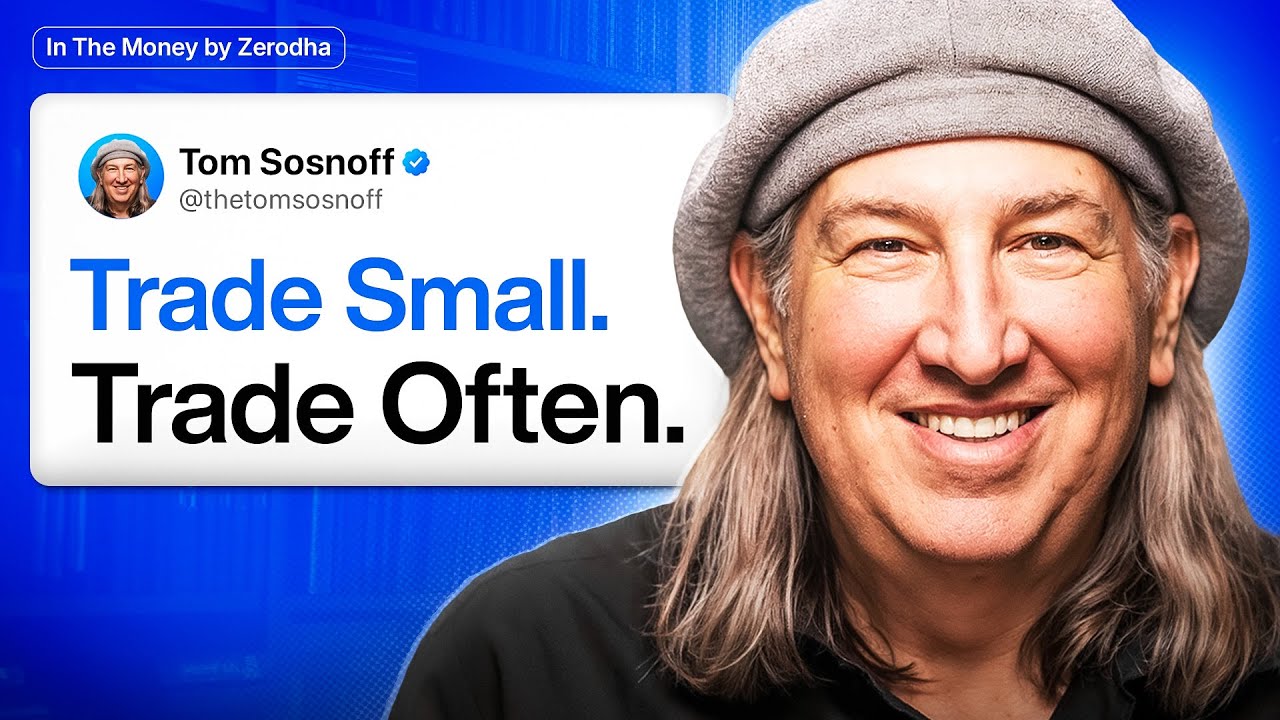
In this episode, Tom opens up about his early life, how he shaped himself into a contrarian trader, and his core philosophy on risk, volatility, and intuition.
He shares a refreshingly honest take on scalping, premium selling, and why so many traders misread market behaviour.
He also dives into the rise of Indian retail participation, the evolving regulatory landscape, the influence of high-frequency firms, and the hard-earned lessons from building iconic platforms like Thinkorswim and Tastytrade.
Here’s a brief from the podcast with Tom Sosnoff.
From Political Science to the Trading Floor
Tom’s path to Wall Street was serendipitous rather than planned. As a boomer growing up during the Vietnam War era, he studied political science at SUNY Albany - not because he was passionate about politics, but because business degrees barely existed in the 1970s.
“There really wasn’t such a thing called finance or business or entrepreneurship back in the 70s”
After graduation, with limited job prospects, he landed an interview on Wall Street at Drexel and took the opportunity. That decision, in a way, led him to the Chicago trading floors, where he found his calling.
“I liked the action and I liked the risk aspect of it. I was always a risk taker”
Once he discovered the world of pit trading, he was hooked, and he’s been in the markets ever since then.
The Evolution of Options Trading
When Tom started trading in the mid-1970s, options were a nascent product used primarily as leveraged speculation tools. Essentially, option buyers were taking leveraged bets. There was little spreading, little sophistication, just traders buying cheap options as speculative plays. The market makers, traders like Tom, would take the other side of every trade, earning small theoretical edges.
“The popular misconception is that floor traders have an idea of what’s going on,”
“ Our job was to take the other side of what anybody else wanted to do because we would get a small amount of edge to do the other side. It didn’t matter what we thought.”
This environment was brutally selective. Only 5-6% of floor traders survived long-term.
Those who didn’t make it either traded too big, developed strong directional opinions, or simply failed to learn proper risk management quickly enough.
So even on the trading floors, I guess only 5% survive, and 95% fail.
Building Revolutionary Platforms
In the late 1990s, Tom founded thinkorswim, an online options brokerage that would reshape retail trading. The company introduced groundbreaking software that helped democratize sophisticated options strategies, eventually selling to TD Ameritrade for approximately $700 million.
But Tom didn’t stop there. After leaving thinkorswim, he identified a gap in financial media.
“Financial media to me didn’t make any sense. I don’t really care what somebody else’s opinion is of the market or a certain stock,”
“I don’t really care what their opinion is.”
I was hoping financial media got somewhere where they were talking about strategies and numbers and probabilistic analysis.”
This frustration led him to create tastytrade (now tasty live) - a streaming financial network built before streaming was commonplace. The platform rejected traditional financial media’s approach: no news segments, no guest predictions, no technical or fundamental analysis. Just quantitative analysis, mathematics, and probability.
For 15 years, Tom personally delivered 3.5 hours of content daily, plus evening and weekend programming. The network accumulated billions of views and eventually sold to IG Group for $1.1 billion in 2021.
The Case for Active Trading
Tom is often seen as someone who is against passive investing, but he clarifies this misconception.
“I’m not opposed to any kind of passive investment. The problem for me is passive investing is essentially dead money and brain-dead activity. There’s nothing to it.”
His advocacy for active trading isn’t about superior returns - it’s about the learning process. Something we have been highlighting as well.
Active trading teaches decision-making, helps you understand how numbers work, and speeds up how your brain reacts to risk. “Life is about making quick decisions.”
“Those who never make decisions never learn, never learn how important speed is, never learn how to process things quickly.”
This philosophy extends beyond trading. When someone says, “I need to think about it,” Tom sees it as a red flag. “You already know what you’re going to do. Everybody already knows what they’re going to do. Nobody who’s ever a successful decision maker says, “Let me think about it.”
The Limits of Market Knowledge & Position Sizing
Despite watching more price ticks in the S&P 500 than perhaps anyone over 40 years, Tom acknowledges a humbling truth: “It took me a really long time to realize that I really don’t know what’s going to happen next.”
I thought I had some kind of edge because all I do is sit around and watch markets every day for four and a half decades… but it doesn’t help.
This realization shaped his approach to risk management. The key to surviving outlier events - like the volatility spikes in August 2024 or April 2025 - comes down to position sizing.
“I have learned to deal with things by keeping my position size in check. I don’t think there’s a better way to do it.”
Contrarian Philosophy and Scalping
Tom describes himself as a pure contrarian who fades trends rather than follows them. “I don’t believe that there’s such a thing as a trend. It’s just a random case of multiple days in a row,” he states, challenging the entire commodity trading advisor industry built on trend-following strategies.
On scalping - something he’s done for 43 years and continues daily. Tom reveals a surprising detail: “I’ve never looked at a chart in four decades.”
He relies purely on price action and his deep familiarity with market levels.
“All I do is watch markets. I don’t need to look at a chart to tell you where we are or where we’ve been.”
Technology, Bots, and the Future
Despite being a technology innovator, Tom remains skeptical about automated trading for retail investors. While AI will be “an extremely valuable tool in helping traders” by accelerating learning and helping quantify risk, he doesn’t see trading bots as the future for retail.
“Most people don’t realize what you’re up against.”
“Your bot is going up against the best bots in the world. Their bots are better than your bot… You are totally disadvantaged right from the start.”
Currently, less than 2% of order flow at major brokerages comes from automated systems, despite growing interest.
The Value of University Education
In an age of YouTube tutorials and AI assistants, Tom strongly defends formal education. “I can’t stress how important university education is at the university level,” he insists. Beyond the curriculum, the university provides maturation, networking, and the foundation to make knowledge actionable.
“Although a lot of curriculums at different universities are outdated, I can’t stress enough how important the foundation is .
There’s so much more valuable to us than somebody who’s just self-taught. It’s not even close.”
Regulatory Perspectives
Tom offered candid observations about regulatory environments, particularly regarding India’s markets. While praising improvements in front-end technology, he notes that exchange technology and regulatory frameworks haven’t kept pace.
His take on the Jane Street controversy in India? He said - “They didn’t do anything that would be even remotely considered illegal in the US, but in India, they disrupted the marketplace.”
He views this disruption as ultimately beneficial:
“The bottom line of this whole Jane Street thing is that it’s going to benefit the entire listed marketplace in India in a big way. That’s how change happens.”
On zero-day-to-expiration (0DTE) options in the US, Tom dismisses concerns about systemic risk:
“It hasn’t had any impact at all. The market’s at record highs.”
He argues these products have brought record volume to exchanges, maintaining the US as the world’s largest liquidity pool.
The Road Ahead: Loss Dog
After decades of building trading platforms, Tom has launched his newest venture, Loss Dog, focusing on worker equity and compensation fairness. Using sophisticated option models, he aims to address income inequality through education and empowerment.
“I am going to go after CEOs that make way too much money, politicians that make way too much money, and corporations that don’t treat their workers fairly,” Tom declares. “I’m going to empower those employees, and it’s going to be one hell of a battle.”
My Key Takeaways from the Conversation
Sosnoff’s career offers so many lessons for us traders and active investors:
- Active beats passive in terms of learning - The learning from active trading can be life-altering, and hence, Tom says, in the long run, being active helps you get better as an investor.
- Position sizing trumps prediction - You can’t predict outlier events, but you can manage their impact by sizing small. Tom here acknowledged that it’s almost impossible to predict freak events and the only way to manage them is to size small and size right.
- Decision-making speed matters - Quick decision-making is a competitive advantage in markets and life. In a way related to point 1. Tom says we all need to get better and faster at making decisions.
- Intuition requires immersion and its limits - True market feel comes from decades of consistent engagement. But at the end, it’s just a feel. There is no way anyone can predict markets, including Tom, is what he acknowledged.
- Formal education provides a foundation - Formal education combined with practical experience creates true expertise. Tom values the role formal university education plays in the making of a person, and believes that, along with other resources, it makes for a great education.
- Credibility cannot be faked esp. In the content world - Content and platforms succeed when built by practitioners, not observers. Tom has always been critical of traditional financial media, where they tend to make baseless claims, and Tom wanted to change that with Tasty, where the idea was to talk about math, statistics, and probability-based outcomes.
As Tom prepares to launch his new streaming network and continue his mission of financial empowerment, his message remains consistent: embrace active participation, manage risk religiously, and never stop learning from the markets’ endless lessons.
If you liked this conversation or have any questions or comments, please write them below. Also, if you think there are guests you would like to be interviewed in this series, feel free to share those names as well, and we’ll try our best to have them over till then.
Ciao,
Sandeep Rao