Our goal with The Daily Brief is to simplify the biggest stories in the Indian markets and help you understand what they mean. We won’t just tell you what happened; we’ll tell you why and how too. We do this show in both formats: video and audio. This piece curates the stories that we talk about.
You can listen to the podcast on Spotify, Apple Podcasts, or wherever you get your podcasts and watch the videos on YouTube. You can also watch The Daily Brief in Hindi.
In today’s edition of The Daily Brief:
- What does it mean to close a coal mine?
India has scientifically closed 42 coal mines for the first time since Independence. But most of them actually shut decades ago, making this more about clearing an old backlog than proving a modern closure system. The bigger challenge is that environmental damage and economic disruption can last far longer than the paperwork and funding meant to address them. - How to keep carbon away from the skies
The government plans to spend ₹20,000 crore on carbon capture (CCUS), but capturing carbon is only one part of the puzzle. It also needs pipelines, underground storage, long-term monitoring and policies that make the economics work. The technology may be valuable for hard-to-decarbonise sectors like cement, but it remains expensive and difficult to scale.
While The Daily Brief covers structural macro trends, Aftermarket is our quick, noise-free daily wrap-up tracking how Indian markets moved, top sector drivers, and key trading stories. Subscribe to Aftermarket to get our daily market recap delivered straight to your inbox every evening.
What does it mean to close a coal mine?
When a shop shuts down, it happens in the afternoon. The owner clears the shelves, pulls the shutter, hands back the keys, and the space becomes someone else’s problem. A factory takes longer with machines to sell and a site to clear, but the logic is the same. You stop, you tidy up, you leave.
A coal mine doesn’t work like that. It isn’t a building you can simply switch off. It’s either a giant pit carved into the earth or kilometres of tunnels running underground. When mining stops and the machines fall silent, the hole remains. And it doesn’t just sit there quietly. Water seeps in and floods old workings. The ground above abandoned tunnels can sink years later. Gases build up. Every monsoon, piles of waste rock can wash into nearby streams.
So closing a mine isn’t about locking the gate. It’s about bringing the pit and tunnels to a state where these risks are under control, and then monitoring them for years because many of those risks don’t disappear overnight. That takes time. Sometimes, it takes decades.
Take Pure Chirimiri in Chhattisgarh. The mine stopped producing coal in October 1975. But its final closure order—the government’s formal sign-off that the mine had been properly closed—didn’t arrive until November 2025. Fifty years passed between the last tonne of coal and the final piece of paper.
India is finally closing its old mines
Pure Chirimiri is not unusual. In July 2026, the Coal Controller’s Organisation — the arm of the coal ministry that runs all this — published its annual report on mine closure, a document it calls Aaroh. Its headline: 42 coal mines have now been “scientifically closed.”
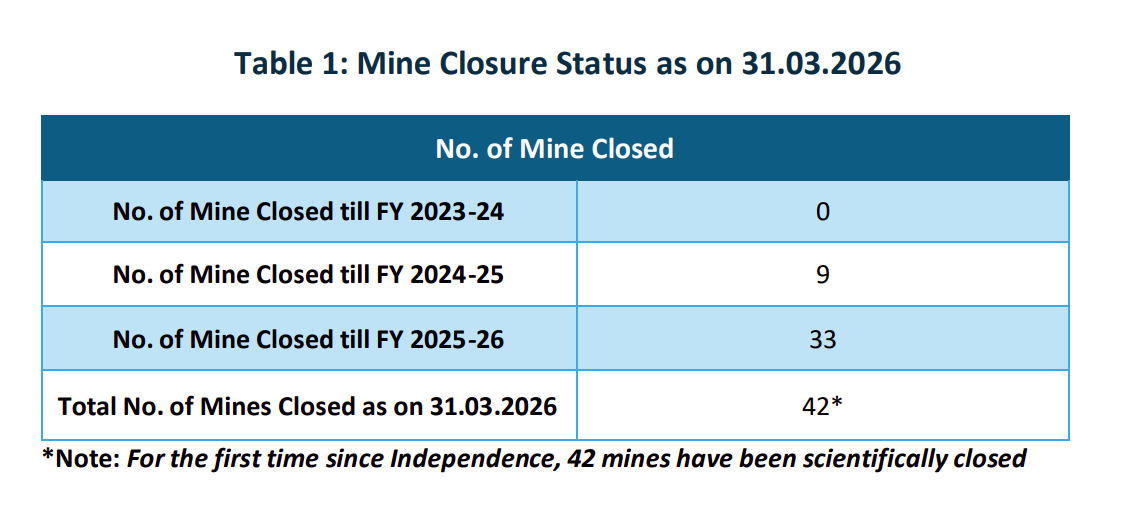
But these 42 are a peculiar sample. They aren’t representative of Indian coal mining today. Most are old underground mines, concentrated in just two central Indian states, and many stopped producing decades ago. In fact, 25 of the 42 were shut before India even had comprehensive mine-closure rules, which only arrived in 2009.
That also explains the long wait. On average, it took about two decades for a mine to go from shutting down to finally receiving its closure certificate. Pure Chirimiri is the extreme case, taking nearly 50 years. But even the median mine spent close to 20 years in limbo.
So the 42 closures aren’t proof that India has built a modern mine closure system. They’re largely a backlog finally being cleared and that’s still important. A mine stuck in limbo leaves its environmental obligations, funding and long-term future unresolved.
But these 42 closures tell us more about how India is cleaning up its past than how it will manage its future. Almost all are underground mines, not the giant opencast pits that produce most of India’s coal today. The real test will come when India has to shut a massive opencast mine that’s still operating, with an entire town built around it.
What a final order actually certifies
A final closure order isn’t automatic. A mine gets one only after it has an approved closure plan, money set aside for the work, the closure work itself completed, an inspection by a government-authorised third-party agency, verification by the Coal Controller’s regional office, and a review by a technical committee. In other words, it’s far more than a company simply declaring the mine shut.
But the order certifies something narrower than the word closed suggests. It confirms that the approved process has been completed—that the required work has been carried out and the necessary checks have been passed. That’s a reasonable standard for a regulator. The bigger question is whether it lives up to the language that surrounds it: “scientific closure,” “restoration,” and “sustainable livelihoods.” Those phrases promise something far more ambitious—a healed landscape and a local economy that has recovered.
New Majri and Adasa, both in Maharashtra, show how limited these closure orders really are. Their underground mines were formally closed even as opencast mining continued above the same ground. The order closed one mine. It didn’t end mining there.
In other cases, the certificate arrived before the site’s planned second life had even begun. In 11 of the 42 mine profiles, post-closure work is still described as “proposed” or “in progress.” Chhendipada, an opencast mine in Odisha, received its closure order in May 2025. But its eco-tourism project was still under preparation, with a tender floated in April 2026, after the report’s own cut-off date. At Pawan in Chhattisgarh, a ₹32 crore community water-treatment plant exists only as a signed memorandum, not as a functioning facility. The report never clearly separates mandatory closure work from optional redevelopment, making it difficult to know where regulatory obligations end and broader development plans begin.
That points to a more important distinction: finishing a task is not the same as achieving an outcome. Sealing a mine shaft is a task. Proving the ground above it has stabilised is an outcome. Planting saplings is a task. Growing a self-sustaining forest is an outcome.
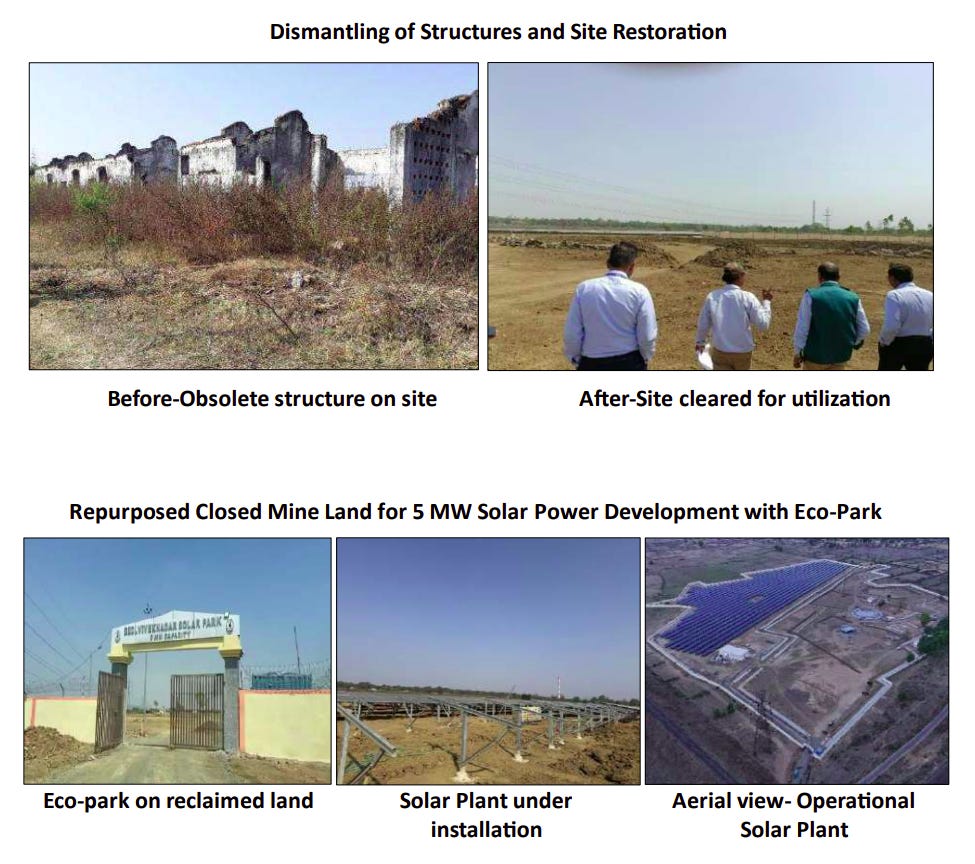
Some projects have clearly delivered useful results. Vivek Nagar, an abandoned mine in Madhya Pradesh, now has a functioning 5-megawatt solar plant and a small park. Elsewhere, a former mine office has become a school, and water from an old mine is being supplied to a nearby town. But the report never offers a consistent way to compare these outcomes.
The mine runs on a longer clock than the paperwork
The problem becomes clearest when you look at the money. The financial guarantees can be released long before the physical risks have disappeared.
India’s escrow system starts with a sensible idea: make the mine operator save for closure while the mine is still making money. From the day a mine opens, it sets aside a small amount every year into a dedicated escrow account, so the entire bill doesn’t arrive at the end. The base amount is ₹14 lakh per hectare for an opencast mine and ₹2 lakh per hectare for an underground one.
But that formula is only a rough starting point. Two mines of the same size can pose completely different risks depending on how deep they are, how many shafts they have, whether there’s underground fire, how groundwater moves through them, or how close they are to villages. The rules partly account for this. Operators have to submit site-specific closure cost estimates, revise them in the final closure plan, and pay any shortfall themselves. The unanswered question is whether those revisions are rigorous. Aaroh doesn’t tell us. It publishes estimated closure costs, but not a mine-by-mine record of what was actually deposited, released, or topped up.
The money is released in stages as the closure work is verified. Once mining stops, the work itself is expected to take around three years, followed by about two years of monitoring — sometimes stretching to seven years in total — after which most of the remaining balance can be released. But many of the risks last much longer. Groundwater can take years to return to its natural level. Backfilled pits continue to settle. Land above old tunnels can shift decades later. The financial security unwinds much faster than the risks it was designed to cover.
So what happens in year twenty? Legally, the mine owner remains responsible. Environmental and safety obligations don’t simply disappear. In practice, though, things get murkier. By then, the subsidiary may have been reorganised, the land leased to someone else, records may be incomplete, and the escrow money long gone. If a fresh crack opens in the ground or a contaminated spring appears years later, there is no obvious, well-funded backstop waiting to step in once everyone else has moved on.
Britain and Germany built permanent institutions for exactly these kinds of long-lived liabilities. Britain’s Mining Remediation Authority deals indefinitely with land subsidence and polluted mine water, often from mines whose owners no longer exist. Germany treats pumping water out of its old coalfields as a permanent responsibility, funded through a standing foundation that is meant to last forever. The lesson is simple: if a liability has no clear end date, it cannot be funded on a fixed five-year timeline.
Jharia shows why that matters. The underground fires and land subsidence there—where the ground still collapses and coal seams have burned for decades—are far more severe than anything seen in these 42 mines. But they make the same point: the risks from a mine can outlive the mining itself by many decades.
A theory of transition, tested on the past
The closure files are also full of community work. By the report’s account, thirty-four of the 42 profiles mention training programmes and twenty-six mention health camps — tailoring, pickle-making, mushroom cultivation, beekeeping, computer classes. These may help individual households. But they are not, on their own, evidence that a mining economy has been replaced.
Notice the timing. Most of these mines stopped producing years or decades ago, so the jobs vanished long ago too. The people who lost mining work around Pure Chirimiri lost it in the 1970s. The pickle-making programme attached to its 2025 closure was not cushioning a fresh job loss; it was added decades after that loss had happened. These projects show the government’s current theory of how a mining town should be helped. They cannot show whether that theory works when an active mine and the economy around it close at the same time.
That is the test that matters, because a working coal mine is rarely just an employer. It usually anchors the local economy. It pays permanent staff, but it also feeds contract labourers, truckers, repair shops, tea stalls, landlords, and the school and clinic the company runs. When it closes, that whole network loses its income, and a training course reaches only a sliver of it.
What evidence we have says the gap is wide. A 2026 survey of coal workers in Jharsuguda, Odisha, by the Council on Energy, Environment and Water, found contract workers earning roughly ₹20,000 to ₹25,000 a month in coal, while most casual workers in other sectors earned below ₹15,000 — and most expected to earn less once coal was gone. A study of Korba, India’s biggest coal district, by the research group iFOREST, found coal, power and their related industries making up more than sixty percent of the district’s output, with two-thirds of the households it surveyed already living on less than ₹10,000 a month.
Coal India can move its permanent staff to another mine. That protects them — but not the contractors, the truckers, the suppliers and the shops whose income depended on the old site.
The hard closures are still ahead
The 42 tell us little about the larger closure challenge still ahead. Large, still-working opencast mines are a different order of problem: they leave deep voids and enormous dumps of overburden, and they still carry payrolls and districts built around them. The physical liabilities are bigger, and the economic shock lands at the moment of closure rather than decades before it.
Closure can also make former mine land valuable again. A coal company can keep that land and lease it out — for a solar park or a factory — with the rent going to the company rather than to the people who lived with the mine, under the rules for coal land. Vivek Nagar’s solar plant makes the question concrete: the report does not say who owns it, or where its value goes. That is a separate story.
A mine can complete the formal closure process long before its ground, its water and its economy have finished dealing with what mining left behind. Sealing shafts and reclaiming land are hard, but they are tasks with a sign-off. Groundwater, ecological recovery and regional decline do not end on a schedule.

How to keep carbon away from the skies
In this year’s Union Budget, the government proposed spending ₹20,000 crore over five years to push carbon-capture technology toward “higher readiness levels.” The programme covers power, steel, cement, refineries and chemicals, and follows a national roadmap the science ministry released weeks earlier.
The idea behind carbon capture, utilisation and storage, or CCUS, is straightforward. When a factory or power plant burns fuel or processes raw materials, it releases carbon dioxide into the atmosphere. CCUS is about catching that CO₂ before it escapes, and then either putting it to use or burying it underground for good.
India already has a few working projects. An NTPC plant in Madhya Pradesh turns captured carbon dioxide into methanol; a chemicals plant in Tamil Nadu captures CO2 for use in soda ash production; a JSW Steel plant in Maharashtra captures it for the food and beverages industry. But all of them reuse the carbon as fuel or feedstock. That is the “utilisation” in CCUS, and it is where almost all of India’s activity sits today.
Permanent storage is a different and much larger problem, though. When methanol is burned as fuel, the carbon goes right back into the atmosphere; utilisation recycles it, but doesn’t retire it. Storing it for good means injecting it deep underground into rock where it will stay for centuries. That needs a chain India has barely begun to build. It is only now drilling its first appraisal and storage wells to find out whether the rock can accept injection and hold the gas.
Capturing is still less complicated: the CO2-capturing equipment has to be at one site, run by one company. It is also usually the single biggest cost. But everything past the factory gate needs several companies, shared infrastructure, characterised storage sites, and rules we’re yet to write.
With this story, we’ll look into what each part of CCUS truly entails.
Catching a tonne
Let’s start with the capture process.
CO2 almost never comes out on its own. At a cement kiln or a coal boiler, it emerges inside a large, hot stream of mostly nitrogen and water vapour, often carrying sulphur and dust. At a fertiliser or gas-processing unit, it can come off already concentrated and under pressure, as a by-product of the chemistry itself. The more dilute the CO2, the more gas the unit must comb through to recover each tonne of CO2.
The exhaust runs through a liquid solvent that grabs the CO2 and lets the rest go. The loaded solvent is then heated, releasing a concentrated stream of CO2. That stream is dried and compressed until it is dense enough to push through a pipe. The solvent is freed to be reused via heat. Concentrated CO2 is, in contrast, far cheaper to capture than dilute chimney exhaust.
What are the sources of concentrated and diluted CO2?
As per NITI Aayog, gas-processing, hydrogen and fertiliser streams at the cheap end, cement and coal exhaust well above them, and refineries higher still. These are modelled capture costs, not observed costs for the whole chain, but they reflect the ranking of the sources fairly accurately. The IEA’s cost curves line up similarly.
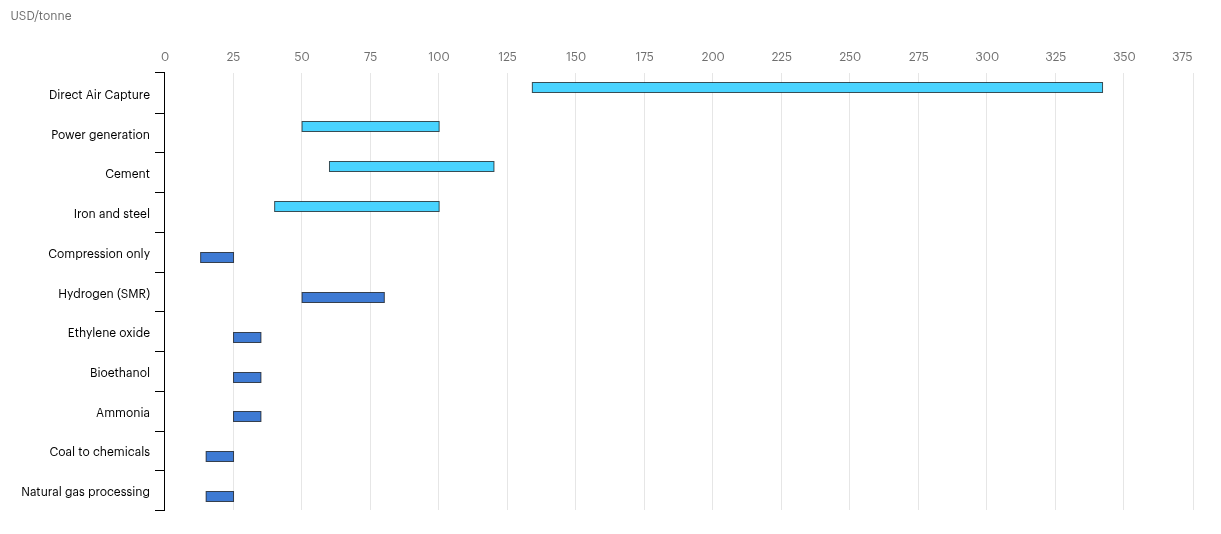
Even so, actual CO2 capture is harder than the cost ranking suggests. A capture unit is really a custom chemical plant bolted onto a host that was never designed to share its steam, power, cooling or space. It needs energy to run, and that itself generates emissions. A headline 90% capture rate can mislead: a unit fitted to one exhaust stack might scrub most of the CO₂ passing through it while the plant’s other stacks keep venting freely.
Moving a tonne
Captured CO2 still has to be transported. Trucks and rail can serve small volumes, while for high volumes over land, a pipeline becomes the natural option, or ships for offshore movement.
A workable pipeline system looks like thin collection lines from individual plants feeding a few fat trunk lines that carry the pooled flow to a storage site. Think-tank CEEW has modelled how India might lay such a network cheaply. Saline formations are spread across much of the country, which keeps the pipes short; basalt is bunched into Maharashtra and Madhya Pradesh, so reaching it takes far more pipe. CEEW points to Eastern states — Odisha, Jharkhand, Chhattisgarh — as the cheapest early corridor, because emitters cluster there.
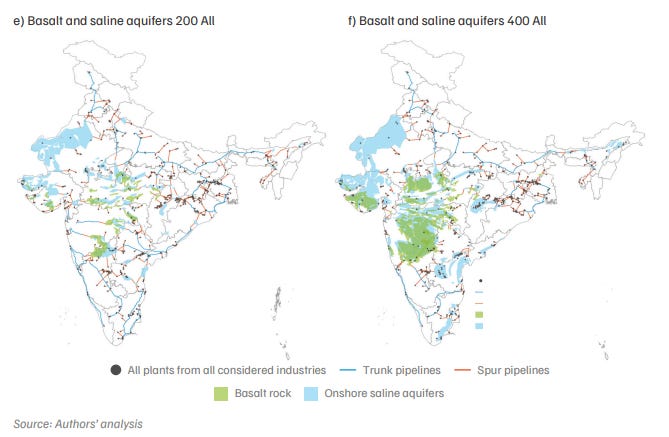
A pipeline is expensive to build, but its operating expenses can be low if high volumes are moved. In CEEW’s model, moving a tonne through a large, busy network costs only a few dollars, which is trivial next to capturing it.
Each piece in this sequence waits on the others. A capture plant is useless without a pipe and somewhere to put its carbon; a pipeline earns nothing until enough plants feed it; a storage operator won’t spend until the pipes and plants are coming. That is the coordination trap.
Finding somewhere to keep it
At the far end of the pipeline, the problem stops being mechanical and becomes geological. The carbon now needs somewhere to stay for good.
Carbon can be injected into deep saline aquifers, depleted oil and gas fields, or basalt. But it’s hard to spot rocks that not only can hold enough carbon, but also into which carbon can be injected fast enough without cracking them every year.
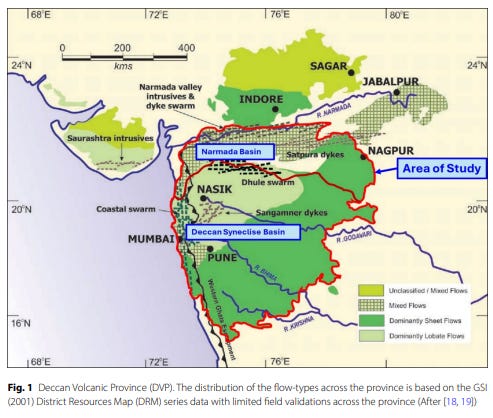
The latter is called injectivity. You see, basalt has a chemical advantage: injected carbon reacts with it and slowly turns to solid mineral, which also removes the risk of carbon leakage over time. But injection rates are site-specific All of this takes seismic surveys and test wells. The permits, injection wells and monitoring come only after you’ve collected sufficient evidence.
India has plenty of storage rock, but their value as industrial storage is still largely unproven. Government-backed figures run to roughly 400 to 600 gigatonnes of carbon dioxide, but those are geological estimates, not necessarily all usable sites. When researchers used seismic surveys and borehole data to reassess the Deccan basalts, their estimate fell to roughly 41 to 76 gigatonnes — and even that extrapolates the fraction of the basalt column porous enough to hold carbon dioxide from just three wells in a single area.
Storage also creates an obligation that can outlast the company that injected the carbon into the rock. After all, someone must monitor the site for years after injection ends. A leak could force costly repairs and void credits already sold. The company that put the carbon there may be gone by the time trouble appears.
For lenders, this exposure runs decades beyond a project’s life. It can’t easily be priced or insured, which pushes up the cost of borrowing. Some European regimes eventually let responsibility pass to the state, but only after injection has stopped, the site has held steady through years of monitoring, and the operator has paid into its future upkeep. Elsewhere, more of that liability stays with the company. India has no dedicated regime for any of this yet.
The business with no natural customer
Who even builds the infrastructure that CCUS needs?
Carbon capture plants do need to be built near steel or cement plants. But is that in the incentives of cement or steel companies to do so? Carbon capture asks them to spend beyond their production requirements. What it does produce is a certificate: proof that some carbon did not reach the sky.
Now, that certificate has real value to the world, but it lacks a customer that’s naturally willing to pay its full cost at scale.
The only thing a carbon storage project sells is the absence of pollution. That earns money only when policy — like a tax, a mandate, or a procurement rule — creates someone willing to pay for it. Without a durable policy prop, even working capture plants die. For years, that buyer was the oil industry, which bought captured carbon to force more oil out of the ground. But as the world shifts to storing carbon for its own sake, even that revenue falls away.
America’s Petra Nova plant, for instance, captured about 90% of the carbon from one unit’s exhaust at a Texas power station, but was shut down in 2020 when oil prices fell and its revenue collapsed; it restarted only in 2023. The IEA notes one project that has survived for nearly three decades: Sleipner in Norway, which has run since 1996, largely because Norway taxed carbon heavily enough to make storage profitable on its own terms.
So the state’s job is not simply to “subsidise capture “, but to make every link investable. The emitter needs an incentive to capture. A shared pipeline needs revenue before the volumes arrive. Storage needs the geological appraisal no firm will gamble on alone, rules for measurement, and someone to carry the distant liability. India’s carbon market, for now, has no approved method that even lets carbon capture earn a credit.
Which tonnes are worth it
It can get very expensive to build a system like what we’ve mentioned above for every tonne of industrial carbon. The right question is not whether capture works, but whether it beats the cheapest alternative at a given plant, like renewables, fuel switching, or electrification.
The easiest place to start is where the CO2 is already concentrated: gas processing, fertiliser plants, and some hydrogen units. These are cheap to capture and useful for proving the plumbing works. But they are not where CCUS matters most.
That distinction probably belongs to cement. Roughly half a cement plant’s emissions come not from its fuel but from the chemistry of turning limestone into clinker. Fuel switches rarely eliminate that carbon, so there still may be a strong argument to be made for CCUS facilities here.
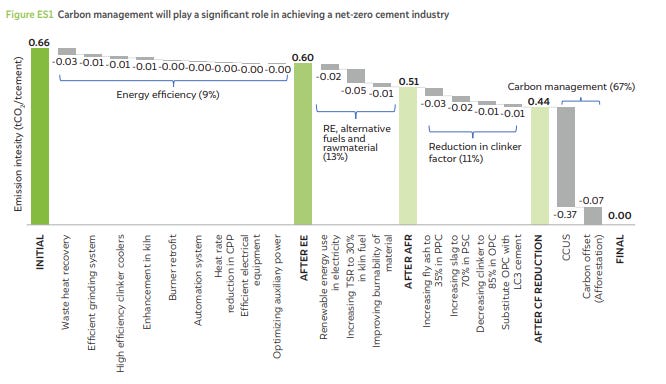
Steel is a weaker case — capture can cut emissions from a blast furnace, but it competes with making steel differently, through electric furnaces running on scrap, or reducing iron with hydrogen instead of coal. Coal power, despite being the biggest emitter, is the worst fit. Its exhaust is dilute and expensive to treat, capture can consume a quarter to two-fifths of the plant’s own energy output, and the economics get worse the less the plant runs. Few Indian coal plants would clear that test.
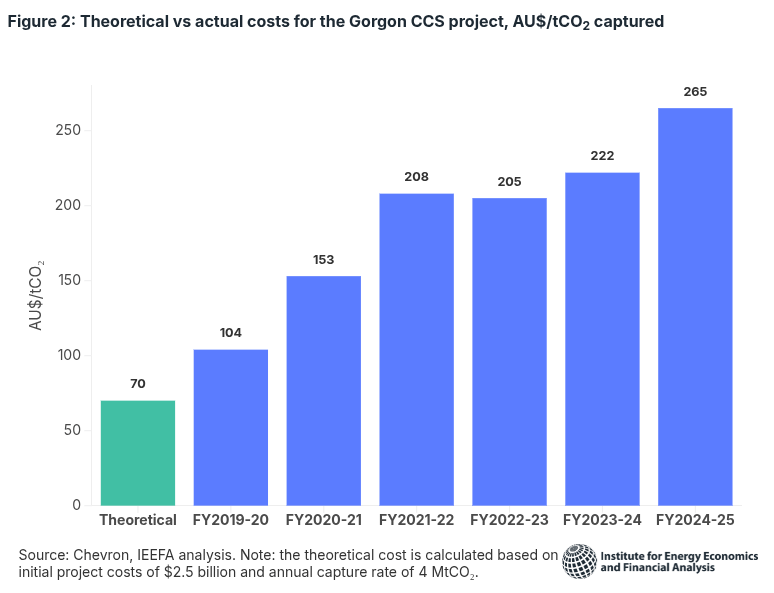
What’s more, CCUS projects operate under severe technical uncertainty even if they’re placed in the right circumstances. For instance, Chevron has built the world’s largest CCUS plant next to one of their LNG facilities in Australia. A gas processing plant is the ideal candidate. But last year, it captured the lowest CO2 since its inception, storing only a mere quarter of CO2 emitted by its reservoir.
That is the standard against which the ₹20,000 crore should be judged. As alternatives like renewables get cheaper, and the costs of CCUS continue to rise, their economics look lopsided. So even before we talk about whether an entire ecosystem can be built behind them, it’s increasingly worth evaluating whether it’s worth it at all.
Tidbits
[1] Japan Intervenes Again as Yen Surges 3.3% Against Dollar
The yen rose 3.3% against the dollar — its largest intraday move since December 2023 — after Nikkei reported Japanese government and Bank of Japan intervention, despite authorities having already spent a record ¥11.73 trillion supporting the currency last quarter.
Source: Mint
[2] Bajaj Finance AI Generates ₹517 Crore in Loans, Team to Double
Bajaj Finance’s AI systems analysed 45 million customer interactions in Q1 FY27, generating ₹517 crore in incremental loan disbursements; the company is expanding its AI team from 230 to 400 as net profit rose 28% to ₹6,081 crore.
Source: ET
[3] India Reviews Net Neutrality Rules to Permit 5G Network Slicing
The government has referred the matter to TRAI to recommend changes to 2018 net neutrality rules, potentially allowing telcos like Airtel and Jio to offer differentiated speeds and pricing for gaming, healthcare, and autonomous vehicle use cases via 5G slicing.
Source: ET
[4] Sebi Clears NSE Colo, Dark-Fibre Cases for ₹1,491 Crore Settlement
Sebi has in-principle agreed to settle NSE’s colocation and dark-fibre cases for a total of ₹1,491.21 crore, requiring an additional ₹714.74 crore payment after NSE’s earlier ₹776.47 crore deposit, clearing a key governance hurdle ahead of its IPO.
Source: Business line
[5] NMDC Scouts Argentina’s Six Provinces for Copper, Lithium Assets
NMDC’s delegation visited Mendoza, Jujuy, Catamarca, Salta, La Rioja, and Río Negro to assess partnerships in copper, lithium, and rare earths, with no investment commitments made but technical cooperation frameworks under discussion.
Source: BS
- This edition of the newsletter was written by Pranav
Beyond Today’s Brief
There’s always more happening at Markets by Zerodha.
- The Chatter: What is driving Tata Steel’s focus on domestic expansion amidst global margin pressure? How are higher tobacco taxes impacting ITC’s net volumes? And what is the RBI MPC watching most closely ahead of its rate policy decision?
- What We’re Reading: Everything from why book clubs often reward identity more than curiosity to the economics of the AI bubble to the hidden history of the Swiss watch industry.
- Points & Figures: How is India rewriting its global trade story? Why is the balance between booming service exports and stubborn merchandise imports more critical than ever right now?
Join us on WhatsApp , where we share interesting soundbites from concalls, articles, and everything else we come across throughout the day. You’ll also get notified the moment a new video or article drops so that you can read or watch it right away.
Thank you for reading. Do share this with your friends and make them as smart as you are 