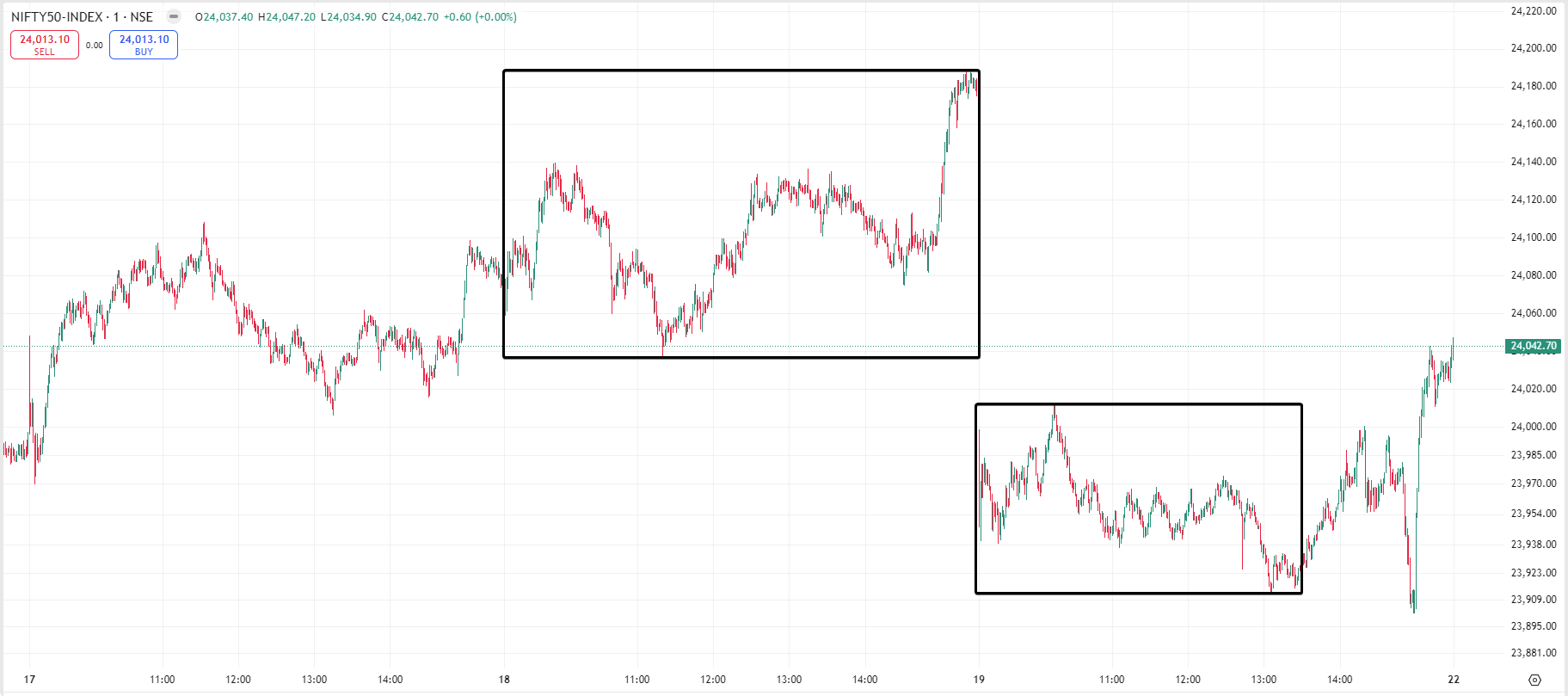
From an intraday trading perspective, one of the most common mistakes is expecting yesterday’s trend to continue at today’s market open. It’s a trap I often fall into myself.
Reading this pre-open report and its trade plan made me realize that this may be a widespread mistake among traders.
yeah that “expecting yesterday’s trend to continue” thing is so real, ive
fallen into that trap more times than id like to admit lol. when that happens
to you, does it usually cost you on the first trade of the day or does it
spiral into more bad trades after?
Eventually, I often manage to recover the initial loss and get back to breakeven. The real problem, however, is that the entire trading day ends up being spent trying to recover that loss from the 9:00 - 10:00 AM period. In the process, I miss opportunities to catch the bigger trades that could have made the day truly profitable.
All those efforts to get back to breakeven also accumulate transaction costs that don’t immediately show up on the P&L dashboard. What looks like a breakeven day on the screen is often a net loss once the contract note is taken into account.
More importantly, the issue isn’t just the monetary loss.
It’s the psychological shift that happens when the goal changes from making good trades and growing profits to simply getting back to breakeven. Once you’re trading to recover losses rather than to execute your edge, your mindset changes completely.
Revenge trading — hands down. One bad loss and I’d take 3-4 more trades trying to recover, ending the day 2x-3x deeper in red.
The worst part? I knew I was doing it in the moment but couldn’t stop. Emotions completely override logic after a big hit.
What finally helped was setting a hard daily loss limit that auto-squares off everything and locks me out. No willpower needed — the system says no and that’s it. By next morning, the urge is gone and you can think clearly again.
Built https://tradeguardhq.in/ for exactly this — set your max loss, max trades, profit target before market opens. Break a rule, positions get squared off and account locks till next day.
damn this is exactly it. that line about the goal shifting from “making good
trades” to “just getting back to breakeven” that’s such a sharp way to put
it. do you track this stuff anywhere or is it more of a gut feeling at this
point that you’ve noticed over time?
oh wow, you actually built something for this… respect. quick question since
you’ve clearly thought about this a lot: do users ever ask you WHY they keep
doing it, like wanting to understand the pattern (time of day, after a loss,
after a big win etc) or do they just want the hard stop and don’t care about
the “why”?
Great question — it’s actually both, and it follows a pattern.
Initially they just want the hard stop. Account is bleeding, they need it to stop NOW. Nobody cares about “why” when they’re down 20% in a week.
But after a few weeks, curiosity kicks in — “why do I get locked out every Monday?” or “why do I always blow up in the first 30 minutes?” The data starts telling a story.
that makes sense. for the phase 2 people who get curious about the “why” do they usually figure it out themselves from the data, or do they end up wanting someone/something to actually walk them through it and help them change? or does TradeGuard not really go there
For me, it has been moving the stop-loss after entry. I’d enter with a clear risk, but once price came near the SL, I’d start finding reasons to give it “a little more room.” Most times it wasn’t new analysis, just an unwillingness to accept the loss.
The dangerous part is that this behaviour occasionally works. Price reverses, the trade becomes profitable, and you feel like moving the SL was the right decision. But over a larger sample, those few lucky recoveries were hiding several losses where a planned -1R became -2R or worse.
Journaling helped, but earlier I was only recording entry, exit and P&L in a sheet. That didn’t show why the loss became bigger. In EdgeLog, I started marking the behaviour behind each trade, such as moving SL, revenge trading or exiting early. The useful part is being able to see the repeated mistake and its actual rupee cost across multiple trades. That number was more convincing than simply telling myself to be disciplined.
My rule now is simple: once the trade is active, the SL can either remain where planned or move towards profit. It never moves farther away. If new information genuinely changes the setup, I exit and reassess instead of quietly increasing the risk.
this is such a clear way to put it — the SL-moving sometimes working is
basically what keeps the habit alive, like a slot machine. quick q — does
EdgeLog actually change your behavior over time, or do you still catch
yourself wanting to move the SL even after seeing the data?
SL shifting is one of the most honest mistakes a trader can admit — most don’t.
The real fix is removing the manual decision entirely when emotions are running high.
TradeGuardhq.in does exactly that — auto exits positions and blocks new orders the moment your loss limit hits. https://tradeguardhq.in/
Revenge trading after a stop-out. The loss itself was manageable, but the next trade placed out of frustration to “get it back” was always twice the size and half the thought. Took a long time to accept that the market doesn’t owe you a recovery. Automating my entries eventually solved it — no manual override means no revenge trades.
Honestly, the urge hasn’t disappeared completely. EdgeLog didn’t magically make me disciplined, but it made the pattern difficult to ignore.
Since the trades are imported from Zerodha, I can’t conveniently leave out the embarrassing ones like I sometimes did with my spreadsheet. I mark the behaviour behind each trade, and EdgeLog shows how often the same mistake repeats and its actual rupee impact. Seeing “moving SL” appear once feels harmless; seeing the combined damage across several trades is different.
Now, whenever I feel like moving the SL, I first ask whether anything in the original setup has genuinely changed. If I can’t write a clear reason, I leave it alone.
So yes, the behaviour has reduced over time. The thought still comes, but EdgeLog has created a useful pause between the impulse and the action. The app provides the evidence; following the rule is still my responsibility.
That pause between the impulse and the action is the real win. Journaling creates friction; automation removes the decision entirely. Same destination, different path — both work depending on how much you trust yourself in the moment.
Exactly. I think the best approach may be to use both for different jobs.
Automation can protect the account in the moment by enforcing things like maximum loss, position size or number of trades. Journaling helps explain why the impulse appeared in the first place. Otherwise, it’s easy to follow the automated rule without actually improving the underlying behaviour.
That’s where EdgeLog has been useful for me. During the weekly review, I can see whether the mistake usually happens after a stop-out, a missed move or a winning streak, and what it has cost over time.
My aim is to automate the hard risk limits while keeping some discretion in the setup, then use EdgeLog to audit those discretionary decisions. Protection during the session, learning after it.
I am guilty of all the items in the list and then some. I now realize, trading like that is called “impulsive trading”. This behaviour includes being indisciplined. Following the rules strictly is not enough. One should be aware when he is adapting/learning vs when he is breaking the rules.
Holding losers too long, without a doubt. Early on, I’d move my stop loss or convince myself the trade would come back. A small planned loss would turn into a much bigger one because I didn’t want to admit I was wrong. The lesson was simple: taking a small loss is part of trading, but refusing to take it can do serious damage to both your account and your mindset. Once I started respecting my stops, my consistency improved more than with any indicator or strategy change.