The Sensex consists of 30 stocks, and AFAIK, almost all (or perhaps all ,I haven’t verified this) of these stocks are also constituents of the Nifty . However, the weight assigned to the common stocks maybe differs between the two indices.
Due to arbitrage between the NSE and the BSE, the same stock typically shows almost the same percentage change from its previous close on both exchanges.
However, I don’t understand why the Sensex and the Nifty themselves almost always show very similar daily percentage gains or losses. Given that:
The Sensex has 30 stocks, while the Nifty has 50.There exist common stocks with different weightages in the two indices.The Nifty also includes 20 additional stocks that are not part of the Sensex.
Why do the two indices usually move so closely together? Is there a structural or mathematical reason behind this?
Please explain/list all the possible reasons.
Both indices are free-float market cap weighted and share the same large-cap stocks, so they usually move almost the same. The small difference comes from Nifty’s extra 20 stocks and slightly different weightings.
1 Like
Around 80% of stocks (weightage) is common between Nifty and Sensex, 20% is different.
Now lets assume 80% stocks moved -1% on a “red” day
Lets assume the remaining 20% stocks are flat (0%).
So Sensex closing = -1%
Nifty closing = 80%* -1% + 20% * 0% = -0.8% + 0.0 % = -0.8%
So Nifty closing also looks similar to Sensex.
Lets assume one unique stock like Trent moved 20% up. It is not in Sensex. But its weightage is only 1% in Nifty. So its impact will be only 0.02% in Nifty (again negligible).
It would be interesting to see on which days there was biggest gap between Nifty and Sensex, and why.
| Symbol |
NSE Weightage |
BSE Weightage |
| RELIANCE |
9.25% |
11.49% |
| HDFCBANK |
6.50% |
8.08% |
| BHARTIARTL |
6.14% |
7.63% |
| ICICIBANK |
5.33% |
6.62% |
| SBIN |
4.97% |
6.17% |
| TCS |
4.23% |
5.25% |
| BAJFINANCE |
3.39% |
4.21% |
| LT |
2.70% |
3.36% |
| HINDUNILVR |
2.60% |
3.23% |
| SUNPHARMA |
2.39% |
2.97% |
| INFY |
2.29% |
2.85% |
| MARUTI |
2.24% |
2.78% |
| ADANIPORTS |
2.18% |
2.71% |
| AXISBANK |
2.13% |
2.65% |
| TITAN |
2.12% |
2.64% |
| M&M |
2.04% |
2.53% |
| KOTAKBANK |
2.00% |
2.48% |
| ITC |
1.81% |
2.25% |
| ULTRACEMCO |
1.78% |
2.21% |
| NTPC |
1.71% |
2.12% |
| HCLTECH |
1.68% |
2.09% |
| BEL |
1.54% |
1.92% |
| BAJAJFINSV |
1.53% |
1.91% |
| ETERNAL |
1.43% |
1.77% |
| POWERGRID |
1.36% |
1.69% |
| ASIANPAINT |
1.33% |
1.65% |
| TATASTEEL |
1.20% |
1.49% |
| INDIGO |
1.05% |
1.30% |
| TECHM |
0.79% |
0.99% |
| TRENT |
0.78% |
0.97% |
@Newbie420 @Adarsh_Patil
The only conclusion that can be drawn from the market is that these differences are negligible, and the weights of the remaining 20 stocks in the Nifty are almost insignificant. However, it is interesting that on an average trading day, the % change in the Nifty and Sensex indices is nearly same.
2 Likes
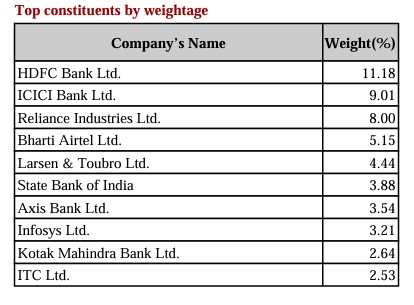
Gone are the days when Reliance was the top weighted stock in the Index.
1 Like
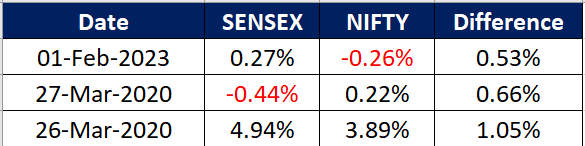
In last 15 years, only 3 times there was difference of more than 0.5%
And all these occurred recently.
First one is Budget, next two dates are after COVID crash when market was violent and recovering.
My guess is most likely IT stocks caused the difference, I have noticed Sensex usually performs well when IT does well.
1 Like
The Sensex and Nifty move very similarly because both are free-float market-cap weighted indices and are dominated by the same large-cap companies.
Although the Nifty has 20 additional stocks and the weights differ slightly, those extra stocks have relatively small influence. Since the common heavyweight stocks account for most of the movement in both indices, their daily percentage gains or losses are usually almost identical.