It’s 2025 and meme stocks are back in vogue with Krispy Kreme and Kohl’s leading the charge. Let’s dive into the origins of meme stocks, its future in a world of AI, and also the economic implications
The origins
Remember the meme stock mania of 2021?
It began with a company called GameStop, a brick and mortar store that sold good old fashioned video games and consoles. Out of nowhere, its share price took off. From just $5 at the start of January 2021 to over $300 dollars just a couple of weeks later.
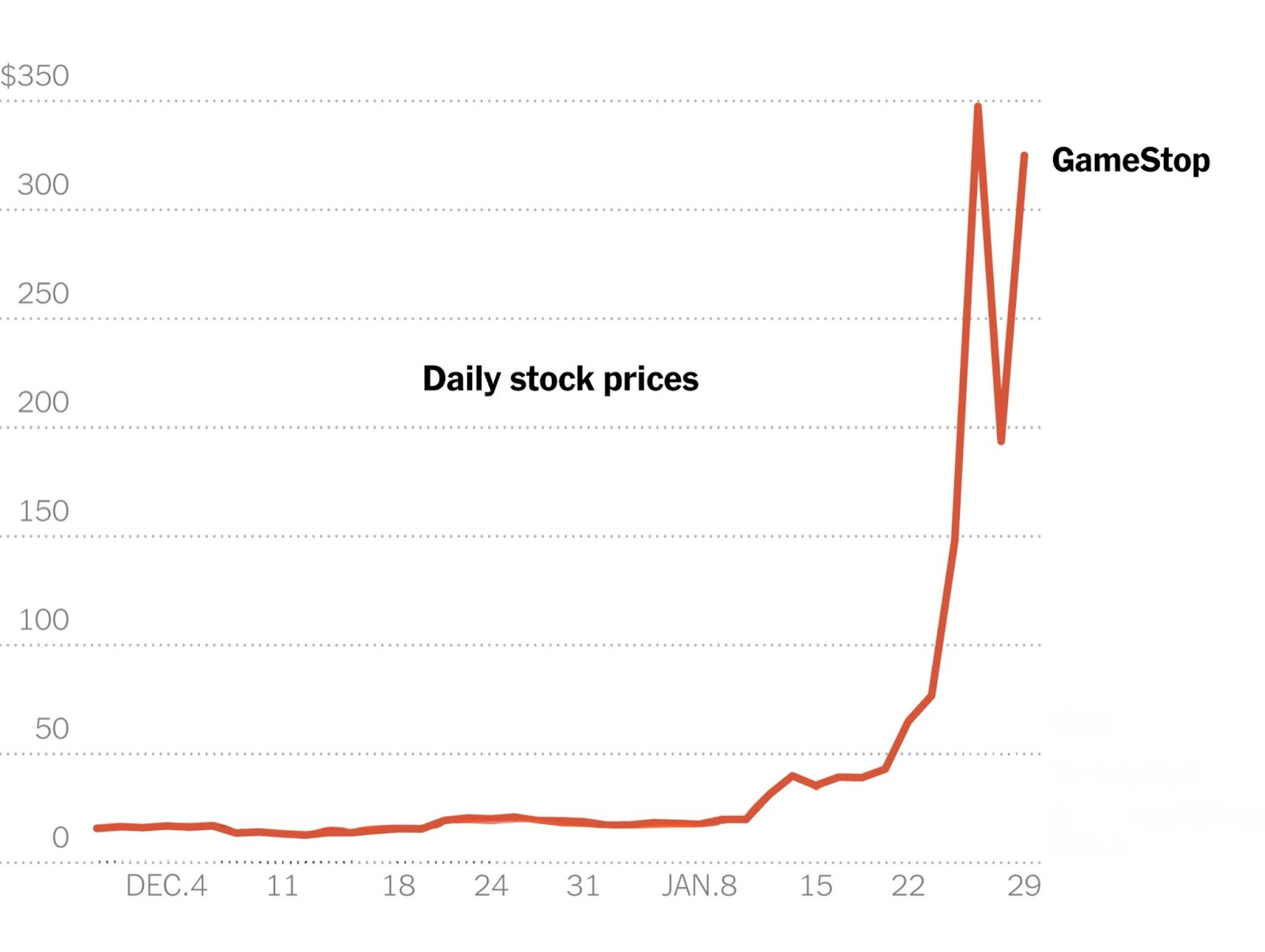
Source - NYT
It was weird because the company was in the red. It was laden with debt. And its business model itself was dying. Yet, its share price was heading up and up and up.
And to understand what was going on we need to first answer “What exactly is a meme stock?”
For that, you first have to unlearn everything you’ve been taught about investing.
The seasoned pros will tell you that stocks are worth the present value of their future cash flows. They’ll implore you to extrapolate what the future earnings of a company will look like, put it all into a spreadsheet, run the famous Discounted Cash Flow (DCF) model, and then figure out how much you should pay for all those earnings if you were to buy it today — the stock’s worth.
And this is indeed a tried and tested approach to investing.
But that’s not the world of meme stocks.
Here, a stock is worth only what you can get someone else to pay for it. It’s just consumer sentiment at play. No models, nothing.
Actually, the part about there not being ‘models’ is not entirely true. The actual model is a narrative or the meme, not a spreadsheet. That is the ‘why’ of why meme stocks gain traction.
For GameStop, the narrative was a David vs. Goliath type story of retail investors taking on powerful Wall Street hedge funds. You see, quite often, the primary catalyst for a stock to be accorded meme status is when there’s extremely high short interest in the stock.
What do we mean by that?
So, when institutional investors, such as hedge funds, believe a stock’s price will fall, they ‘short’ it by borrowing shares and simply selling them. They’ll then buy it back later at a lower price and make money off of it.
Many folks consider such activity predatory in nature — where the biggies try to make money from the misfortunes of a smaller company.
So if enough retail investors band against this seeming atrocity, they can buy massive chunks of these stocks and trigger a ‘short squeeze’. This essentially means that hedge funds who short-sold the stock hoping for the price to fall now are faced with a reality of the prices going up. And their ‘borrowed’ shares losing them money. So they have to quickly buy back such shares at a much higher price to cover their losses.
This sort of model or narrative is quite common across meme stocks. Where stories and not earnings forecasts drive the buying behaviour of investors and create a scenario where certain companies’ shares become overpriced compared with the state of their underlying businesses thanks to a flurry of attention from retail investors.
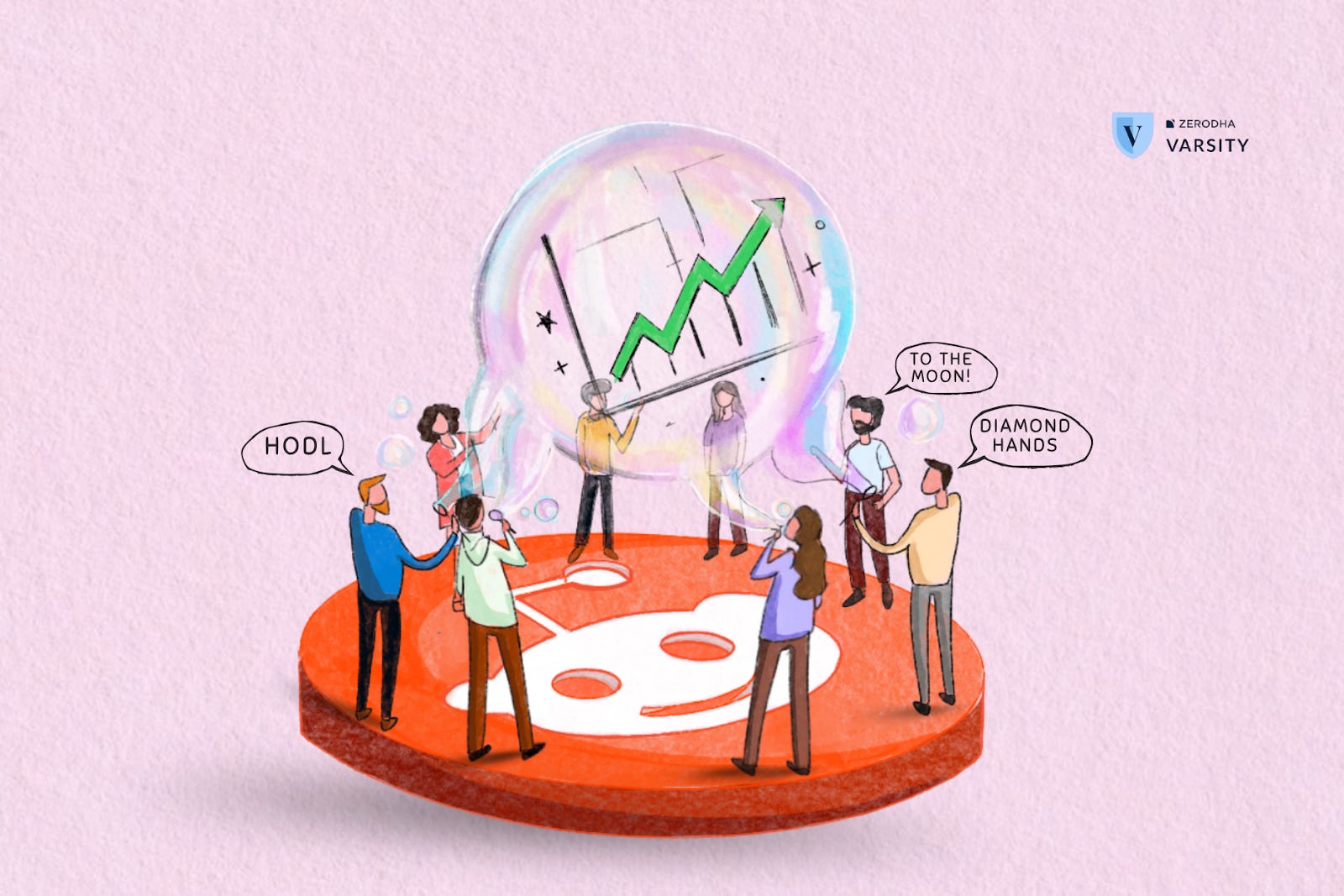
And no prizes for guessing where the retail investors gather to debate which stock to drive up next…social media! Especially Reddit which has dedicated investment communities. These forums had become the breeding ground for meme stocks. In fact, the birth of the first ever meme stock, GameStop, was in a Reddit forum called r/wallstreetbets.
The popularity
But why did meme stocks suddenly become a thing?
There’s a theory that when the internet is bored, you get a new meme stock.
I mean just think back to the peak meme stock era of 2021. People were stuck at home during the pandemic doing pretty much nothing. Entertainment options had come to a standstill because sporting events and live events were canceled. But a ‘live’ stock market was still in play.
And once the market rally began, the message boards of the internet came alive and were more entertaining than anything else around. Social media communities were the spark that led to the fire. In fact, social media actually became an exponential extension of real world investment interactions. Here’s an excerpt from a research paper talking about this.
Inexperienced retail investors frequently turn to friends and family members for investing advice. Financial economists, for instance, have found that retail investors’ decisions on investing in the stock market and constructing their portfolios are highly correlated with those of their neighbors. Interestingly, this research is consistent with braggartry being a key determinant of retail investors’ social behavior….[where] retail investors wanted their peers to admire their stock-picking prowess…
Such bravado continues to characterize retail investors’ participation in online communities dedicated to meme stocks. The explosion in retail investor interest in meme stocks was propelled by posts on the Reddit group “r/Wallstreetbets.” Posters engaged in bombastic exchanges, claiming to have made spectacular returns making bets on stocks that seems unmoored
Now add to this the ability to trade literally for free, on your phone, and you can see why and things went and continue to go berserk at times.
The ‘other’ perspective
From an economic lens, the meteoric rise of meme stock mania creates another very interesting debate.
See, the capital markets are supposed to be a place for investors to allocate capital judiciously to efficient companies. This capital will help the already growing company grow further, maybe hire more people, generate higher profits, and pay better. This form of capital allocation has a direct impact on economic growth when done the right way.
But when investors put this capital towards buying almost dead stocks, that’s the complete antithesis of what the capital markets stands for. And speculative bubbles or sustained capital misallocation can detract from economic growth.
In a way, it’s a contradiction of Joseph Schumpeter’s Creative Destruction theory. This theory says that newcomers introduce disruptive innovations and technologies that replace older, less efficient business practices. Thus, established firms must either continually adapt or perish.
For instance, GameStop’s physical video game sales were going nowhere and digital gaming was taking over. GameStop was doing nothing to adapt back then. So it would have been better for investors to allocate the capital to the disruptors who would bring greater economic progress. And let creative destruction dictate the terms.
But, then, just look at what that ‘misallocated’ capital has done for GameStop since then. It is now a consistently profitable company. Without getting into the nitty gritty of how it achieved that, let’s just say that the company was able to raise tons of money from investors thanks to the meme stock era and also began diversifying its business into selling collectibles and merchandise.
While a similar story might not always play out in meme stocks, you could argue that there is a distinct possibility that it might. The real test may be whether meme stock mania becomes a persistent feature that systematically misallocates capital, or remains an occasional market quirk that sometimes accidentally funds useful corporate transformations.
The future
Anyway, I want to leave you with one more thought – on what the future of meme stocks could look like. And in the mind of Bloomberg columnist Matt Levine, we could end up living in an AI-dominated meme stock world.
Think about this — where do tools like ChatGPT get their data from? You know, the data that they get trained on?
It’s from things that already exist that you can find on the internet. This includes news media, hardcore scientific research papers, but also stuff it finds by trawling social media and places like Reddit.
It’s watching all the chatter on these subreddits dedicated to a niche like investing. So ChatGPT knows exactly the kind of stuff people are considering before they declare they’re going to buy a meme stock — beaten down, misunderstood management, turnaround potential, short squeeze.
That means,
…that consensus might now be reflected in the thinking of AI models. “Let’s all do short squeezes on the same small-cap stocks” was once a niche idea in a small corner of Reddit, and then it became a meme, and then it became an enormous viral phenomenon, and now it is perhaps a permanent part of human culture reflected in the conventional wisdom of AI.
So if someone decides to ask ChatGPT about a potentially cheap stock that could be the next big multibagger, it could end up relying on all that it has gleaned from subreddits and make recommendations. Or it would at least give an investment generation framework that sounds very much like what we know to be the definition of a meme stock. Heck, it might be there already.
Here’s what ChatGPT pointed me to when I prompted it to “Find me the next Carvana” (a meme stock from a couple of years ago).
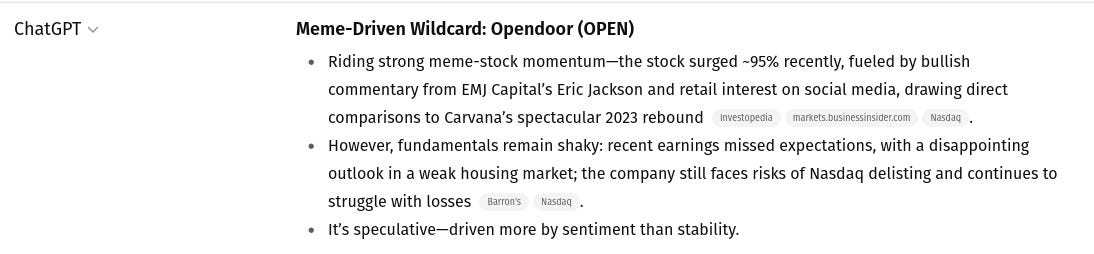
See how it called an online real estate firm Opendoor a “meme-driven wildcard”?
What comes next is people buy the stock; they talk about it on Reddit; the cycle continues.
And heck,
Eventually autonomous AI agents will do it all themselves: Identify unloved companies, buy their stocks, engineer short squeezes and post about it on social media.
Who knows! And that’s the world of meme stocks.
This newsletter is written by Nithin Sasikumar.
Do read ITR: Old Tax vs New Tax Regime in our newsletter, ‘Second Order’ by Zerodha Varsity.
For any feedback or topic suggestions, write to us at [email protected]