
Our goal with The Daily Brief is to simplify the biggest stories in the Indian markets and help you understand what they mean. We won’t just tell you what happened; we’ll tell you why and how too. We do this show in both formats: video and audio. This piece curates the stories that we talk about.
You can listen to the podcast on Spotify, Apple Podcasts, or wherever you get your podcasts and watch the videos on YouTube. You can also watch The Daily Brief in Hindi.
In today’s edition of The Daily Brief:
-
Why is America bailing out the yen?
The US joined Japan in an unusually coordinated intervention to support the yen, signalling growing concerns over currency weakness, trade competitiveness, and the risks of a one-way carry trade. -
Indian midcap IT: reading between the lines
Midcap IT firms are building AI-led competitive advantages through deep domain expertise, enterprise context layers, and new pricing models, even as evolving client expectations reshape deal cycles and revenue visibility.
Why is America bailing out the yen?
On Thursday, July 30th, Japan entered the currency market to support the yen. This wasn’t a routine move. Historically, Japan’s interventions have run in the opposite direction, trying to keep the yen from becoming too strong. That said, it was hardly astonishing. The Yen has been shrinking steadily to new lows, and with that, Japan has switched to propping it up.
What happened on the next day, July 31st, was far more unusual. The United States joined Japan’s defence. Its Treasury began selling euros into the market, buying yen instead. This was extraordinary . The United States had last joined hands with Japan for a currency intervention fifteen years ago, in 2011. The last time it actively bought yen was before the start of the millennium, back in 1998.
To be fair, this fits its recent worldview. The Treasury has explicitly argued that when foreign currencies are weak, their products become too cheap for America to compete with. But it is one thing to claim you believe something, and another to step into the market and make it happen.
After two days of intervention, the yen strengthened from nearly ¥164 — a four-decade low against the dollar — to around ¥155 by Monday. It was a swing of nearly 5% in just two days.
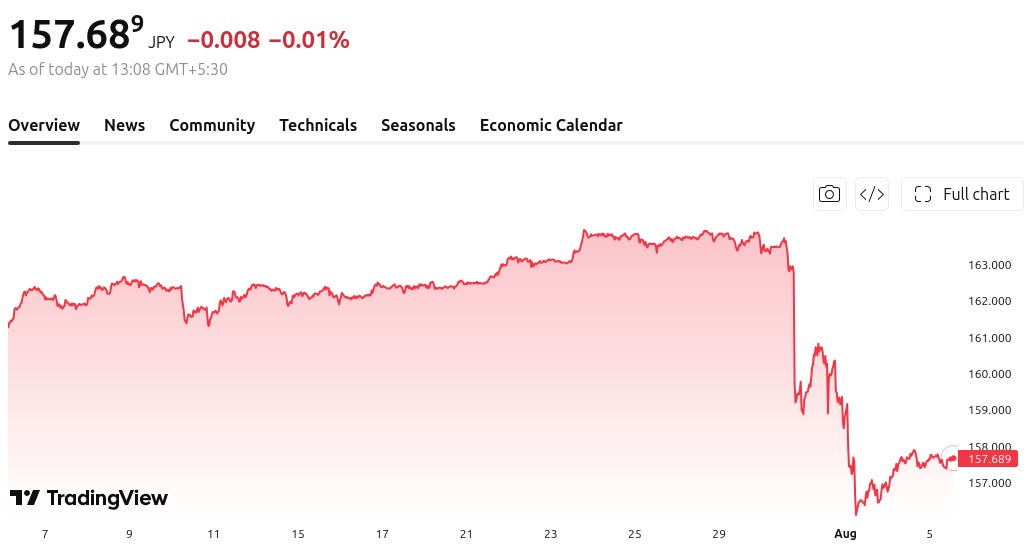
Price movements, though, weren’t the most interesting outcome of this move. More interestingly, it sent a signal. If you were betting against the yen, your bets could suddenly go wrong, leaving you scrambling to close your position.
But why was this necessary? And more importantly, why did America jump into the fray?
Why the yen was weak
The world has offered a simple “carry trade” for a long time: the interest you pay to borrow yen is always much lower than what you get from American government bonds. At the moment, a new Japanese two-year bond yields ~1.5%, while two-year US treasuries pay out ~4.25%. While the two stay in place, you can borrow yen, buy US bonds, and make easy money for no cost.
This comes with one risk, though: if the yen rises more than roughly 2.75%, the trade disappears, and you have to pay out of your own pocket.
The long-term trajectory of the yen, however, has looked downwards for some time. In fact, there has been constant pressure to sell the currency. Like us, for instance, Japan imports most of its energy. As global prices rise, Japanese buyers need more foreign currency to pay for those imports — pushing them to sell yen. A range of fiscal worries, which we wrote about previously, added to the pressure. Meanwhile, the “carry trade” made it profitable to sell yen and buy dollars in their place. And so, the yen kept falling, even as the rate gap narrowed.
Meanwhile, as investment opportunities within Japan have been dry, institutions and households were also sending money abroad in search of better returns. Much of that landed in the United States. As the US Treasury noted, the United States received 84% of Japan’s outbound portfolio investment in 2025.
If you were the betting sort, the yen falling further was an easy bet to take.
By late July, non-commercial traders were net short on the yen by more than 163,000 futures contracts. This was the most visible signal of a wider market sentiment that expected more yen weakness. This consensus was making things even harder for Japan — sending up the prices of everything from energy, to raw materials, to consumer goods. The average Japanese household was finding that their paychecks could fetch less, while its economy was fragile.
When there’s such a consensus in the market, however — and a trade gets this crowded — it creates room for a rout. Even a small reversal might push many traders to unwind their trades, which creates a stronger reversal, which pushes even more traders to unwind, and so on. An avalanche can follow.
What actually happened
And so, on July 30, when Japan reportedly began buying up yen outside its own normal trading hours, it pushed the dollar-yen exchange rate from around ¥164 toward ¥158 in one session.
It didn’t interfere with how cheap the yen was to borrow, however. The next day, the Bank of Japan held its policy rate at 1%. Over the long term, yen funding would look the same. It changed market conditions over the short term, but its fundamental direction stayed the same.
But if anyone thought the yen would resume its downward trajectory, they were mistaken. Because, within hours, the United States jumped in. The US Treasury reportedly instructed the New York Fed to sell yen. Soon, Morgan Stanley and Goldman Sachs were facilitating its trade: pumping euros into the market for yen.
US Treasury Secretary Scott Bessent described the sale as a reallocation of America’s reserve resources. To him, the euro was close to its fair value. The yen, in contrast, was well below. He then said the United States would do “whatever it takes” to arrest the yen’s decline. Japan publicly confirmed the coordination.
These orders had two effects. For one, the two countries just bought up the yen being offered over those sessions, sending its price up. But the bigger effect was psychological .
The intervention added sudden uncertainty to the market. If they intervened once, chances were, they could do so again. Traders weren’t simply thinking of how much the two countries had already spent, but how much more might follow and when. As long as Japan acted alone, traders largely knew where and when the threat would come from. But with the United States in the fray, anticipating an intervention became harder. Yen purchases could now arrive from anywhere. They could come at unpredictable times. Nobody knew what rate either country targeted. The objective, it seemed, was to stop disorderly shifts in the yen, by raising the possibility that a bet against the currency could suddenly go wrong.
The markets had seen a trailer of this as early as January. Back then, the New York Fed asked currency dealers for indicative USD/JPY quotes on Treasury’s behalf. It didn’t make any actual trades. But that check alone was enough to shake the markets. The yen moved 1.7% that day, without anyone’s intervention.
While the details of this particular move aren’t clear, research indicates that usually, at times like this, a feedback effect quickly takes hold, amplifying the market’s direction. Traders that bet on further yen weakness suddenly need to buy it back. Many buy yen to limit their losses. Others facing margin calls — or demands for more collateral to keep their bets going — either cut their positions, or reduce leverage elsewhere. The BIS, for instance, documented a larger version of this during the yen-funded unwind of August 2024
Chances are, this added wind behind the yen’s sails.
Why did Washington act?
The United States has shown a willingness to bless Japanese intervention for some time. As early as September 2025, the U.S. and Japan publicly agreed on intervention being an appropriate tool against excessive currency volatility.
But by intervening itself, it has gone one step ahead: it is signalling that it considers the yen’s decline as an American problem. Why is that?
Frankly, there isn’t one clear answer to this question. But we can make a few educated guesses.
For one, simply put, Washington thought the yen had fallen too far. In its mid-2026 review, the US Treasury estimated that it had lost 51% against the dollar since the end of 2011. This was true even if you adjusted for inflation, and how the currency of Japan’s other trading partners had moved. To be clear, it didn’t claim that this was deliberate or manufactured. But, to Washington, the currency had fallen below what its economic fundamentals could justify.
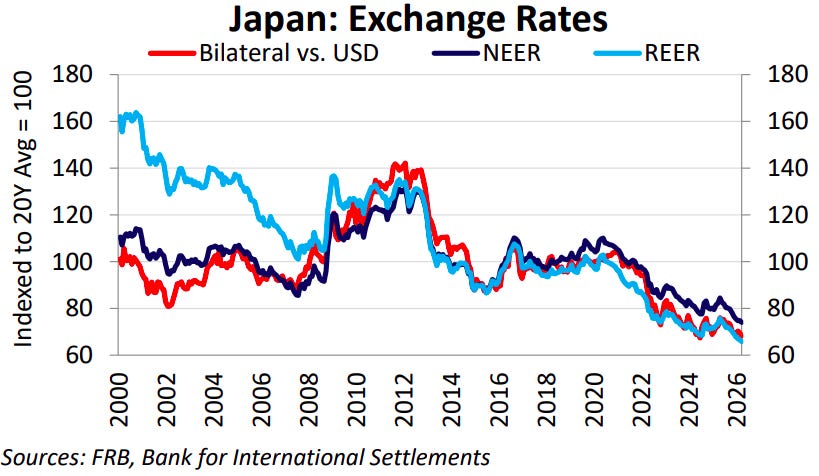
This could become a problem for America’s own trade agenda. As the yen falls, Japanese goods become cheaper in dollar terms, giving Japanese exporters an advantage. This would effectively neuter what America was trying to do with its tariffs. Japan’s goods surplus with the United States has averaged around $56 billion a year over the past fifteen years, and to America, currency differentials have been one ingredient in this asymmetry.
Now, trade is more complex than exchange rates alone. For instance, this deficit fell from $62 billion in 2024 to $55 billion in 2025, despite the yen remaining historically weak. Even so, a stronger yen would deliver a relative advantage to American industry.
The larger concern, perhaps, comes from how currency weakness could travel across the region. Bessent has argued that Japan’s competitor economies have been weakening their own currencies in view of the yen’s trajectory. He claims, for instance, that the falling yen was dragging the Korean won down with it. To him, it also gave China less reason to allow the renminbi to strengthen, because doing so would leave Chinese exporters competing against Japanese firms. If the yen kept dropping, in other words, it would start a wider round of competitive depreciation across Asia.
What the intervention didn’t fix
For all of this, however, the fundamental causes for the yen’s fall remain.
Japan still imports its energy, and the oil market’s volatility has not yet subsided. The Bank of Japan’s policy rate is still 1%. The structural, fiscal pressures ailing the Japanese economy remain. The yield gap that makes the carry trade attractive still hasn’t closed. Japanese capital still seeks returns abroad.
The yen has already given back part of its rally. By Wednesday, the yen had slipped back to around ¥157.60. While it remained above its pre-intervention level, it hadn’t erased the currency’s foundations.
As Bessent himself said, intervention can signal a desired direction, but only stronger policy can sustain it.
but Washington and Tokyo can interrupt a one-way currency trade. They can punish traders that treated yen weakness as inevitable. They cannot, however, remove the reasons the trade existed through intervention alone. For that, the economics behind that bet will have to change.

Indian midcap IT: reading between the lines
Lately, India’s midcap IT firms have been out-competing their large-cap peers. You’re probably tired of hearing that Persistent has, this quarter, achieved 25 consecutive quarters of growth. KPIT also had a streak of 23, which broke this quarter. In the last 9 years, Coforge’s margins have grown 24% annually. Their momentum hasn’t particularly slowed down this quarter, either.
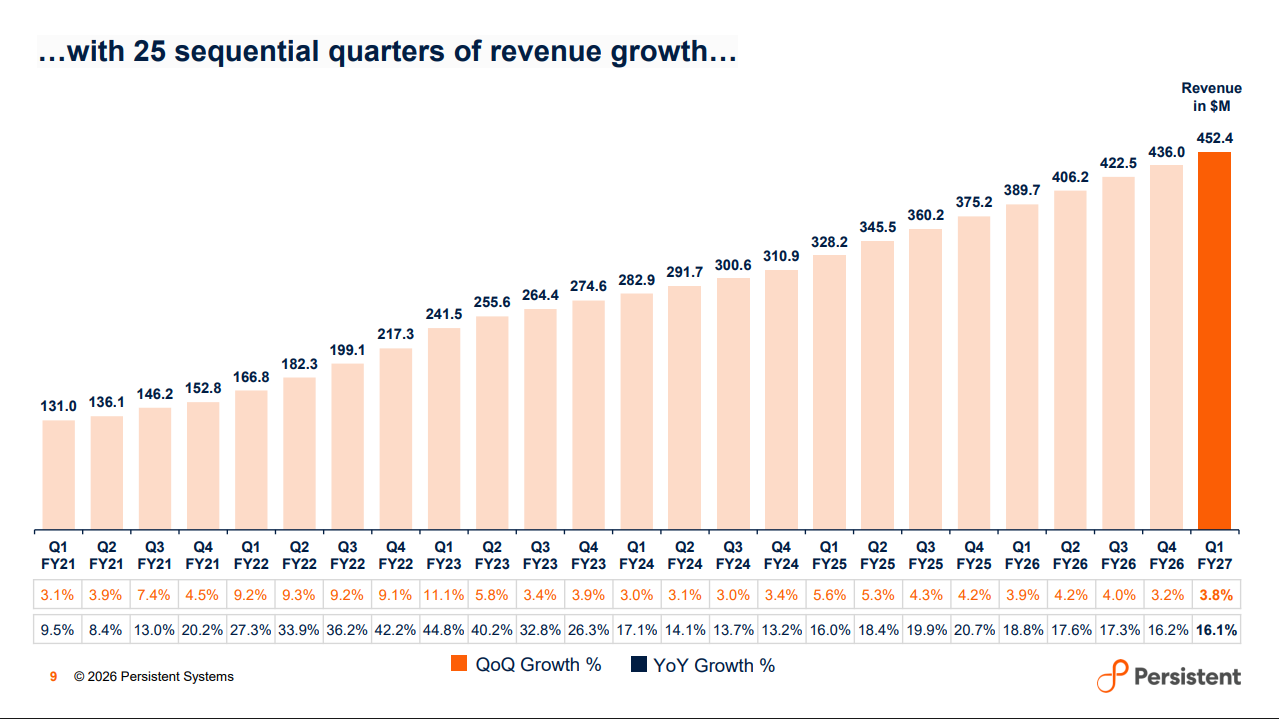
You also probably know that midcap IT firms are playing the AI game differently from their larger peers, being consistently more transparent and faster.
This time, we’ll take a slightly different approach to midcap IT results. We won’t look at the specific numbers. But what we’ll be focusing on is the narrative that 4 midcap IT firms — Persistent Systems, Coforge, KPIT and Mphasis — continue to build around AI through what they say in their earnings calls. We’ll address three questions:
- What is a midcap IT firm’s moat in the AI era?
- How has AI changed deal cycles? Have they gotten longer or shorter?
- How does AI alter the pricing of IT deals?
The answers to them are not straightforward, but they’re extremely fascinating.
The enterprise context layer
Let’s start with the first question.
The principle
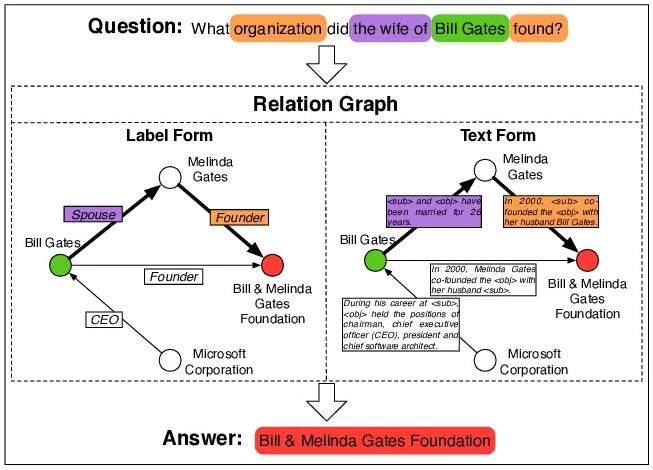
In the AI era, the new moat is what the industry calls the “enterprise context layer “. In essence, this refers to how well you’re able to build a pipeline between the client’s knowledge base and an LLM.
Any company can access LLMs, which means that the model itself, whether Opus or GPT 5.6, can’t be the moat. Think of an LLM as a brilliant intern on their first day — smart, but clueless about how your business operates. The enterprise context layer is the process of giving that intern the company’s proprietary training manuals, business and market rules, and years of specialized workflow data.
An LLM that’s connected to this layer can pull the best answer with a single, short query that doesn’t need a lot of context in the query itself. The better the context layer, the more efficient the query, and the lesser the cost of using LLMs. There are multiple strategies of doing this that we won’t get into here.
But this is easier said than done.
Part of the reason is that different departments have different ways of working. The accounts division will maintain documents that look completely different from the marketing division. Within an industry, different companies will have their own business languages. Furthermore, to get one answer, you may need to rely on multiple ancient, even insensible documents strewn across departments.
But that’s just the knowledge you can explicitly point to. After all, a lot of companies have knowledge that can’t be spoken or written into rules.
Imagine AR Rahman making a song; he can do it in an hour. But he can’t teach you in a single day how you can do it, too . He can’t truly explain to you why he made certain kinds of judgement calls on what drums to use. That came through the instinct he’s built over the thousands of songs he’s made. This is called tacit knowledge. It exists in every company, and it only comes with practice.
So, the game then turns into how well the IT company can build systems that, rapidly and accurately, feed to any LLM all kinds of context — be it explicit, tacit, organized, unorganized, between departments, within an industry. In this paradigm, being a domain expert who knows an industry inside-out couldn’t be more important.
The application
Each company is heavily focused on the best way to build this layer quickly for each of their clients.
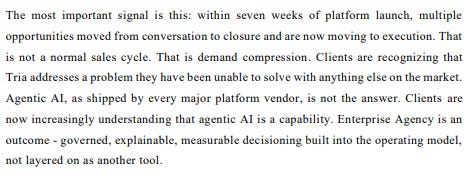
Take Mphasis, for instance. Their bread-and-butter is legacy modernization, where it updates the clients’ old codebase and technical systems into new ones. They have built a platform called Tria , which starts using AI to speed up a modernization project, and then use its success to land newer projects with the client.
In Mphasis’ view, IT services firms are better-placed to pull this off compared to AI labs like Anthropic because of two reasons: a) they lack context of how modernization cases in each industry works, b) they aren’t willing to own accountability for an LLM’s decisions.
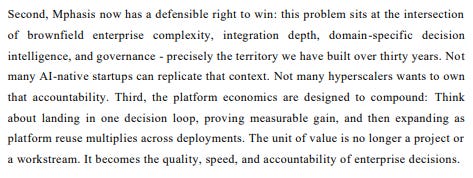
The launch of this platform has compressed deal conversations with clients significantly. They see real value in Mphasis’ offering.
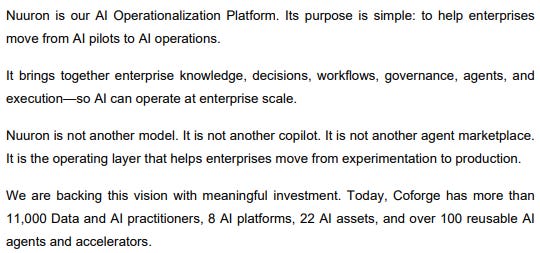
Coforge, meanwhile, is the largest player in travel and has a sizable presence in healthcare and insurance. Like Mphasis, they are building a platform that upgrades AI experiments of clients to a production-ready solution. The need for this exists because AI experiments keep failing.
Persistent is building a similar solution tailored for SaaS and healthcare. Meanwhile, KPIT has already seen how car companies became more software-driven over the last 2 decades. They’re uniquely positioned to integrate AI solutions into cars in a way that meets auto standards.
The deal cycle
Now, we move onto the question of deal cycles.
Push-and-pull
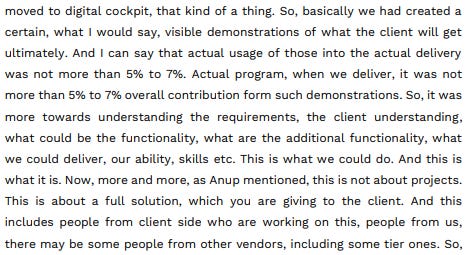
On one hand, clients are demanding demos faster. That wasn’t the case before AI, when there would be a lot of back-and-forth even on presenting a proof-of-concept. Last year, KPIT highlighted how automakers had become tired of superficial demos that would look nothing like what would finally get built.
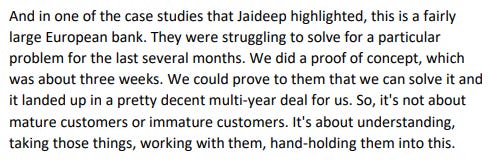
Similarly, in Q3 FY26, Persistent highlighted how they built a proof-of-concept in just 3 weeks which helped them sign a deal with a European bank.
So, this should mean deal cycles would be faster with AI, right? Well, there’s another force pulling in the opposite direction: clients are taking longer to decide on a deal.
In its Q1 earnings call, Coforge highlighted that clients were interested in maintaining in-house systems that didn’t depend on a single LLM . This was likely driven by three factors. One was the abrupt cutting off of Fable 5 access by the Trump government. Second is the rapid development of new cutting-edge LLMs. And third is how much money got spent on tokens.
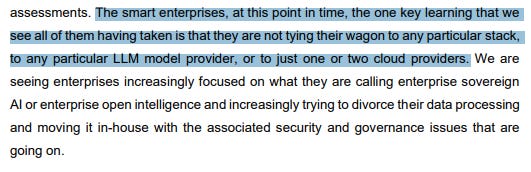
Naturally, clients want to avoid vendor lock-in, especially if its token costs could spiral out of control anytime. And they’re obviously unsure of which model could become the best at any given time. This is also why these IT firms are building AI platforms and context layers that don’t depend on having access to the best LLM. That being said,
Actual length
So, how is this push-and-pull showing up in how new contracts are being signed?
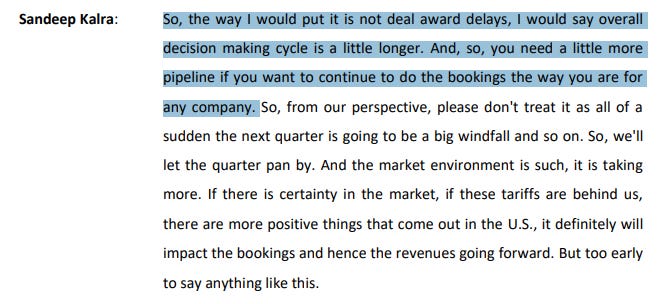
On one side, large-scale transformation deals have been stagnating. Clients are taking longer to make decisions, simply because no one wants to commit to a massive five-year technology stack when LLMs are evolving every quarter. This has been going on for much of last year.
But at the same time, shorter-cycle deals have become far more common this quarter. Mphasis, for instance, has proclaimed that this quarter saw their highest proportion of short-cycle deals. These are bite-sized, “early start “ contracts that are designed to be consumed rapidly, frequently wrapping up in just 12 to 16 weeks. These proof-of-concepts, in their view, are what convince a client to sign a longer-term contract.
This increased reliance on shorter projects is affecting the correlation between the total contract value (TCV) that a company has booked, and their near-term revenue. Mphasis noted that their correlation index has dropped from above 0.9 down to 0.74. You get quick bursts of cash rather than a long multi-year realization. Last year, Persistent also noted that since clients are taking longer to make decisions, they need a much larger order book to make the same revenue.
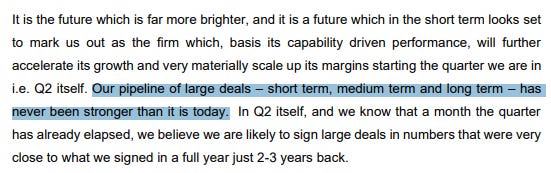
Coforge, however, has been a complete outlier in this aspect. Over the past year, their deal-making has accelerated across all contract lengths.
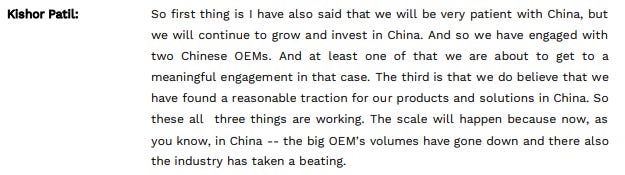
With KPIT, an auto-heavy IT services firm, the situation is different altogether. Many of their clients are based out of Europe, and they’re facing immense competitive pressure from Chinese automakers. That is forcing them to cut costs, directly impacting IT spend. This has been an ongoing trend, and KPIT has been planning for it. But this quarter saw a last-minute cancellation by a Japanese carmaker, which snapped their growth streak.
As a hedge, KPIT has been increasingly engaging with Chinese brands on potential deals. It is also trying to sign more commercial vehicle-heavy deals as opposed to passenger ones.
Pricing the AI outcome
Now that we know how AI-led deals are moving, how are they priced?
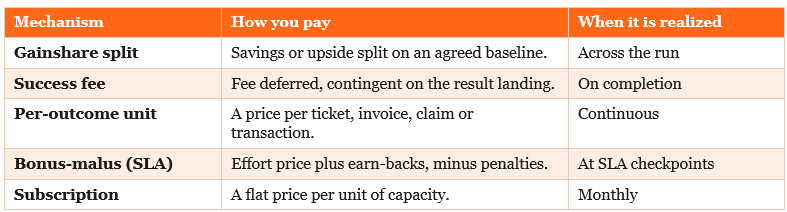
With AI, the old form of billing based on manpower and hours won’t last forever. But what truly replaces it is also uncertain. Right now, multiple forms of pricing have emerged, and they don’t necessarily fully replace headcount-based pricing. We covered some of these shifts in our coverage of large-cap firms last quarter.
One is the fixed-price deal, where a client pays something akin to a flat subscription fee. This has existed before, but it has never been as popular as headcount-based pricing. A fixed price gives the IT firm flexibility: if they manage to deliver outcomes more efficiently, then they pocket much of the productivity gain.
Secondly, there is outcome-based pricing, which is charging for the actual business value achieved. For instance, if you improved underwriting decision accuracy by 10% for an insurance company, they would pay you an agreed-upon reward. In the wake of AI, the expectation has been for the industry to move here, but that change was never going to be easy or clean.
Which is why fixed-price deals exist. In KPIT’s view, they’re the mid-point between headcount-based billing and outcome-based pricing.

In fact, Coforge is moving aggressively in this grey zone. Last quarter, we highlighted their “Mod Squads “, which are teams combining some human forward-deployed engineers (FDEs) and AI agents. For one Mod Squad, a client pays a monthly subscription. This has sidestepped charging based on man-hours, but it is only partly outcome-based.
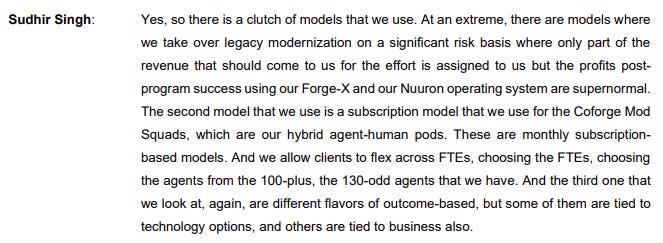
This quarter, Coforge has claimed that 6-7% of their global revenue is driven by outcome-based contracts, which is a big claim. But likely, a large chunk of it involves these grey-zone deals. Coforge itself has said this, and there may be a logic to why they’ve done so.
Ameya P, a veteran IT professional (and someone we hosted on Subtext) breaks this claim down in his blog. The problem is that outcomes take a long time to show up. If, theoretically, an IT transformation program that’s priced fully based on an outcome doesn’t produce the desired result, then the IT firm earns nothing while bearing all the risk. A fixed-price (or even headcount-based pricing) component has historically always solved for that.
In this situation, Coforge has combined the two. An IT firm charges a client money for the cost of running a transformation program, and then there’s a bonus reward once it’s clear that the program, once completed, has led to a real business outcome.
Conclusion
So, what should you watch out for in the next quarter?
For one, if this is how companies are thinking about price, how should they think about growth versus margins? You could price low to win market share. Coforge, however, is managing the rare feat of achieving growth and higher margins. That is partly because they’ve significantly reduced their administrative expenses (using AI), and partly because their recent acquisition of Encora has already begun adding to margins.
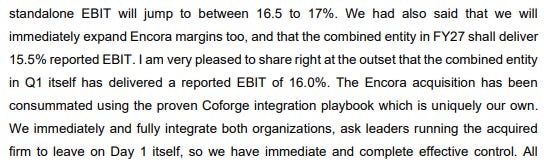
This trade-off becomes more complicated for companies that have recently spent heavily on acquisitions. Just last month, we covered Persistent buying Nagarro for over a billion dollars — the largest acquisition in its history. Many of these deals are being made to get domain expertise. But it’ll be a while until we see whether, like Coforge, this is margin-accretive.
Then there’s the deal cycle. How quickly does the order book translate into revenues? Will we see a major change that tips over the AI decision cycles of clients?
And lastly, sector-specific headwinds. While healthcare deals are growing rapidly (benefiting mostly Persistent and Coforge), automotive is clearly under turbulence (specifically affecting KPIT). Acquisitions help primarily with diversifying away from the risk of depending too much on just certain sectors.
Tidbits
[1] Companies participating in the government’s Production-Linked Incentive (PLI) scheme for specialty steel have invested ₹26,320 crore as of June 2026. This robust funding has driven incremental domestic production and import substitution of around 3.7 million tonnes.
Source: Business Standard
[2] Coal India has reportedly tapped leading investment banks, including SBI Capital Markets and Axis Capital, to manage the initial public offering of its subsidiary, Mahanadi Coalfields. This strategic move aims to unlock significant value from the state-owned miner’s highly profitable arm.
Source: Livemint
[3] The government has tabled the Taxation and Other Laws (Amendmend) Bill, which contains a proposal to introduce the Merchant Discount Rate (MDR) on large UPI transactions. It could reportedly unlock a revenue pool of ₹5,000 to ₹10,000 crore for banks and payment firms by FY28. While large retailers would bear the fee, small merchants and everyday person-to-person transfers are expected to remain entirely exempt.
Source: Business Standard
[4] The RBI has opted to hold its key repo rate steady at 5.25%. This decision is different from many of India’s peer countries, who have tightened rates in response to the inflationary pressure of higher energy prices and currency volatility. The RBI also nudged up its growth outlook slightly from 6.6% to 6.7%.
Source: Reuters
[5] Larsen & Toubro’s hydrocarbon business has bagged an “ultra-mega” contract worth over ₹15,000 crore from the UAE’s ADNOC Offshore. L&T will act as the lead partner in a consortium to engineer, construct, and upgrade multiple offshore oil and gas facilities in the Middle East.
Source: Business Standard
- This edition of the newsletter was written by Pranav & Manie.
Beyond Today’s Brief
There’s always more happening at Markets by Zerodha.
- The Chatter: How is Marico navigating demand trends across urban and rural markets? What is driving DLF’s momentum in luxury housing pre-sales? How are rising trading volumes fueling BSE’s top line, and what does Nykaa’s latest performance signal for beauty and personal care growth?
- Subtext: Policy researcher Mausam Kumar breaks down the mechanics of India’s industrial strategy, structural bottlenecks in manufacturing, and what it will take for state intervention to build true factory scale
- Aftermarket Report: How did a late Closing Auction Session (CAS) boost help Nifty defend key support levels despite a weak session? And what snapped the market’s multi-day winning streak?
- What We’re Reading: Everything from why book clubs often reward identity more than curiosity to the economics of the AI bubble to the hidden history of the Swiss watch industry.
Join us on WhatsApp , where we share interesting soundbites from concalls, articles, and everything else we come across throughout the day. You’ll also get notified the moment a new video or article drops so that you can read or watch it right away.
Thank you for reading. Do share this with your friends and make them as smart as you are 