676GS2061-GS why it is being traded at 95 dspite of 6.76 interest in next 7 months
face value 100
LTP 94.8
INT payment date 22 feb/aug
why it is so undervalve ?
676GS2061-GS why it is being traded at 95 dspite of 6.76 interest in next 7 months
face value 100
LTP 94.8
INT payment date 22 feb/aug
why it is so undervalve ?
One reason is that unlike a guaranteed 100 (face-value) in 2061 upon redemption,
there is no guarantee that one will be able to sell it for 100 in 7 months.
Estimates the ability of Indian government to pay over 30 Years. Higher the reward. Higher the risk.
its chart shows 90-100 range multiple time in 55 months even withhout interest consideration .
True. One reason for that is sporadic liquidity of these instruments on NSE/BSE.
Though a volume of hundreds of crores of INR exists across GSECs in these secondary markets, it is spread across 100+ such bonds, with many days having even a lakh of transaction volume (if any).
Plus the other pet theory i have is that folks sell-off GSECs (and other such relatively low-risk-low-return assets) at significant discount, for immediate liquidity during market downturn to invest in potential higher returning assets in the immediate short-term.
However, this is simply a guess based on correlation between GSECs/SDLs/TBILLs being available at significant discounts on their face-value during periods of significant equity market downturn.
now i am buying discount highly liquid gsec availablee in the market - @94 i am purchased , long time i wait now only gsec come below 95 , its good to have in our portfolio
For those wondering, that’s an effective interest of 7.3%
face value 100
LTP(Dirty price) 94.7
Coupon interest: 6.76%
INT payment date 22 feb/aug
Accrued interest 2.83(154 days)
Clean price 91.86
Actual interest: 7.293%
Thanks for your insights.
But I donot think that pet theory is behind for gsec discount.
somethink else that seller knows?
This is not undervalued. Price of Gsec keeps on changing based on current prevalent interest rates. I’ll try to explain this in simple terms.
This Gsec is paying 6.76%, but what is market expecting currently as interest for a 35 year govt bond?
We can look at recent govt auctions to get some idea.
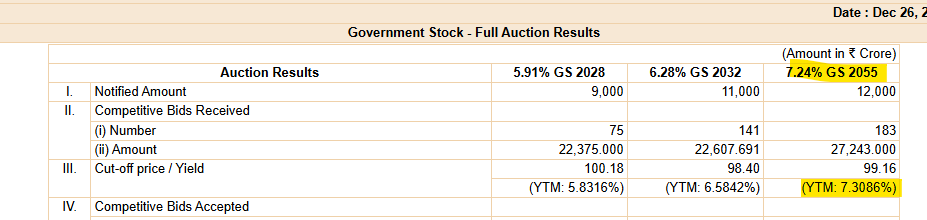
Last month RBI auctioned a gsec maturing in 2055 and it ended up at yield of around 7.3%
So now, if Gsec with similar maturity is available at around 7.3% why would someone by this gsec at 100 rs and be satisfied with 6.7% interest?
So prices of this Gsec will have to fall below 100 till buyer gets yield of 7.3-7.4% and hence price is trading below 100.
If tomorrow interest rates falls, then price will rise till actual yield matches with current rate.
In effect, prices of Gsec (and all bonds, but gsec is highly liquid) continues to fall or rise above face value to ensure that calculated yield matches current interest rates.
Yes, what you are seeing in chart is precisely that, bond prices changing continuously to align with current market rate
Hope this helps.
This 
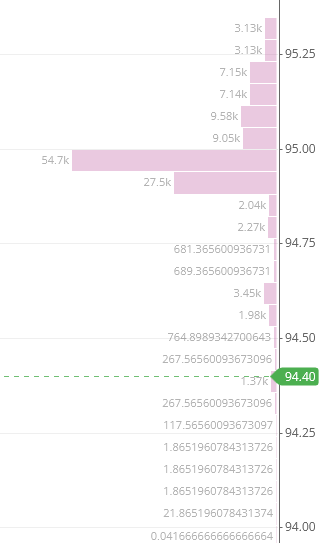
The high-volume going-rate of GSECs
is in-line with the yield in recent RBI auctions
of GSECs with similar target maturity-date.
Other “potential reasons” are opinions
that can explain any minor deviations from the above (especially for illiquid GSECs).
thanks for your insights
Yield?
for this bond yield is 7% for next 7 month.
somethink else that seller knows?
No, it is not.
Unless you have already found a buyer,
to commit today to buy it at price 100 exactly 7 months from now.
As per the above calculations shared in this topic-thread,
the bond yield is ~7.3% per year upto 2061,
since the guarantee to receive the principal/face-value is in 2061.
Looking at the volume of the recent trades at various price ranges,

Yield is not 7% but what you are saying is that in next 7 months, 7% (6.76% actually) will be earned as interest.
This is a known thing and not some hidden information which buyer / seller are unaware of.
In trading bonds, there is a concept of clean price and dirty price
Clean Price vs Dirty Price in Bonds Explained | IndiaBonds
What price you are seeing on terminal is dirty price and already accounts for fact that you will get cash flow of (6.76/2) % in next one month itself. Price is already adjusted for that.
why not 7% for next 7 month ?
int payment date is 22 feb/ aug
so if I hold till 22 aug 6.68/94.4= 7.07%
and 90-100 range multiple time in 55 months even withhout interest consideration .
The way to look at it is what volume one wishes to invest.
If one wishes to purchase 100 units of this bond with a face-value of 10,000 INR, at 9,400.
then sure, one can atleast hope to possibly buy/sell at such off-base prices multiple times in future as well.
If investing something like 10L or 1Cr,
look for how often such volumes of this bond are transacted, and at what prices.
That will help one decide one’s risk of being unable to exit/sell such a bond in future without a further discount.
(i.e. a capital-loss that will lower one’s effective yield/returns.)
94.4 is already inflated with accrued interest. The actual price at dirty price of 94.7 is
Clean price 91.86
Yes you’ll get 7.3%pa but your capital is at risk. It(clean price) might go to 89. In that case, you lost around 3%, if you were to sell.
Sellers cumulatively think it’ll go even down and doesn’t believe in the Indian government to pay up. Buyer think it might not go down. Buyers and sellers agree that there is a risk of India going bust and for that risk, seller is willing to sell at a discount and buyer is willing to buy at a discount for that risk. This is risk discount.
now it is down to 91. even after a decent coupon rate, it is now 9% discount to FV