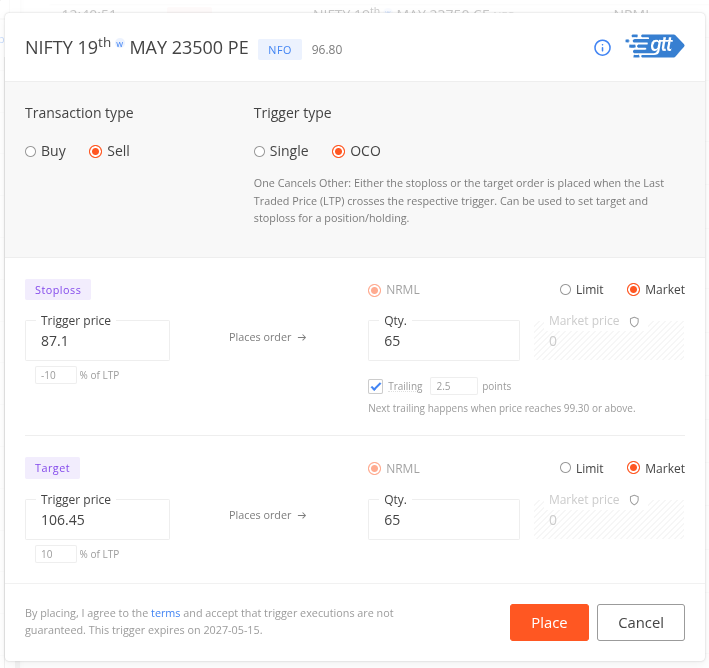
We are excited to announce the launch of Trailing Stop Loss (TSL) for Good Till Triggered (GTT) orders on Kite. One of the most requested features is designed to help you protect your profits and manage risk dynamically as the market moves in your favor.
Unlike a standard stop loss, which remains at a fixed price, a trailing stop loss in a GTT order automatically adjusts its trigger price. This can now be accessed on the Kite beta portal kite-beta.zerodha.com. Keep in mind that the GTTs created on kite.zerodha.com won’t appear on the beta site, and the same applies to GTTs created on the beta portal.
How it Works
When the market price of a stock or contract moves favourably, the trailing stop loss price “trails” the current market price at a specific rate, known as the trailing point.
For Sell SL: The trigger price is revised upward as the market price increases.
If the market moves against your position, the stop loss remains fixed at its last updated highest (for sell) or lowest (for buy) level, helping you lock in gains.
Practical Examples
1. Sell GTT Stop Loss
Example: A sell GTT order is placed with an initial stop loss at ₹90, creating a ₹10 gap from the current market price (LTP) of ₹100, and a trailing stop loss point set at ₹1.
Market Price
SL Price (Trigger)
Action
₹100 (Initial)
₹90
Initial ₹10 gap established.
₹105
₹95
Price rose by ₹5; SL adjusts upward to maintain the gap.
₹130
₹120
Price rose significantly; SL moves to ₹120.
₹125
₹120
Price dropped; the SL remains fixed at ₹120.
2. Buy GTT Stop Loss
Example: A buy GTT order is placed with an initial stop loss at ₹110, creating a ₹10 gap from the current market price (LTP) of ₹100, and a trailing stop loss point set at ₹1.
Market Price
SL Price (Trigger)
Action
₹100 (Initial)
₹110
Initial ₹10 gap established.
₹95
₹105
Price dropped by ₹5; SL adjusts downward to maintain the gap.
₹70
₹80
Price dropped significantly; SL moves to ₹80.
₹75
₹80
Price rose; the SL remains fixed at ₹80.
Minimum Trailing SL Ranges
Stocks NSE, BSE, and Futures
From
To
Minimum
0
50
0.05
50
100
0.1
100
250
0.25
250
500
0.5
500
1000
1
1000
2500
2
2500
10000
5
10000
20000
25
20000
No limit
50
Options
From
To
Minimum
0
50
1
50
100
2.5
100
500
5
500
No limit
10
Key Features & Guidelines
Segment Support:
Supported segments are NSE, BSE, NFO, BFO, and MCX. Supported product types are CNC, MTF, and NRML.
Equity (EQ): Trailing is allowed only for the sell side. This can be applied to both single-leg and OCO (One-Cancels-the-Other) orders.
NFO (F&O): Trailing is permitted on both buy and sell sides.
Simultaneous Adjustments: Both the stop-loss trigger and the limit price are updated simultaneously by the same trailing point value.
Manual Modifications: If you manually modify the Stop Loss trigger price of a GTT, the anchored price used for trailing resets to the LTP at the time of modification.
Visual Indicators: A “Trailed” tag will become visible on the order once the GTT has successfully trailed from its initial position.
Market Protection: GTT orders now support the Market order type with market protection, ensuring better execution during periods of volatility.
Platform Availability: The feature is currently available only on the Kite web (in beta) and will be integrated into the mobile app in the near future.
Once the trailing point is applied for a GTT, it cannot be modified or removed from the GTT. One needs to delete and create a fresh GTT with the new trailing point.
In F&O GTT orders will not trigger sometime and i have faced earlier, can we get these options in ATO orders. Please make some enhancement to ATO with additional features and easy option for selection
GTT: Price-Based SL, Not Just Percentage [NEEDS IMPROVEMENT]
The GTT currently supports only percentage-based stop-loss and target inputs. As a swing trader, I place stop-losses based on chart structure — specifically the swing low of the setup. There is no clean way to convert that price level into an exact percentage upfront.
Request: When creating a GTT from holdings, show both options side by side — percentage-based and price-based input. Let the trader choose. Like same we want order window too, This is a simple UI change, but it makes GTT genuinely usable for swing traders.
As Zerodha users, we are still begging for very basic features needed for simple trading.
Please understand that we are living in the AI era, yet Zerodha still does not provide many basic features, even after claiming 16 successful years. Some features available for long-term investors are not available for intraday traders. Also, when a new feature is introduced on the web app, it takes almost 6 months to arrive on the mobile app.
The latest NSE active client data clearly shows changing user behavior. While competitors like Groww and ICICI Securities are gaining users, Zerodha is losing active clients despite being one of the biggest brokers in India.
This is exactly how companies like Nokia and BlackBerry started declining — they ignored evolving user expectations and underestimated fast-moving competitors.
Trailing stop-loss on buy orders is not available in CNC, and this is by design.
Trailing a buy stop-loss makes sense only when you’re short on a stock; it lets you trail your buy trigger downward to cover your short at the best possible price if the stock reverses. Since CNC is a delivery product (long-only), short selling isn’t allowed in CNC. There’s no open short position to cover, so a trailing buy stop has no valid use case here.
i have a trade in place and a GTT for SL.
if i exit the trade the GTT does not get cancelled automatically, i have to manually cancel it. sometimes it happens that the GTT opens a new position after i close the earlier position manually, there should be some way to avoid this behavior as this can lead to a disastrous outcome for traders…
We are happy to announce that the Trailing Stop Loss feature for GTT orders is now live on Kite Web. Kite app will be followed soon.
To provide better visibility and a more intuitive trading experience, we have added some data to the GTT interface:
1. Watermark Price in Info Window
The GTT “Info” window now features a Watermark. This represents the most favorable price reached by the stock or contract since the GTT was created or last modified.
Example: Sell GTT with Trailing
Initial Stoploss: ₹20,000 (Created on 20 May 2026)
LTP at creation (Reference LTP): ₹23,776.80
Trailing points: 50
The contract reached a high of ₹24,210 on 18 June 2026. As the price moved upward, the GTT’s trigger price trailed upward by 400 points, moving from the initial ₹20,000 to ₹20,400.
The Watermark captured in the GTT Info window shows ₹24,176.80. This is the most favorable price (highest price) reached by this contract since the GTT was created. This gives visibility into how much the contract has moved in your favor during the GTT’s lifetime.
Indicates the trigger price has been reduced following a fall in stock price.
Sell GTT
Upward Arrow
Indicates the trigger price has been increased following a surge in stock price.
For a detailed breakdown of how it works, you can hover over the arrow icon to see exactly how much the GTT has trailed from its initial trigger price.